RSS

Tag Archives: students

On plagiarism

So … plagiarism.

We tend to think of plagiarism as “copying” – picking up chunks of text out of a book (then) or good old Wikipedia (now) and putting it in our essays and claiming it’s all written by us.

But plagiarism is really “passing other people’s work off as our own”, and this includes a lot of other things as well as copying out of books.

I’m going to talk about some examples and also about how I work with students to make sure I retain their authorship while helping them with any problems they might have with their writing.

Plagiarism includes:

  • Not citing your sources.  In example 1, below, the author has claimed something but not said where they got it from.  All sources need to be cited and you can have a look at my article on referencing to see how to do that.
  • Copying.  You need to either put other people’s words into your own words, or quote them directly (within the text for short quotations, as an inset block of text for longer ones) and then reference them.
  • Having another person write your work for you.  Very occasionally I get asked to rewrite an essay.  A lot of companies prey on students’ academic worries and fears and try to sell them essays.  If you buy and use someone else’s work like this, you are plagiarising and lying.  Any qualification you gain from this has not been gained legitimately or legally.

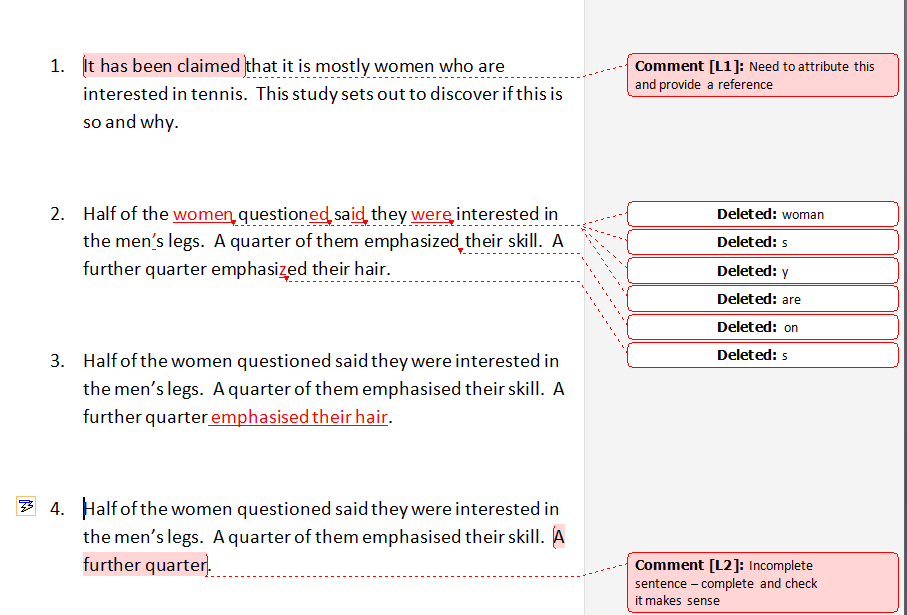
So, when I work with an essay, dissertation or thesis, I am very careful not to rewrite anything but only to tweak grammar, punctuation and spelling and suggest where things should be sorted out.  The following image shows a few examples of how I work, and one of how I DON’T work.

In Example 1, the author has not quoted their source and I’ve inserted a comment to remind them to do so.

In Example 2, there’s quite a lot wrong with spelling and grammar, but you can see that the author knows what they’re talking about.  I’ve amended their mistakes, but again that’s all tracked, so they a) can see what they’ve done wrong and b) have to choose whether to accept the change themselves.  By the way, the ‘s’ is changed in emphasized to make it consistent.  I’ll do a post about s and z another time.

In Example 3, a Very Bad ProofReader has seen something missing and decided to add it in.  In this case, rather than a few missing words, it’s a concept or part of the explanation of the actual results that’s missing.  This is a small example – but the author has not written that and the proofreader shouldn’t have.  I’ll suggest adding a word or two, but I wouldn’t complete something missing from the actual substance of the research or discussion.

Example 4 shows how I’d handle that same sentence.  No re-writing, no suggesting – I’ve just highlighted and told them something’s missing.  I’ll do the same if a sentence is mangled, incoherent and just doesn’t make sense.  But I don’t write my clients’ words for them, and students shouldn’t expect their proofreaders to do so (most don’t!).
 
16 Comments

Posted by on June 29, 2011 in proofreading, Students, Writing


Tags: , , , , ,

Referencing for academic writing

It’s dissertation season, in the UK at least, and so I thought I’d talk a little bit about some topics that are important to students, whether you’re doing your undergraduate dissertation or a postgraduate Master’s dissertation or PhD.  I’ll cover referencing this time, and then something on planning, structuring and handy hints. If you’ve been through the process and have any hints and tips to share, do get in touch so I can weave them together into a useful document.

So: referencing.  We reference (or cite) what we’ve read when writing an essay or thesis in order to avoid plagiarism and demonstrate that we’ve read around the subject and know what we’re talking about.  There are two aspects to referencing:

  • recording what you’ve read and referred to
  • referring to it appropriately in the text and bibliography of your dissertation

Recording what you’ve read

Putting together your references and bibliography is so much simpler if you keep a note of what you’ve read and consulted as you go along.  In the days of my Library and Information Studies post-grad, it was all done on card index cards.  Now there are lots of different options, including software like EndNote and Reference Manager.  For my research project, I’m just keeping a list on a spreadsheet in Excel.

The information you need to note:

  • Author’s full name.  Editor(s) if appropriate
  • For books: full title of the book.  Full publisher information for the book (you can find this on the bottom of the title page, or the back of the title page), including publisher name, location and date published
  • For chapters in books: Full title of the chapter and a full citation for the book, too (see above)
  • For articles in journals: Full title of the article.  Full title of the journal.  Page numbers for the article
  • For everything: page numbers for any direct quotations or sections you are going to refer to heavily
  • For websites: full URL and date you accessed the web page

Obviously, this is easy to do at the time; just note down the details and off you go.  Much, much harder to reconstruct after the event.

Referring to what you’ve read / citing

Now we’re talking about how you refer to what you’ve read and quoted in the text of the document you’re writing. The most important thing to do here is …

  • CHECK WHICH REFERENCING SYSTEM YOUR ORGANISATION PREFERS YOU TO USE!

This is hugely important.  Get it right first time, and you’ll pop all the references in easily.  Get it wrong, or don’t bother to check, and you’ll be going through and through the thing, fiddling around with the references, when you should be spending your time refining your arguments and putting your thoughts across.  Or you’ll be paying someone like me £x an hour to sort it out for you!

Referencing systems include Harvard Referencing, APA (American Psychological Association), MLA (Modern Language Association).  They all differ in how they ask you to present the information you collected above within your text.

For example, you could be expected to add a footnote number to each quotation in the text, with either a full bibliographical citation in the footnote section or a shortened reference there and a full bibliographical citation in the bibliography.  Or you could be expected to put Smith (2001) in the text and supply a full reference in the bibliography.  Or you might be putting a number in the text, referring to a numbered list in the bibliography.

A full bibliographical citation looks something like this:

Smith, J.L. (2001) The correct way to do referencing.  Birmingham: Libro Publications.

Jones, A.B. (2001) “Me and my essay”, in Smith, J.L. The correct way to do referencing.  Birmingham: Libro Publications.

Robinson, X. (2009) The different forms of citation.  American Journal of Footnotes 33 (1): 202-204.

But it doesn’t always, and the citation method does affect how this looks.

Always, though: ALWAYS, the bibliography is in alphabetical order by author’s surname.  It can take ages to sort this out if it isn’t!

How to conform to each referencing system?  That’s a long, long post that no one would want to read! Your academic institution should provide you with links to reference materials about their preferred system, and, if not, the dreaded Wikipedia does do a good summary of most of the common ones.

Good luck – and happy referencing!


Tags: , , , ,

On (not) crossing the line

I had another learning experience last week. I offer a proofreading and copyediting service to students, but obviously I have to be really careful about authorship and plagiarism. Plagiarism is not just “copying”; it also encompasses “passing off someone else’s work as your own”. Now, I’m sure none of my clients would intend to do this. Usually, I’m tweaking spellings, word usage, the occasional sentence re-write – I do everything in “track changes” in Word so the client can see what I suggest and make their own decision about what to change and whether to change it or not. That means they retain their own authorship. People in the know with whom I’ve discussed it are fine with this approach and it just gently helps the meaning come through.

But just sometimes, there’s a piece of work where I feel uncomfortable with the amount I’m suggesting and working on. For “working on”, read “re-writing”. I did always wonder where the line was drawn; well, it turns out that with this one, I *should* go for gut reaction (unlike in my previous post, where I thought I couldn’t do the work, but it turned out I could). If my gut reaction says that I’m crossing the line where your work is concerned, I will – politely – turn it down and return your work to you without corrections. There are probably people who wouldn’t act like that, but I very firmly believe in doing what is right, above doing what is profitable. Work on which someone is given a grade should be their own work.

Of course, if you’re not a student and you want me to re-write your mangled metaphors, your tortured text, your slippery sentences, then bring it on!

 
14 Comments

Posted by on July 5, 2010 in Ethics, proofreading, Students, Writing


Tags: , , ,