RSS

Tag Archives: writing

Whether or weather?

I have seen several instances of weather being used for whether recently, so it’s worth setting these down just in case.

Weather as a noun is the state of the atmosphere at a certain time and place – sunny, windy, snowing, hot, cold, etc. To weather (the verb) is to change in appearance or form through long exposure to the weather (more commonly: to be weathered).

Under the weather means unwell or depressed – you’re metaphorically under a cloud of unwellness, I suppose!

Whether is a conjunction expressing …

  • a choice between two alternatives – “I can’t decide whether to go to the cinema or the park”
  • a doubt, either expressing a question or investigation – “I don’t know whether keeping this hat I’ve found is the right thing to do” / “He will check whether she lost a hat”
  • an indication that a statement is true, whichever of the alternatives mentioned is the case “I will go to the cinema whether they’re showing a western or a thriller”

Of course, the two can always be found together: “I’ll go out, whether the weather is sunny or wet”, but hopefully you know the difference now!

Edited to add – my friend, Ian Braisby, just reminded me that a wether is a castrated sheep! So now you know …

You can find more troublesome pairs here and the index to them all so far is here.

 
3 Comments

Posted by on September 7, 2012 in Errors, Language use, Troublesome pairs, Writing


Tags: , , ,

My short cuts: full dialogue boxes for fonts, paragraphs etc.

This post was inspired by my partner, Matthew, suddenly asking me about this. Once again, I realised it was something that I and other people who work with Word know about as second nature, and assumed everyone else did, too. Apparently not!

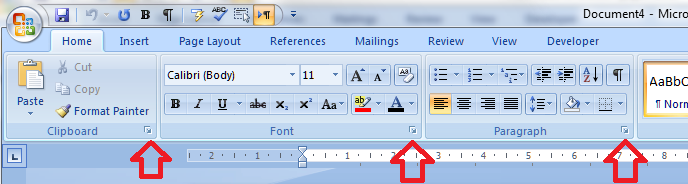
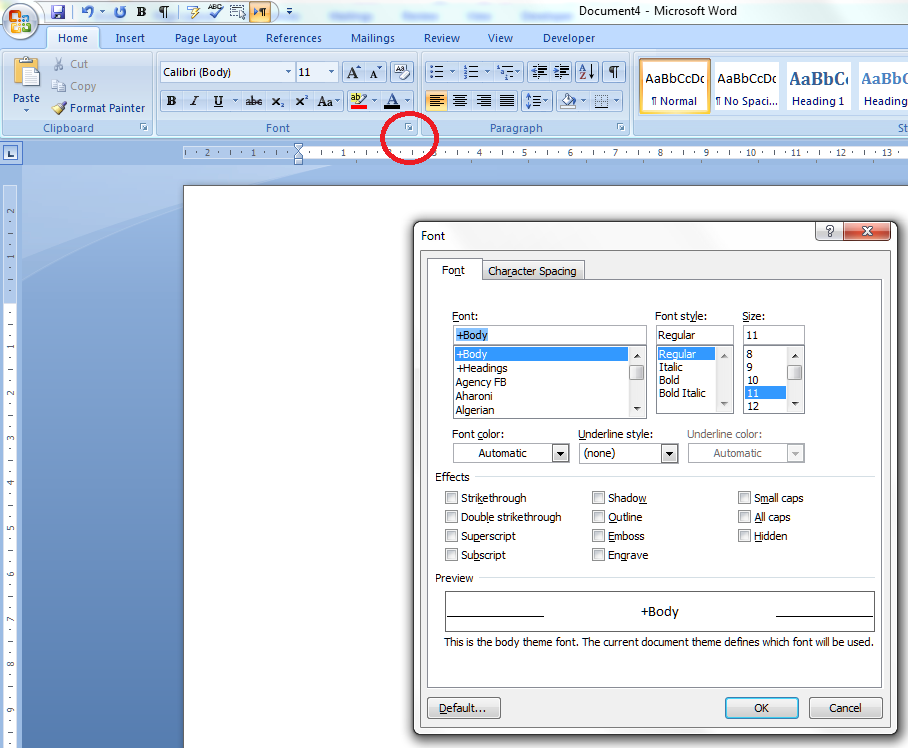
Ever wondered what the little arrow in the bottom right corner of your Word 2007 and 2010 ribbon areas was? Wonder no more – today you will find out what they do, and how to access the font, paragraph, headings (etc!) dialogue boxes with the click of a mouse button.

Expansion arrows in the Word Ribbon

In the Home, Page Layout and References tabs on the standard Word 2007 and Word 2010 ribbons, you may notice little arrows in the bottom right-hand corner of some of the sections, for example, Home – Paragraph, Page Layout – Page Setup or References – Footnotes. Some of them are indicated by the red arrows in the image above. What do they do? Click and find out!

Basically, there is not enough room on that pesky ribbon for all of the functionality and options that Word 2003 used to show you in nice, sensible menus (one of these days I’ll share with you how to get the classic menu view in Word 2007 and 2010).

So, if you see a little arrow in the corner, try clicking it and see what different options you have. The one you’ve always wanted to be able to do might be languishing there, waiting for your click!

Please note, these hints work with versions of Microsoft Word currently in use – Word 2003, Word 2007 and Word 2010, all for PC. Mac compatible versions of Word should have similar options. Always save a copy of your document before manipulating it. I bear no responsibility for any pickles you might get yourself into!

This is part of my series on how to avoid time-consuming “short cuts” and use Word in the right way to maximise your time and improve the look of your documents. Find all the short cuts here

 
3 Comments

Posted by on September 5, 2012 in New skills, Short cuts, Word


Tags: , , , ,

Cite, sight or site?

I come across site and sight being mixed up quite a lot, and citing is on my mind as it’s dissertation editing season at the moment … so here goes with this troublesome trio!

Let’s get the easy one out of the way first. To cite is to refer to – you might cite a reference in a document, or use the word to refer to something that has come before, usually a precedent: “to cite precedent, we have let a man into our women’s tennis club before, and so we will have to do so again”.

A site is the place where something is located, whether that’s the piece of land where something is built or the location where something happens. To site something is to place it in the location where it is going to stay or take place.

Sight is the power or faculty of seeing, as well as the more metaphorical extensions like foresight, where you are not physically seeing something, but perceiving something in the future. A sight is something that you see.

When you see the sights, you are, literally, seeing them with your sight. Therefore they are sights, not sites.

But sites can also be sights that a sightseer would view! “The main sights of the trip are the sites of the Pyramids and army encampments”. We see the touristic sights, but they are all sited somewhere.

If it’s a feature, phenomenon or building, etc.,  that you see, it’s a sight. If it’s the place where that thing is situated, it’s the site of that thing. And if you refer to an essay about the phenomenon, you might cite it!

“Jeremy cited the newspaper article about the argument over the site for the new ‘see the sights of the world’ exhibition in his report on the controversy”.

You can find more troublesome pairs here and the index to them all so far is here.


Tags: , , ,

Unmeasurable or immeasurable?

This is one that came up in something I was editing a few days ago. And, I admit, one that I had to check in the dictionary. I was pretty sure the writer wanted unmeasurable (I was right), and I wasn’t sure that immeasurable was a word (I learned something, notably that SpellChecker doesn’t think it’s a word, which is why we still use dictionaries!).

Unmeasurable means, specifically not able to be measured objectively. We use this one in the literal sense: “the immense lizard was unmeasurable with the tiny ruler in the standard lizard measuring kit”; “the sea trench in which the angler fish lived was of an unmeasurable depth”.

Immeasurable means, a bit less specifically, I suppose, too large, extensive or extreme to measure. We should reserve this one for the more figurative sense (otherwise there’s no point in having two different words, is there, and where would THAT leave us?): ” the immeasurable mercy of their god”; “he had immeasurable ambition”.

“I experienced immeasurable relief when I discovered that the width of the lake, filling and evaporating as it did, was actually unmeasurable.”

You can find more troublesome pairs here and the index to them all so far is here.

 
18 Comments

Posted by on August 24, 2012 in Errors, Language use, Troublesome pairs, Writing


Tags: , , ,

A new publication from Libro

How I Conquered High Cholesterol Through Diet and Exercise As well as writing and editing for other people, I have been busy writing my own guide to dealing with high cholesterol through diet and exercise. I’ve published it on Kindle and it’s available now. If you or a family member or friend has been diagnosed with high cholesterol, whether or not you are taking statins at the moment, this guide can help you reduce your intake of saturated fat and increase your intake of substances that promote cholesterol reduction, so that you could possibly come off statins or not go on them in the first place.

I’m not making any wild promises, but this system has worked for me and some of my friends, and the book cuts to the chase with easy-to-remember guidelines. It does try to accentuate the positive, so there’s lots of information on what you CAN eat and enjoy.

If you’re interested, please click through. There are some great reviews on there right now. And even if you don’t decide to buy a copy, please consider clicking on the “Like” button. Enjoy!

 
2 Comments

Posted by on August 13, 2012 in Business, Ebooks, Writing


Tags: ,

Impact or affect?

Here is a pair of words that are often used in reports and academic work; they do have a subtle difference which it’s worth noting and remembering.

To affect something is to have any effect on it, to make a difference (remember the difference between affect and effect).

To have an impact (on) something means to have a strong effect on it (of course, an impact also occurs when something comes forcibly into contact with something else – in a collision or wedged and crushing like an impacted wisdom tooth).

So everything that has an impact on something has an effect on it, affects it, but not everything that affects something else has a strong enough effect to be an impact.

We also have the tricky issue of the phrasal verb impact on – “low interest rates have impacted on saving”. People tend not to like new phrasal verbs, and this one is seen as business jargon. If you’re tempted to use “have impacted on”, try “have had an impact on” instead: you know you’re safe with that one

You can find more troublesome pairs here and the index to them all so far is here.


Tags: , , ,

Past or passed?

This one was suggested to me by my friend and fellow freelancer, Lyndsey Michaels, and is, indeed, an important one.

Of course, these two are linked, and formed from the verb to pass. And they are easy to confuse and HARD to explain! But that doesn’t mean that they shouldn’t be used correctly …

Passed is a verb and is the past tense of pass. It expresses the idea that something has gone by something else, or that anything that passes anything else has done so in the past tense. “She had passed the elephant house and was on her way to the penguins”; “Many years had passed, and he was an old man with only his memories of pandas to sustain him”.

If you can use the word “pass” in the present tense, the future tense, or use it in the form passing, etc., i.e. if you’re using it as a verb, a “doing” word, when you’re using one of the past tenses, or a conditional, you can use passed:

I will pass my driving test one day – when I have passed my driving test I will get a car – if I had passed my driving test, I would have been so happy –  I have passed my driving test.

I am passing the jeering pub-goers with pride: after all, I’m running and they’re not – I passed the jeering pub-goers with pride – I will have passed the pub-goers in five minutes, and then I can relax.

Time will pass and all will be better – Time passed and all was better

Contrast this with past:

Past can be a noun meaning the time that has come before – “my divorce is in the past now, and I’m moving on!”. It can be an adjective – “Past prime ministers gathered for the Royal Wedding” meaning gone by in time and no longer existing. It is also a preposition meaning on the other side of “You can see him over there, past the crazy golf but in front of the candyfloss seller”. And it can be an adverb with a meaning of “so as to go by or so as to pass – “The ball went past the goalkeeper and the Mexican team scored”.

If something has passed something else, it has gone past it. It hasn’t past the other thing, and it hasn’t gone passed it.

So past doesn’t change when it’s used in the future, present past in a conditional sense, etc.: it works as a noun, an adjective, an adverb or a preposition and as an adjective, adverb or preposition will be found alongside a verb, rather than BEING a verb.

I went past the pub – I am going past the pub – I have gone past the pub – I will go past the pub – time will go past – the driving test was in the past – the driving test was in the past – the ball will go past the goalkeeper – the ball went past the goalkeeper – the ball was going past the goalkeeper.

You can find more troublesome pairs here and the index to them all so far is here.


Tags: , , ,

My short cuts: format painter

Today I’m going to introduce you to a lovely quick short cut that can save what can only be described as a lot of faffing around: format painter.

We use format painter to pick up the formatting of some text, copy it, and paste it into some other text, to make the formatting match. I’ll give you a simple example.

How do I copy the formatting of one bit of text into another?

Here we have some text in the format we want, and some text not in that format, which we want to change.

Now the trick is to use a little button you may not have even noticed before. It’s on the Home tab (in Word 2007 and Word 2010; in Word 2003 it’s in the Format menu) in the cut, copy, paste area. Handily, it has its name next to it:

Now, it’s important to get this next bit in the right order! Highlight the text which is formatted in a way you want to copy, in this case the first line of text, and, once it’s highlighted, press the Format Painter button:

It doesn’t matter how much of the original text you pick up, as long as it has the right formatting. Now you will notice that the cursor has changed into a little paintbrush. Annoyingly, this doesn’t show up on a screen print, so you will have to take my word for it. “Paint” with the paintbrush across all of the text you want to change, keeping your left mouse button down, and it will highlight it (but nothing will change … yet):

Now let go of the mouse button and hey presto …

Note: the formatting will change to exactly what you picked up from the original text. So if you have a word in bold in the middle of your text, it will change to whatever the original had.

This is quite a simplistic example, but here’s where it comes in handy:

Say you’re editing a document with a lot of different text styles, header styles, etc. Maybe there’s a table with a variety of fonts. Rather than clicking on the text that you want your text to look like, noting the font, size, etc. then highlighting your text and changing all those features manually, simply highlight, format painter, and paint away!

Please note, these hints work with versions of Microsoft Word currently in use – Word 2003, Word 2007 and Word 2010, all for PC. Mac compatible versions of Word should have similar options. Always save a copy of your document before manipulating it. I bear no responsibility for any pickles you might get yourself into!

This is part of my series on how to avoid time-consuming “short cuts” and use Word in the right way to maximise your time and improve the look of your documents. Find all the short cuts here

 
4 Comments

Posted by on July 25, 2012 in New skills, Short cuts, Word


Tags: , , , ,

Elude allude or illude? Elusive, allusive or illusive?

Are they escaping or are you referring to them? That’s an odd sentence, but it’s what you need to consider when you’re choosing between these two words. They are used in different ways, too, which helps!

To elude means to escape from or evade, usually in some kind of skilful or cunning way (this can be concrete or abstract – “The moth eluded me and flew out of the window”; “The meaning of his ideas eluded me”). Note that elude has one l and something eludes something else.

To allude to something means to hint at it indirectly, or mention it in passing: “When discussing Betty he alluded to her plastic surgery but it was not the main part of the conversation”. “‘Ah, the majesty of your figure,’ said Adrian. ‘Are you alluding to my boob job?’ shrieked Betty”. Note that it has a double l and someone alludes to something else. Also note that this is sometimes used mistakenly in place of refer. You can’t say “He alluded to the actress by her name”, as to allude is to be indirect. Here you would use “He referred to the actress by her name”. Save allude for a use such as, “He alluded to the actress, mentioning an infamous role she played earlier in her career but not naming her”.

And to illude (has anyone ever used this?) means to trick or delude. But it’s hard to see when either of those words wouldn’t do, and it saves you remembering this one. I am just including it for the sake of completeness, to be honest. It is important when it comes to the word formed from it, illusive, though …

A bonus section today …

If something (language, on the whole) is allusive, it means it uses suggestion (yes, alluding to something) rather than mentioning something explicitly. “The poet uses allusive language to describe the pile of droppings without mentioning what it actually is”.

If something is elusive, it is difficult to achieve, find, catch, etc. It aims to elude the person who is trying to catch it. “The moth proved elusive, as I chased it around the bathroom, and it escaped through the window”.

If something is illusive, it is illusory and deceptive – it’s main purpose is to illude. “His wealth was illusive – all fur coats on top, all cheapo clothes underneath” (wealth can be elusive, of course, too, if you can never manage to achieve it, but the meaning is different).

You can find more troublesome pairs here and the index to them all so far is here.


Tags: , , ,

A proper author – Victoria Eveleigh and her story

Victoria Everleigh I am delighted to publish this guest post by author, Victoria Eveleigh. I “met” Victoria via Twitter, through a discussion I was having about pony books with a bookseller (who I’m going to feature on the Saturday Small Business Chats soon). Victoria has an interesting story to tell, as she has become a somewhat unlikely author, and has now moved from self-publishing to being published!

You can read all about Victoria’s farm, horses and books on her website. Let’s hear her story …

How I became a Proper Author by Victoria Eveleigh

Nobody was more surprised than me (with the possible exception of my old English teacher) when I became an author.

I grew up in London, but spent as many holidays as possible on my grandmother’s farm on Exmoor. From an early age, my ambition was to marry a farmer and live on Exmoor. Remarkably, I’ve managed both: Chris and I have been farming for over twenty-five years now.

At 240 acres, our farm is fairly small, so we’ve had several other enterprises: a self-catering holiday cottage, horse-drawn tours over Exmoor with Shire horses, Land Rover tours of the farm, organic farming, cream teas, renewable energy and publishing.

Starting to write

The Foot and Mouth crisis of 2001 was partially responsible for my first book. We never got Foot and Mouth on our farm, but it came far too close for comfort. For nearly half a year we closed the self-catering cottage and horse-drawn tour businesses, and our children stayed at home for the whole of the spring term. It was a nerve-wracking year, and our cash flow became a trickle, but in some ways it was a holiday from all our usual commitments. For the first time since we were married, we had time to spare. Chris took up drawing and painting, while I sat down and wrote the book that had been forming in my head for several years: the story of a girl and an Exmoor pony growing up on an Exmoor hill farm together.

Full of optimism, I purchased a copy of The Writers’ And Artists’ Yearbook and started writing to agents. After several months, I’d received polite rejections from some and no communication from others. I felt utterly disheartened, and would have given up completely if a friend hadn’t suggested publishing the story myself. She’d published her own books in the past, and said all I needed to do was register myself as a publisher (I registered as Tortoise Publishing), get someone to design the layout of the book (I asked a good friend who’s a graphic designer), get a printer to print it (our local printer who printed our holiday cottage leaflets obliged) and some people to buy it (um…).

Learning from self-publishing

It was shocking how much space 6,000 books took up when they were delivered to our house by the printers. Too late, I realised I knew nothing about selling and, being typically British, I didn’t feel comfortable promoting myself. However, the prospect of never being able to use the sitting room again spurred me on. I loaded some books and leaflets in the back of the car and went for a drive around the Exmoor area. There weren’t many bookshops but there were gift shops, tourist attractions and tack shops, so I had more outlets than I’d realised. In fact, my best customers turned out to be places which normally didn’t stock books because there was no competition. (I’ve found that the easiest way to get depressed is to go into a large bookshop and see how many different books there are, all vying for attention!)

Probably because of Chris’ illustrations, the first book sold so well that I had to do another print run, and I was encouraged to write a sequel. Now I had stacks of boxes and a bit of money, so we converted Chris’ work shed into a farm office where I could store both the books and the ever-increasing quantity of farm records. At last I had a warm purpose-built room where I could write and deal with the paperwork for the farm and publishing businesses.

We made the Exmoor pony story into a trilogy, wrote and illustrated a colouring book about the farming year for the Exmoor Horn Sheep Breeders’ Society and then published a story set on the island of Lundy.
The amount of effort it took to promote, sell, distribute and account for the books meant I had an ever-decreasing amount of time for writing. Furthermore, while I was trying to build up my publishing business several things happened to the book industry: the economy slowed down, then went into recession; fuel and postage prices went up, squeezing margins because books are typically delivered for free; paper and printing costs increased, and large bookshops and online stores started a price war. Simultaneously, the whole book industry was going electronic, and I couldn’t really get my head around it all.

Never give up …

I’d more or less decided to quit while I was ahead when I received an email from Louise Weir, who runs a website called Lovereading4kids. She’d read my Lundy book and wanted to make it a book of the month on her website and, to cut a long story short, through her I was taken on by Orion Children’s Books just over a year ago.

Since then my life has changed quite a bit. I have to treat writing like a proper job now, and it’s a scary, serious business with deadlines to meet, schools to visit and talks to give. However, I wouldn’t turn back the clock for anything. I love writing and I’m so glad I’ve been given this fantastic opportunity to turn it from a hobby into a whole new career. I’ve re-written my existing stories (which have been published as Katy’s Wild Foal, Katy’s Champion Pony, Katy’s Pony Surprise and A Stallion Called Midnight) and I’m writing a new trilogy for publication in 2013. It will have horses and the countryside at its heart, but it will have a boy as the main character for a change. Chris is still doing the illustrations for my books – so I’m now a proper author and he’s a proper illustrator!

I wish Victoria all the best with her new trilogy, and I’m looking forward to reading the Katy books soon. I should mention that Victoria’s publisher will be sending me a copy of “A Stallion Called Midnight” to review, but I wanted to share her story to encourage my readers who are writers: never give up!
 
3 Comments

Posted by on July 18, 2012 in Guest posts, New skills, Reading, Writing


Tags: , ,