RSS

Category Archives: Language use

Lightning, lightening or lighting?

Several people have mentioned this trio to me, so it’s time to set it all out and explain it …

Lighting is the system or arrangement of lights, in a home or a theatre or film studio or wherever there are lights, or the effect that this arrangement has – “The lighting in the scene gives a feeling of doom”.

Lightening means becoming lighter in weight – “He was lightening the balloon by throwing out the ballast, and we went up, up and away!” or paler in colour – “She’s been lightening her hair again”. It also  has a technical, gynaecological meaning to do with wombs: you can look that up yourselves, as I think that’s one of those terms that you will know if you need to know it.

Lightning is the visual presentation of the electrical discharge between clouds, or between clouds and objects, during a thunderstorm. As a modifier, it also means very quick, linking of course to the very quick nature of lightning itself, as in, “His lightning reflexes meant he caught the pint glass before it hit the floor”.

You can find more troublesome pairs here and the index to them all so far is here.

 
11 Comments

Posted by on December 7, 2012 in Errors, Language use, Troublesome pairs, Writing


Tags: , , ,

Bullet points – grammar and punctuation

Last week we talked about when to use bullet points and how to personalise them. This week, we’re going to have a look at the actual language of bullet points, including top tips on making them easy to understand for the reader. There are two parts to this: word forms / grammar and punctuation.

Punctuation in bullet points

Over recent years there has been a shift towards less punctuation and “cleaner” looking documents. I remember this being called “open” punctuation, and it’s the difference between typing an address as:

1, Avenue Gardens,

Brighton,

BN1 1AA.

and

1 Avenue Gardens

Brighton

BN1 1AA

Of course there is a place for punctuation, but it can get a bit messy looking, and I’m all for clean lines as long as you don’t forget your semi colons within normal runs of text!

So, here are some things not to do. We never introduce a list in a sentence with a semi colon, and we don’t introduce a bulleted or numbered list with one, either.

It used to be the case that we included semi colons and even “and”s at the end of every line. But I think that does look old-fashioned and cluttered nowadays …
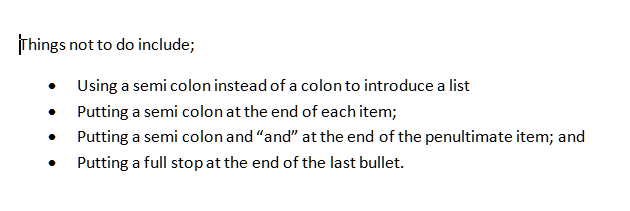
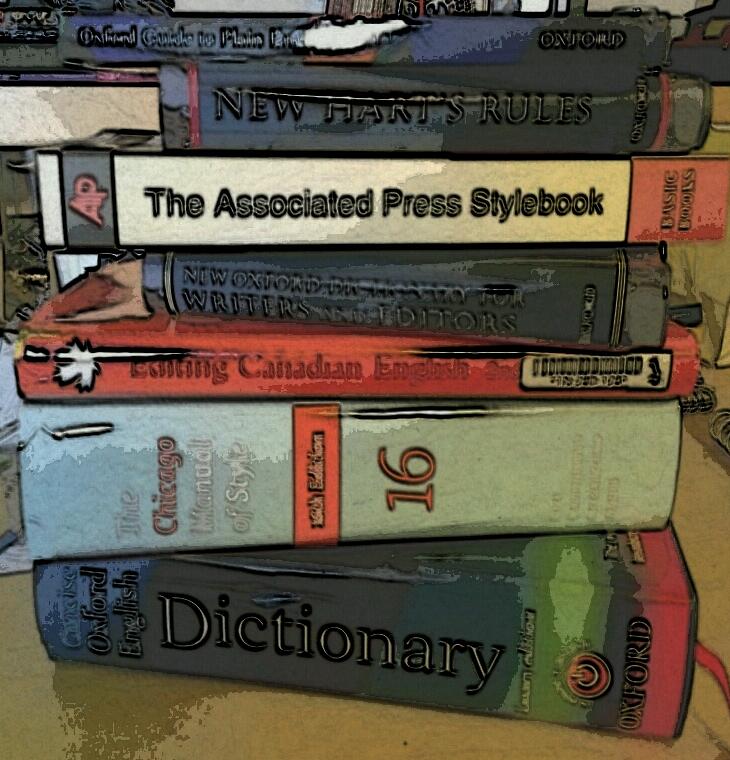
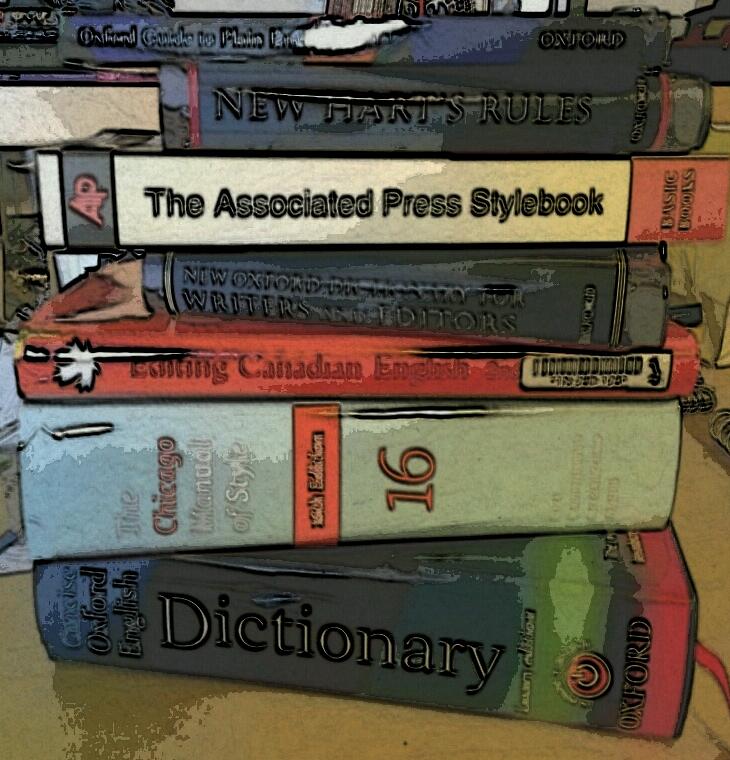
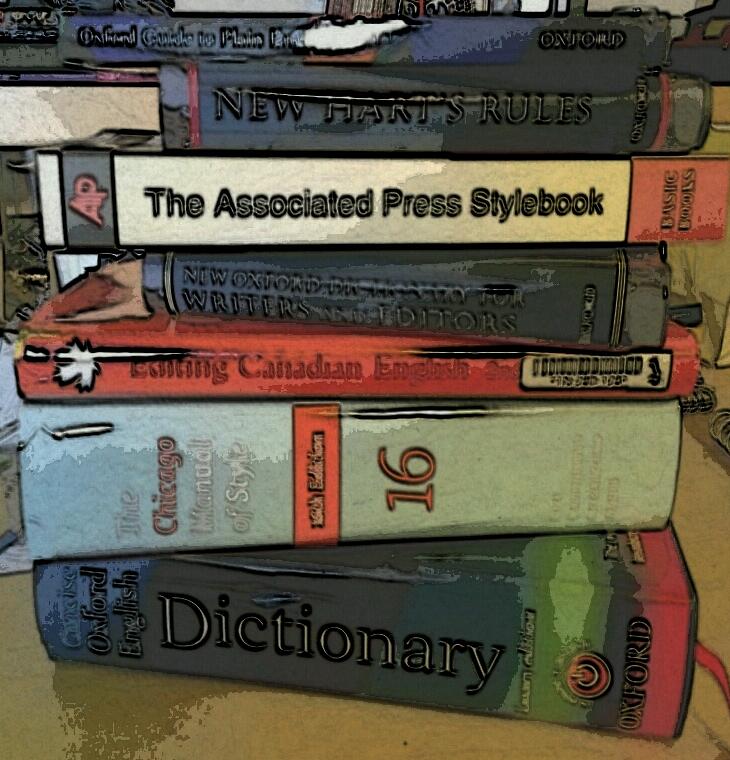
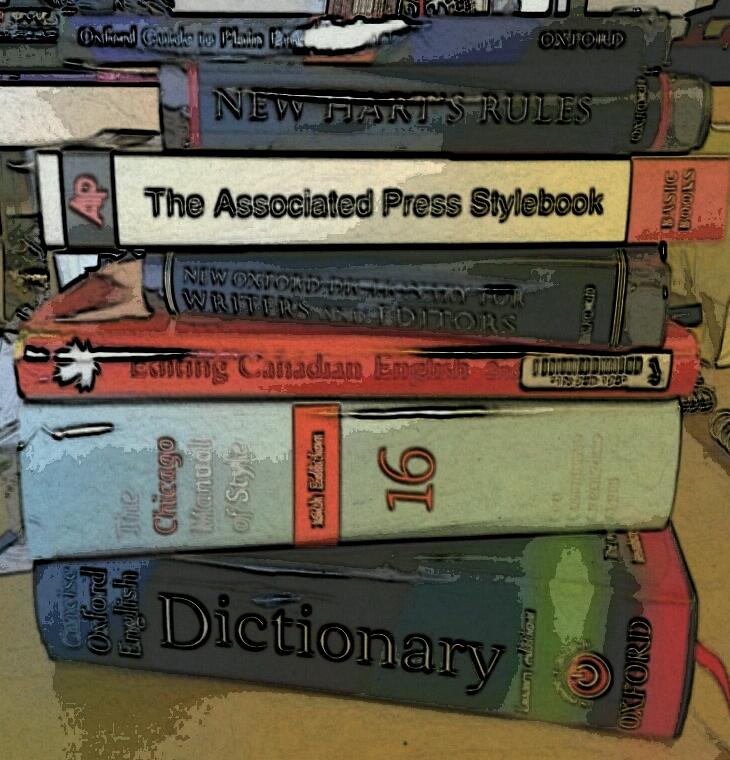
Regarding the full stop at the end of the last bullet point … well, the jury is out on that one. It’s one of those style choices that don’t have a specific rule. I’ve checked in my New Oxford Style Manual and my Oxford Guide to Plain English: the former doesn’t talk about the punctuation much at all, and the latter has some general standards to consider following.

Here are my suggestions:

  • If the bullet points come in the middle of a sentence, and it is still clear when you read that sentence even though it’s got bullets in the middle, you can
    • start each bullet point with a lower case letter
    • put a full stop at the end.
  • If the bullet points are very short and don’t form a sentence, like this:
    • Start with a capital
    • Don’t add full stops
    • Use full stops sparingly
  • It is fine to add a full stop at the end of each bullet if the bullet points are long and include:
    • More than one line of text which therefore forms a solid block when you look at it on the page.
    • More than one sentence. It would look odd to have a full stop there and not here.

In summary:
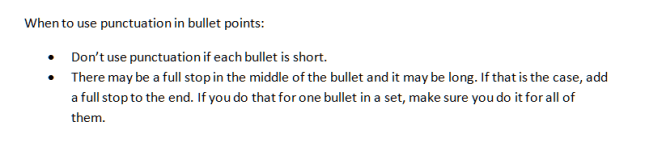
But the single most important thing to do is KEEP IT CONSISTENT within each bulleted list! If you use capital letters or lower case letters to start each bullet, keep them the same throughout. If you end the first bullet with a full stop, end each of them with a full stop.

But of course, you can use different styles for different lists, as the context demands, although I’d be wary of having wildly different ones very close together, as it can look messy.

And this point on keeping it consistent brings me on to …

Grammar in bullet points

We insert bullet points into a text to make it more easy for the reader to understand. This means that the grammar within the bullet points should be consistent, so the reader doesn’t end up scratching their head and going over and over the same bit of text, trying to work it out.

Have a look at this example, and you’ll see what I mean:
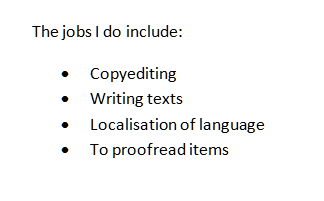
Even if the reader can understand the basic sense of this, the uncomfortable disconnect between the different grammatical forms bring the reader’s attention to the form of the text and not the meaning of its content. And that’s not what good, clear writing should do. However, this is one of the most common mistakes I find in the text I proofread and edit. Especially if the bulleted list is long, the writer will lose track part way through and start going all inconsistent.

This is what that list above should look like:
Nice and tidy: everything following the same structure.

The grammar of bullet points must be consistent and matching so that the reader is not confused. It’s a different matter with the punctuation, which is, when it comes down to it, more of a matter of choice. Personally, I prefer capital letters and no full stop in my bullet points, which is why, if you’re my client and your bullet point punctuation is a little inconsistent, you’ll find me using that as standard!

So now you know all about how to insert and customise bulleted and numbered lists, and the grammar and punctuation to use with them! I hope you have found this helpful.

This is part of my series on how to avoid time-consuming “short cuts” and use Word in the right way to maximise your time and improve the look of your documents. Find all the short cuts here

Do let me know if this has helped you – and do share with the buttons at the bottom of this article.
 
13 Comments

Posted by on November 28, 2012 in Language use, New skills, Short cuts, Writing


Tags: , , , , , , ,

Homonym, homophone or homograph?

A timely post, as I was discussing this, with examples, at home yesterday evening. Yes, that’s how we like to have fun here at Libro Towers: a bit of etymology of an evening …

We’ve already had one pair where I explain the difference between homo and hetero, so we know that the prefix “homo” will essentially introduce a word that’s all about two things being the same. But what happens when those words themselves all look horribly similar?

These three are quite similar-looking technical words used in English literature and linguistics. It is important to know the difference if you are working in these fields.

Homonyms have the same spelling or pronunciation but different meanings (the word comes from the Greek – having the same name), for example, pole and Pole, pear and pare, but also bass and bass. The homonym is the main class of words, divided into homophones and homographs.

Homophones have the same pronunciation but different meanings, origins or spellings, new and knew, beat and beet, fair and fare.

Homographs have the same spelling but different meanings, with either different pronunciations or the same pronunciation – for example bass (the deep singer) and bass (the fish), or cleave (separate) and cleave (join together).

You can find more troublesome pairs here and the index to them all so far is here.

 
1 Comment

Posted by on November 26, 2012 in Errors, Language use, Troublesome pairs, Writing


Tags: , , ,

Annex or annexe?

I’ve been working on a document that described a number of buildings with annexes, and I have to admit that I had to look this up, just to check. Well, to be honest, I look up a lot of things to check them, as I’d always rather get it right, oddly enough (one of these days I’ll write a post about a word that I’ve always thought is a word, but doesn’t actually exist …)

So, to annex is a verb, never has an e on the end, and means to add as an extra part or to appropriate territory. I can’t give an example of the latter without getting all political, but you could have a set of tables and a document they refer to, and decide to annex the tables to the document rather than present them separately. That’s an acceptable, discrete verb form, not one that’s been oddly made out of a noun (like “to inbox” – ugh) as far as I know.

An annexe, the noun, is an addition to a document or building. Now, I have to admit that I thought the difference lay here, and that the e was only added for a building. But all of my good old Oxford sources say no, it’s used for both. So, “The table was added as Annexe 1 to our document”; “Coffee will be served in the annexe to the church”.

Or, you can just skip the e there altogether. But you know me: I like to maintain different forms of words to preserve the variety of our language. So I say verb: no e; noun: add that e. Add it as an annexe, if you will!

You can find more troublesome pairs here and the index to them all so far is here.

 
2 Comments

Posted by on November 23, 2012 in Errors, Language use, Troublesome pairs, Writing


Tags: , , ,

Invite or invitation?

I have come across this rather more times than I’d like recently. If anyone remembers the short-lived Libro character, Ranting Ron, who turned out to be too negative for this nice, friendly, supportive blog, he would have been ranting about this one ..

Invite is a verb. It means to ask someone to go somewhere or do something, and can be informal (“she invited me to go for a coffee after yoga”) or formal (“Mr and Mrs Perkins invite you to the wedding of their daughter, Polly”). It can also be used to refer to eliciting a response of some kind – “I would like to invite questions from the audience”. Full stop.

Invitation is a noun. It’s a written or verbal request inviting someone to go somewhere or do something. It’s the bit of card that is used to do this, which Mr and Mrs Perkins will send to you when they want to invite you to their daughter’s wedding. Invitation is the noun to invite’s verb.

Now, I have to admit that the esteemed Oxford dictionaries do admit that there is an Informal use of invite to mean invitation. But I don’t think we need that, do we? Let’s keep the distinction and keep it all nice. OK?

You can find more troublesome pairs here and the index to them all so far is here.

 
2 Comments

Posted by on November 16, 2012 in Errors, Language use, Troublesome pairs, Writing


Tags: , , ,

Ocular or oscular

Is it the eyes or is it the mouth? I have to admit that this is a bit of a cheeky one, inspired by the ramblings of a group of vision scientists who were discussing vision and kissing … but what’s the point of having even a fairly serious work blog if you can’t be cheeky occasionally. So this one is dedicated to Matt, Arthur, Dicle, Matthew, Aidan and their chums …

Ocular means of or related to the eyes or vision.

Oscular, in its “humorous” sense (according to the Oxford dictionaries, whose sense of humour may be slightly ponderous) refers to kissing. In its zoological sense, it means something related to the osculum. And the osculum, dear readers, is a large aperture in a sponge from which water is expelled (from Latin os, mouth: diminutive, osculum, little mouth). Now, if that hasn’t killed the romance, I don’t know what will …

You can find more troublesome pairs here and the index to them all so far is here.


Tags: , , ,

Waste or waist?

Another troublesome pair that I’ve seen a few times recently: another of these homonyms, or words that sound the same, which I suppose is where the problem arises. Because we all know the difference, don’t we?

A waste occurs when you have something left over that has to be thrown away, or you don’t use something and it goes off, or you spend too much – it’s all about using something carelessly or extravagantly, or not accounting for what you need. So you can waste a bag of apples if you don’t eat them in time and they go rotten and have to be thrown away, or you waste money if you pay for a gym membership and don’t ever go to the gym.

A waist is the middle of something, where it’s nipped in, particularly in the human body, where it’s the big between the ribs and the hips, but also in other creatures, and inanimate objects, like a violin.

“I wasted a lot of satin making her wedding dress, because I didn’t measure the size of her waist so I had to trim lots of pieces off the original pattern.”

You can find more troublesome pairs here and the index to them all so far is here.


Tags: , , ,

Gunnel or gunwale?

I’ve seen a few blog posts and articles mentioning something being “packed to the gunnels” and I’ve been getting all steamed up about the mistake, knowing it should be “packed to the gunwales”. So, I decided to write up one of my Troublesome Pairs to differentiate them.

A gunwale is the upper edge or planking of the side of a boat. By extension, we tend to use “packed to the gunwales” as a metaphor for something being full up, as if a boat is literally packed to its gunwales, it will be completely full up to the brim.

A gunnel is … an alternative spelling for gunwale. So I apologise to the writers against whom I have fulminated. Luckily, I didn’t mention it to anyone before I checked! And I still prefer gunwales, myself.

Note: they are pronounced the same: “gunnel(s)”.

You can find more troublesome pairs here and the index to them all so far is here.

 
23 Comments

Posted by on October 8, 2012 in Errors, Language use, Troublesome pairs, Writing


Tags: , , ,

Alternative, alternate or alternating?

These three words are very close in form and have related but not identical meanings. There is also a British English / American English aspect, something I don’t often cover in these Troublesome Pairs, but one that needs addressing here.

Alternative means available as another possibility, or mutually exclusive, said of one of more things (originally, it could only be used of two entities, but matters have freed up and more than two alternatives are now allowed). So you could use the services of one typist or an alternative typist if the first one is busy, or you could choose between the alternative answers “yes” or “no” when answering a question. Alternatives are the two or more available possibilities.

Alternative can also mean activities that depart from and/or challenge traditional norms – like alternative health and alternative lifestyles – the same meaning is there, in that they are offering an available possibility other than the “main” one.

The adjective alternate (with the stress on the middle syllable: alTERnate) means every other – “We hold the event in alternate months” means the event is held in, for example, January, March, May, etc. In biology, leaves alternating on a stem will appear on each side in turn, rather than being in matched pairs, two leaves together. But it’s worth noting that the American English usage of alternate carries the same meaning as the British English alternative defined above. To alternate, the verb (with the stress on the first syllable: ALternate) means to swap between two contrasting options repeatedly – “I alternated between watching the diving and hiding behind a cushion”. If two things are alternating then they are doing the swapping – “Mary and Sue were alternating as the front runners in the race”.

You can find more troublesome pairs here and the index to them all so far is here.


Tags: , , ,

Bazaar or bizarre?

There have been a few odd things in the news recently, and seeing people’s comments on them has highlighted a common difficulty distinguishing between bizarre and bazaar. They’re odd words, and tricky to spell, with those difficult decisions on the double letters, so bookmark this blog post if you’re not sure about this pair!

Bizarre is the word you’re groping for when you want to describe something odd. It means something VERY odd or unusual, so a woman with a hat on her head might be less bizarre than a woman with three hats, or a parrot, on her head. How you remember the double r as opposed to the double z you might be tempted to include, is anybody’s guess. Maybe think of rolling your rrrrrrs in emphasis of the oddity of it all.

And here’s a lovely bonus word: A bizarrerie (plural: bizarreries) is a strange and unusual thing. Go on, work that into a sentence today.

Now we’ve got the odd one clear, a bazaar is a market in a Middle Eastern country (think souk, and the word comes from Persian, via Turkish and Italian) and also, more commonly, I suspect, a fund-raising sale of some kind, beloved of Church and charity fund-raising attempts. There’s a nice double a in this one, not a spelling you find often. If you watch Strictly Come Dancing, you can imagine Craig saying it in that voice of his: “I bought it at a bazaaaaaaar, dahling”.

Of course, you could find many bizarre items at a bazaar; in fact you’re pretty well certain to. Maybe that’s a good way to remember it.

You can find more troublesome pairs here and the index to them all so far is here.

 
Leave a comment

Posted by on September 28, 2012 in Errors, Language use, Troublesome pairs, Writing


Tags: , , ,