RSS

Tag Archives: errors

Biennial or biannual?

This is a perennial (ha, ha – see what I did there?!) mix-up and it’s worth just setting these words down for everyone – but I would maybe even advise that you don’t use them yourself, limiting yourself to using the explanation rather than the word. Then no one will be confused, and no one will turn up for a biennial party that they think is biannual!

Biennial means occurring every other year.  So a biennial event might happen in 2010, 2012 and 2014. It won’t happen more than once in a year, and it won’t happen in the years in between.

Biannual means occuring twice a year. Usually regularly – so you might have a biannual event taking place in February and August every year, for example, six months apart. So a biannual event will happen twice a year, every year, so in our above example, twice in 2010, twice in 2011 … twice in 2014, etc.

There are more of these words floating around too – for example, bimonthly.  The dictionaries and other reference materials do actually suggest avoiding these, in order to avoid mistakes, and to use “every two months” instead, and as I mentioned above, I think this is a good precept by which to go. So that biennial event can become an event that happens every two years – then we all know where we stand.

You can find more troublesome pairs here and the index to them all so far is here.


Tags: , , ,

Me or I?

When do we use me and when do we use I, in a sentence where we’re talking about ourselves and another person? “Ali and me went for a walk”, or “Ali and I went for a walk”? “Gill gave presents to Matthew and I” or “… Matthew and me”?

I have to admit here that this is one I get wrong, I’m not sure whether I somehow learned it wrong, it’s sheer sloppiness, or that I get all psychologically discombobulated when I’m coming up to it (Don’t drop that! Don’t think of an elephant! have the same effect on people).

Anyway, there is a trick, as there so often is, and the trick is: Take the other name out of the sentence, and which of the words would you use?

“I went to the pub”, “He handed a glass to me”, “George said I was lucky to get a glass”.

Put the other person back in, and you get the correct versions.

“George and I went to the pub”, “He handed glasses to George and me” / “He handed me and George glasses”, “George said he and I were lucky to get glasses”.

So, do get it right in future. I’m looking at you, Liz

You can find more troublesome pairs here and the index to them all so far is here.


2 Comments

Posted by on November 28, 2011 in Errors, Language use, Troublesome pairs, Writing


Tags: ,

Lend or borrow?

Welcome to another Troublesome Pair – I wonder if I can keep these going indefinitely. I’m almost sure I am – but I do appreciate when people take the time to suggest pairs for me to write about, so do drop me a line and let me know about any you need explaining, or any you see around you and think need explaining to people in general.

Apparently these two, lend and borrow, do get mixed up often. I can’t say I’ve seen it that much, but the person who suggested it isn’t the only one to have confirmed they’ve noticed it.

It should be quite simple. When you lend something, you are allowing someone to use it, on the understanding that it will be returned will be returned.  So Max lends Jim some money that Max has, and Jim needs. The library lends out books.

To borrow, on the other hand, is to be on the other side of the bargain and to be the recipient of the loaned item. Jim is borrowing Max’s money, and you borrow books from the library. You borrow money from a mortgage lender, for example.

The slight problem with lend is that it does tend to get used in the “wrong” way in colloquial speech and regional dialects, which means it’s floating around more, gets heard more, and the hearers can become inclined to think it’s the correct usage.  We’ve probably all heard “can I have a lend of your pen?” and, while the use might be regional and the sense can be perceived, it would be best if people whose regional dialect it is not part of, especially people learning and speaking English as a second or additional language, refrain from using it like this.

So – I have a book. You don’t have a book. I lend you my book. You borrow it. Now you have the book – but you will be giving it back (otherwise I’ve given it to you).

You can find more troublesome pairs here and the index to them all so far is here.

 
7 Comments

Posted by on November 25, 2011 in Errors, Language use, Troublesome pairs, Writing


Tags: , , ,

Be careful! Unique

I’ve heard a lot of comments about unique since I originally wrote this post, and most people think it should be used as I originally thought it should be used. So hopefully this post will clear things up and stop people getting annoyed about an “incorrect” usage that actually turns out to be allowable!

The word I’m talking about here is unique. Unique, according to the dictionary, means “being the only one of its kind” and “unlike anything else”.  So if it’s the only one of its kind, something can’t be more unique than something else, can it? Or very unique. Or a bit more unique, or less unique. Can it? Many people feel this usage is creeping in and diluting the “original” meaning of the word.

However: It also means “special or unusual“! The Oxford Concise English Dictionary says that the less precise sense of “special or unusual” is a valid one and that means it CAN be modified! So, next time you see something described as being more unique than something else … save your irritation for some of the other Be Careful! words I write about!

Be careful! is a series of posts about words that are misused commonly – but really shouldn’t be. It’s not a new variant of meaning, it’s an error that gets duplicated as people see the word misused and copy it. Contact me via email or via my contact form.

 
1 Comment

Posted by on November 21, 2011 in Be careful, Errors, Language use, Writing


Tags: ,

Valuable or invaluable?

Remember Gill and her Libro Holiday?  Well, I’m still working through the word pair suggestions she sent me after that!

Today, we’re going to have a look at valuable and invaluable. You might be thinking that this might be another pair like flammable and inflammable, that mean exactly the same thing. Well, not quite, this time.

Valuable means either worth a great deal of money or extremely useful or important.  “Meryl’s contribution to the meeting was valuable; she provided tea and coffee and took the minutes”.

Invaluable means extremely useful; indispensable – very valuable, if you will. “Valerie made an invaluable contribution to our awayday when she single-handedly saved our MD from drowning.”

So in this case, the in- prefix does its usual job of multiplying the meaning to become, well, more so.

You can find more troublesome pairs here and the index to them all so far is here.


Tags: , , ,

Here! Here! or Hear! Hear!

This isn’t quite a classic Troublesome Pair, in that one of them is definitely correct, and one of them is definitely incorrect – as a result, you only tend to them mixed up in one direction. Well, I’ve never seen them mixed up in the other direction, but I bet someone has!

The phrase I’m talking about is Hear! Hear! What do we see used instead? Here! Here!

The only time you should use Here! Here! is when you’re playing a team sport and want the ball to come over to you, or perhaps if you’re at a lecture and you want someone to notice your hand waving in the air so you can ask your incisive and apt question and make the lecturer feel all upset and silly.  And even then it’s a bit rude to shout out too, if you ask me.

If you’re agreeing with someone and supporting their statement, it’s Hear! Hear! That’s what the MPs are saying in the Houses of Parliament! I know it sounds like Here! Here!, but it isn’t.  I suppose it stands for “I hear you! I hear you!” and maybe that makes it a bit easier to remember.

Contact me via email or via my contact form.

 
7 Comments

Posted by on November 14, 2011 in Errors, Language use, Troublesome pairs


Tags: ,

Rain, rein or reign?

Today we have three very different words, spelled differently and with different meanings.  I think most people, if they stop and think, could define each one individually.  But where I see people constantly coming unstuck, even venerable institutions that should know better, like authors with several books published, newspapers and the like, is with the phrases in which these words are commonly used.

Some definitions first.

Rain is precipitation of non-frozen nature – water that falls out of clouds.

A rein is a leather strap attached to a bridle, with which you guide a horse’s direction, either from on its back (usually reins) or walking by its side (a lead rein) or standing in the middle of a paddock with the horse going in a circle around you (a lunge rein).

A reign is the period of time during which a monarch (or, by extension, any high-up leader) rules over their people (or, in the extended version, their social group, organisation, etc.)

So far so good. So, those tricky phrases. In fact, you can work out quite easily which one should be used where, by considering the literal meaning.

“Don’t rain on my parade” – don’t ruin my fun (I’m having a parade up the main street of town, if it rains it’ll get all soggy and ruined and everyone will go home – no one’s ruling anyone (reign) and there are no leather straps involved (rein)).

“We’ll have to rein him in” – he’s out of control and we need to limit what he’s able to do and bring him back under control (we need to have a little pull on the reins and stop the horse running too fast – we’re going to rule him but not in the sense that we’re a monarch and he’s one of our subjects (reign), and he’s not going to get wet (rain))

“A reign of terror” – something or someone is making things rather uncomfortable for everyone else (they are reigning over something that they are able to rule and control – no one is getting wet (rain) and we’re not frightening any horses (rein))

So that should be all clear now, right?

You can find more troublesome pairs here and the index to them all so far is here.

 
5 Comments

Posted by on November 11, 2011 in Errors, Language use, Troublesome pairs, Writing


Tags: , , ,

Your short cuts: my short cuts

Whether you’re using office software for work, fun, creative writing, or studying, it’s very common to not worry about learning how to do things properly, but just to launch in and start typing. How hard can it be?  That’s fine, if you’re just typing a document or making a very simple spreadsheet.  But when things get more complicated, documents need more formatting, and the right way to do things isn’t immediately obvious, it’s very tempting to fudge something together and hope it’ll work out in the long run.

Your short cut: don’t learn how to do it properly; just make up your own solutions.

You would not believe how many documents I’ve been sent where the writers have done this.  In fact, it’s so common that I usually send clients a note to congratulate them when they’ve done something the right way.

This is not just me being over-picky or trying to persuade people to pay out for my services. I once spent seven hours – that’s SEVEN HOURS (remembering my rates vary from £10 per hour upwards) sorting out the formatting and contents page of a PhD that someone had got in a mess with.  What took up most of those seven hours? Stripping out the attempts to do it right that the author had flailed around with, before calling me in.

I’m going to share some of my short cuts. They involve knowing how to do something (I’m not blowing my own trumpet here: people pay me to know how to do this stuff) and doing it properly, to save yourself time and, indeed, money.

I’m going to look at various tasks your documents need to perform (we’re mainly going to be looking at Microsoft Word here, although other wordprocessing programmes will have similar features and capabilities), how you tend to do it, so you recognise what you’re doing even if you don’t use the same words to describe the task, and then show you how to do it “properly”, i.e. the way that is most suited to the software you’re using; the way that will make it easier for you.

I might even go all daring and post some video! Not sure yet …

So, the kinds of issue I’m going to cover will include

– making a new section start on a new page

– using tabs and margins

– using heading hierarchies and creating an automatic Table of Contents

– counting particular instances in Excel

– page numbering

– saving time typing and coping with words you regularly misspell

All quite simple stuff, but you’d be truly amazed at the muddles people can get into …

I’m also planning to do a series of posts that go into more detail, for those of you who really want to know about the nuts and bolts of how to do these things. Please do get in touch if you have any issues you’ve been wrestling with that you’d like me to cover, especially any short cuts of your own that you know aren’t quite right!

Contact me via email or via my contact form.


Tags: , , ,

Be careful! Enormity

The word enormity is used an awful lot more than it should be.  In most cases, instead of its correct usage, to describe something bad of extreme seriousness – something like a tsunami, an earthquake, a deadly virus sweeping the world. Instead, it’s just used for something, well, enormous.  Enormousness, even.  The thing, is, we have a word for enormousness already. The beauty of the English language is in its variety and scope – so we have ranges of words for very precise shades of meaning.

It’s like your Mum used to say as she threaded those mittens on a string down your winter coat sleeves: don’t put your coat on indoors or you won’t get the benefit.  Over-use enormity and you’ll be stuck for a word to use when something REALLY big and bad happens.

Be careful! is a series of posts about words that are misused commonly – but really shouldn’t be. It’s not a new variant of meaning, it’s an error that gets duplicated as people see the word misused and copy it.

Contact me via email or via my contact form.

 
Leave a comment

Posted by on November 7, 2011 in Be careful, Language use


Tags: ,

What to do if your comment boxes go tiny in Word

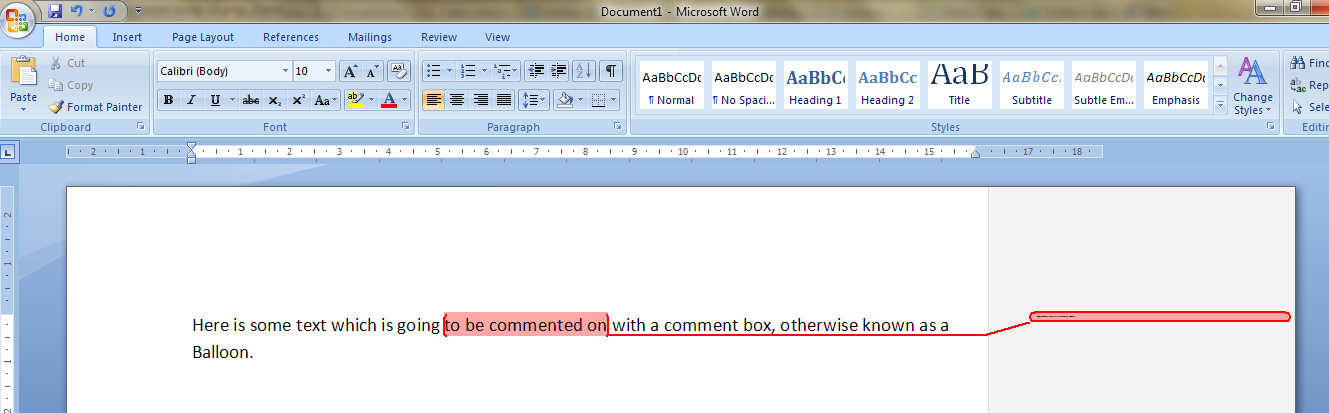
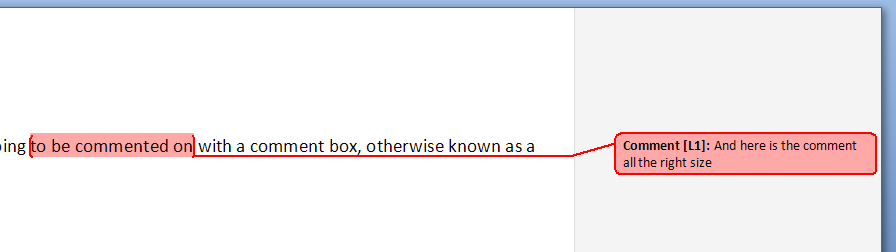
I had been editing a document for a client.  I added some comments in the margin, as always – but when my client opened it and when I re-opened it, to my horror and his, all of the text boxes containing the comments had gone TINY and unreadable. It looked like this:

It apparently happens if you’re working with a document originally created in an older version of Word which doesn’t have the requisite Styles set up for comment boxes.  You then work on it in Word 2007 or Word 2010 (this solution works for both!) and the horror happens …

It took me and Matthew longer than it should have to work out what to do, as there didn’t seem to be an easily found solution if you searched for one online – so as an aide memoire for me, for next time it happens, and as a public service for anyone else trying to work out what to do … here’s what you do (now edited to add screen shots).

Note for experts: if you’re already familiar with Styles, note that you need to change the Balloon Text.

What to do if your comment boxes go tiny in Word documents:

Let’s look at what the full horror looks like first of all:

First of all: don’t panic! The comments will have typically gone into Times at 1 point. But there is a way to make them readable again.

Open the document. Don’t highlight anything. Don’t put the cursor into a comment box.

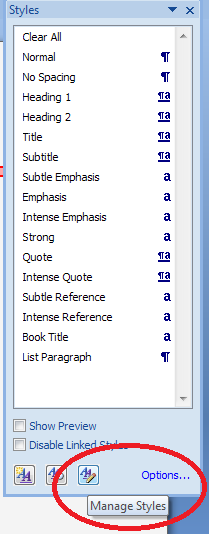
Now you can do one of two things. Either hit Control + Alt + Shift + s all at the same time, or make sure you’re in the Home tab and click on the little tiny arrow at the bottom right of the Styles menu – this will bring up the full Styles dialogue box.

Using either of these methods, you will bring up the Styles dialogue box.

This looks like a very useful dialogue box, but for our purposes you need to ignore all of it except the three buttons at the bottom. Click on the rightmost button: Manage Styles to bring up yet another dialogue box.
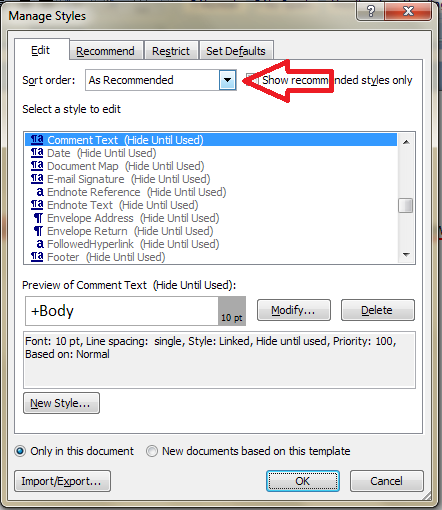
We’re not there yet: the sort order shows as Recommended – but you need to click on the down arrow to change it to Alphabetical:
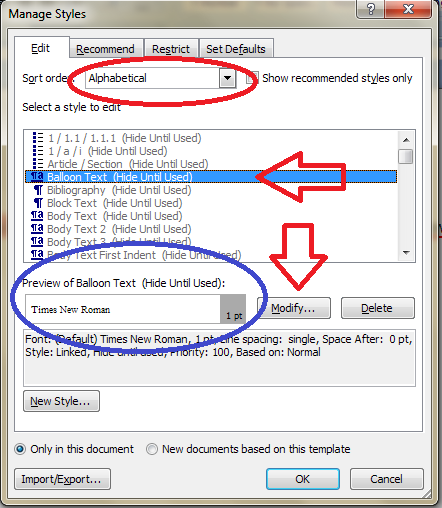
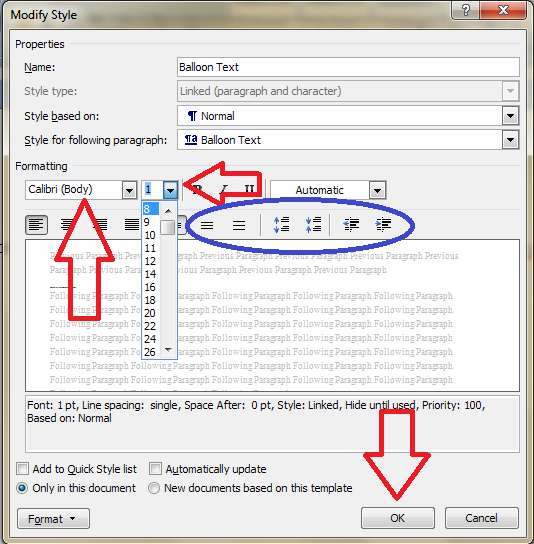
Once it’s in alphabetical order, it’s relatively easy to find Balloon Text (note: not Comment text) and you will see that it then confirms how you have your text set up (blue circle). Click the Modify button

Now you can change your font (which will probably have defaulted to Times) and font size (which will probably have defaulted to 1). You’ll notice lots of other options (blue circle) to change the spacing, etc. – I don’t usually worry about changing those, but this is where they are if you want them – and of course you use this menu to change the styles on headings, normal text, etc., too. Press the OK button, and carry on pressing OK buttons until you get back to your document.

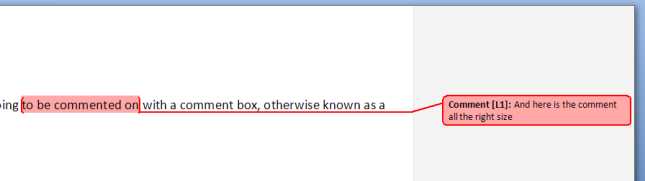
And there it is, all changed:
Save document

Want even more information on customising your comment boxes? Read this article full of everything you would ever want to know!

Related topics: What to do if your comment boxes start running from right to left

Changing the language in your comment balloons

Note that these tips are primarily for Word 2007, 2010 and 2013 for PC. Most of them will work for Word for Mac, although you may find some menus in different places. This is part of my series on how to avoid time-consuming “short cuts” and use Word in the right way to maximise your time and improve the look of your documents. Find all the short cuts here

Do let me know if this has helped you, saved your bacon, etc. – and do share with the buttons at the bottom of this article.
 
343 Comments

Posted by on November 6, 2011 in Copyediting, New skills, Students, Word, Writing


Tags: , , , ,