RSS

Tag Archives: writing

Fair or fare?

I saw this one at the weekend – it’s another one where people know the difference between the two words but sometimes get into a pickle with phrases (see rein, rain or reign, peak, peek or pique, bear or bare or cue or queue for more examples of this issue).

So, fair means “just or appropriate” and “treating people equally” and “moderately good” as well as “blond(e)”, and the adverb fair means “in a fair manner”. So, “I said I will give all applicants fair treatment and judge them solely on their ability”; “Yes, the process was fair and everyone was treated appropriately”. “It’s not FAIR”, of course, too, when you expect to get something and you don’t. A fair is also a public entertainment made up of stalls and attractions, but I don’t think that is the version that gets confused.

Phrases associated with fair include fair and square (honestly and accurately); fair game (a reasonable target).

Fare, however, has a few disparate meanings, which is probably how the confusion creeps in. It refers to the money paid for a journey on public transport – “have you got change to pay the bus fare to get into town?”. It refers to a range of food – “traditional English fare is available at the pub”. And it is used in the sense of to perform in a specified way – “he fared badly in the local elections”. The archaic meaning of travel also survives in farewell (fare thee well, travel well).

So none of them are a fayre (that’s just a pseudo-archaic spelling of fair), and you fare badly, you don’t fair badly, which is the one I tend to see.

You can find more troublesome pairs here and the index to them all so far is here.


Tags: , , ,

Homogeneous or heterogeneous?

Well, I have to admit that I don’t often see these two mixed up as such, but because they look quite similar, there is a need, in my opinion, to have a quick and easy way to distinguish them laid out. And that’s what these Troublesome Pairs are for, after all. I do monitor how many searches I get on the pairs, and it’ll be interesting to see how many people search for these in a search engine and come through to here. (If you have a website or blog, statistics are your friend, and can give you surprising results, too!)

Anyway …

Homogeneous means of the same kind, consisting of parts all of the same kind (it is also the name for a chemical process involving substances in the same phase, i.e. all liquids or all gases, if that helps you remember it). It comes from the Greek for same race or kind. Yes, the same as homosexual. The way I remember this is that homogenised milk is the one where the cream is mixed into the milk rather than sitting on the top (that made me feel a bit nauseous for a moment, as I only drink skimmed milk, myself!)

Heterogeneous, on the other hand, means diverse in character or content (a heterogeneous chemical process is one involving substances in different phases, e.g. mixing a gas with a liquid, in case that helps you remember). It comes from the Greek, again, for other race/kind. And, yep: heterosexual.

Note the spelling, by the way: -geneous, not genous. Not even if you’re in the US, I believe.

So a word pair and a pair of prefixes defined for you today: extra value!

You can find more troublesome pairs here and the index to them all so far is here.

 
1 Comment

Posted by on March 30, 2012 in Errors, Language use, Troublesome pairs, Writing


Tags: , , ,

How to quote sources without plagiarising

I work with a lot of students, and one of the things that seems to be an issue is how exactly to use your sources when you’re writing an essay. So I thought it was time to write some notes to help you.

How will this article help you?

This article will help you to avoid plagiarism. I’m going to take a text I’ve written and re-write it in some different ways. Because, and this is important, if you just take text from somewhere else and dump it into the middle of your essay … that’s plagiarism. Plagiarism is serious. It’s passing off someone else’s work as your own. And most academic departments use plagiarism detecting software. If they run your work through the software and it shows you’ve plagiarised,  you may well have marks deducted or the whole essay may be returned unmarked.

What’s wrong with just cutting and pasting stuff I’ve found?

I know that in most cases, you don’t mean to plagiarise. You’re pushed for time, you’re often not writing in your native language, and it’s easy to take that text and put it into the essay. But these are the reasons you shouldn’t do it:

  1. It’s morally wrong to plagiarise.
  2. You won’t gain an understanding of the text if you just paste it into your essay.
  3. You will get caught.

How do I use source material in the correct way?

There are two ways to use source material you’ve found in your research:

  • use direct quotations, which you’ll need to indicate using quotation marks ” … ” or ‘ … ‘
  • talk about what the author has said, but put it in your own words

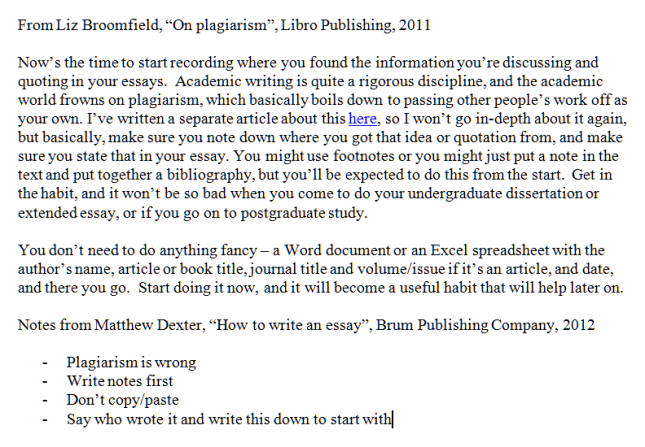
So, how do we do it. Here is a passage I’ve copied from one book and some notes I’ve made from another one. These are the sources for my essay.
Using quotations to talk about your source

This is direct quotation. A simple example:

Mary says “I am going to the park”

I write: “Mary said, ‘I am going to the park'”

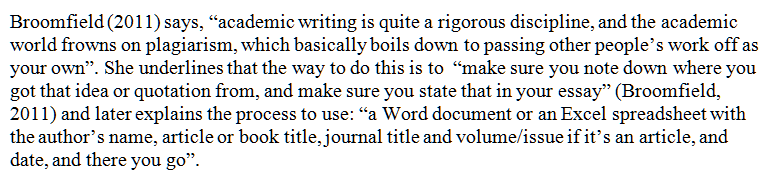
An easy way to talk about your source material is to use quotations. You don’t need to re-write what the authors say, however you do need to show you understand what you’re talking about and to link the quotations in a sensible way – you also need to make sure they’re all within quote marks and referenced properly. With the notes you’ve taken (above) you might end up with something like this:
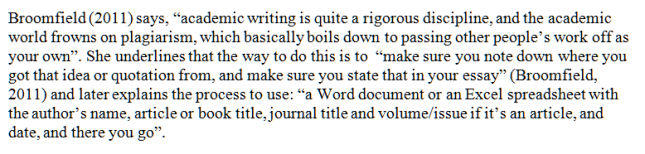
So what I’ve done here is take sections from the text, put them in quote marks, noted where they’re from, and linked them appropriately so it’s clear I understand what I’m talking about.

Note that if you start off in the present tense, “Broomfield (2011) says that there are … ” you need to continue in the present tense; if you start off in the past “Broomfield (2011) said that there were … ” you need to stick with that. You can pop into the present tense if you are talking about a universal truth rather than something rooted in the time frame, so “Broomfield (2011) said that people are always likely to plagiarise” but “Broomfield (2011) said that the results of her study were not clear and she was not able to draw conclusions from them”.

Rewriting source text to talk about what the author is saying

This one is slightly more tricky. You need to do “indirect quoting”, or reporting what the author said. Simple example again:

Mary says “I am going to the park”.

I write: “Mary said that she was going to the park.”

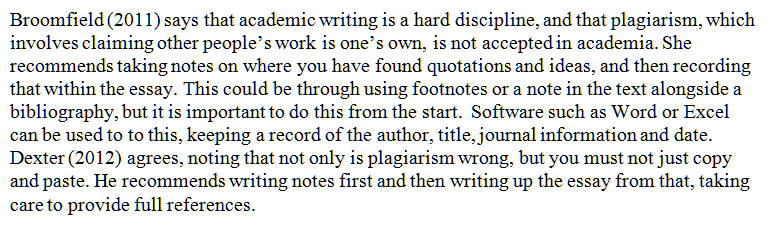
What we have to do here is retain the sense of the original, while writing it in our own words. Here’s what I came up with. Note that I can now use the notes I made on Dexter, too, as I don’t have anything in his words but can talk about what he said and I noted down:
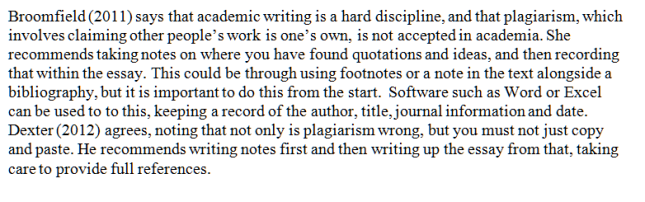
Here I have used a number of different techniques. In no case, though, do I use more than a couple of the original source’s words exactly as they appear in the original. Instead I do this:

  • using synonyms: “hard discipline” instead of “rigorous discipline”
  • simplifying the words but getting the same sense across: “involves” instead of “basically boils down to”
  • reporting what the source said and using that to link the essay together: “she recommends using”
  • expanding on what the source says: “This could be through” rather than “you might”
  • summarising and synthesising (summing up and putting together) “Software such as Word or Excel could be used”, and “keeping a record of the author, title, journal information and date”.
  • Introducing the other research but linking it to the first idea: “Dexter (2012) agrees … “
  • Expanding notes into full sentences: the notes taken on the Dexter text.

Oh: please note here that you use “Broomfield (2011) says this is the case ” or “According to Broomfield (2011) this is the case” but never “According to Broomfield (2011) says this is the case” – I see that last one all the time.

Combining direct and indirect quotation

Of course, the best way is to combine them – some direct quotations, some reported speech or indirect quotations. This has the benefit of breaking up the text a bit, giving some interest, and allowing some use of the authors’ words to save having to rewrite everything.
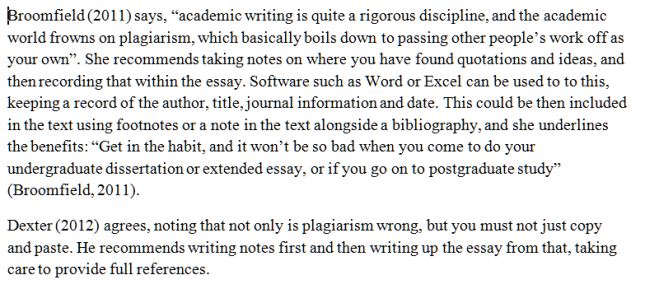
Note that here I have shuffled around the order of what the first author says, too.

Rewrite, don’t copy and paste

I hope I’ve now managed to explain

  • What plagiarism is (see more in this post)
  • Why it’s not a good idea
  • Different ways to avoid it
  • Direct and indirect quotations
  • Some tips on how to rewrite text

Please do let me know if you’ve found this useful – or if there is more detail you’d like to know about. And do share using the buttons below if you’d like to tell your friends and colleagues about this information.

If you want more … here is a whole article on plagiarism, here is one on essay writing in general and one on writing dissertations and theses, and if you click on the students or writing or Word categories in the right hand column of the blog, you’ll get loads more hints and tips.

 
10 Comments

Posted by on March 28, 2012 in Ethics, New skills, Punctuation, Students, Word, Writing


Tags: , , , ,

Though or although?

Here is another pair of words with an identical meaning but subtly different uses. There’s a style warning at the end, too. We like a style warning, don’t we!

Both though and although mean” in spite of the fact that”, “however”, “but”. “Although he’s messy at home, he’s very organised at work”, “She was a plainly dressed woman, though with a flamboyant taste in hats”, “The dogs, though fierce in appearance, were friendly”.

Although is the more formal of the two. I prefer it to though at the beginning of a sentence, which is the traditional way of doing things. “Though he was firm, he was fair” just looks better to me as, “Although he was firm, he was fair”.

You cannot replace though with although in adverbial uses – “it was nice of him to write, though”. or with as or even – “she doesn’t look as though she’s reading that book, even though she says she is”

And finally, you shouldn’t start a sentence with either of these if it’s actually acting as a linking word between the previous sentence and this one: “He was firm. Although he was fair too”, or if it’s making a link between two concepts in the upcoming phrases: “Although he was firm. He was fair too”. Make sure both of the linked ideas are in the same sentence.

You can find more troublesome pairs here and the index to them all so far is here.


Tags: , , ,

Pore or pour?

Another pair of words that sound the same but don’t mean the same, and that get mixed up more times than I’d care to mention. Read on to find out how to differentiate between pore and pour.

First off, the more uncommon one. To pore (over) something is to be absorbed in the reading of it. “She was so busy poring over the article on semiotics that she missed her stop on the Tube”. A pore is also a minute opening in the skin (etc.) through which liquids and gases can pass. But I don’t think that’s the usage that gets mixed up with this pair.

To pour (over, out, etc.) is to flow or cause to flow in a steady stream. “Water poured down the wall as the shower leaked from above”; “she poured herself a cup of tea”.

Short but sweet. The same sound, but different spellings, meanings and, well, words.

“As she pored over the ancient manuscripts, it began to pour with rain”.

You can find more troublesome pairs here and the index to them all so far is here.


Tags: , , ,

Peek, peak or pique?

We have an extra value Troublesome Triplet today, with a look at peek, peak and pique. These all sound the same, but not only are they spelled differently, they mean very different things, too.  But this doesn’t stop them getting mixed up – presumably the fact that they sound the same overrides all other factors!

To peek is to look furtively or quickly, and the noun means a quick or furtive look. “I’ll just take a peek at your first chapter but I’ll read it properly later”; “She peeked in through his window and saw him reading a book”. Going along with this shifty, round-corners type of feel, to peek can also mean to protrude slightly so as to be just visible: “the end of the dog’s tail peeked out from under the duvet, revealing his location”.

Moving on (or up) to the peak, this is the pointed top of a mountain (or refers to a mountain with a peak) and in a similar way, a point of highest achievement or activity (“The peak of his achievement in running was winning a gold medal”), point in a curve or on a graph that is highest point, and, well, the brim at the front of a cap (it sticks out/up). The verb to peak means to reach the highest point (“the hits on my website peaked at 229 in one day and never achieved that heady height again”) and the adjective peak refers to maximum or utmost – “he’s at peak fitness right now, just in time for the big athletics meeting”) or characterised by maximum activity or demand – “phone call charges increase at peak hours”.  There is a secondary, archaic, meaning, from the 17th century, to decline in health and spirit – we use this one when we refer to someone as looking a bit peaky, if they look a bit pale and unwell.

Pique has two linked meanings to do with prickings and prickliness: it’s either a feeling of irritation or resentment resulting from a slight especially to one’s pride – “he stormed off in a fit of pique” – or refers to stimulating interest or curiosity, again with a little prick or prod: “he piqued her interest with his fascinating talk of shower sealant, and she resolved to take a plumbing course”.

So, in essence, “She piqued his interest in mountaineering when she scaled the highest peak in the range and peeked at him from behind the cairn at the top”.

You can find more troublesome pairs here and the index to them all so far is here.


Tags: , , ,

Comprise, compose or consist?

Comprise, compose and consist have come to my attention quite forcibly this week, as I keep coming across examples of them being used incorrectly. Or, rather, comprise being used incorrectly. “Comprise of” and, in the past tense, “comprised of” seem to be getting more and more common, and the three words do have a similar meaning, in that they are all about larger things being made up of smaller things. But the way they are used, and the constructions that are built around them, are different and do need care. There is also a subtle shift in emphasis from the parts to the whole, which I’ll describe as I go through them.

The problem creeps in when they are not adequately differentiated in the writer’s mind, in which case the constructions leak across from one to another, causing (gasp!) incorrect sentence structures. And yes, there is a school of thought that says “if you can understand it, it doesn’t matter if it’s a bit incorrect or clumsy”, but I don’t think there’s any need to be incorrect and clumsy if you don’t have to be. There, I’ve said it. Anyway, here goes!

To comprise is to consist of (yes, I know), be made up of: “the country comprises four regions”. But not (please!) “the country comprises of four regions”. If you are desperate to use “of”, then you can turn the verb around and make the country the subject, so: “the country is comprised of four regions”. But I’ll repeat again, it’s not comprises of, and really I don’t much like is comprised of much, either, when it comes down to it, and if you write that in something I’m editing, I’m likely to suggest changing it!

The emphasis here is very much on the smaller constituent parts. We’re talking about what the larger thing is made up of, and they are the important things, rather than the whole.

Note that the large thing comprises the small things. The small things don’t really comprise the big one, or at least we don’t write it that way round.

To consist of means to be made up of – “the country consists of four regions”.  You can use that “of” as much as you like with consist! The emphasis here is on the parts that make up the whole, but also on the fact that they do make up a whole, so there’s an equal balance of importance.

And a little bonus: to consist in means to have as an essential feature – “Bob and Tom look very similar: their difference consists in the way they talk”.

If you can replace “consists” with “lies”, then use in. If you can replace “consists” with “is made up” then use of.

To be composed of, again, means to be made up of, although the emphasis shifts here subtly to the whole: the parts compose the whole, and the whole is what is important. “The work is composed of four movements”.

You can find more troublesome pairs here and the index to them all so far is here.


Tags: , , ,

Disorganised or unorganised?

Having become known as someone who writes about this kind of thing, I was asked on Twitter the other day to explain the difference between unorganised and disorganised. It’s another one of these subtle shades of meaning, with one being more specific and the other more general – we seem to have quite a few of those in English and I do like them!

Being unorganised is all about the specific thing that is unorganised; it’s the acute version, if you like. A party where you haven’t planned any food for people to eat, an essay that has no plan to it and is that bit harder to write – that’s unorganised

Being disorganised is a general, holistic thing, more of a character point than a specific item. Following the medical analogy above, the chronic version of lack of organisation. So a disorganised person is generally chaotic and inefficient, and a disorganised committee or event is not properly planned and controlled. A disorganised desk is one in constant disarray, a disorganised essay has been written from that unorganised plan and is pretty unreadable.

I said it was subtle!

You can find more troublesome pairs here and the index to them all so far is here.


Tags: , , ,

Persuade or convince?

I have to admit that I thought there was more of a difference between persuade and convince than there actually turns out to be, but there is some interesting background that we can look at too.

To convince someone of something means to cause them to believe firmly in the truth of something, or – aha – persuade them to do something.

And to persuade someone to do something means to cause them to do something through reasoning or argument; to cause someone to believe something; to provide a sound reason for someone to do something.

So, all very similar. But here’s the interesting bit, and it does come across a little bit in the above explanations … Traditionally, convince is used in situations in which someone’s belief is changed but no action is taken – “I convinced her to believe in the tooth fairy”, whereas persuade is traditionally used in situations in which someone’s belief is changed and action is taken – “I persuaded him to buy the red trousers, even though he usually wore black”. Feel free to keep that distinction going if you want to!

You can find more troublesome pairs here and the index to them all so far is here.


Tags: , , ,

What I got up to in February

Yes, it’s that time again when you get to find out what a busy self-employed editor/writer/transcriber gets up to. I’ll carry on writing these while people carry on letting me know they enjoy them!

I’ve had another amazing month in February. I can’t really believe it’s going so well – I have described it as like that expanding foam you put into a space in your house – pff and it’s filled up the space allowed!  My new blog has been useful as an outlet through which to express myself from time to time! So, here’s a snapshot of what I got up to …

The first part of the month was heavily devoted to transcription – the client I worked for just before Christmas came back to me with another international conference to transcribe. My experience with minuting meetings and with non-native speakers of English really helped here, as I was typing out presentations and discussions by people from all around the world. Fun and interesting work, I got to share the work with some colleagues by recommending them to the client, but, my goodness, I typed a lot – I transcribed over 20 hours of conference (remembering that each hour of speech takes several hours to transcribe) and actually wore the letters off some of the keys on my computer keyboard! I put into practice the lessons I learned about avoiding RSI from the last lot, took lots of breaks, went to the gym every day for some heavy sessions on the rowing machine, and got through it fine. I like this client a lot, too, because they always come back to me quickly if I have a query.

I also did more transcription for two other regulars; a writer teaching people about marketing and a journalist interviewing musicians. Those ones were in British English and also interesting to do.

And I did do other things, too (somehow),  writing a library of 42 short articles for one regular client, articles on medical subjects for another, and putting together marketing letters/emails and web text for another.

I edited some texts that had been translated from Polish, Finnish, Dutch and Chinese, and ones written by people with French as their first language.  I edited the Moseley B13 magazine again – I do that for free and enjoy it greatly, finding out what’s going on in my local area and using my powers for good at the same time. I also did a bit of localisation for US and other clients.

There was some of the usual academic work – bits of theses, dissertations and articles. I had some more short essays from my coaching clients, who are all progressing through their Master’s courses nicely – it’s great to see their English improving as they take on board my suggestions and tips.

So a nice busy time of it! In other news, I got back into my giving back and networking, helping at a one-off local Social Media Surgery session, and attending Social Media Cafe as usual (I wouldn’t miss that for the world) although I missed the Central SMS owing to a clash with another meeting. In response to my need to have people to talk to now and then, and after testing the waters, I’ve established a Kings Heath Home Workers group on Facebook and blogged about it.

Coming up – I have some academic work booked in and I’ll be doing more transcribing towards the end of the month. I am hoping to get some time to work on my research project, as I’ll be presenting on my research at the Iris Murdoch Society Conference in September. I’ll be going to Jelly co-working session this Friday – now I’ve been to one and know how they work, I’ll be taking along some draft blog posts to write up.  I ran a competition in my newsletter last month and I’ll be announcing the winner later on today or tomorrow – if you would like to receive a short summary of Libro goings-on and interesting facts and links, do sign up here!

Libro offers copyediting, copy writing, proofreading, transcription, typing and localisation services to other small businesses, individuals and corporations. Click on the links to find out more!


Tags: , , , , , ,