RSS

Category Archives: Business

New series on expanding your business – looking for contributors

handshakeI’m planning a series of blog posts on how to expand and grow your business, and I’d like to feature guest posts from professionals and case studies from people who have taken the various paths, as they’re not something of which I have direct and personal experience.

Ideally, I’d like to have at least one professional (HR consultant, accountant, estate agent, etc.) and at least one case study for each topic.

I want to write about:

  • Changing from being a Sole Trader into a Limited Company
  • Going into a partnership with another person or company
  • Going VAT registered
  • Moving into premises
  • Employing your first staff members
  • Doing nothing – staying as a Sole Trader

and I want each article to cover:

From the professionals:

  • Why you should do it
  • When you should do it
  • How to do it
  • Potential benefits
  • Potential pitfalls

From the business owners:

  • Why you did it
  • When you did it (i.e. what stage was your business at?)
  • How you did it
  • Benefits gained
  • Pitfalls / disadvantages you experienced or saw coming and managed to avoid
  • Would you recommend it to other businesses? Why / why not?

Note: I am primarily aiming this at the UK market, however if you have useful information about how this stuff works in the US or elsewhere, do feel free to join in, just let me know the region to which your experience/advice applies.

What do you get out of it? Well, in the article where I mention you, I’ll put whatever links you’d like to your website, twitter feed etc at the bottom. I might be looking to put it into my new book, too, again with a full credit and links in the e-book version – let me know when you get in touch whether you’re OK with that. I can also keep you anonymous if you’d like to contribute but not have your name on the piece.

I get around 20,000 hits per month on this website / blog and that’s still building every month, and I have great Search Engine Optimisation so this website / blog shows up well on search engine searches.

If you’d like to take part, please contact me via email or my Contact Form.

These articles will appear on this blog and will be indexed in the Careers section of the blog.


Tags: , , ,

Using Canned Responses in Gmail to create default email templates

Did you know that you can create default email templates in Gmail to save you typing the same message over and over again? Or are you using copy and paste to save typing? In this post, I’ll explain how to create and use “Canned Responses” in your Gmail email to save time and ensure that you send consistent messages.

Why would I want to create email templates?

If you run or work for a business, you’ll know that you send a lot of the same text over and over again. To use my business as an example, I send these emails a lot:

  • A pre-work email to students to explain exactly what I do and any issues around plagiarism that I need to tell them about
  • An email to transcription clients that lists the choices I need them to make so that I can provide the transcription they need (do they want me to type the exact utterances or tidy them up, insert time stamps ever 10 minutes, etc.?)
  • An email to enquirers to say that I can’t fit them into my schedule but here’s a list of recommended proofreaders
  • An email to my small business chat interviewees to ask for their annual update, telling them how many hits their interview has had and what they said last time

I save considerable amounts of time by automating these emails using Canned Responses, and I’m sure that you have at least a couple of standard texts that you’re always sending out.

Where can I find Canned Responses in Gmail?

Canned responses are a “Lab” feature in Gmail. This means that they’re an experimental feature, written by a third party, a bit like a plugin that you can add to your email. Having said all that about them being experimental, I’ve been using them for YEARS now and they haven’t broken or disappeared.

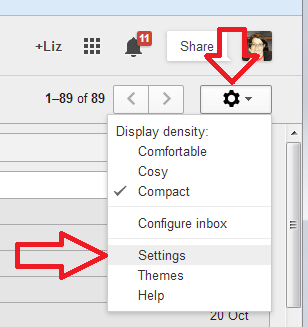
To access the Labs, go into the Gmail settings by clicking on the cog icon at the top right of your screen, then choosing Settings:

1 settings

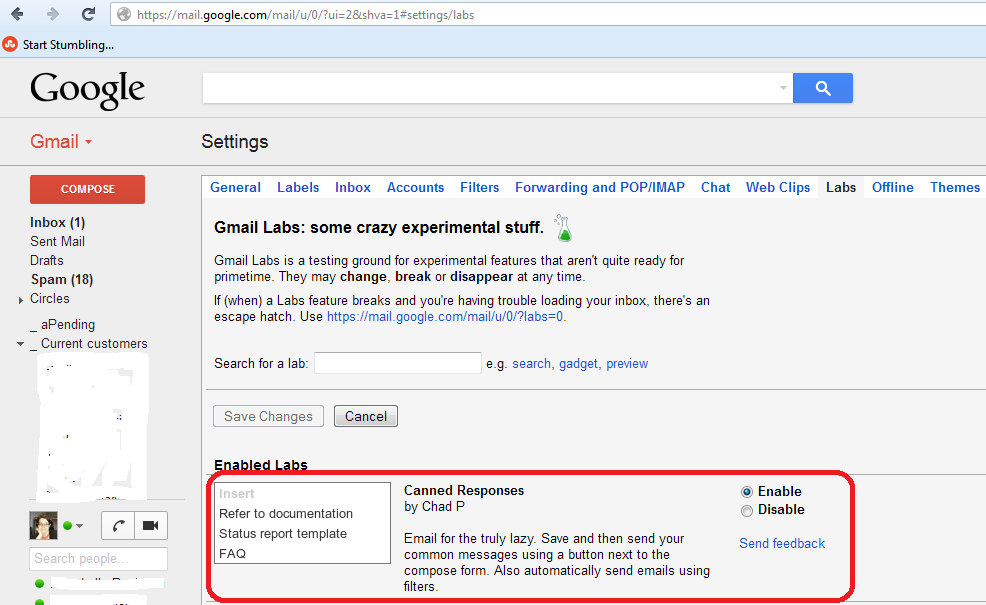
Then choose the Labs tab at the top:

2 labs

I’ve already got Canned Responses enabled, as shown here, but you will need to scroll down until you find it, or enter “Canned Responses” in the Search for a Lab search box (not the top search box):

3 canned responses

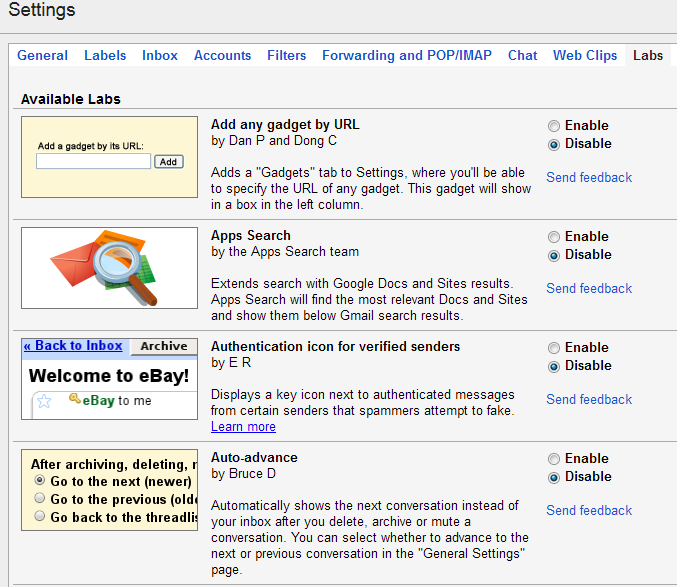
Any labs that you enable will show at the top of your screen, and you can scroll down to see the others that are available, each with a description of what they do:

4 canned responses

So do have a little explore another day! For now, click Enable and then Save Changes under the search box or at the bottom of the screen (to get back to your email, click on Inbox on the far left).

How do I use a Canned Response?

I’m going to show you what happens when you use a Canned Response first, to help you to understand what they are, and then we’ll look at creating a new one.

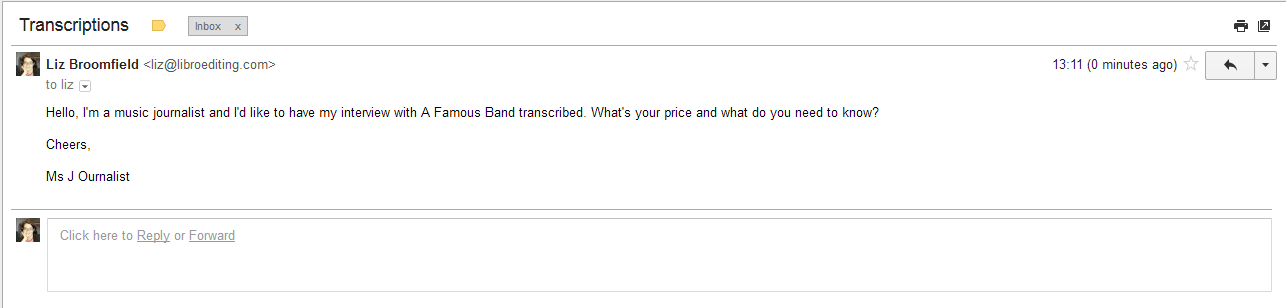
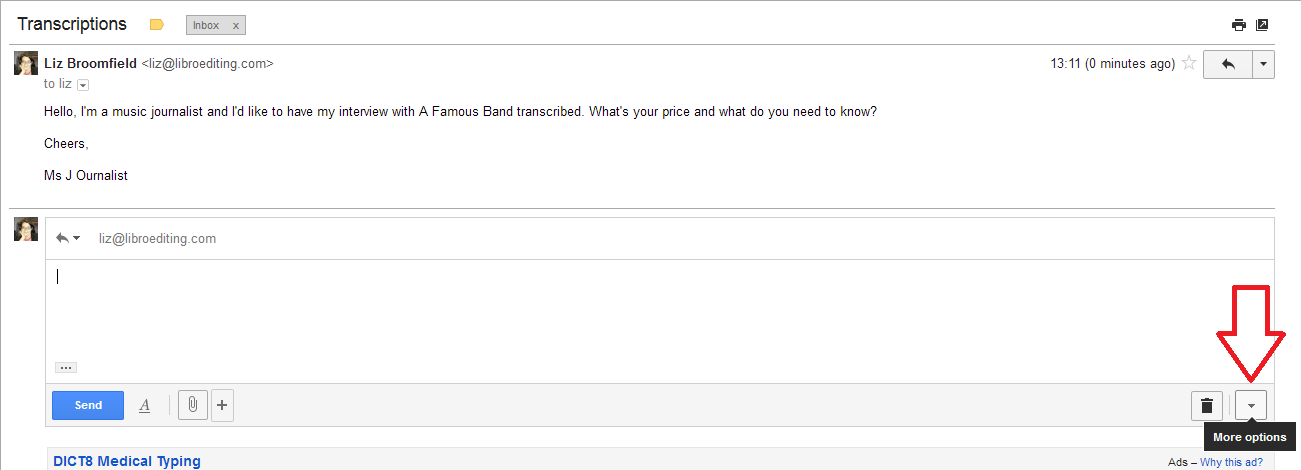
Let’s pretend I’ve received an email from a music journalist wanting to know about my transcription services:

5 incoming email

I click on the Reply arrow at the top right or in the Reply pane at the bottom to start my reply:

6 more options

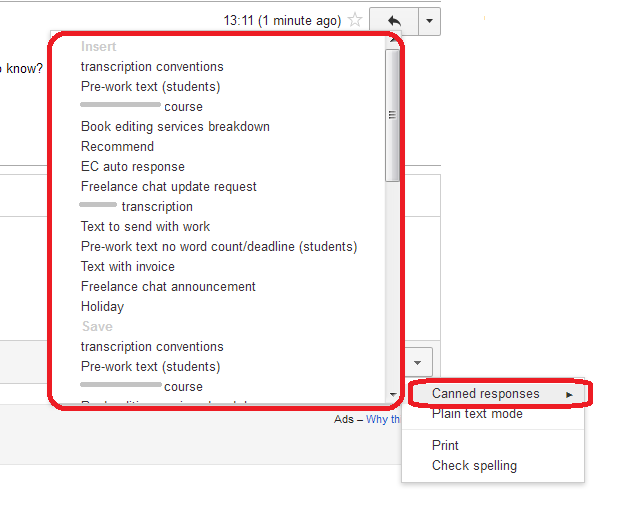
But instead of typing my reply, I click the More options button at the bottom right of the screen. This brings me up a list of, well, more options, oddly enough … and then I click on Canned Responses:

7 canned responses

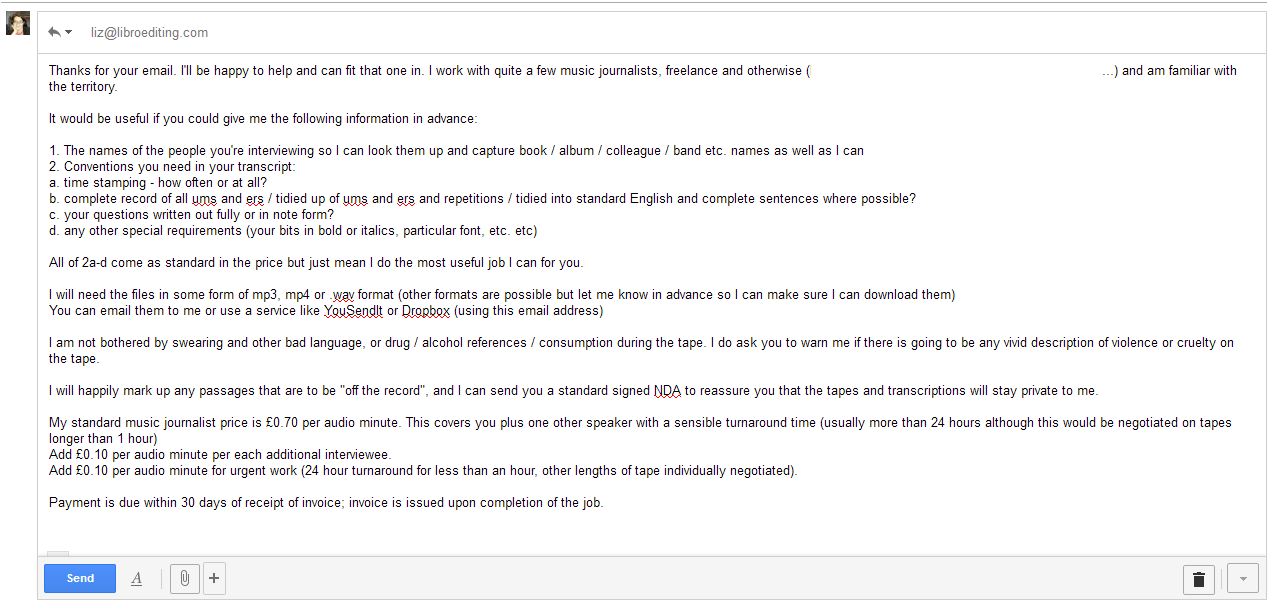
Here I have a list of all of the canned responses I’ve set up. I’m going to click on Transcription conventions at the top, and when I do, the text will insert itself into my email automatically, saving me masses of typing!

8 canned response

It’s just like a  normal email that I’ve typed, however, and I can add a greeting and do any editing to the text that I require in order to personalise it:

9 canned response addition

How do I set up a new canned response?

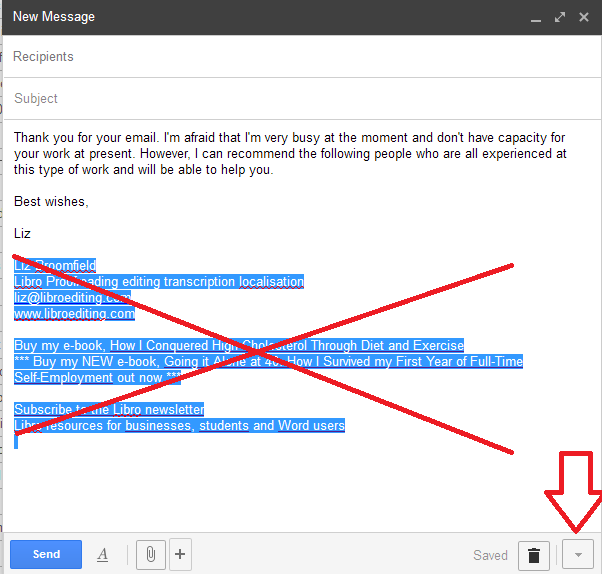
To set up a new canned response, start a new message in Gmail and type your standard text. I haven’t addressed this one, but you can save an email that strikes you as a particularly useful one to use again, at whatever stage. One important point, though: when you want to save it as a canned response, delete any signature file you have at the end of your emails. If you don’t delete it, it will become part of the canned response. Then when you add it to an email, your signature will be automatically added at the end anyway, duplicating it.

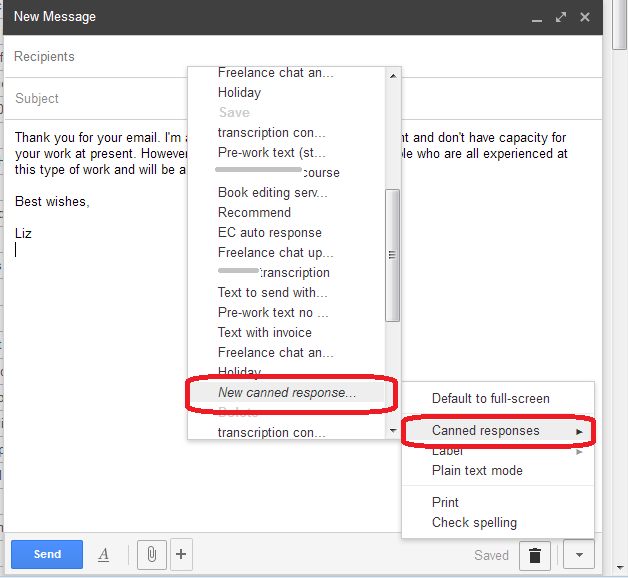
So, delete your signature and press that More options button at the bottom right before you send your email:

10 new canned response

Now scroll down past the canned responses you have already set up (if you haven’t set up any, this will be almost at the top, underneath save) and select New canned response:

11 new canned response

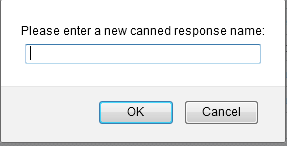
It will prompt you for a name for your canned response:

12 new canned response

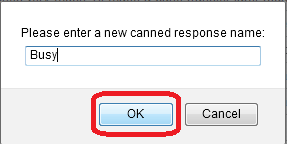
Type this in and press OK:

13 new canned response

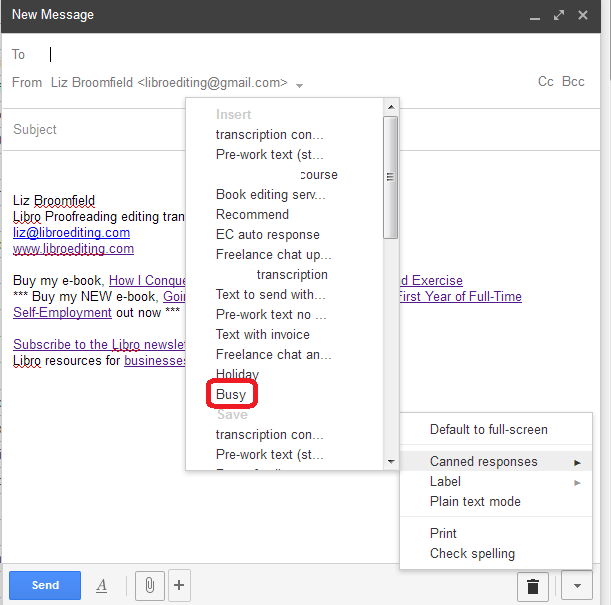
Now this response will appear in your list next time you want to use an email template:

15 new canned response

How do I change a canned response message?

if you want to alter a canned response message, the easiest way to do it is:

  • Start a new email
  • Load the original canned response
  • Choose More options / Canned responses then choose the appropriate Canned response name under the Save sub-heading
  • The new version will be saved to replace the old one

What else can I do with canned responses?

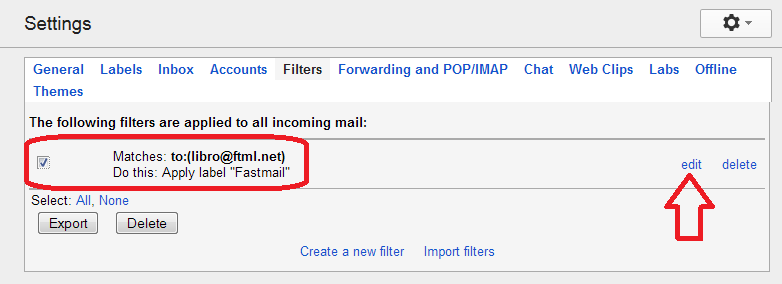
You can use your canned responses in a filter. If you want a special message to go out to a particular customer automatically, To do this, go into Settings – Filters. I have already set up a filter to mark emails that are forwarded from my old email address as coming from there. I am now going to edit that filter:

16 filter

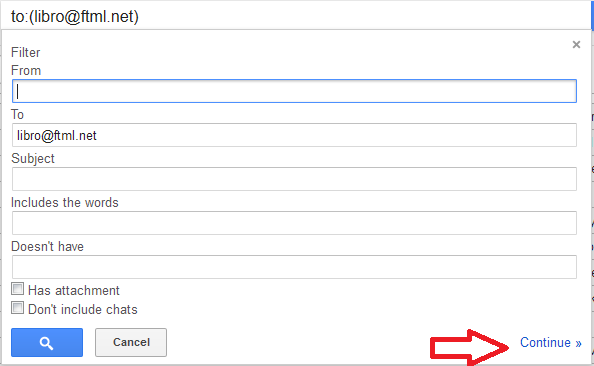
Having hit Edit, I then select Continue:

17 filter

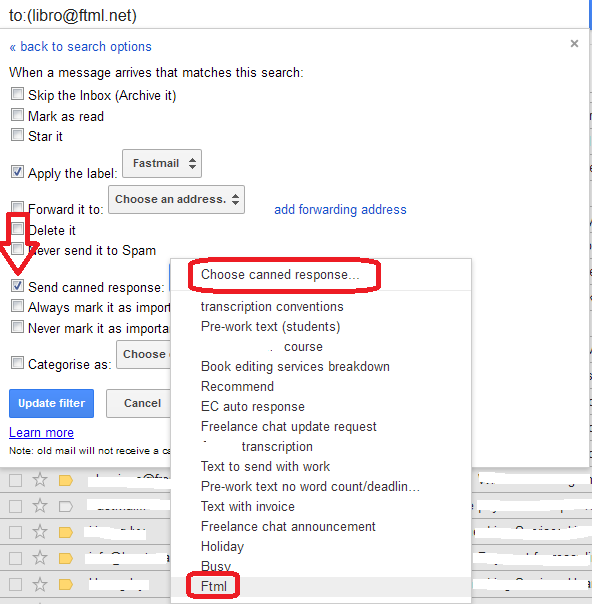
I then access the options where I can choose to send a Canned Response to anything coming through that filter, and I choose the Canned Response from the list:

18 filter

And finally choose Update Filter to make the changes stick.

———-

Have you found this useful? Please comment – especially if you’d like to see more Gmail tips – and use the sharing buttons to share this post with your friends and contacts!

 
103 Comments

Posted by on October 30, 2013 in Business


Tags:

Localisation as a career

localisationI was recently asked for some hints about developing a career in localisation, and so here I share a bit of information about this rather specialised area of work.

What is localisation?

I covered the definition of localisation in an earlier post, but basically it’s all about changing content (whether that’s content in a novel, a website, marketing materials, dialogue in a computer game, instructions for operating equipment, etc.) so that it works in a different geographical location.

Typically, being a British English native speaker, I am asked to localise from American English into British English, for the British (or British English influenced English speaking) market.

“Oh,” you might cry, “that just means you change color to colour and organize to organise, right?” Well, there is a bit more to it than that, and I really don’t think it’s something that just anyone – even any editor – can do.

What background and skills do you need to do localisation?

As well as the classic attention to detail and background in perhaps editing, or indeed translation (it is actually often seen as a branch of translation, which brings its own issues, as we’ll find below), I think that it is vital to have experience in the language out of which you are localising: the way it works, its vocabulary, its punctuation, its spelling.

I used to work for an American company in its UK office. I spent a lot of time working on documents aimed for the two marketplaces. I travelled to America and had a lot of dealings with American colleagues, as well as travelling to America at other times, and got a good grasp of the difference between the two cultures. Still, like translators are meant to do, I will only localise out of US English into UK English. I do edit American English, so I see it and am made aware of its differences and special rules on at least one job per week.

Because of the links with translation, you also need a very special set of skills to do with operating specific, specialised translation software – which is very often not easy to use. I’ll talk about that in a minute.

I’ve also got a number of reference books – the New Oxford Style Manual is good on the variants in spelling, and I have other books in addition to the resources I use to edit in US English.

What is involved in US – UK English localisation?

As I mentioned above, it’s not just a question of changing the or spellings to our and taking out some zs (actually, British English of the Oxford variety does allow zs; however, I’ve found that all of my localisation clients or those who ask for work in specifically British English prefer to have the s spellings which they associate with British English – I do as I’m asked!). American and British English differ in terms of their spelling, punctuation and other grammar, and terminology. Here’s an invented example (US English on the left):

localisation

Now, of course, English is nothing if not subjective, and you might not agree with my choices here, but this serves as an example of the level of work involved in localisation. I might not change so much in every sentence, but there are an awful lot of issues to be aware of.

Another important issue is the range of texts involved in localisation projects. Most of mine have been under Non Disclosure Agreements, but I can tell you that I’ve worked on instructions for medical devices; dialogue for computer games; error messages for software; marketing materials for various large multinationals; and quizzes for people who sell a particular brand of product. So you need to be aware of the different registers involved in English writing, perhaps more even than when you’re editing.

How do localisation jobs work?

Herein lies the rub. As I mentioned earlier, localisation is often seen as akin to translation. And very often, a British English localisation is just one of a whole slew of translations into other languages that is being done, or it’s being handled by a company that handles translations and is used to dealing with translation software.

So, while pretty well all of my editing and proofreading jobs come in Word or PDF files, just one document to be annotated or changed, my localisation jobs come in the form of:

  • A Word document that has been output from translation software and has two columns, one for US English (the Source) and one for UK English (the Target), usually with the US English pasted into the UK column to be changed and marked up, broken up into sentences or sentence fragments, often with some highlighted in different colours
  • An Excel document in two or more columns, again broken up into sentences or sentence fragments. Sometimes the UK English is pre-populated into the Target column, sometimes not.
  • A file to be manipulated using standard translation software like Trados or Across. To use the full versions of these, you might need to buy and download somewhat expensive software.
  • A file to manipulated using the client’s own proprietary translation software – this is often web-based and free, but can take some learning, and they are ALL DIFFERENT

I’m not going to go into the details here, but basically any work done in a translation management system can be a bit frustrating for the localiser, as typically you’re not changing words in every segment, yet you will have to mark each segment as translated, often by hand and using a repetitive set of actions. All very well if you’re a translator, poring over every word, not so great when you are only changing one segment in five!

How do I get localisation work?

I tend to get my localisation work in two ways:

  • Through my membership of Proz.com, which is a jobs (and more) website specifically for translators, but which does have editing (usually non-native English texts) and transcription jobs
  • Through people searching the web and finding that I discuss and offer localisation

I have several regular localisation clients. However, I don’t think I would want to do only localisation, as it’s quite a specific field and the projects involved can be quite long and complex.

In conclusion, localisation is something I would only suggest you go into if you have …

  • Good, solid experience with US and UK English
  • A high tolerance and capacity for learning new software interfaces fast and dealing with often recalcitrant and tricky systems

————

Related posts on this blog:

Read all of my careers advice posts here!

 
14 Comments

Posted by on October 28, 2013 in Business, Localisation, New skills, Skillset


Tags: ,

How do you know that you’re running a mature business?

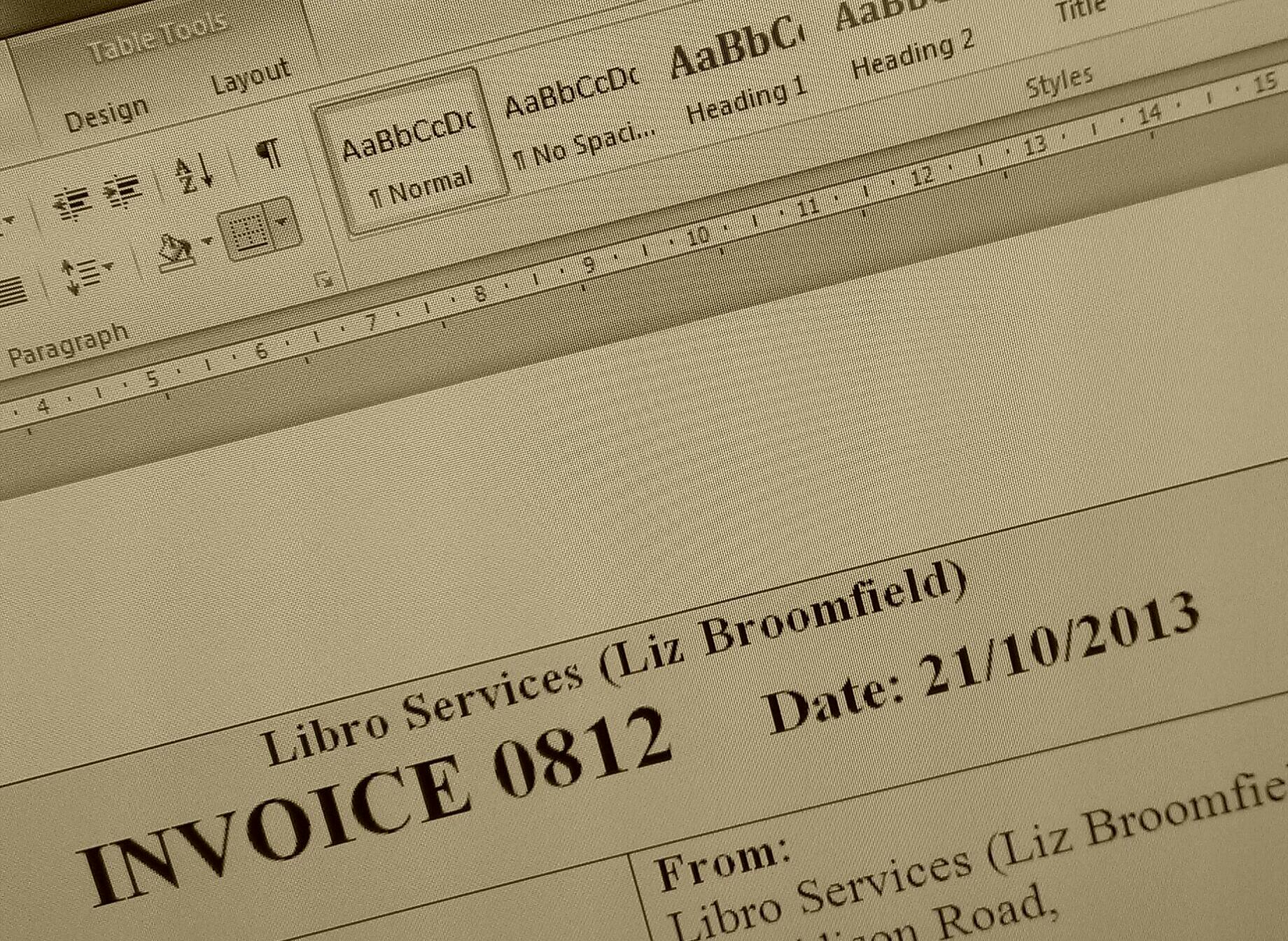
invoiceLots of posts and books and blogs and courses and STUFF have been written about start-ups and about starting a new business. But what about when that phase is over? Some people, especially, it seems, in the technology sector, like to bounce from start-up to start-up, selling the business on or changing it in some way as soon as it has settled down. But what if you’re in the one business for the long run? How do you tell when you’ve moved from the start-up phase to running a mature business?

What is it like running a start-up business?

In my experience, the first few years of running your own business are characterised by

  • Uncertainty – will I get customers, will I keep customers, where will my next customers come from
  • Active marketing – trying different marketing methods, signing up for directory websites, trying some adverts
  • Overwork – working all the hours there are for clients who need everything now! It’s also possible that you’re working at a day job while developing the business on the side
  • Underpay – thinking “can I actually charge for this? That much? Really?
  • Constant change – changing strategy, changing business model, changing clients, changing business cards
  • A change in lifestyle and your social life – especially if this is your first start-up, you’ll disappear from your friendship groups, become invisible to your family, and probably start hanging out with new business chums as well

What is it like running a mature business?

I’m in Libro’s fifth year now, and things are markedly different from when I started. I know a few people who are just starting out, which helps me remember what it was like and see the differences. Here’s what it’s like once you’re up and running

  • Certainty – much fewer worries about where customers are coming from; working with regulars who you know well, knowing their payment schedules and how they operate
  • Less marketing – many more jobs will be coming from repeat clients and recommendations, so marketing is more about brand awareness and making sure that people know you’re there, rather than grasping for new clients all the time
  • Steady work – you have reclaimed your evenings and weekends
  • Steady pay – you have worked up your rates of pay to industry standards, and are confident that what you do is worth what you charge for it (however, you might be on tax payment on account if you’re in the UK, which can be a slightly tricky transition)
  • Less change – while you still check for return on investment, buy the new technology you need to run your business and keep up with your personal development, things should be more stable, changing when you choose to change them
  • You get your life back – you can go back to your friends and family, but you also have a peer group of people in your industry who you can use as a mutual support group

How do you get from start-up to mature business?

These are some things that I’ve done – what do you think are the key processes in this move?

  • Outsource some functions of the business – design and accountancy are key ones that I’ve done, but you might go ahead and outsource all of your admin functions
  • Optimise your customer base (I’ve written about this in more detail here) so you have good, reliable, regular customers who bring in a good rate of return
  • Organise your work so that most of it comes from regulars who book it in advance, and have a system to record what you’ve got booked in so you can fit new work around it (I use a simple Gantt chart)
  • Turn away work and recommend it on rather than taking on anything and everything
  • Build a good network of peers who you can pass work to and from whom you can get advice and support or just a laugh or a rant occasionally (especially important if you work on your own)

Giving something back

When I was talking about this article on social media, someone pointed out that another feature of a mature business is that you find yourself advising people on how to do it! True indeed – from my experience …

  • I wrote a post on how to become a proofreader which ended up as a whole careers section on my website, because so many people were asking me how to do it
  • I wrote a book on my first year as a full-time self-employed business person
  • I share the knowledge I’ve gained of social media by volunteering at the Social Media Surgeries
  • I am informally mentoring a few colleagues through their first years as self-employed editors

And that’s one of the main benefits of running a mature business for me.

Who are you calling mature?

I’m starting to plan my new book at the moment. Working title: “Who are you calling mature? Running a successful business after the start-up stage”. What do you think of the title? Do you think this would be a useful addition to the millions of business books that are out there?

Do pop a comment on this post if you have anything to say about that or any of the points I’ve raised above – I always love hearing from my readers!

Sign up for my newsletter to find out all the latest information about my new book.

 
16 Comments

Posted by on October 21, 2013 in Business, New skills, Organisation


Tags: , ,

What is the best mix of customers to have?

to do list If you’ve got a mature business that is up and running and busy, then you’ve probably used something like these criteria to choose which clients to work with, and you might have used these ways to turn one-offs into regular customers. But what is the best mix of customers to end up with?

Obviously, in an ideal world, all of your jobs as a freelancer will be fun, interesting and high-paying, for clients who pay up on time. But, well, we’re not in an ideal world. The paying on time thing is non-negotiable for me (although I’m always prepared to listen if a client is having cash flow problems, IF they tell me about them), but I’ve learned to live with the fact that not all of the high-paying jobs are fascinating, and not all of the really fun ones pay well. It’s all about balance, and in this post I’m going to share with you how I balance my mix of customers, which might help you, too.

What are the types of customer?

Whatever industry you’re in, you tend to have a few types of customer:

  • Customers who send you a lot of work regularly (great, although try not to rely on just one or two of these, just in case, and sometimes they can get a bit demanding)
  • Customers who send you a bit of work irregularly (only keep these on if you really can slot them in as and when)
  • Customers who pay high rates (why? they may have set the rates for their industry and they’re in a region with higher costs of living and pay rates for freelancers)
  • Customers who pay lower rates (why? you might have long-standing customers on a historical lower rate or offer discounts, as I do, for special groups of customers such as students, individuals and music journalists)
  • Customers who have fascinating work that’s right up your street and relates to your interests
  • Customers who have dull work which nevertheless you can tackle
  • Customers who always need their work to be done at the last minute
  • Customers who send you stuff that’s at the edge of your comfort zone – or outside it

I’ve put a little space before those two, because they’re the ones who you really do need to minimise.

As I said, in an ideal world, you would have customers with loads of fascinating work who pay high rates. But that’s not always going to happen, so it’s a matter of …

BALANCE

Isn’t it always, though?

Boulders, pebbles, sand

Time management techniques make use of the boulders, pebbles and sand metaphor when talking about how to fit your tasks into your day. The idea is that you slot the big jobs (the boulders) in first, then you can fit pebbles (smaller jobs) in around them, and fill up the gaps with sand (I usually see the sand as being my admin tasks). So, if I have a big transcription that must be done by tomorrow and will take 3 hours, I will plan to do that in the afternoon, with a couple of small editing jobs slotted in around it.

It’s the same with customer types.

It would be great if you loved loved LOVED all of your projects, but some of them are still going to be more interesting than others. To take some aspects of my work as an example (but as I said, this works for all industries) …

  • Localisation is my most lucrative work but it’s often fairly repetitive marketing or web texts. It also often uses specialised software that can be quite tricky to work with.
  • Working with translators is a specialised job and so my rates are higher than for native English editing. The texts I get from my translators and agencies are varied and often interesting.
  • I have a particular transcription client who pays great rates and has interesting tapes to send me – they used to have a conference for me to transcribe for every 2 months and now it’s less regular but still interesting. I now have another regular corporate transcription client.
  • I love transcribing for music journalists. Music is an obsession of mine and I love both hearing all the bits that don’t make it into the articles and seeing how the articles are written up from the tapes I’ve transcribed. But I do charge these clients less than my corporate transcription rates, because they’re usually freelancers like me. These are very, very rarely uninteresting, even if I’m not a big fan of the music style. Even if it’s Justin Bieber.
  • Student work can be interesting but can be very tricky and time-consuming, typically involves quite a lot of emailing back and forth, and I charge a lower rate than for corporate editing. I used to work on Master’s coaching, but found that it was difficult to commit to small bits of work coming at short notice over a long period of time.

Case study: how I balance my customers out

To maintain the analogy of the boulders and pebbles, this is how I manage this customer base:

  • Boulders have to be regulars with the more lucrative end of the work. I have kept down my number of localisation clients – I could do just localisation, but it would be a bit same-y and I would end up relying on very few, large clients, which is something I avoid. So: regular localisation clients, regular translator clients and at the moment a large regular transcription client are the boulders of my client base.
  • Rocks (ha – you’re going to laugh in a minute) are my music journalists (see what I did there?). The work is fun, the clients are lovely, and I get more return on investment than just the money. But I have to be careful not to take on too many of these, because I do not make as much per hour and I am in this job to make a living. I do let the odd rock crash into my personal time, because these clients are often on odd schedules. But I encourage them to book me as far in advance as they can, and they do pay extra for urgent work.
  • Pebblesstudent work and the occasional one-off fiction or non-fiction book referral from a regular customer. I’m afraid I am more likely to take on a referral than somebody out of the blue these days – but I will always refer on anyone who I can’t take on. I already pass on all Master’s students to one of three colleagues who have the time and attention they need. Also in this category come the few clients I still have who send small projects regularly – if you have few enough of these, you can slot them in around the rocks and boulders. I have one client who sends me middle-sized projects but with lovely long deadlines – work I can break into pebbles and pour around the bigger jobs.
  • Sand of administration – my monthly invoicing session is a boulder, and because it’s sand, so each job is small, I can slot a few email replies or jotting down some blog post ideas among all of these.

It’s all about the balance

When it comes down to it, it’s all about balance and return on investment (which doesn’t take a solely monetary form).

I could do just localisation all day every day, and push for more of that work, but it would be a bit repetitive and I could run the risk of only working with a few, large clients, which leaves me a bit exposed.

I could just work with translators and translation agencies, but I’d only really be editing then and I like the variety of my other work.

I could just work with music journalists and have a whale of a time listening to all sorts and picking up on new band to like. But the work can fluctuate madly (in a nod to a certain publication this week, it can oscillate wildly from all to nothing), so it would be unreliable as a steady source of income. And I’d probably get RSI.

I could just work with students and self-publishing novelists but I wouldn’t make enough to live on doing that full time, and again, I’d just be editing all day, every day.

By balancing all of these different customers (and you can do the same, whether you’re a roofer with a mix of full roofs, porches and repair jobs, or a decorator doing whole houses, front doors and window screens, or a graphic designer creating adverts, logos and cartoons), I get variety, balance my income and have fun!

How do you do it?

Whether you’re a fellow editor / transcriber / localiser or you’re in a different industry, I’d love to know how you balance your different types of customer. Do share in the comments

————-

If you enjoyed this post, please click one or more of the share buttons below.

Find more articles about careers and freelancing in this resource guide. Related articles:

How to decide who to work with.

Turning a one-off customer into a regular.

How to make more money in your freelance business

When should I say no?

 
18 Comments

Posted by on October 15, 2013 in Business, Jobs, Organisation


Tags: , ,

Ten top tips for transcribers

keyboard, headphones and penI’ve been advising a colleague on how to develop the transcription side of her business recently, and these tips and hints came out as being the most useful for her – so I’m sharing them with you, too. Do comment if you find these helpful or have more to share!

1. Make sure that you can do it!
Before you launch into your first transcription project, check that you can do it first! This includes:
  • Being able to touch type
  • Being able to type quickly
  • Having the requisite technology

You can have a look at this post to check you’re suited for the work, and this one about the technology to use. Transcription jobs often come in at short notice and have tight turnarounds, so it really pays to be prepared.

2. Make sure that your ergonomics are tip-top

Transcription is the most demanding of my tasks. Typically, you’re pounding a keyboard for several hours at a time, typing as fast as you can while straining to hear the tape. Here are some of the things I and my colleagues have learned:

  • Use a proper keyboard with little legs, not a laptop keyboard, even if it’s propped up
  • Make sure that your chair is adjusted so that you can sit straight, looking slightly down at the screen, with your forearms sloping slightly down to your hands and your hands arched over the keys
  • Make sure that your feet are flat on the floor with comfortable bends to the knees; if not, put a box or footrest in front of your chair
  • Make sure that the cable on your headphones is long enough to reach your computer without you having to bend at all sideways or twist your head
  • Make sure that your headphones or earphones are comfortable
  • Take regular breaks to stand up, stretch, give your ears a rest and refocus your eyes – once an hour at very least (I do some squats and calf raises every hour as I seem to store tension in my legs when I am transcribing)

3. Get software to manage your transcriptions

Professional transcription software allows you to control the tape using function keys or even a pedal (like in the old days of audio typing) and will make you much quicker at doing the work. More information on software here – make sure you get used to it first!

4. Make sure that you understand what the client wants

You wouldn’t believe how many choices are involved when it comes to providing transcriptions for clients. Here are just some of them:

  • Do they want  you to type out exactly what the speakers say, take out the ums and ers but retain the rest, polish up the sentences so they make grammatical sense, or make non-native English speakers sound like native English speakers?
  • If you are transcribing an interview, do they want you to include the full questions or just notes?
  • If the person who they are interviewing says that something is off the record, do they want you to stop typing, or take it down and mark it up as off the record?
  • Do they want you to include and mark pauses, and how?
  • How do they want you to mark unclear sections or words that you can’t understand but can type a phonetic version?
  • Do they want you to timestamp the document (i.e insert 05:00, 10:00 etc. at the relevant points in the document), and how often, if at all?
  • How do they want you to differentiate between the speakers? (this could range from first initial, surname, in bold, with a colon to putting the questions in italics with no names)
  • Do they want US or UK spelling? Oxford -z- spellings or “British English” -s- spellings?
  • Do they have a special font or line spacing they wish you to use?
  • Do they have a template that they wish you to use?

I have experienced all of these variations in my own transcription work. You may be working in a team where it’s vital to have all transcriptions looking the same, or the client might just work with the transcriptions in a particular way.

I have a standard list of questions I send out to clients if they don’t specify, so that I can make sure that I’m doing what they want.

5. If it is anything but a general text, ask for a list of terminology

When I work with music journalists, I always ask for the band name so I can check the album and song titles and band members’ names – I feel more professional if I get that right for them.

If I’m working with a particular kind of client and there seem to be a lot of specific terms, I ask for a list of terms, or send my own list and ask them to check if they’re correct, especially if it’s a long-term project. Again, this makes you look professional and avoids the client having to do any extra work to correct your interpretation of terms.

Of course, it helps if you know a bit about the topic to start with. I always turn down medical and legal transcription jobs because they’re very specialised, and I like to think that I know about music, but I did have to ask a client if I’d heard “Bowel Bass” correctly (I had!).

6. Get to grips with Word’s auto complete function

Auto complete can save you keystrokes and time by allowing you to type a few letters or a word fragment and have it expand into a word or phrase. I’ve written an introduction to this topic with more detail on personalising it, if you want to read up on this. Being able to type “tyv” and have “thank you very much” appear in your document, or having your “beh” turn into “behaviourally” is key to cutting down the time taken to type out that tape.

7. Monitor how long it takes you to do an hour or whatever, on average

Once you’ve got into transcribing, monitor how long it takes you to transcribe an hour of tape, on average. This will help you to predict workflows and give your client an estimate of how long you will take to complete their work.

However, do note two things here:

  • Time taken can vary considerably (see Point 8 below) so always under-promise and over-deliver. My average rates vary from 2 hours typing to 4 hours typing for one hour of tape, although my absolute average is around 3 hours typing for every hour of tape
  • Don’t forget to build in breaks – if I’m sent 3 hours of tape at midday, it will not take me until 9pm!

8. Be aware of the variables

I’ve known people who are new to transcribing to get upset when a tape takes them a long time. It might be just that the job is difficult or has some factors that would make it take longer for ANYONE to complete.. It can really vary – here are some reasons why a tape could take longer to type than average:

  • It’s a new client or project – I always speed up as I get used to the client’s voices and terminology and the way the conversations go
  • The sound quality is poor, leaving you to have to rewind and go over much more than usual
  • The job involves taking down every single word the speakers say and they have a lot of repeated words and / or talk very quickly
  • The speakers have heavy accents
  • There are more than two speakers and they are difficult to differentiate (that’s why I charge more for more than two speakers)

As I said in Point 7 – try to have a listen to the tape before you make any promises on timing, and always under-promise and over-deliver!

9. Be a perfectionist but not too much of a perfectionist

It’s brilliant if you take great care over your transcription and try to make it all as good as you can. It’s not brilliant if you spend hours labouring over every tiny section of tape, trying to make everything out or frantically Googling for obscure titles of album tracks:

  • Sometimes the tape will be unclear and no one could hear it – mark it as unclear, pop the tape timing down and move on
  • Sometimes people talk over each other and you can’t hear what one or both of them is saying – mark that and pop the tape timing down and move on
  • Sometimes people use words or talk about people whose names you cannot make out – have a go at sticking down what you can hear, mark with a question mark and the tape timing and move on

I know that when I’ve read some of the stories that my journalist clients have written, I’ve thought – “Oh, THAT’s what they said!” and I’m very experienced at this work. The clients don’t mind, as long as you get most of it and tell them about what you can’t make out. Often they will be quality checked by someone else, or the journalist will know much more about the band than you do, or they might have a little giggle at a mis-hearing and move on from it. The world will not end, and I don’t believe that anyone can transcribe a whole long tape completely perfectly.

10. Ask for feedback

Each time that I complete the first job for a new client, I ask them if there is anything that I could do differently that would help them to work with the text I produce. And if I don’t get any feedback at all from a corporate client (some of them only feed back when there is an error, which I find a bit challenging!), I will ask them for it. If you really didn’t grasp a section of tape or fear you mis-heard an important term and it’s going to come up again, ask for feedback.

And if the feedback is good AND the client says it’s OK to use it, pop it on your references page!

—————————————
Thanks to Laura Ripper for helping me to put together this list. Was it helpful? Is there anything else that I haven’t mentioned that would have helped you when you were a new transcriber?

If you want to learn more about Transcription as a career, buy my book: A Quick Guide to Transcription as a Career – buy from Amazon UK or visit the book’s web page for worldwide links and news.

Related posts on this blog:

————

If you’ve enjoyed reading this post, do share and like using the buttons below! Thank you!
 
40 Comments

Posted by on October 7, 2013 in Business, Transcription


Tags: , , , ,

How to turn a new customer into a regular customer

handshakeWhatever field you’re working in, having a stable of good, reliable regular clients who send you work, are good communicators and pay decent rates in good time is a good place to be. The kind of client you want as a regular is the kind of client who follows all of these rules. You may have chosen to work with them based on these criteria. And, in fact, if you follow these rules for freelancers yourself, you should have no trouble in attracting regulars.

I’ve written about how to decide which companies to work with. Here are some ways to help you turn a good first-time client into a trusted regular. If you have other suggestions, do add a comment to this post!

Do a good job the first time

This one’s a bit obvious, but it’s worth saying. Do a good job the first time, and you’re likely to create a regular client just like that!

Be memorable for your good customer service

Leave the client with a good final impression. I’m always sure to say thank you for their payment and to wish them well with the publication / website / new service / novel / whatever it is that you’ve done for them this time.

Make sure that your client knows you’d like to work with them again

When I send my thank you for their payment, I make sure that I make it clear that I’d like to work with them again. Something along the lines of “I’m looking forward to working with you on future projects” will set a good note.

Remind the client that you’re available

When you’re establishing a relationship with a client, the odd little email reminder of your availability is fine (obviously don’t hassle them). If you have a newsletter, asking them if they’d like to be added to your mailing list and sending them a monthly newsletter can keep you in their mind.

Make sure that clients know about all of your services

If, like me, you offer more than one service, make sure that your clients know this, too. I’ve got several long-term customers who use me for more than one service – one has moved from using my transcription services to using me as an editor (I also still transcribe for them) and a few use me for editing and localisation. Even if they only do one thing themselves, it’s useful for people to know your range, in case they recommend you to their colleagues.

Offer an incentive

Once I have completed a job for a new customer and they’ve paid me successfully, I offer then an incentive. No, not money off! But I will usually offer to invoice them for all of the jobs I do for them in a month, at the end of the month. Win for them: they are given longer to pay and will receive one invoice for several jobs. Win for me: I only have to produce one invoice and record one payment, and I can add them to my monthly invoice run.

Note: make sure you are clear that this is an offer and they don’t have to take it up. If they don’t want to do this, make a note and invoice them how they like it to be done, for example.

Thank them for their repeated custom and treat regulars well

I regularly tell my regulars how much I appreciate their regular custom and I treat them well in as many other ways as I can, too:

  • I make it clear that at busy times, I will prioritise their work over new work (and I tell new prospects this, too – I think it gives a good impression to let everyone know that I treat my regulars well).
  • I will also go above and beyond, doing a super-fast turnaround or working late to fit a job in – not to the detriment of other clients or my own health and sanity, but I treat them as well as I can.
  • If I’m booking holiday or other time off, I will email my regulars in advance to warn them, so they don’t just find out when they get my out of office reply.
  • I will offer regulars a named holiday cover contact who they can work with when I’m not available, and introduce them to a trusted colleague if they wish me to.

————-

This is how I have converted one-off customers into regulars, and have built a group of regulars who bring me regular work and income and peace of mind in knowing I’ve got a stable business. And how I keep them!

If you have any more tips and tricks do share them in the comments. And do please click on the buttons below to share this post!

Find more articles about careers and freelancing in this resource guide. Related articles:

How to decide who to work with.

What’s the best mix of customers to have?

 
9 Comments

Posted by on September 30, 2013 in Business, Ethics, Jobs, Organisation


Tags: , ,

How do I decide who to work with?

dictionary coins watchWhen you’re new to your editing career – or any other freelance career for that matter, it’s tempting to rush around picking up every job you can. But it’s really worth evaluating the companies with whom you choose to work, from the very beginning. At the very least, you can avoid making yourself uncomfortable or making a small amount of money for a large amount of time. At the most extreme, you can avoid losing money, or even breaking the law! Read on for my hints and tips, and do add a comment if you can add any more!

Do conduct background checks

When a company contacts you to book your for a job, it’s easy to say yes without thinking. But it’s always good to do a few basic background checks.

  • If the company has found you through a professional organisation or website that has discussion boards or feedback mechanisms, check what other people have said about the company
  • Run a Google search for [company name] and phrases such as “bad payer”, “didn’t pay”, “don’t work with]
  • Ask your peers or any networks you’re in (on and offline) about whether they’ve worked with them before

I love it when a company approaches me via Proz, a jobs website I belong to, because members can see peer reviews of companies that are also members. The only time I’ve had a problem with a company that booked me through Proz was when I forgot to look at the “Blue board” and assumed they’d be OK.

Do check what they say on their website

This can tell you a lot about the company that wishes to book you. Is their website professional? Does it have terms and conditions? If it’s a middle man itself, does it seem to offer fair terms to its clients (and what’s the difference between what it charges its clients and what it’s offering to pay you – always interesting!).

You can also find massive red flags by doing this. This article was inspired by a friend, new to the editing business, who told me that they were doing tests for a company that offered student proofreading. When we had a look at their website, they were boasting that their rewriting service was able to bypass plagiarism-detecting software! Now, of course, it’s not ethical to rewrite student work – so we could see immediately that this was NOT a good company to work for. Which brings me nicely onto the next point …

(If you’re considering going into student editing / student proofreading via middlemen, it’s worth reading my Choosing a Proofreader: Student Edition article and using that to help you decide who to work with.)

Don’t do something that goes against your ethics – or the law!

Is it worth undermining your own ethics to make a bit of cash? I don’t think so, personally. One, you’re going to feel uncomfortable about what you’re doing, and two, it might come back and bite you later. I certainly wouldn’t want to work with the company I talk about in the above point, and I also wouldn’t want my name to be associated with any company I wouldn’t be proud to be associated with!

I’ve turned down jobs for companies that operate in areas I’m not personally comfortable with (someone writing a website in order to attract people in the sex industry to his professional services springs to mind), and I have certainly turned down work for SEO and linking farms, which I don’t agree with as a concept. I’ve never been asked by a company to write an essay for a client, but I know that I’d say no if I was asked. You can find articles by people who work for content farms, or write fake reviews of products for money, or write essays for people and feel they can justify it*, so it’s not black and white, but do stick with your own boundaries and don’t upset yourself by crossing them,

I have written text for marketing websites that I find to be a bit cheesy and I am not exactly hugely proud of. But they don’t tell any lies (and it was “white label” work, i.e. my name is not on it. Doesn’t mean I’d go against my ethics if my name wasn’t on something, though!).

Do go to the edge of your comfort zone; don’t cross out of it

I took on my first transcription job as a “why not?” kind of test – but I did have audio typing training, so I knew that the skills involved would be close to ones I already had (read more here about what happened next). I also once took on a job doing some audio recording for a website that needed an English accent. I didn’t really have the experience or equipment to do this, and although I did a decent job, I turned down further requests to do this kind of work. The return on investment and the professionalism of the job I was able to do didn’t match my expectations or requirements, so I ditched that idea.

So do push yourself a bit and move into new areas by all means, but don’t jump too far in one go.

Don’t do (too much) work for free

I will do a test for a company for free, but I won’t do more than one, small job for them for free. And I don’t do anything for free for a commercial company (I do do the odd bit for other start-ups or local small businesses, to help them out) nowadays.

Even if you do end up doing something “for free” for a company while you’re building your client base and establishing your reputation, make sure up front that they will supply you with a testimonial / reference with their name and company name that you can publish on your website if you do a good job for them. This does give you some sort of return for the work.

It’s also OK to do work for a ‘skills exchange’ – I wrote some marketing materials for someone who designed some graphics to use on this site. Don’t do too much of that, though, as the tax man can get quite interested in that sort of thing …

The main point is, you don’t want to end up labouring away at unpaid work and – heaven forbid- turning away paid work because you’ve got to get the project finished!

Do ask for recommendations

Hopefully you’ll have been building networks and contacts in your area of work. I have lots of colleagues who I can turn to for advice, and I have a few colleagues who are just starting out in full-time editing businesses. I’m happy to turn to them for holiday, sickness and I’m-too-busy-help cover, and I’ve also passed on some of my clients to them – as my client base has matured, I’ve had to move away from some of my clients who needed me to be able to drop everything to do work for them on a tight deadline, regularly, whereas someone starting out who might be a little less fully booked is ideal to take them on.

It’s always worth asking colleagues if they would like some holiday or sickness cover, or just establish mentoring kinds of relationships that will promote this kind of thing. Hopefully, the clients who your colleague passes to you will be decent payers and good clients (otherwise you might want to look at your choice of colleagues!) so you’re likely not to get burnt.

Do check your return on investment

When you’ve done some work for a new client, and they’ve (hopefully … eventually) paid you, then do take the time to monitor the project and check for return on investment. For example, I always think that a client who sends you several small jobs a month and always pays on time is better than one who sends you a few big jobs but always needs chasing for payment. How much time are you wasting on chasing for payment? Here’s how I tell if a client is worth working with again:

  • Were they decent and easy to deal with?
  • Did they communicate effectively with you?
  • Did they pay me on time? (the payment schedule might be a long one, but did they match it?)
  • Was the work interesting? (this can matter, although at the start and through your career, you will need to accept that sometimes it just isn’t!)
  • Am I proud to be associated with this work / client?

If you can answer yes, then they’re good at working with freelancers (see this article for more detail) and hopefully you’ve got yourself a regular client – try to keep hold of them and make sure you say thank you for their payment and express interest in working with them again.

If they …

  • Didn’t resolve any project teething problems in good time
  • Made you feel uncomfortable with what they asked you to do
  • Didn’t communicate with you and answer questions
  • Didn’t pay / paid late

… those are red flags and, even if you’re just starting out and you feel you’re desperate for clients, I’d have a good think about whether to work with them again.

Do listen to your gut feeling

On most of the occasions when I’ve had trouble with clients and have made a bad decision about working with one, I’ve found that I had a gut feeling that it wasn’t a good idea. If you get a gut feeling, by all means back it up with some of the ideas above, but do listen to it, and save yourself hassle and possibly heartbreak!

———–

When it comes down to it, we all want clients who:

  • Pay well and on time
  • Have interesting and regular work to do
  • Are likely to become regular clients

These tips and hints will hopefully help you to end up making good choices about the companies with which you work.

* Thanks to Linda Bates for alerting me to this article and this more recent one about why people work for essay writing companies. I wouldn’t do this, but it’s worth acknowledging that these things are a matter of personal preference. I do NOT recommend doing this, however!

Do share this article using the buttons below if you’ve found it interesting and useful, and do post a comment if you’ve got something to add!

More articles on careers can be found here.

Here are tips for how to turn that new customer into a regular customer.

What’s the best mix of customers to end up with?

How to make more money in your freelance business

When should I say no?


Tags: , ,

Guest posts 2: How to be the perfect guest

handshake

Getting guest posts published on other people’s blogs is generally considered to be A Good Thing. It can bring you new clicks, followers and even customers. But even if you’re being commissioned to write a blog post for someone else, there are some fairly unwritten rules that will help you to make it a success on both sides.

In this article, I share what makes a good guest blogger, from initial contact to thank yous and shares in ten top tips for being the perfect guest blog poster. I talk about being a good host here, by the way).

1. Do your homework

You’ve got a post you want to share and you think it’s a good guest post. Before you even contact the host to ask them to post it, do your homework. Check whether they have a guest post policy (I have one, and you can find a link to it on my main blog and in more detail on the Libro Full Time blog). Many busy bloggers will not even reply to you if you haven’t looked and noted any guidelines. I will give people a second chance if I have time – but not always!

Presumably you know the blog because you’ve been reading it already. Have a think about who the audience is. What sort of posts does this person publish? How does your prospective guest post fit in with them?

2. Pick your hosts wisely

Have a think about whether this person welcomes guest posts. Are they on your topic or are they specific interviews or on other subjects? Is this someone you’ve engaged with on a long-term basis? Have you liked, shared, commented on their posts for a few months already? If they know your name and where your expertise lies, they are more likely to welcome your guest post.

Note that common advice is to only guest post on blogs that are more popular than your own. You can look at their Alexa score and yours, for example, to see which is more popular. BUT, because part of my mission is to help other small businesses and colleagues, I’m happy to guest on smaller, newer blogs, like I did here and here, to help to promote them as well as myself.

3. Show that you’ve done your homework

When pitching to place a blog post cold, or when replying to a commission, make sure that the host knows that you’ve had a look at their blog, that you’re familiar with their style and content, that you have an idea who their readers are. Nothing annoys a blogger more than having a random person contact them saying “I have read your blog [on football] and I think this post [on nuclear physics] would fit really well, please post it and all my links as soon as possible”. Even super-polite old me doesn’t always reply to those ones!

4. Follow the guidelines

If a blog has guidelines for guest posts, like The Creative Penn does, for example, then do follow them! (These ones are very detailed because it’s a very popular blog with lots of guest posts, but as I said above, most people have them). In fact, if you can’t find any published guidelines, ask the blogger if they have any specifications as to the ideal length, angle, etc. Make your piece match these as closely as possible.

5. Don’t duplicate content

Google and other search engines do not like duplicated content. So make sure that any blog post you tout around is fresh, new content, not something that has appeared elsewhere or been pitched elsewhere. It’s fine to pitch the same post to several potential hosts as long as you do it in series not in parallel, i.e. you wait for the first rejection, then try the next blogger. Also see section 9 to avoid doing this on your own blog.

6. Help the host with the formatting

As we learnt in the last post on hosting guest posts, formatting text sent in by someone else can be a nightmare. If you really want to help your host, by all means write your post in Word so you can spell check it, etc., but then “save as” a plain text file with a .txt file (drop down the “save as” box when you’re saving and choose “plain text .txt”). Your host can then open the file in a text editor and paste it into their blog editor.

You can always send a Word version as well, so they can see any bold or italics or special formatting.

It goes without saying that you’ll spell check your post and – if necessary – have it checked by your proofreader first, doesn’t it?

7. Provide an author bio and links

To make it easy for your host, do provide a short author bio about yourself, and links to whatever it is you want to promote. I usually put together a few sentences on what I do and what I care about (this guest post by me has a good example which the host has altered slightly to fit her style and context) and then give the full URLs for the links, with an explanation of what they’re linking to. Some hosts will put the links under the text, some will put them next to the text, all should make them live.

8. Accept feedback and give feedback

Many bloggers who accept guest posts will want to tweak your article a little to make sure it fits their guidelines, style and readership. Please do accept this graciously – you’re playing round someone else’s house, so you do need to play by their rules.

I submitted one piece to a blog as a guest post, but it wasn’t what they were looking for. They came back to me with ideas for tweaks, but in the end I thought it was better to abandon that idea and do a whole new post for the other blogger. That was accepted immediately and proved popular with their readers. Not being one to waste some good text (and proving that it was fine as a blog post, just not as a guest post on that particular blog, I tweaked it to remove references to the original blogger and published it on my own blog!).

Once the piece has been published, have a look at it, and if there are any errors, do let the host know. Typical things to look for include spelling your name incorrectly and not putting live links on. If you spot anything like this, let them know right away and give them an opportunity to put it right. No one’s perfect, and I would certainly prefer my guests to let me know if there was a problem.

Related to this, though: don’t push. If you’ve submitted a request to guest and haven’t heard back, by all means drop one reminder or question a week or so later, but that’s it. For many bloggers, blogging isn’t their only job. Sometimes my blog has to come second to my paid work (I pre-write and auto-post, so even if it looks like I’m spending time on the blog every few days, I might not be!) and I’m sure other people are in that situation, too. Hassling will probably lead to a refusal!

9. Promote and share

Your guest post will build hits for and interest in both your host’s blog and products/services and yours. So get promoting and sharing on their behalf, since a hit on your guest post is likely to generate a click-through to your blog or other resource. I get a lot more hits on those posts that both my guests and I promote – AND because there are more hits, the click-throughs go up, too (this is particularly noticeable on my small business chats, when it can make a big difference). So you have a vested interest in promoting the blog on which you’re guesting.

One important point: don’t paste the whole of your guest post into your own blog. By all means write about it and link back to the original (this is a good example by one of my guests) but duplicating content over two different blog posts will make your content disappear down the search engine rankings very fast, as the search engines are suspicious of anything that looks like automated activity and will ignore two blocks of identical text.

10. Say thank you

It’s always nice to say thank you. So email the blogger who has hosted you and also put a public thank you out there on the social media. I’ve got a page on my blog where I list my own guest post requirements but also list all the guest posts I’ve placed – and that sends a few people over to my hosts every day.

———–

This post has talked about how to be a good guest blogger. If you enjoyed this post, please click some of the share buttons below or post a comment yourself – all are welcome! And if you have an idea for a guest post for this blog … do get in touch!

Related posts:

Guest posts 1: How to be the host(ess) with the most(est)

10 reasons to start a blog

10 reasons NOT to write a blog

Reciprocity and Social Media

Top 10 blogging sins

Scheduling blog posts and keeping going

 
9 Comments

Posted by on September 16, 2013 in Blogging, Business, Social media, Writing


Tags: , , , , ,

Guest posts 1: How to be the host(ess) with the most(est)

handshake

We know that placing your guest posts on other people’s blogs and hosting other people’s guest posts on your blog is A Good Thing. It increases traffic to both of your websites, gains you social capital, and gives you new, fresh and different content for your blog.

But how do you make sure that you do it right – for both you and your guest? Here are ten top tips to help you get the most out of hosting guest blog posts. If you only read and apply two of these, please make them numbers 7 and 8!

1. Know what you want

It’s all very well deciding to welcome guest posts onto your blog, but what do you want to achieve? Do you want to show different angles on your line of business? Allow so-called competitors space to talk? Give your clients some publicity? Help other people in your geographical area? Start to formulate a policy rather than having a scattershot and random approach. This will help your readers to understand why you’re hosting guest blog posts, and will help potential guests match their posts to your blog.

I accept guest posts on writing, especially on editors as writers and writers as editors. The more random ones I’ve posted up in the early days didn’t get many hits, because they didn’t really mesh with what I write about. The most popular – ones that chime with my experiences, and the odd Troublesome Pair or Be Careful post that someone has written from the heart.

2. Know what you don’t want

Once your blog has a certain reach, you’ll find that people get in touch regularly wanting to place guest posts. Many of these seem almost completely random, with almost no (or absolutely no) relevance to my blog. I might give these people a second chance, but not often. I realised early on that there wasn’t room on my blogs for random links to unconnected companies, or links to companies doing things that I didn’t quite approve of – I get a lot of requests for “guest posts” which are just ways for a company to place their client’s URLs in popular places and build their SEO, and a good number for links to student proofreading companies that I wasn’t entirely sure about.

3. Be clear on what you will and will not accept

Once you know what you want and don’t want, you can narrow this down to what you will and will not accept. Most of the guest blog posts you publish will probably be suggested to you rather than commissioned, and it’s up to you to say yes or no to these ideas. Personally, I will accept trial copies of relevant software or hardware but I’ll say if that means my review is effectively a sponsored post, but I won’t accept requests to place blatant ads. I might in future accept ads for products that I have reviewed, found good and am happy to recommend. I have got a few links that earn me an affiliate fee on my Links page, but I make it clear that I earn a fee from purchases coming from those clicks. Some people won’t take any ads, some will take anything that pays. I don’t mind what you do but it’s best to be clear about it.

So, once you know what will and won’t accept, get clear about it. I have a Guest Post Guidelines page on my other blog (linked to from this one) – I put it there because it linked in with my policy on reviewing books I’m sent. I refer enquirers there when they want to place a guest post with me.

4. Commission guest posts

I get a lot of requests for guest posts, but I’ve also commissioned them (and been commissioned to write them too – I was asked to write this one after chatting about exercise with a fellow attendee at a networking event). Commissioning doesn’t mean paying: it means asking someone if they’d like to contribute.

I have done this recently with a fellow editor who is less far along her business path than I am. She’s got a specialism in which I’m interested, and fits with what I do, but isn’t something I do, personally. So I’ve asked her to contribute a guest post on it, which will be interesting for my readers and get a link to her website on mine, too.

Another aspect of this is reciprocal posting. I did this recently with Tammy Salyer. I asked her to write a post on being an editor/writer, and she then commissioned me to write about 10 top tips for fiction writing. I’ve noticed a good flow of hits and referrals between the two posts – win-win for the two of us!

5. Don’t be afraid to give feedback

Once the post has been written and sent to you, rather than just publishing it as is or rejecting it wholesale, if there are aspects that I think could be changed, or I think the post needs major work, I will feed that information back to the poster. If there are minor spelling and grammar errors in Small Business Chats, I tend to change them silently (my initial instructions should make it clear that I’m likely to do that), but if there’s a more major content change, I will send a note to the poster before I publish (or reject)

6. Help people out

I try not to use guest posts just to give me me me more content, more hits, more interest. If I can give someone an opportunity to promote their book, service or specialism, AND it fits in with my blog and its readers, I’ll offer them a guest post or accept their proposal. I do care about hits, but I also care about helping people and promoting things that are of value. That’s why I’ve turned my own posts over to topics like Kiva and the Soberistas, and am happy to work in guest posts on topics that I feel are valuable.

7. Format the post

Most people will send their guest post to you in one of two ways: text in an email, or a Word document attached to that email.

Probably, like me, you usually write your own blog posts straight into the blogging interface you use – you hit “new post” and start typing. Fine, that’s all new text and it should format OK. If you copy text straight from an email or Word document and dump it into your blog interface in a “new post”, you are likely to end up with a mess.

This is because most emailing programs and definitely Word documents contain all sorts of invisible formatting commands that will carry over into your blog post and run paragraphs together, put it all in unfeasibly tiny print, and all sorts of other sins.

It’s easy to avoid this. Copy the text that will form your blog post and paste it into a text-only editor – most PCs will have Notepad installed as standard, for example. Paste it in there and then copy it and paste into your blog editor. Job done. You may have to reformat any links that the guest blogger has given you, but see the next point for how to work that one out.

8. Include links and an author biography

In my opinion, this is the most important one of the lot – and something that sadly I see going wrong quite a lot of the time.

If someone is decent enough to provide you with a guest blog post for your blog, be decent enough to tell your readers about them, and put links to their product / service / book / cat pictures / whatever they want to promote – and that’s LIVE LINKS, not just URLs that you can’t click through with – on the post.

This is a good example (I won’t share a bad one to save people’s blushes, but I’ve come up against this with my own blog posts). It includes an author bio with proper links that make sense and are in a different colour, so readers can find me and the book I wanted to promote easily.

It’s great to reciprocate, but the effort someone has put in to writing a guest post for you will be simply thrown away if you don’t provide links so that people can click through to them and their websites.

So make sure you ask your guest blogger for a quick biography and links to the things they want to promote (don’t assume!), and then place the links in the article.

If you don’t know how to create live links in your blog posts, read this article. Now.

9. Share and promote

Once you’ve published your guest post, make sure that you share and promote it just like you do your own ones. It’s nice to include the author’s name and link in any posting you do on Facebook, Twitter, LinkedIn and Google+ etc.

This extends to telling the author that you’ve published the article and where they can find it – send them a link to the URL. And ask them to promote it, too. That way, you can leverage the social capital of both of you – or in simple terms, get more people to look and click. And that’s really what guest posts are about!

10. Say thank you and feed back again

Once someone has been kind enough to provide you with a guest post, do say thank you publicly and privately. It’s also nice to let them know how many hits the post has had – say in the first week. You look at your stats for your posts, right? You can also let them know how many click-throughs they got to their website or other resource. Also let them know if there are comments on the post that you think they should see or even reply to – not every guest will bookmark it and check obsessively for comments. But don’t leave them to do all the responding – take part yourself, too. Again, this one is a good example – look at the comments, where both I and the guest poster respond to them in turn.

———–

This post has talked about how to be a good host to guest bloggers. Next week I’ll look at how to be a good guest. In the meantime, if you enjoyed this post, please click some of the share buttons below or post a comment yourself – all are welcome!

Related posts:

Guest posts 2 – how to be the perfect guest

10 reasons to start a blog

10 reasons NOT to write a blog

Reciprocity and Social Media

Top 10 blogging sins

Scheduling blog posts and keeping going

 
8 Comments

Posted by on September 9, 2013 in Blogging, Business, Social media, Writing


Tags: , , , , ,