RSS

Category Archives: Business

How to maintain a good online reputation

a man's hands typingYou are your brand. I know that that sounds a bit marketing-speaky, but it’s true. If you run a business, people are going to look for you online as well as your business name. I can vouch for that, because I get loads of searches coming through to this blog for the people I feature in my Small Business Chat. Far more of them are looking for the person’s name than for their business name (if it’s different). Today I’m going to talk about my personal methods for maintaining a good and positive online image, with some tips which should be useful for you, too.

These tips mostly relate to social media, but you can extend them to anywhere where people see you, and your business, in operation, such as networking events, trade fairs, etc.

What do you mean by “You are your brand”?

This is particularly important if you run a small business or are a sole trader. However, even if you look at a  multinational, the person at the head of the company and the reputation they personally have has an effect on the perception of the company.

Think about Richard Branson. What about Theo Paphitis and Duncan Bannatyne? Remember Gerald Ratner and how he ruined his business with one sentence?

In the same way, when you go out networking, or you do stuff online, and you run a business (or even if you don’t), people are getting an impression of you which extends to the perception they have of your business.

My personal dos and don’ts

This is of course a personal list. Maybe you disagree? I know that I’m ultra-careful about my brand and company reputation, but I’d rather be ultra-careful than too relaxed. Reputations can be destroyed in an instant!

This is not about manipulating your image to sell more of your product or service; it’s about making sure that you’re representing your company in a positive light and making sure you match in your behaviour the message that you want your business to get across.

DO be yourself

It’s no good trying to hide who you are. Yes, if you’re shy, you can project more of an image of self-assurance, but also kindness, respect and care often come with shyness, and they’re good things for your clients to see. Personally, I’m very open and honest, and I try to give something back through charity donations and helping people. Therefore I have made small business loans to celebrate Libro’s anniversary and help out other small businesses with my weekly features, etc. I also keep my blog posts linked to what I do and my own practices – someone mentioned to me just the other day that my posts are very personal and friendly – which is how I hope my business comes across, too.

DO stay true to your morals and ideals

As an addition to this, I try to make sure that what I do with Libro mirrors my own personal morals and ideas. This is why I won’t put ads on my blogs unless it’s a testimonial for someone’s work that I know is good, and why I am very careful about the guest blog posts I publish (I recently turned down a fair amount of money offered to me to mention a blog hosting company on a blog post, because I was asked not to disclose that it was a sponsored post. Not my thing). I have also turned down work through my personal ideals.

DO be human

If you have a personal presence on social media, and even if you only have a business presence, make sure that the person behind the business shows through. This applies especially if you’re sharing your business posts on your personal account. I have a Libro Facebook page (where I make sure you can see photos of me and ask for feedback as well as sharing my blog posts) and a personal page, and I try to make sure I post more personal than business stuff on the personal page. People want to know the person behind the business, and they particularly don’t want the friend they’ve followed to turn into a corporate mouthpiece all of a sudden.

DON’T bombard friends with your business message

It’s very tempting to repost all of your business blog postings, etc. on to your personal Facebook and Twitter streams. It’s even more tempting to shoehorn a mention of your business into every comment you make to your friends. We all know at least one person who does this (I’ve been accused of it myself by one person, but I do try hard to keep the balance), and what does it do? It puts you off buying their goods or service. Sorry, but it does. Do share your business stuff with your friends, but not at the expense of the normal friend stuff!

DON’T moan about your customers

This one is oh-so-tempting, too. Especially if you work alone, sometimes you have to MOAN. Here’s the thing: moan, but don’t do it in public. Really, don’t. If you only follow one of these tips, follow this one. If you moan about a customer, even “just” on your personal Facebook timeline, how many of your friends might have been going to recommend your services to a friend, and might now not be inclined to. It’s unprofessional.

Of course, we do all need to moan, but this is what you do: do it in private. I set up a local homeworkers’ support group and an “Editors’ Rah and Argh” group on Facebook – as private, invitation-only groups. If we want to roar, sob or moan, we do it there, or in an email to a friend, or in a cafe, not in public!

DON’T talk about your customers at all, actually

Not only the moaning, but be careful what you say about your clients in public. I have Non-Disclosure Agreements with some of mine, which means no talking, ever, but even with the others, I do not identify them by name, when talking in public or writing about them in my book. I don’t Tweet to my music journalist clients, outing myself as their transcriber, unless they specifically mention it in public first. I don’t put their comments on my references page and CV before asking first. It’s just good practice.

DON’T let people see the frantic paddling, just the serene swan

Cash flow problems or upset by something? I might mention in the most general terms that I’m feeling a bit stressed, but I usually won’t. Although it’s good to talk things out, if you run a business, you don’t know who is watching. If you would be worried if a customer or prospect saw what you were writing, do it privately – create a filter or a private group on Facebook. If in doubt, don’t talk about it in public.

DO be appropriate

If you manage rock bands and hang out at heavy metal festivals, by all means swear a bit on your public tweets. If you earn your living editing, try not to have spelling mistakes and typos all over your blog (this is really hard to do – I know. Collect a group of friendly people who will let you know privately if such a thing occurs). I lead a pretty quiet life, but I do try not to swear or have inappropriate pictures of me all over social media. Obviously that’s easier the older you are and the less of your adult life has been lived in the full glare of social media, but you can always politely ask people to untag you from that hen party pic or horrendous shot from your younger days. If you explain politely that your business is linked to your name, and you’re worried about affecting it, most people will surely comply with that! You can also untag yourself from Facebook posts and pictures and set up your profile so that you have to approve all tags, if you’re at all worried (thanks to Linda for that tip!)

My golden rule for maintaining a good online reputation

This is my golden rule. I’ve stuck by it ever since I started having an online presence:

Never say anything in public online that you wouldn’t be happy shouting out loud in the middle of Birmingham.

What if your reputation is already less than stellar? I think that’s a post for another day, don’t you?

Related posts:

10 reasons to start a blog

10 reasons NOT to write a blog

Reciprocity and Social Media

Top 10 blogging sins

Scheduling blog posts and keeping going
 
22 Comments

Posted by on September 2, 2013 in Blogging, Business, Social media, Writing


Tags: , , , , ,

Scheduling blog posts, scheduling writing, and keeping going

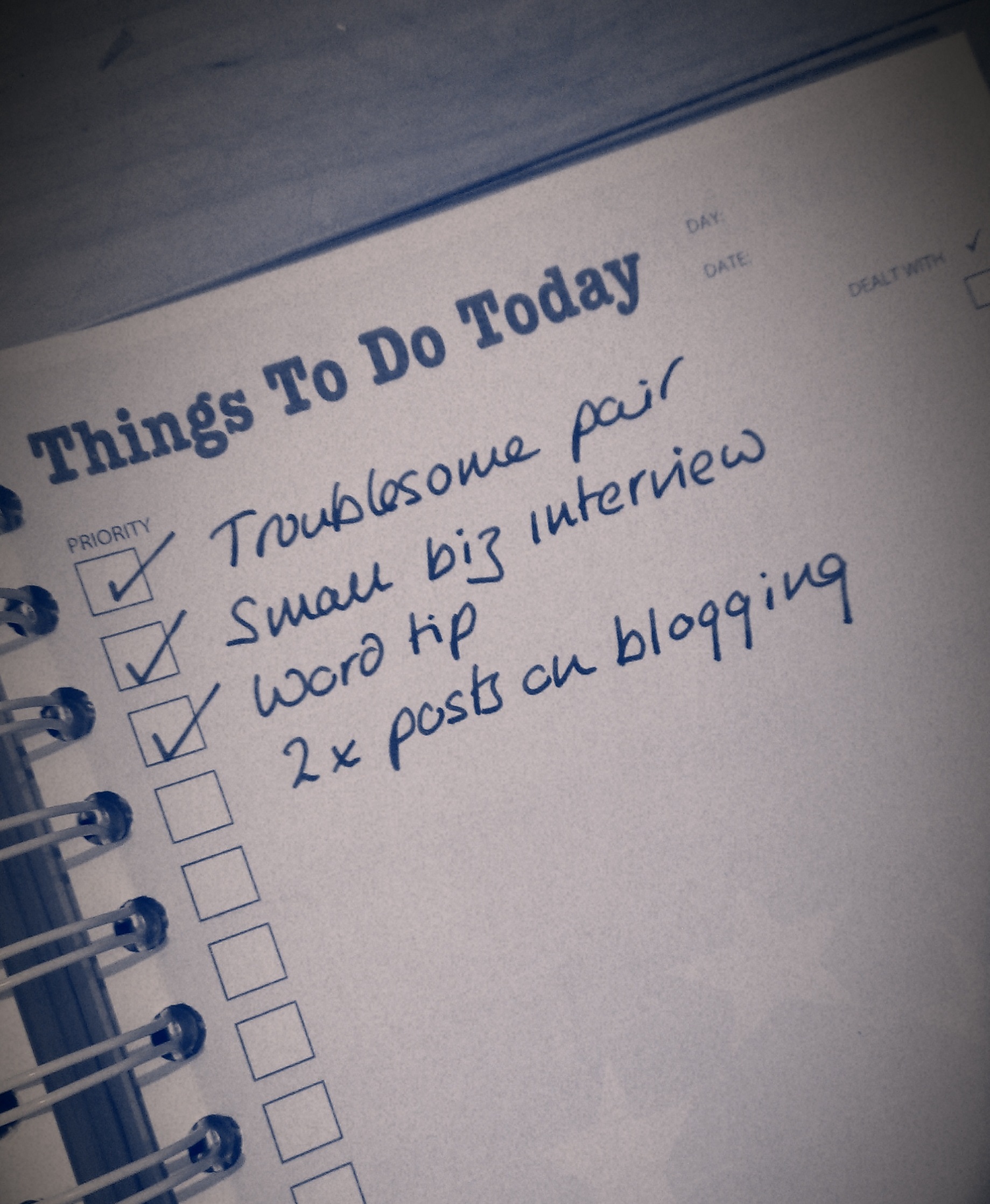
Things to doAs part of my series on blogging, in this article I’m going to talk about how frequently to blog, keeping going, and how to get down to writing those posts. This is primarily aimed at people who are blogging for their business, but this advice applies to anyone who wants to build the audience for their blog and needs help getting down to writing posts and sticking to blogging.

So that’s everyone, right?

How often should I blog?

How often should you publish a blog post? Well, that’s up to you to a certain extent. But if you’re looking to appear high up in the search engine results and keep your readers happy, you should keep it regular.

Most advice that I’ve read suggests posting at least twice a week. This will keep your readers engaged, keep your content updated enough for the search engines to promote it up their lists, and get enough keywords and content out there to keep your statistics nice and busy.

Varying your blog posts

Even a book review blog could do with a bit of livening up every now and again. A good example is my friend Ali – she mainly posts long-format book reviews, but she also takes up general topics or talks about book-buying trips – which varies things for her readers and gives them something new every now and again.

I choose to vary things and give myself a structure by running series in different topics every week. I tend to publish a short Troublesome Pairs post about a pair of easily confused words or at present an article on blogging on a Monday, a Word tip or business post on a Wednesday, and I always run a Saturday Business Chat or Chat Update each Saturday. I don’t stick to this slavishly – this post is coming out on a Tuesday to avoid the bank holiday, but it helps me to structure things and means that there’s something for everyone every week (I hope).

You don’t have to just publish text pieces, either. I’m sticking to text for the moment, but you can include video and audio pieces as well.

This article by Joanna Penn of The Creative Penn has really good advice about when she schedules her text, audio and video content. Her blog is really popular, with loads of comments and great search engine optimisation, and if you’re planning on using different media, this would be a good plan to follow.

Including guest posts on your blog

I’ve talked about this a bit already in my article on Reciprocity in Social Media, but hosting guest posts (and having them on other people’s blogs, too) is a great way to spark up interest in your readers and get reciprocal links and readers. I’m going to write more about the etiquette of guest blogging soon. But again, it varies things a bit. I wouldn’t personally have a guest post more than once every couple of weeks.

How do I remember my ideas for blog posts?

If you’re anything like me, you’ll have ideas and inspirations for blog posts at the oddest moments. If I’m anywhere near my desk and PC, I pop into my WordPress platform and create a Draft blog post, sometimes with just a title, sometimes with a few jotted notes. If I’m learning something new (like turning footnotes into endnotes, just today), I’ll take screenshots as I go along, and save them ready to insert into a post on the subject. If I spot a picture I want to take or have a document with a feature I want to use, I take a photo and email it to myself or save the document in the relative folder.

If I’m out and about, I use the note app on my phone to make a quite note of what I want to write about, or, if I’m feeling brave, I go into the WordPress app and create a draft from there!

How do I organise my images for my blog posts?

Because many of my blog posts are very screen shot based, and I always include some kind of image in my posts (looks good when sharing, attracts readers, etc.), I have a folder in my Windows Explorer called Blog posts. This has sub-folders for all of the blog posts I write, or plan on writing, so I can pop screen prints and pics into the appropriate folder and know they’ll be there for later. I have a set of generic pictures in the Blog posts folder, too, that I can use as images at the top of posts. I prefer to use my own images to avoid copyright issues.

How do I get down to writing my blog?

Here’s my secret: blogging SESSIONS.

You do not have to write your blog posts on the day you publish them! You can write them in advance, save them up, and publish in advance!

I’ve always got some draft posts on the go – either because I’ve had ideas (see above) and not yet written them up, or I’m part way through a series and I’ve planned the whole thing out. So when I can see at least a 90 minute slot in my schedule, I’ll schedule in time to write blog posts.

I’ll then bash through as many as I can, using my draft posts for inspiration and possibly already having pictures ready to go, either saved or inserted into the posts. Then I just need to write the text. In a good session I can get at least a week’s worth of posts ready in one go.

I’m used to having to write because that’s some of what I do in my job. If you have to wait for inspiration to strike before you write posts … just make sure that inspiration has plenty of room to keep going! Anyway, it’s surprising what you can produce when you sit down and tell yourself that you have 90 minutes to generate a load of blog posts!

Scheduling publication of blog posts

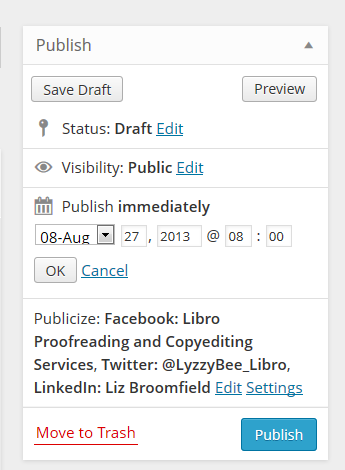
schedulingI would imagine that all blogging platforms have a scheduling feature. Here in WordPress, I can edit the Publish Immediately field to the right of my writing pane, and choose a date and time to publish the post (I also automatically post a link to Twitter, Facebook and LinkedIn. This means I can schedule a post to publish when I’m going to be away from my desk and the post will still be publicised).

If you don’t know how to schedule blog posts on the platform you’re using, Google your platform name plus something like “schedule blog posts” and you should be able to find instructions.

So, when I do a big writing session, I write the posts I want to write, then schedule them all in for the appropriate days. I can view just the posts I’ve scheduled to make sure there aren’t any clashes, then I can get on with work or even go on holiday, knowing that my blog will be publishing when I’m away.

How do I make myself keep on blogging?

If you get stuck and don’t post for a while, or don’t feel like posting, don’t panic! Here are some things you can consider doing:

  • Have a think about why you’re blogging and whether you do actually want to continue (try reading my article on 10 reasons not to blog or the one on 10 reasons to write a blog!)
  • Have a little brainstorm and think of some ideas for blog posts – just jot them down and write them up later
  • Get into a writing routine that suits you – whether that’s posting once a day or having a weekly blogging afternoon
  • Sign up for one of the various schemes that suggests something to post, or ask your friends or readers to make suggestions about what to write about
  • Consider creating some themes – it’s easier to come up with an idea for a Word tips post than an idea for “a post”
  • Don’t beat yourself up. Look at other people’s posts for inspiration. Ask for some guest bloggers. Review something you use in your work life. Write about something personal

————–

This article has talked about how often to blog, how to organise your blogging, how to schedule posts and what to do if you get stuck. I’d love to hear your thoughts on these topics – do post a comment, and if you’ve enjoyed this post, please share it using the buttons below.

Related posts:

10 reasons to start a blog – why you should do it now!

10 reasons NOT to write a blog – and why you should stop and think, at least!

Reciprocity and Social Media – how to negotiate social media kindly and politely

Top 10 blogging sins – avoid these if you can!

 
20 Comments

Posted by on August 27, 2013 in Blogging, Business, PowerPoint, Social media, Writing


Tags: , , , , ,

Top 10 blogging sins

pens and ink bottleI’ve been talking about why and why not to blog recently. Once you’ve committed to your blog, it can be a bit of a minefield. Here are the top ten blogging sins that I see over and over again, or hear other people complaining about. No one can be expected to know everything straight away, and we’ve probably all made at least one of these mistakes, so hopefully I’ll help you to avoid the big, bad ones with this list.

1. Not having an RSS feed

File:Feed-icon.svg RSS is a way to allow blog reader software to collect your content whenever it’s  updated and send it on to any of their readers who subscribe to your blog This Wikipedia article explains it all and examples of RSS readers include Feedly.

If you look at the top of this blog page, you will see that I have an RSS feed logo in the top right-hand corner, and a link in the right-hand menu bar, and I also offer a link to subscribe by email. All blogging software will have something in their settings that allows you to add this. If you don’t add this link, it makes it that bit harder for people who want to subscribe to your blog to do so (they can usually put the URL in their reader software, but are they going to do that extra process? Not always). Not having a button to use to do it quickly and easily can give the impression that you’re not interested in people reading your blog. That’s probably not true. But I’ve seen people get really cross about this and say that they’re not going to look at a person’s blog any more if they don’t have this. I know … but if one person’s saying it, how many are thinking it?

If you get stuck trying to add this button to your blog, the easiest way to find out how, is to Google your blogging software’s name and “RSS feed button”. You should find a YouTube video or set of instructions telling you how to do it.

2. Not updating your blog

If you set up a blog and you then don’t update it, it won’t help you to get more readers or to promote whatever it is you’re promoting. Google and the other search engines thrive on updated, fresh content. If you don’t update your blog regularly, it will fall further and further down the search rankings and no one will be able to find it. If you want to write a blog, commit to updating it regularly.

I’ll be publishing a post about scheduling and keeping active with your blog posts soon, so watch this space!

3. Stealing content from other people

It’s fine to “reblog” other people’s blog posts onto your own blog (where a snippet of the post appears on your page, with a link to the real thing). It’s fine to link to other people’s blog posts and tell other people about them. It’s even fine to be inspired by another person’s blog or content – one of my friends has started a questionnaire series a little like my Small Business Chat one but with an emphasis on marketing techniques: similar idea, different content, that’s fine.

It’s not fine to lift content wholesale from another person’s blog or website. If you quote large amounts of text written by someone else, it’s just the same as if you were using that in an article or essay – you need to reference where it came from and acknowledge the author. It’s fine to talk about newspaper articles or reports in your blog and react to them, not fine to quote them verbatim, or quote people they have quoted, and not give the original source.

Never be tempted to take someone else’s content for your blog post. At best, you won’t get picked up by the search engines anyway (see below). At worst, you’ll find yourself slapped with a lawsuit for plagiarism! And it’s just not right.

4. Reusing content in exactly the same form

Say you’ve had a guest post on someone else’s blog and you’re really pleased with how it’s turned out – so much so that you want to share it. So you post it in its entirety on your blog, too. Not a good idea.

All of the search engines, like Google, like to offer their users varied content. So if the same content appears in two places, both places won’t come up in search results. Effectively, one of them will be invisible to search engines, therefore invisible to people searching for keywords that might lead them to that content.

To look at it from a different viewpoint, if you’ve published information in a guest post, the owner of the blog you’re guesting on will want to be posting up original content, not things that can be found elsewhere. Some people actually specify that the content must be original in their guidelines for guest posters. See more about this in a week or so when I blog about guest posts.

How do you deal with this? Publish a snippet of the post on your blog, with a link to that post. Put some of your own text around it, then the search engines will find your post and your guest post, both of you will get found and viewed, and no one’s copied anything. There are clever ways to deal with all of this in the coding behind your blog, but I’m guessing that most of us aren’t the kind to deal with that level of complication – I’m certainly not!

5. Being rude or negative

I feel like a  bit of a hypocrite writing this, because obviously this post is a little bit negative. But I’m also genuinely trying to help people to avoid making common mistakes! In the same way, I tried to make sure that my 10 reasons not to write a blog article talked about reasons for reviewing your blogging and content and making a positive decision. Whining and moaning and relentless negativity won’t make your readers like you any more than they would like you in real life.

Being rude can get you views in the short term. But it’s like those restaurants that people go to only because the waiters are desperately unfriendly. Fine for a laugh: but will they go back regularly for birthdays and anniversaries? Probably not. Even ranty blogs about politics or issues have to be constructive as well as rude!

If you want to have a rant or talk about a mistake you’ve made, try to vary and space out these posts, and make them as constructive as you can. We can all get a good blog post out of a bad experience, but make sure that you and your readers come away having learned something. I’m going to post soon about managing your social media brand, and this comes very strongly into that, too.

6. Posting inappropriate content

I don’t just mean lurid or dirty pictures here. If you want to share information about your management courses, then blogging about your exercise classes won’t get you the audience you want to buy your courses, unless you’re doing some very clever keyword placement and making the articles valuable to both groups of readers.

I have to admit to having a laugh at funny spelling mistakes as much as the next person. However, I’m careful not to mock or talk about or post pictures on this blog, because a lot of the people I work with as an editor are unsure about their English and using it as a second, third, fourth language … and would be mortified if they thought people were laughing at them (I don’t laugh at their English: I know I couldn’t do half as well as my overseas clients if I was writing in my second language. Bong joor toot le world).

7. Not giving your guest posters what they need

If someone takes the time to write a guest blog post for you to to give you more, fresh content, bring their fans over to your website, give you a marketing opportunity, etc., etc., then you need to do certain things to make the experience a good one on all sides. Chief among these, and something I see people having issues with all the time, is making sure that you provide live links back to their website and whatever it is they’re promoting, be it another website, their book on Amazon, or whatever. A live link is one that your readers can click on and be taken to their page, like this one which takes you to a post I wrote telling you how to add links to your blog posts!

Formatting guest posts that have come through in an email or an attachment can be tricky, full stop. I recommend pasting the text into a Notepad file on your computer, then pasting it from there into your blog post. Lots more on this in an upcoming article. But please make your guest blogger’s links live so that your readers can visit them online!

8. Not letting people respond to your posts

I like responding to blog posts. We all like responding to blog posts. We like to feel it’s a two-way conversation when we read something online, don’t we. But I still come across blogs every day that either don’t allow any comments at all, or make the commenting process so complex that people give up.

I have to say that the blogging software can be a culprit here. I can never seem to reply to Blogger posts, and WordPress itself can give the impression that you have to sign up to a WordPress account in order to comment on one of its blogs (you really don’t, you just need to add your name and email address).

Enable comments, even if you moderate and check all of them for spam (most blogging platforms allow you to set the level of moderation, for example, I hand-moderate the first post by anyone, and am alerted to all new comments, so I can check they’re not spammy or inappropriate). And listen to your readers – if you’re getting complaints about how hard it is to reply to a post, have a look at your settings and see if you can make it easier. One of my blogging friends has a note whenever you go to comment with an email address to use if the process won’t work – very helpful!

9. Not responding to comments

Allied to the above, if people take the time to reply to your blog, it’s only polite to take a moment to respond to them. Some people who get a lot of comments will do a general reply mentioning all of the previous commenters with a sentence addressed to them, and that’s of course fine. But I get a bit frustrated if I comment thoughtfully on a blog post and the author never responds. You don’t have to do it immediately, but I try to do it within 24 hours, a couple of days at most.

Conversations on your blog can be one of the most interesting things about blogging – so get out there and engage with your readers!

10. Only advertising, never helping

Yes, I and other people have told you again and again that having a blog will help your business. That’s true. But just blaring out adverts to your readers won’t make them keep coming back. Imagine two blogs, both about plumbing:

  • One lists the different areas of plumbing the plumber can do, and has carefully inserted keywords to attract the search engines
  • One talks about the jobs the plumber has done this week, including how she solved a particularly tricky question. She sometimes posts a question and answer about a common type of issue, like changing the washer on a tap

Which blog will you go to once, to find a plumber? Which one will you bookmark and read, share and tell other people about? Which one will actually bring the plumber more business in the long term?

I give away quite a lot of free advice on my blog, but just because I tell people how to set up a table of contents doesn’t mean that none of my clients ever ask me to do that now. On the contrary, seeing my expert advice, they trust that I can sort it out for them!

———–

That’s my personal top 10 list of blogging sins. Would you add any to that? Are any of those NOT sins in your book? I’d love to know what you think, and whether you’re enjoying this new series of articles all about blogging!

Related posts:

Top 10 reasons to write a blog

Top 10 reasons not to write a blog

Scheduling blog posts and keeping going
You can find a growing set of articles on blogging and social media in the resource guide. Do click on the share buttons below or comment if you found this article interesting or useful!

 
35 Comments

Posted by on August 19, 2013 in Blogging, Business, New skills, Writing


Tags: , , , , , , ,

10 reasons not to write a blog

pens and ink bottleWe’ve already looked at reasons to write a blog. But what are the reasons for not writing a blog, or for taking an informed decision to stop writing one, even if you started?

Note that this, like the last post, is mainly targeted at business bloggers. However, if you have a blog that you want to gain an audience and maybe earn some money from in whatever way, these points will interest you, too.

So, what are the reasons NOT to write a blog, or to give up?

1. You are only doing it because someone told you that you should

I go on about blogging to people ALL THE TIME. I even did it when I was buying vegan food from a stall in Greenwich at the weekend. But don’t just do it because someone tells you to. OK, it’s worth looking at the reasons why having a blog is good (see my previous post) and making an informed decision, but if someone just tells you, “start writing a blog” and you do, it’s not so likely that the habit will stick and it will be useful and fun.

2. You actually dislike doing it

So, you’ve started blogging and you’ve got into a routine, and then you realise that you’re just dreading writing that next post. I’m going to talk in another post about slumps and maintaining momentum (if I forget to link to it here, look in the index). But what I’m talking about here is hating it all the time, disliking putting fingers to keyboard and putting the thing together, resenting the time it takes up. If you don’t enjoy doing it

  • get someone else in your organisation to do it
  • pay someone else to do it
  • stop doing it entirely

3. You haven’t got time to post regularly

Although if you have a personal blog and you’re not worried about statistics and search engines, you can get away with blogging very irregularly, if you are doing it so as to appear in search results and get more exposure for your business, you really do need to post regularly. I find that, for me, three posts a week are the sweet spot. When I publish three posts a week, I get the most visits to the blog. It’s worth noting that not all of those are long posts (my Troublesome Pairs certainly are not), but it’s regularly updated content, full of relevant keywords and useful to different groups of readers.

Once a week is, I think, the minimum you can get away with and still gain value from the process. If you don’t have the time to do this, again, consider outsourcing, or consider not doing it at all.

4. You’re not organised to post regularly

Following on from the time issue, you do need to be organised enough to generate new content fairly regularly. Again, I’m going to talk about this in detail in another article, but you do need to be able to plan what you’re going to talk about, gather photographs and illustrations for the posts, and organise yourself to sit down and write them, and then publicise the posts and deal with any comments that might ensue. If you fly by the seat of your pants and do everything as and when, and find organisation in general to be a tricky thing, blogging for business might not be for you.

5. You’re only in it to make money

You do read loads of posts about making money from your blog. And you can make money from your blog, for example by …

  • Allowing adverts to appear on your blog (but be very careful with this and make sure you only allow adverts relevant to your readers or this will be a big turn-off. The best way to do this is through carefully selected product placement that matches with your content and readership)
  • Hosting affiliate links on your blog so that readers can click a button or picture on your blog to be taken through to buy a product, while you get a percentage of all sales (this is notoriously difficult to make money from)
  • Selling your blog to a publisher to make into a book (but not many people make money writing and selling books, and there’s more to a blog-to-book than just bunging all your blog posts in one place – I have direct experience of this)

It’s not common to make money directly from your blog. It’s hard to say how many page views you need per month to do well out of advertising, but recommendations start at 10,000 unique visitors per month. Not many publishers convert blogs into books outside the big ones we’ve all heard about. What my blog does is let people know about me who then become customers … but that’s using your blog to build your business, not to make money per se. If you’ve read an article or been to a seminar about easy ways to make money online, be VERY careful what you sign up for and get into.

6. You are not interested in engaging with your readers

People who read blogs like to comment on them. People who comment on blogs like to see the blogger reply to these comments. I know that personally I’ve stopped reading and commenting on blogs when I’m never responded to, especially if I can see that the blogger never responds to any comments. This is actually one of my Top 10 Blogging Sins, too.

If you’re not actually interested in having a conversation, in engaging with your readers, in replying to their comments, and you just find it a chore; if you just want to broadcast and don’t want to engage in two-way conversation, I don’t personally think that blogging is for you. You will lose readers as fast as you gain them, and it will never be personally or professionally fulfilling for you.

7. You are not interested in engaging with other bloggers

This is similar to point 6, but we’re talking here about other people in the same line of business as you (whether that business be small business support, engineering or book reviewing). If you see other people blogging on a similar topic to you as rivals, and you want to keep apart from the, set yourself apart and distance yourself, then you may not find blogging to be useful. You probably can’t “beat” the most successful blogger in your industry, and if you don’t want to engage with them, share guest blog spots, link to their material and comment on each other’s blogs, then it might be wise to disengage with the process.

8. You haven’t got anything interesting to say

If you’re boring yourself with your blog content, you will probably be boring your readers. If you’re constantly scratching around for topics to write about, or covering the same ground time and again, consider scrapping that series, if you have various topics you cover on your blog, or the whole thing. I used to post up an update about what I’d been doing in the previous month at the beginning of each month. Although some readers said they enjoyed it, it was becoming very repetitive and boring to write. So I stopped doing it and added something else in that slot on the blog.

Note: what you think isn’t interesting might be to other people – it’s always worth doing some market research. When I meet people like locksmiths, carpenters and electricians, I always tell them they should write a blog about their daily lives and the jobs they do (keeping their clients’ confidentiality, of course) as many of us would find that sort of thing really interesting. I’m talking about when you’re struggling for ideas and you’re maybe not getting any positive feedback or a growing readership, and your blog becomes bogged down and repetitive. Have a rethink or ditch the blog!

9. Your blog isn’t relevant to your target market

If you’re blogging for business, your blog posts need to be relevant to your target market(s). For example, I blog about …

  • Word tips and hints – because most of my clients and target market use Word
  • Language tips and hints – because my business lies in improving written language
  • Business tips and hints – because I’ve written a book about business and I am passionate about engaging with other businesses
  • Blogging tips and hints – because I get asked about this a lot and because of the business reason above and because I noticed that I get searches coming through to my blog on that topic already, so people want to know about it

If you sell garages but blog about hairstyles, the people who read your blog are not likely to have a huge overlap with the people who are going to buy your services. If you have a book review blog and want to engage with mystery authors but only review romance, that’s not going to engage your audience. There needs to be a big overlap between what you talk about on your blog and the people you want to attract to read it. Even “the general public” has niches – people who like to read about fashion, or the work of an ambulance driver, or about low cholesterol eating.

10. Nobody is reading your blog, even after 6, 12, 18 months

It takes time to build a blog and its audience. Both of mine have grown over the months, pretty gradually. My book review blog wasn’t growing its audience much for a while, and I did wonder whether to cancel it. I actually published a post asking if people found it interesting to see whether anyone was reading it! What I found out was that many people were reading it on blog aggregators, which don’t show up on my statistics. So it was worth doing, but I also took steps to add value, beefing up my reviews, adding some more web pages to the blog, and importing a whole wodge of old reviews from another blogging service I used to use. My traffic improved and the blog was saved. But if you do that, and you change things and no one’s looking, maybe it’s time to consider other ways to market and raise awareness.

———–

These are not necessarily ten reasons to stop blogging altogether. They certainly are reasons to stop, look at what you’re doing, reconsider things and maybe tweak your posts, style, content or other aspects.

Have you stopped writing a blog? Why?

Relevant posts:

10 Reasons to Write a Blog

Reciprocity and social media

Top 10 blogging sins

Scheduling blog posts and keeping going

Coming soon …

WordPress blogging 101


19 Comments

Posted by on August 12, 2013 in Blogging, Business, Writing


Tags: , , , , , ,

10 reasons to write a blog

pens and ink bottleWhy should you write a blog? Why should you start writing a blog, and why should you continue writing a blog? Here are my top reasons why. I’m really looking at business blogging here, but the first one applies to everyone!

1. Because you want to

This reason covers both personal bloggers and business bloggers. You should start writing, and continue writing, a blog, because you want to. Forcing yourself to do something you don’t want to do is no fun, and you should enjoy the time you spend designing and honing your blog and writing those entries. Whether you want to share holiday pictures or reviews of restaurants or share your professional expertise, do it because you want to.

2. You’ve got something interesting to talk about

There are so many interesting things to talk about. I often meet people running businesses where I have no idea of the nitty gritty of their everyday lives. How does a carpenter learn his trade? What does a freelance solicitor do, day to day? How many projects does a crafter have on the go at any one time, and how does a mobile hairdresser help their clients to choose a new hairstyle?

I have found that my posts on building my business struck a chord and interested many people. A series of posts that I started really for myself about Word hints and tips has turned into a popular series. If you run a business, think about some of the behind the scenes things, some of the aspects of your knowledge that people might be interested to know about (don’t worry about giving away your secrets – I might publish articles on Word headings and tables of contents, but I still get asked to do them by my clients!).

Of course, it goes without saying that you shouldn’t share personal details about your clients. But I think it’s fine to talk about them if they’re heavily disguised – or ask if they’d like to have a case study published with links back to their website!

3. It will set you up as an expert in your field

This is invaluable when you’re building your reputation and your business. Don’t see it as giving away information for free, think of it as sharing your expertise with the world. Once you start appearing in people’s Google searches when they’re trying to resolve a problem, they’ll be more likely to come to you for help when they need your services. If you can offer a back catalogue of useful, targeted advice on your blog when you’re negotiating with a new prospect, they will see that you can walk the walk as well as talk the talk.

This may not lead to direct sales – but I’ve often seen my blog posts shared among other people and organisations in my field. Keep your name in front of them as well as prospects, and you never know where the next recommendation and job might come from!

4. It will attract people to your site

This links in to the above point. The more content you have on your website which is packed full of keywords and language to do with your business, the more findable it is in the search engines. The more people find information that is useful to them and engages with them, the more time they will spend on your website. The more time people spend on your website, or the more repeat visits they make, or the fact that they’ve signed up for your RSS feed and get regular updates into the RSS* reader or email inbox, the more likely they are to remember your name and your products or services when they or a contact need them.

More website visitors does not directly lead to more sales in a quantifiable relationship. But as long as you do show genuine expertise and a willingness to engage with your audience, you will build your exposure, get more visitors to your site, and this will help you to become better known and gain more sales.

5. It will build your platform

Your platform is the group of people who are engaged with you in whatever way – through personal connections, social media such as Twitter, Facebook and LinkedIn, through your email newsletter, through your blog – and who can then be “leveraged” (horrible word) when you want to get the word out about something new that you’re offering.

For example, if you’re self-publishing a book, it’s vital to have built a circle of connections before it comes out, so you have a guaranteed audience of at least a few people. If you start offering a new service, for example when I added transcription services to my proofreading and editing offering, it’s useful to have people who you can tell, and who will then hopefully spread the word.

Having a blog builds your platform because it engages people’s interest. It brings them to your website, it gets them reading your content regularly, and it encourages them to sign up for your RSS feed or to receive your posts by email as they’re published. Once you have subscribers, you can get information out to that guaranteed audience when you need to. That’s much harder if you only have a static website for them to visit.

6. Regularly updated content will boost your position in search engine search results

It’s fairly common knowledge that the search engines (Google, Yahoo, etc.) like content that is regularly updated. This means that their complex and little-known (and ever-changing) algorithms will promote websites that are frequently updated above those that are static. Updating your blog once a week or more gives all of the content on your website a better change of being found by potential contacts and clients, because it gives it a better chance of appearing in a higher position in the search results.

7. So will information crammed full of the keywords that are important in your industry

Keywords are vital for search engines, too. If you just write a set of keywords over and over again, the chances are the the search engines will pick up that it’s not real content, and will not show it to searchers. But if you are writing well-crafted copy which includes a good sprinkling of keywords among the text, you will find yourself doing better in the search engine results.

I write natural text in my blog posts that is (hopefully) interesting and gives something to the reader – but I am also careful to include relevant keywords at a regular rate in the blog posts I write, which does improve my search engine optimisation no end (it’s also good to get them into sub-headings and the blog title itself). SEO is a fairly dark art, but the more keywords you can sensibly insert into your content, the more the search engines will be happy to find and display your content to their users.

8. You want to engage with your readers / prospects / clients

Blogs are not a one-way conversation. Once your audience has built a bit, you will get comments, shares, etc. on your blog posts, and on the places where you promote them (I will get almost as many comments on my Facebook post advertising a new blog post as I will on the post itself).

One of the golden rules of blogging is that you need to respond to your comments. Some bloggers are very good at this, some are not. I’m sure everyone’s commented excitedly on a blog post, only to find their comment is effectively “ignored”, with no reply from the writer. I think that’s quite rude, and I am likely to engage a lot less – or stop engaging – with bloggers who have a habit of not replying. Obviously, we all get times when we’re away or too busy to reply that moment, but most blogging platforms alert users to replies, and you want to keep that feature switched on and engage with your audience, otherwise they will stop coming back.

And those commenters might just be your friend Ali or your ex-colleague Steph, but every person who engages with your blog is a potential client or recommender.

9. You want to engage with other bloggers

There’s nothing like blogging for building communities of like-minded people. Once you’re blogging in a niche area, whether it be fiction writing, editing, ironing services or Sage, people who are interested in the same sorts of areas will start to follow your blog, comment on your posts and share what you’re saying.

This is useful for a couple of reasons: firstly, it’s always good to have colleagues. I’ve written elsewhere about how I treat other people in the same line of business as me as colleagues rather than competitors. It’s always good to have people to recommend prospects on too if you’re fully booked and can’t take them on, and to have people to send you referrals. Sometimes you need to have a moan or a chat or ask advice, and you might want to do this privately rather than publicly, which is where your network of colleagues can come in very handy. You can also read what they’re saying, get new ideas, keep up to date, and slot into networks that offer mutually useful posts, services and applications.

Secondly, this may give you the opportunity to guest post on other people’s blogs, and vice versa. We’ll talk about sharing your content in other places next. But just to give you some examples, if I hadn’t started blogging, I wouldn’t have got to know many of the editors I now know who link to my blog articles, share them on social media, and act as a sounding-board when I need to talk things through. That’s worth every hour of effort I put into my blog, to be honest!

10. You want to share your content in other places on the web

The good thing about your URLs and name appearing in places on the web that are not connected directly with you, your website and social media is, you guessed it: it boosts your position in search engine results. The more times your URL appears on a website that’s on a solid standing itself and has followers and people talking about it, the more the search engines will consider your website to be appropriate to present in their search results listings.

These links to your content on other people’s pages are called backlinks. You can secure these in a number of ways:

  • Comment on someone else’s blog post, including your URL
  • Contribute when someone asks for examples, experiences or feedback, again making sure that your URL is included
  • Write a guest blog post for someone – ensuring that the biography at the end includes all of your links

Now, you’ll know if you’ve ever allowed comments on a website or blog that a lot of companies do this seemingly randomly, just to get their URL into other people’s comments, and now you know why they do it. So do make sure that the content and comments you share are appropriate to the topic of the post on which you’re commenting! But this is a great way to increase traffic to your website and blog.

So, there are 10 top reasons for writing a blog. Do you have any others? Why did you start yours? Do also read … 10 top reasons NOT to write a blog!

File:Feed-icon.svg *What’s this RSS stuff I keep talking about? RSS feeds are file formats that allow your regularly updated content to be collected and sent on to readers, usually involving them reading all of the blogs etc that interest them using an RSS reader that accumulates them all in one place. This Wikipedia article explains it all and examples of RSS readers include Feedly. RSS feeds can be found on blogs around the symbol at the beginning of this explanation.

Related topics:

10 top reasons NOT to write a blog

Reciprocity and social media

Top 10 blogging sins

Scheduling blog posts and keeping going

 
39 Comments

Posted by on August 9, 2013 in Blogging, Business, New skills, Writing


Tags: , , , , , , ,

What is worth it for me?

dictionary coins watchIn Part 1 of this article I talked about how to tell if a product, service or outsourcing is worth it for your business. In Part 2, we looked at Return on Investment, and how both the investment and the return can take the form of money, time or effort spent or saved. This time, I’m going to share some examples of what investments have worked for me – and for some other people, too.

Investing in hardware and software

In terms of hardware, I’ve mainly spent money on these three:

  • New PC – definitely worth it in terms of speed and reliability. My current one doesn’t fall over if I try to look at a whole PhD thesis in one go.
  • New laptop – definitely NOT worth it. I could see myself working in cafes with a coffee … but of course the kind of work I do doesn’t do well in a noisy environment. And I can’t transcribe on a laptop keyboard and find a trackpad tricky for editing. In addition, I spent extra getting a giant laptop with a separate numeric keypad … which means it’s massive and heavy and hard to lug around.
  • External hard drive – definitely worth it. I spent under £100 and it automatically backs up all of my files every day.

My editor colleague, Laura Ripper, wishes she’d thought more about her printer:

What I wish I had spent more money on, in hindsight, is a printer that will take several sheets at a time for photocopying. I hate standing over it feeding in one sheet at a time!

I’m glad that we invested in a printer/scanner/copier as the most printing I do nowadays is contracts and other forms, which I invariably have to sign, scan and return to the client.

In terms of software, it boils down to:

  • Microsoft Office 2007 then 2010 – must-have items although I haven’t picked up Office 2013 yet as I don’t think any of my clients are using it yet and I need to put aside time to learn it. However, my clients use all sorts of ancient versions of Word, so I keep both 2007 and 2010 open on my machine and tend to use 2007 unless I have to move to 2010.
  • Transcription management software – I have the paid version of the software I use (full article on this here) as it saves me time so makes me more money, being able to manipulate tapes using the function keys.
  • Invoicing and time management software – I did download a free time tracker but got so obsessed with my percentage of productive time that I became less productive. I have a simple invoice template and use that at the moment.
  • Financial management software – I will be using my new Accountant’s online system to record my bank reconciliation information – watch this space for whether this is useful!

Investing in other office equipment and reference materials

I am lucky in that my partner invested in a very expensive, posh office chair when he ran his own business. I’ve inherited that up in my office, and it’s very comfortable, adjustable and cool in the summer. If you use a laptop a great deal, here’s a nifty tip from Laura:

My laptop stand from IKEA has meant I can actually sit at my desk all day if necessary without feeling like my wrists, neck or fingers are going to drop off. It was less than a fiver (£3.50) and was definitely worth the money!

I’m very glad that I’ve invested in my reference books. I have a range of them: I update the basic ones that I started off with whenever there’s a new edition, and I’ve also bought more on Plain English and international Englishes as I’ve gone along. I like using paper copies, having them there in front of me, and they save me from getting things wrong!

Investing in memberships and training

I’m going to present two different points of view on industry-related memberships here. Please bear in mind that these are about different people at different stages in their career. It might make you think, though, or feel better about not having industry memberships.

I’m an established editor who also works in lots of other different fields, has clients around the world who don’t tend to be publishers, but translation agencies, translators, marketing companies and individual writers. I have decades of experience and lots of testimonials, and I’m busy enough that I am very choosy about taking on new clients. I also work predominantly on electronic documents.

This does not make me too arrogant to join industry based associations. I did try it, but I found that, while they’re excellent for new editors, and provide training courses and forums and advice, most of the training is around paper-based editing for publishers, something that I very, very rarely do. For me, personally, it’s not worth the effort, time and money to do qualifications in an area in which I don’t actually work in order to progress my membership. But this is a very personal decision. Read on for my colleague, Laura’s, take on things:

Laura Ripper told me how useful she finds her membership of the Society For Editors and Proofreaders:

It means I can attend my local SfEP group, so that’s one way of meeting other freelancers and sharing ideas and information. It also gives me access to online forums like the Marketplace where members can post jobs they’re too busy to do, and I’ve got a couple of jobs through that. You also get discounts on SfEP training if you’re an associate or member. At the moment I’m only an associate, which isn’t as good for marketing as I can’t appear in the public directory, but after doing more training I’ll upgrade. Oh and there’s also the reassurance aspect for clients. I don’t blog, so, especially before I got any testimonials, I felt that being able to use the SfEP logo (I checked this was OK) and say I am an associate would reassure potential clients that I’m professional in my work.

Other professional organisations do exist, in editing and in other professions, of course. But it’s always worth reviewing when you’ve paid for that first year, what you got out of it in terms of support, jobs or referrals.

One membership that has worked well for me is my local business association. I pay a minimal sum, have an advert in their directory, and get to go to breakfast get-togethers: just this week I met a carpenter, financial advisor and solar panel installer who I will be in touch with later!

With regard to training, if it’s tailored to what you need and focused on your business, it can bring a great return. I’m largely self-taught but I have an English degree including a lot of Lingistics behind me, plus jobs working on dictionary editing and in marketing. I discussed my choice NOT to take an indexing course in the first post in this series, and I keep up my professional knowledge by reading blogs and participating in forums.

Sarah Bartlett  has had this good experience:

I have come to value one-to-one training from trusted freelancers in their area of expertise with the training tailored to my needs. That’s the best money I’ve spent this year so far and I intend to do it again. It’s brilliant value for money.

Investing in marketing and advertising

This splits down into two sections in my book: marketing and advertising that you put money into, and marketing and advertising that you put time and effort into.

Paid-for advertising

The two main things in terms of advertising that have done it for me have been:

  • Very local and specific advertising – early on in my career, I advertised my student proofreading services in the University staff magazine. I ran the ad for a year at a cost of £120 and made that back many times over.
  • Thanks to my friend, Sian, I bought membership of a site called Proz, which is mainly for translators, because I work editing people’s translations and people also go there looking for localisers and transcribers. That costs around £50 a year, and for that, your details are put in front of prospective clients when they put forward a particular job. I have made this money back many, may times over; probably a hundred-fold each year. Definitely worth it.

I have joined some free listings sites and get a few enquiries from them, but not enough to justify paying for enhanced listings. Some listings companies charge a fortune; others, like the thebestof range in the UK can be useful if you have a very local client catchment area.

Marketing-wise, I tend to be a bit mean and use Vistaprint for business cards and postcards. While there is a general dislike of Vistaprint, I am careful to design my materials carefully and attractively and pay to not have “vistaprint.com” on the back. People have generally liked them, and I do too – but I don’t give out millions of cards, so it is worth going to a more specialised designer if you’re giving them out all of the time.

Julia Dickson from Patricks Pieces has a good point here:

I quite like my vistaprint cards but that’s probably because I use their plain template and import my images, that way I don’t have the same motif as everyone else.

If you need to call attention to yourself at craft fairs and around and about, here are some great investments people have made:

Sarah Goode from jewellery company, Pookledo says, “I’ve invested in good display units to make everything look coherent”. And Hev Bushnell from Hev’s Happy Hounds explains an interesting marketing concept:

My car. I covered it in pawprint vinyls and also paid to have lettering on the back. I also invested in car business card holders. Since doing the car, my business has boomed!

Also worth paying for:

  • Professional photographs. I was lucky and called in some social capital here (i.e. got a friend to do it – but he is a professional photographer)
  • Website – If you’re not an expert, it’s far better to have a website designed and written for you than to link to a woeful attempt full of 1990s design and typos

Marketing using your own efforts

I’ve invested time and effort, but not money (unless you count the money I could have made if I wasn’t doing this – however paid work comes first and these efforts fit around it) in the following:

  • Website(s) and blog – they maintain and grow my reputation, bring people to me, and allow me to share what I do as well as help people. They take a long time to put together but showcase my writing and I do enjoy doing it, too.
  • Guest blog posts – I’ve been placing these more recently, to help to promote my books. It’s a good way to get link backs to your own website/blog and to get your name known. I offer guest spots on my blogs, too, of course.
  • Commenting on other blogs – comments I’ve made on colleagues’ and other writers and business people’s blogs still send people over to my own sites even years later, and you never know what someone might be looking for
  • Social media – having a presence on Facebook and Twitter has definitely got me clients. All of my music journalist clients have come out of one response to a tweet from someone looking for a transcriber, taking me on and recommending me to her colleagues (thanks, Jude!)

Investing in networking

I looked at the big, nationwide networking groups, and they can be good for some people: personally, I find that it’s hard to explain what I do in 40 seconds round a breakfast table and I’m not able to bring in referrals for other people to every monthly meeting (to squish together what the two main big organisations do). I do however go to more informal networking groups, and I’ve made friends, got advice and support and made contacts that have led to jobs at the Social Media Cafe in Birmingham.

Looking at networking in a wider sense, I gain great support, laughs, help and a feeling of a set of peers from my editor colleagues on Facebook and in person and my business colleagues on Facebook and Twitter.

Investing in outsourcing

This is a work in progress. I’ve just taken on an Accountancy firm to do my bank reconciliation, provide me with certified accounts and prepare my tax return. I hope the financial cost will be outweighed by the peace of mind and time saved messing around balancing my books … I’ll let you know!

What works for you?

I’ve shared my personal experiences of what works for me, and those of a few people who responded to my call for input on Facebook and Twitter! Over to you – what has been the best thing you’ve invested in? Do share the area of business you’re in so other people who do something similar can learn something, too.

RELATED POSTS:

How do you know if it’s worth investing?

Working out your return on investment

Interested in finding out how I made the transition from part-time to full-time self-employment and built my business safely and carefully? Take a look at my new book, out now!

 
8 Comments

Posted by on May 30, 2013 in Business, New skills, Organisation


Working out Return on Investment

dictionary coins watchIn Part 1 of this article I talked about how you work out if an investment is worth making. Now I’m going to look at how you work out what the ROI (Return on Investment) is for something you’ve bought, and in the final post I share some examples from me and some other people about what’s worked for us – and what hasn’t.

What is Return on Investment?

Return on Investment (ROI) is what you get out of something as compared to what you put into it. A straightforward example is if you invest in some stocks and shares. If you put in £10,000 and get £1,000 back on top, that’s a good ROI. If you put in £10,000 and get back £8,000, not so good.

It’s not quite that simple if you’re looking at your own investments, though.

Time / money / effort

Investments and their returns can be subdivided into several categories, for example, time, money and effort.

Investment:

  • Time: You might invest your time in learning a new skill or trying out a new tool, or writing your web text yourself.
  • Money: Lots of products and services and memberships cost money to buy. Even if you’re bartering,  there is still a “cost” involved, even if you’re paying your proofreader in falafels!
  • Effort: I’m including emotional/psychological factors here. You might put a lot of yourself into going out networking if you’re shy and would rather stay at home. Chasing late invoices can be full of effort if you hate hassling people for money. Working part time and running your business part time can involve a huge emotional and psychological investment, as can building relationships with your clients.

Returns on Investment:

  • Time: Do you save your time by using a new product or by out-sourcing? Your time is also money, of course, but there is only so much time in the day, or week, or month, and you should really be concentrating on doing the core tasks that only you can do, whether that’s making your jewellery, editing novels or selling widgets.
  • Money: If you streamline your production line with a new machine so you can make and sell more items per day, or get your invoices paid on time and improve your cash flow, or you buy a tool that makes your hand-made cards look more professional, then whatever you’ve done has saved you money, or made you more money.
  • Effort: If you hate doing something and you can pay someone to do it for you, or you want to branch out into a new area of work that you find attractive and interesting but need to do a course to get into it, or, indeed, you’re tired of the day job and know that by working hard on your business you can move away from it and gain a more free and flexible lifestyle, then those all save you effort or bring you an emotional gain in the long term.

These factors can inter-relate, so you might get something like this:

  • I spend MONEY on an accountant and she saves me MONEY in terms of the tax I pay
  • I spend TIME setting up automated invoicing systems and save myself TIME every month when I run my invoices
  • I put EFFORT into networking and save EFFORT in getting new clients in other ways I don’t like to use, like cold-calling
  • I spend MONEY on an accountant and she saves me time working on my accounts
  • I spend TIME setting up automated invoicing systems and make more MONEY because I’m more efficient, and save EFFORT tracking down invoices and chasing up late payers

And of course, you can have negative or neutral returns on investment, too:

  • I spent MONEY on paying to advertise on this website, but I’ve never directly made any MONEY from it (referrals can be tricky to work out as people sometimes see your name a few times before they buy, but if you pay for membership or an ad you should be able to see some direct worth coming from it)
  • I invested lots of TIME writing my blog but no one looks at it so I can’t be making any MONEY from it and if no one reads it and I never get any comments so I don’t get any emotional (EFFORT)  output either
  • I made MONEY making these rip-off teddy bears but I feel awful that I went against my principles

You get the idea.

So, is it worth it?

An investment, whether it’s in a product, a service or something less tangible, is only worth it if you get more out of it than you put in.

This can be very subjective. If you hate doing your bank reconciliation, you might be happy spending more on an accountant to do it for you than your friend, who quite likes doing it. If you join a professional association but get no business, kudos, support or fun through it, then it’s not worth paying those fees next year – but that can be very different for your colleague at a different stage of her career, as we will see.

So, it’s a question of sitting down and looking at what you’ve bought, and working out whether the return on investment, in terms of money, time or less tangible factors is worth it. You can do this in advance, too, for example “I need a new computer, it will cost me money but save me time recovering from crashes and increase my income as I can do more work more efficiently”, but you MUST also do this in arrears, rather than spend-spend-spend and never tot up the benefits.

Next time I’ll be talking about the investments I (and some other people) have made, which have been worth it and which have not.

RELATED POSTS:

How do you know if it’s worth investing?

What is worth it for me?

Interested in finding out how I made the transition from part-time to full-time self-employment and built my business safely and carefully? Take a look at my new book, out now!

 
6 Comments

Posted by on May 23, 2013 in Business, New skills, Organisation


How do you know when it’s worth investing?

dictionary coins watchYou want to invest in something, but how do you know when it’s worth it? Is it worth laying out a sum up front, or is it always better to save up first? In this article I reflect on some purchases I’ve made which have been worth it (and some that haven’t), and discuss how you tell if they’re going to be in advance.

How do you tell whether an investment is worth it?

Investments for a small business can be broken down into

  • Outsourcing (paying other people to take on tasks you might do in-house)
  • Products, materials and services
  • Training

Is it worth outsourcing this task?

In a previous post, I talked about how to tell when it’s time to outsource a task to do with your business. My rules then were:

  • If you’re rubbish at doing something and I’m good at it, outsource it to me (even if you’ve got the time to do it yourself or it’s going to cost you more per hour)
  • If the time it will take you costs more in your worth per hour than it would cost to pay someone else to do it, then outsource it (e.g. transcribing your interview will take you 6 hours and you’re worth £40 an hour (£240) – better to send it to me who can do it for you for £60.

This links into a couple that are about time:

  • If it’s going to take you 6 hours to do but me 3 hours to do, then outsource it to me
  • If it’s going to take you 6 hours to do and me 6 hours to do, but you don’t have those 6 hours free, then outsource it to me

But you can add in some other factors, too, such as the boredom factor:

  • If you’re perfectly able to do the task and it would cost more to have someone else do it, but it bores you to tears and you never get round to doing it until it turns into an unholy mess, outsource it to me.

This last one is how I decided to hire an accountant to do my accounts and my bank reconciliation.

Is it worth buying this product or service or these materials?

That’s all about outsourcing. What about investing in products and services? These are my rules:

  1. If it will make my work more quick or more efficient – consider buying it
  2. If it will make my records more secure – consider buying it
  3. If it will advertise my services to my core market – consider buying it (for a year on a trial)
  4. If it costs under £100 – go for it

Points two and four combined to make me buy my external back-up drive and my professional version of my transcription management software.

Points three and four combined to make me sign up for membership to Proz (a jobs board service), which I’ve stayed with, and other sites and associations, which I have trialled and haven’t stayed with (see section on Return on Investment in the next article).

Of course the £100 level is an arbitrary level I selected. In fact, I didn’t select it consciously: I’ve just noticed that that’s the level I’m comfortable with.

Regarding materials, I don’t use materials in my editing business. But the golden rule here has to be:

  • Will the price of the item you’re making be higher than the cost of the materials? If not: find cheaper materials or adjust your prices within sensible limits

Is it worth buying this training course?

And a special consideration on training, as this is something I have been pondering and decided not to invest in:

  1. Is the training run by an accredited provider that is respected in my industry?
  2. Does it train me on something I will use in my everyday work life?
  3. Will it add a skill to my portfolio that I
    • know there is a market for
    • will enjoy doing
    • have got time to commit to fully once I’m trained up?

Point two helped me decide not to take the training provided by a well-known and respected association in order to gain qualifications with them, because they are all about editing on paper and I have done one job on paper in four years.

And the last bullet in point three is how I decided NOT to pursue training in the art of indexing. Yes, there’s a market for it; yes, I would enjoy doing it; but no, I have a full roster of valued clients at the moment. If I was to take on indexing work, something would have to give: either my evenings and weekends, which I have pretty well reclaimed from Libro, or one or more of my current customers. I wasn’t ready for either of those scenarios, so let it go.

Do I invest in advance or arrears?

This is a tricky one. I’m facing it at the moment with my book.

I really want to publish a print version of my e-book. I’ve got some quotes for producing the back and spine cover art and wording, and for producing it as print-on-demand and fulfilling it via the online bookshops. I would be able to buy copies for myself and sell them at events. I’d also have a physical book with my name on.

I was always adamant that the book needed to pay its way, i.e. I wouldn’t do new or paid-for initiatives until the book had actually brought in the money into my bank account to pay for it. Ignoring the hours I put into writing and promoting the book so far, I would need to sell approximately five times as many e-copies as I have already to pay for the setup, design and print-on-demand service (the fulfilment cost comes out of the profit on each copy).

I should make at least twice the profit on each print copy that I sell as I do on the e-books, if they sell.

Do I wait until I’ve made that money to go ahead? Do I wait until I’ve made half of it and then risk the other half, assuming it will take me half as many books sold in print to get the investment back? Do I do it now and hope I sell 2.5 times the books in print that I’ve sold in electronic form to pay myself back?

Before, I’ve always waited until I have the money put aside before I buy something – I didn’t invest in my new PC and laptop until my Libro business had been going for a couple of years and I had the money in the bank (were they worth it? Read next week’s article to find out!). But I’m eager to get those print copies out there … and I really don’t know what to do at the moment.

How do you choose how to invest / whether to invest?

How do you make your decisions? Have I missed something here? I’d love to know your thoughts – do post a comment! And … should I make a leap of faith and invest in print copies of my book? Help me to decide!

In the second part of this article, I talk about how to calculate your return on investment, and I’ll be going on to share what’s been worth it for me (and some other people) – and what hasn’t.

RELATED ARTICLES

Working out Return On Investment

What is worth it for me?

Interested in finding out how I made the transition from part-time to full-time self-employment and built my business safely and carefully? Take a look at my new book, out now!

 
8 Comments

Posted by on May 15, 2013 in Business, New skills


Tags: , ,

Working as a professional transcriber

In  previous posts I’ve talked about why it’s necessary for humans (rather than machines) to do transcription work and how to work out if this is a career for you. This article goes into more detail about the technology you can use to help you, and how to produce a professional transcription that will bring you repeat and recommended business.

Technology for transcription work

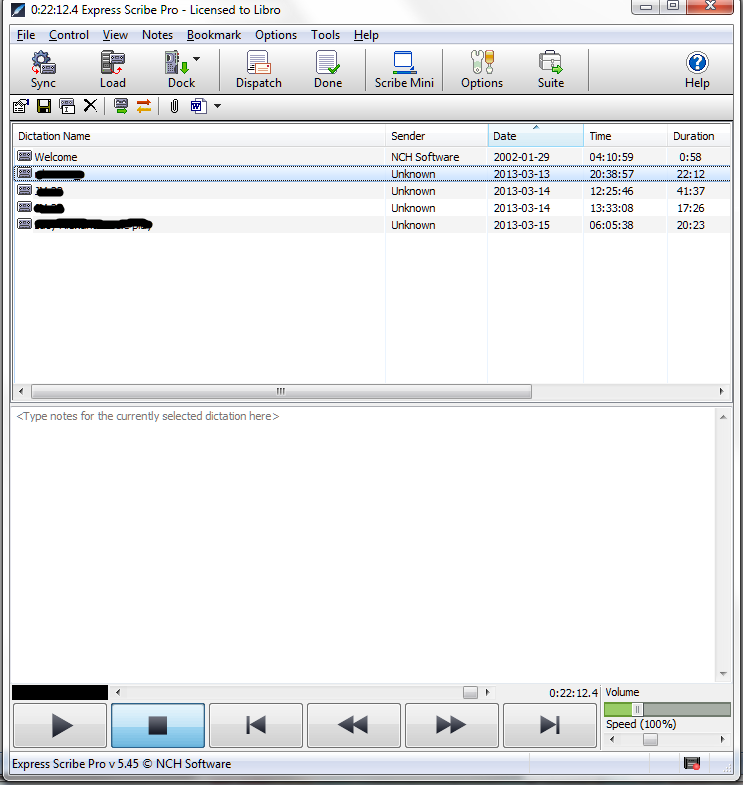
The first thing you need is a word-processing package, of course. I use Microsoft Word. Then you need some software to manage your recordings. I use NCH ExpressScribe. It’s also a good idea to sign up to (the free options of) services like Dropbox and YouSendIt, and to be aware of these services, as the audio files people will want to send you might well be very large – too large to send by email attachment.

Why do I need to use transcription software?

When I mention transcription software, some people think I sneakily use special software to do the actual transcription! Not at all! What ExpressScribe does is allow me to

a) manage my transcriptions – I load all the ones I have to do into the software and I can see how long they are and keep my place in them. As I complete them, I delete them from the software (they’ll still be in my files on my PC, though).

b) manage aspects of the tape like the loudness and speed of the tape (if people are talking really slowly, I can speed the tape up slightly and get through it more quickly)

c) start, stop, rewind and fast forward the tapes using the function keys on my keyboard (or any other keys I choose to assign – I messed around with this a bit and did move one function key that I kept hitting by accident, causing the tape to slow to 50% speed!). You can connect the software to a USB foot pedal if you need to save keyboard movements and use your feet to stop and start the tape.

NCH express scribe

How can Word help me to transcribe faster?

The way Word can really help  you is through the use of shortcuts or AutoCorrects. I have written two articles about these previously (what it is and how to find it and how to use it to speed up your typing).

Basically, you need to get good at:

  • Identifying commonly used words or phrases, especially
    • longer sets of words or phrases
    • words that you stumble over typing, however short
  • Assigning keyboard shortcuts to them that you can remember when you’re typing

In this way, you can type something like:

v imp to give envl pons to all ppl in the group to save the env.

and have Word turn that into:

Very important to give environmental responsibility to people in the group to save the environment.

I’ve saved almost 50% of the keystrokes needed to type that sentence there, which does build up over the course of 20 pages of transcription!

How can people send me big audio files to transcribe?

Your clients have four options for sending you their audio files. You’ll just be sending nice, neat Word documents back, but their files might be enormous!

  1. An ftp server – this looks scary but is used by some of the larger corporates I work with. They will place the audio files on their own server. You will log in and download the file onto your own computer, then either upload the transcription or email it to your contact.
  2. Zipping – this will work for small files but a huge .wav file will still be too large for this method. Your client should be able to right click on the file in their own Windows Explorer (or Mac equivalent) and choose “Send to zip file”. This will make the file small enough to send. You will need to unzip it at your end – download the file, right click in Windows Explorer and choose “Extract”.
  3. File sharing – a file and folder sharing service like Dropbox will allow your client to save their file in a special folder that can be shared with your email address. Dropbox acts like another folder on your system, and means that you can access the file and save it into your transcription software from the shared folder. You need to have Dropbox installed yourself before you do this but you can get a free version.
  4. Download services – there are millions of these around, but I usually recommend http://www.yousendit.com as I’ve found that easy to use and reliable. Here, the client uploads their file to the service, enters your email address and the service emails you a link from which to download the document. Watch out, as many of these have a time limit, so get it downloaded as soon as you know it’s there! I have an account with YouSendIt for sending large files, but most of these do not require you to have an account, and the client should be able to send up to a certain file size for free.

All of these options have advantages and disadvantages. Many of my clients know what to use, but some need advising, so it’s worth being aware of the options. For options 1 and 4, it’s worth waiting a little while from when the client tells you they’re uploading the file, as it can take a while to get up onto the server and back to you, so if you’re too eager to download, you might end up with half a file!

Producing a professional transcription

I have many regular transcription clients and they recommend me on to their friends and colleagues at a remarkable rate, too. I’ve asked them what differentiates me from other transcribers, and it comes down to this:

  • I check the client’s requirements up front
  • I produce an extremely accurate transcription
  • I produce a transcription with time stamps and other features to make it easy for the client to work with the text

of course, I’m super-reliable and always set appropriate expectations, but that’s part of being a good freelancer, not specific to transcription.

Establishing client requirements

It’s important to establish what the client wants out of their transcription right from the start. I will always send my clients a list of questions. These include:

  • Do  you want time stamping every 5 or 10 minutes, or at all?
  • Do you want me to record every single word, pause, um and er / smooth out the worst bits / rewrite the text in clear English?
  • Do you want American or English spellings?
  • Do you need your questions written out in full or just in note form (for journalists and researchers)
  • Do you have any other requirements – questions in Italics, speakers’ names in a particular format (for conferences) etc.
  • Do you have a list of conference attendees and session / paper titles (for conferences)

Once I’ve established these, I will make a note of them and obey them!

Being accurate

Your client is paying you to take down what’s on the audio file for them. Often they won’t be able to check the whole thing. I believe it’s important to:

  • Listen carefully and take down the words as accurately as you can
  • Look up band names, place names, company names and other things they mention
  • If you can’t hear something, don’t guess – make a note (see below)
  • Read through the transcription when you’ve completed it
  • Run a spell check over the document when you’ve finished

I do also warn my clients that any company names, brands, album titles etc. may not be accurate and should be checked. You can’t check everything. But you can make sure you spell that village in Somerset or Kazakhstan correctly (if you can’t type Kazakhstan quickly, create a shortcut!).

Making your transcription as professional as possible

It’s relatively easy to provide a professional transcription that will please and impress your client.

  • Give the transcription a sensible title and file name
  • Type it out clearly using a clear font and a fairly large size
  • If people are talking in great slabs of text, divide it up into paragraphs at natural breaks
  • Mark time stamps at 5 or 10 minute intervals – new line, 05:00, new line, carry on the text (with no capital if it’s half way through a sentence)
  • Mark places you can’t hear like this: insert a note in square brackets with the time of the unclear section: [unclear 32:44] (unless the client requests a different format – I have one who prefers <unclear 32:44>
  • If the audio file is 50 minutes long and there’s a 5 minute gap while the interviewee goes off to answer the phone, or it finishes at 45:30 and then all you can hear is your journalist putting the phone down, sighing and typing, only charge for the audio you transcribed. It’s a nice and ethical touch.

In this post I’ve talked about the technology and details that will help  you to be a popular and professional transcriber. I hope this has been helpful – do let me know if it has, or if you have any other advice for a new transcriber!

If you want to learn more about Transcription as a career, buy my book: A Quick Guide to Transcription as a Career – buy from Amazon UK or visit the book’s web page for worldwide links and news.

Related posts on this blog:

Why transcribers need to be humans and not machines

So you want a career in transcription?

Ten top tips for transcribers

If you’ve enjoyed this post, please like and share, click the buttons below here, and tell your friends!

 
53 Comments

Posted by on March 27, 2013 in Business, Jobs, New skills, Transcription, Word


Tags: , ,

How do you start a career in transcription?

keyboard earphonesIn my article about why we still need humans to do transcription work, I promised to give you some insights into transcription as a career. Here are some pointers to give you an idea of what you need to know in advance, the skills and software you need, and ways to get work in this field – plus some pitfalls to avoid.

What is transcription?

I cover this in detail in another article, but basically transcription is what we used to call audio-typing – turning recordings of spoken words into documents containing those words written down. There is quite a lot of call for transcription work of various kinds as we’ll see in a moment. But the work basically involves putting on a headset or ear phones, and typing out what you can hear on a tape.

What kinds of transcription job are available?

Personally, I’ve worked on the following kinds of transcription job, which just shows how varied it can be:

  • Journalists interviewing musicians and actors
  • Someone interviewing their elderly parent in order to write a memoir for them
  • Academics and students interviewing subjects for their research
  • Students’ role-plays for learning how to provide phone counselling
  • Presentations at international conferences
  • Panels at conferences including questions
  • Discussion panels for market research companies
  • Podcasts by one person so they can provide transcriptions to their listeners
  • Podcasts of one person interviewing another
  • Free and paid-for telecasts (phone-in sessions where people listen to a speaker)
  • Free and paid-for teleseminars (as above but with questions and discussion)
  • Content for a book, dictated in the first instance before being edited

There are also specific roles that people can take on who have particular specialised skills such as legal proceedings or letters and medical transcription.

All of these clients have had different requirements in terms of the level of detail, time stamping, etc. but all have provided variety and interest!

Am I suited for transcription work?

In essence, the answer comes down to these three points:

  1. How fast do you type? You need to be able to type really fast to be able to make enough money (see below)
  2. How careful are you with your posture? (sounds odd, but sitting in one position typing like mad for hours is the highest risk part of my job for RSI)
  3. How good are you at using Word and its autocorrect features? (this makes a lot of difference to your speed – see the section on technology below)

The best way to find out if you’re suitable for this kind of work is to practise before you’re doing a paid job. Learn from me, here! I did train as an audio typist, with a foot pedal and a tape player back in the old days. So when a journalist I followed on Twitter asked if anyone offered transcription, I went for and got the job. Fine, I did lovely fast typing but I was using Windows Media Player to play the tape, switching windows to start, pause and rewind it. That first tape took me hours! I wish I’d known what I know now about technology and how to actually do it!

Technology for transcription work

There’s quite a lot to the technology for transcription, so I’ve written a separate article about working as a professional transcriber which includes loads of detail on this and other aspects.

In essence, you will need:

  • a word-processing package
  • software to manage your recordings
  • ways to receive large files – you need to know about dropbox, yousendit and other services

How do I work out if I’m suitable for transcription work?

If anyone asks me about how to find out if they’re suitable for transcription work I tell them to do this:

  1. Record an hour of general conversation, interviews, etc. from the radio
  2. Get the technology set up (see separate article) and transcribe it
  3. Work out how many minutes it takes you to transcribe one audio minute

I’d say you’re looking for at least a 1:3 relationship here. That’s 3 minutes to transcribe one minute of tape. Not long! you cry. But that means it will take 45 minutes to transcribe a 15-minute tape, or 3 hours to transcribe a 1-hour tape. Build in the fact that you need to take a break at least once an hour, and good old cash rears its ugly head.

Can I make money doing transcription?

Here’s the thing it all boils down to:

If you can’t type fast and use the technology to boost your speed, it’s not financially worthwhile to take on transcription work.

The standard industry rate for transcription is around £0.85 per audio minute. That’s £8.50 for a 10-minute file. If it takes you 1 hour to type out a 10-minute file, you’re going to make £8.50. Before tax. But if you can get two of those done in an hour, you’re getting £17.00 an hour – not so bad.

Some companies have standard rates and pay more. Personally, I stick to that rate for one to two speakers speaking clear English in a relatively quiet room, with a turnaround time that allows me some room for manoeuvre, and I add £0.10 per minute for urgent work, extra speakers, noisy tapes, etc. And if any of my music journalist clients are reading this, yes, I give fellow freelancers a discount (and other people a discount at my discretion, based on the quality of the tapes and the time it takes me to transcribe them).

There are internet job boards out there trying to hire transcribers for £0.10 per audio minute – honestly. The more people accept these prices, the more they will stay. I have more self-worth than that, and even when I was starting out, I’d rather do a transcription for free in return for a reference than do hack work for a corporation paying peanuts. Rant over!

How do I get transcription work?

There are loads of sources of transcription work. I have to say that my main one is personal recommendation – strings of journalists, etc. But it’s also worth trying the following:

  • Set up a saved Twitter search for “need transcriber” and contact people with an offer. This can work – it’s how I got my first transcription client!
  • If you are near a university that has a lot of research going on, ask to put up some posters offering your services. A lot of researchers conduct interviews and need them to be transcribed.
  • Tell your editing or other clients that you’re offering this new service – I’ve transitioned clients to and from transcription services.
  • Join reputable job sites like Proz which advertise transcription jobs at decent prices.
  • Use social media and tell all your contacts what you’re doing
  • Join transcribers’ groups on LinkedIn, etc. – there are often people looking to pass on overflow work

I would strongly suggest that you don’t just do transcription work full time. It’s very physically tiring, you can get RSI from all the typing and sore ears from the earphones (I’ve got a sore ear at the moment and I’ve been doing this for years!) so add it into the mix, and remember to take a break every hour of typing!

This article has helped you work out if you’re suited for transcription work and given you some hints and tips. Have you found it useful? Please comment if you have, and let me know how you get on!

If you want to learn more about Transcription as a career, buy my book: A Quick Guide to Transcription as a Career – buy from Amazon UK or visit the book’s web page for worldwide links and news.

Related posts in the series:

Why you need a human to do your transcription

Being a professional transcriber – software to use to help

Ten top tips for transcribers

 
119 Comments

Posted by on March 20, 2013 in Business, Jobs, New skills, Transcription, Word


Tags: ,