RSS

Category Archives: Errors

Counsellor or councillor?

Counsellor and councillor are very commonly mixed up – you find them everywhere, from non-fiction books to blog posts and all points in between. I suppose both of them try to help people – but they are different words for different things, and they need to be kept separate and understood as such.

A councillor is someone who sits on a council. So, local councillors are those people we elect to sit on the city council and run bits of our lives for us. Oh yes, let’s not forget our capitalisation rules in all the excitement: Councillor Broomfield sits on Libroville City Council. She is a councillor who sits on a city council.

A counsellor is someone who provides help with personal problems. They give counsel, they counsel you. Maybe that’s the way to remember it, as you can’t council someone. Can you? You go for counselling with a counsellor (I have seen the two spellings being mixed up even in that context) and maybe that’s the way to remember it.

If anyone has any nifty ways to remember these differentiations, do post a comment!

You can find more troublesome pairs here and the index to them all so far is here.

 
2 Comments

Posted by on January 9, 2012 in Errors, Language use, Troublesome pairs, Writing


Tags: , , ,

Weary or wary?

Weary or wary seems to me to be an odd pair to mix up – sorry if you do this and don’t think it’s odd, but they just seem so different. Having said that, I do keep seeing them being mixed up, so this will probably be helpful!

I see weary being used where it should be wary more than the other way round; I have a feeling that perhaps a memory of leery is getting into it, and then the pronunciation means the writer goes for the word that sounds like leery. Who knows. Anyway, here we go:

Weary means tired. And to weary of something means to be reluctant to experience any more of it. “I’m weary, because I’ve worked 10 hours today” (this is not literally true, don’t worry!). “I’m weary of writing Troublesome Pairs posts and I don’t think I’ll do it any more” (this, also, is not true).

Wary means cautious about possible dangers or problems. It’s linked to beware, and maybe that will help people to remember it. “I’m wary of dogs after being bitten a few times”, “I’d  be wary of going down that dark alleyway if I were you.”

Let’s see if we can use the two in the same sentence … “She was weary of being wary, jumped into the middle of the pack of dogs … and got bitten.”

Sorry, dog lovers – please feel free to substitute any other biting animal in these sentences!

You can find more troublesome pairs here and the index to them all so far is here.

 
5 Comments

Posted by on January 6, 2012 in Errors, Language use, Troublesome pairs, Writing


Tags: , , ,

Confound or confuse?

I’ve been working my way through the last of Gill’s massive list and this is one of the final ones … I have had some more suggestions here and there, though, so the supply won’t run out just yet!

So, today we have confound and confuse.

To confuse someone is to make them bewildered or perplexed – “He confused her with his rapier wit until she would agree to anything”.”1% fat or 99% fat-free? I’m confused”. In a linked way, it also means to make something less easy to understand – “He confused all the issues with each other until it was impossible to understand his arguments”. And it also means to identify wrongly – “Is that Busted? Oh – I’ve confused them with McFly.”

Now, confound does carry a meaning of to surprise or confuse,  but it’s more used in the sense of proving something wrong or causing it not to work, defeating a plan, a hope or an aim “Her hopes of living off her savings were confounded by the low interest rates”; “Ha! With my intelligence and wit, I have confounded your dastardly plot!” A useful and flexible word, it can also mean to mix up with something else: “in his formula, x is confounded with y, and that makes it come out wrong”.

Special bonus word: to confute – is to prove to be wrong (shall we do confute and refute next time?)

So, a simple rule – confuse if you want to perplex or mix up; confound if you want to ruin the dastardly plans. Got that?

“She was confused by the bright lights, and he confounded her plan for escape by tripping her up.”

That’s probably the last troublesome pair for 2011 – will anybody be on the internet reading blogs next Friday?

You can find more troublesome pairs here and the index to them all so far is here.


Tags: , , ,

That, Which or Who?

That, which or who? This is a set of words that I see used incorrectly all the time, especially using “that” instead of “who” (although there are a few debates, it’s normally quite clear). I’ve also been asked for help on that/which a number of times, and I have to admit that I wouldn’t have been able to reel off the rules without checking it. Of course, I do check all of these, even when I think I know the answer, just to make sure I’m giving you the correct information!

So, to start off, you can use that OR which if you are introducing clauses that define or identify something (the fancy name for these is “restrictive relative clauses”) and it doesn’t seem to matter which – it’s a question of style preferences or what feels better in the sentence (wouldn’t you know: another one without a proper rule!) So: “A book which aims to explain all human life”, “a book that aims to explain all human life”.

Which is officially used (instead of that) if the clause gives additional information. “The book, which costs £15, has sold 1000 copies”.

Although it’s not officially specified in my reference books, I would therefore use them like this:

– If you’re just saying what the book (or whatever) does in general, use that: “these are the books that will tell you about the stars”.

– If you’re explaining something in comparison with something else, use which: “This is the book which explains all human life, unlike this other one, which just explains about men”.  The way to remember this? “Which is which?”

Moving on to who, we use who when we’re talking about a person or something that’s personified such as a group of people or a named animal. “The man who said yes”, “The proofreaders, who were all a bit pernickity”, “Felix the cat, who was very naughty” (and possibly, “the cat, who was very naughty”, if it’s a specific cat, but “the cats that lived in the barn”, “the cat that I saw on my way to work, which was white with a grey tail … “).

Things do get a bit confusing when you get to a group of people, as a group is non-personified, but the people are – you can do it either way but someone will argue with you, whichever path you take (“The group of men who were going to the ball”, “The group of men that was going to the ball” – I prefer the former, personally. Remember to make the verb agree when you do this – it depends whether you’re referring to the singular group or the plural members of the group).

You can find more troublesome pairs here and the index to them all so far is here.

 
4 Comments

Posted by on December 16, 2011 in Errors, Language use, Troublesome pairs, Writing


Tags: , , ,

Till, ’til or until?

Another troublesome pair from my friend Gill’s enormous holiday list – if you have any more you’d like me to look at, do let me know …

Today we’re looking at till (or more properly, ’til, although the Oxford Dictionaries no longer include a listing for ’til) and until, which I do see being used interchangeably by both native and non-native English speakers (this is quite rare, actually: most of the pairs I’ve been talking about are usually only found in native English speakers, in my experience. Non-native English speakers have all sorts of other common issues, but  not these.) (That gives me an idea for a new series of posts!).

Anyway: till and until. I have consulted the dictionaries and reference books and … they are the same. They mean up to a particular point in time or an event that is being mentioned (“He wasn’t able to take any holiday days until Christmas”), but in a sense that’s more concentrated on that particular date or event, as opposed to a word such as by which is more about the period itself. (“He was told to take all of his holiday by Christmas but he didn’t manage to do it until the gap between Christmas Day and New Year’s Eve”; “You can’t play on the Playstation until you’ve finished your homework”).

Until is considered to be more formal, occurring more often in written English. Till is, wouldn’t you know it, more informal, and occurs more in spoken English. Till is also used as a noun (a cash register or a glacial deposit) or a somewhat archaic agricultural verb to do with preparing the soil before planting a crop.

However, there is one important distinction: you always use until when starting a sentence.

“She gave him the pills till he felt better” or “She gave him the pills until he felt better” but always: “Until he felt better, she continued to give him the pills”.

You can find more troublesome pairs here and the index to them all so far is here.

 
6 Comments

Posted by on December 9, 2011 in Errors, Language use, Troublesome pairs, Writing


Tags: , , ,

On Route or En Route?

I think this mix up, another one that’s not a classic troublesome pair, in that one is correct and one is incorrect, comes from people writing down what they think they’ve heard. This has come up with Here! Here! vs. Hear! Hear! and would of vs. would have, too. I’ve started noticing this one a lot on Twitter, too, so it might be that people just stick down what they think it might be when typing in a hurry.

Incorrect: on route. Correct: en route

The incorrect usage does make sense in a funny kind of way, and it sounds the same too, but, it really isn’t!

So, as we probably know, it means “on the way” to or from somewhere. It comes from the French – 18th Century French, so it’s been around for long enough that it’s stuck and isn’t likely to be that pliable. You can use on route, but only in a very specific sense, when talking about named roads in places like America. And then there’ll be a capital in the middle, and you’re not using it in precisely the same way. So, “On Route 66 I found a lovely motel” – fine.  But in all other cases: “I was en route to Chicago when I happened upon a charming hotel” – also fine.

This also applies to phrases like en masse. If there’s an “on” sound and the other word looks like it might be French, check it!

You can find more troublesome pairs here and the index to them all so far is here.

 
28 Comments

Posted by on December 5, 2011 in Errors, Language use, Troublesome pairs, Writing


Tags: ,

Biennial or biannual?

This is a perennial (ha, ha – see what I did there?!) mix-up and it’s worth just setting these words down for everyone – but I would maybe even advise that you don’t use them yourself, limiting yourself to using the explanation rather than the word. Then no one will be confused, and no one will turn up for a biennial party that they think is biannual!

Biennial means occurring every other year.  So a biennial event might happen in 2010, 2012 and 2014. It won’t happen more than once in a year, and it won’t happen in the years in between.

Biannual means occuring twice a year. Usually regularly – so you might have a biannual event taking place in February and August every year, for example, six months apart. So a biannual event will happen twice a year, every year, so in our above example, twice in 2010, twice in 2011 … twice in 2014, etc.

There are more of these words floating around too – for example, bimonthly.  The dictionaries and other reference materials do actually suggest avoiding these, in order to avoid mistakes, and to use “every two months” instead, and as I mentioned above, I think this is a good precept by which to go. So that biennial event can become an event that happens every two years – then we all know where we stand.

You can find more troublesome pairs here and the index to them all so far is here.


Tags: , , ,

Me or I?

When do we use me and when do we use I, in a sentence where we’re talking about ourselves and another person? “Ali and me went for a walk”, or “Ali and I went for a walk”? “Gill gave presents to Matthew and I” or “… Matthew and me”?

I have to admit here that this is one I get wrong, I’m not sure whether I somehow learned it wrong, it’s sheer sloppiness, or that I get all psychologically discombobulated when I’m coming up to it (Don’t drop that! Don’t think of an elephant! have the same effect on people).

Anyway, there is a trick, as there so often is, and the trick is: Take the other name out of the sentence, and which of the words would you use?

“I went to the pub”, “He handed a glass to me”, “George said I was lucky to get a glass”.

Put the other person back in, and you get the correct versions.

“George and I went to the pub”, “He handed glasses to George and me” / “He handed me and George glasses”, “George said he and I were lucky to get glasses”.

So, do get it right in future. I’m looking at you, Liz

You can find more troublesome pairs here and the index to them all so far is here.


2 Comments

Posted by on November 28, 2011 in Errors, Language use, Troublesome pairs, Writing


Tags: ,

Lend or borrow?

Welcome to another Troublesome Pair – I wonder if I can keep these going indefinitely. I’m almost sure I am – but I do appreciate when people take the time to suggest pairs for me to write about, so do drop me a line and let me know about any you need explaining, or any you see around you and think need explaining to people in general.

Apparently these two, lend and borrow, do get mixed up often. I can’t say I’ve seen it that much, but the person who suggested it isn’t the only one to have confirmed they’ve noticed it.

It should be quite simple. When you lend something, you are allowing someone to use it, on the understanding that it will be returned will be returned.  So Max lends Jim some money that Max has, and Jim needs. The library lends out books.

To borrow, on the other hand, is to be on the other side of the bargain and to be the recipient of the loaned item. Jim is borrowing Max’s money, and you borrow books from the library. You borrow money from a mortgage lender, for example.

The slight problem with lend is that it does tend to get used in the “wrong” way in colloquial speech and regional dialects, which means it’s floating around more, gets heard more, and the hearers can become inclined to think it’s the correct usage.  We’ve probably all heard “can I have a lend of your pen?” and, while the use might be regional and the sense can be perceived, it would be best if people whose regional dialect it is not part of, especially people learning and speaking English as a second or additional language, refrain from using it like this.

So – I have a book. You don’t have a book. I lend you my book. You borrow it. Now you have the book – but you will be giving it back (otherwise I’ve given it to you).

You can find more troublesome pairs here and the index to them all so far is here.

 
7 Comments

Posted by on November 25, 2011 in Errors, Language use, Troublesome pairs, Writing


Tags: , , ,

My short cuts – proper page breaks

As promised in my original post, I’m going to write some quick guides to things you do when you’re writing documents which you think are a short cut but actually cause more trouble than they’re worth.

The idea of this series isn’t to criticise people, just to show you how to do things in a more formal way which will actually make things easier for you in the long run, especially if you’re dealing with a larger document like a dissertation, a thesis, a funding proposal, a workbook, a technical guide …

Please note: these examples can look rather wide. I want them to be as near full-size as possible, so you can see exactly what I’m doing. If you’re looking at this post on a monitor, you should be able to scroll across to see the full image. If you’re viewing on a tablet, some of the screenshot may be cut off: hopefully you can see enough to get an idea of it, or you should be able to select the image to view it separately.

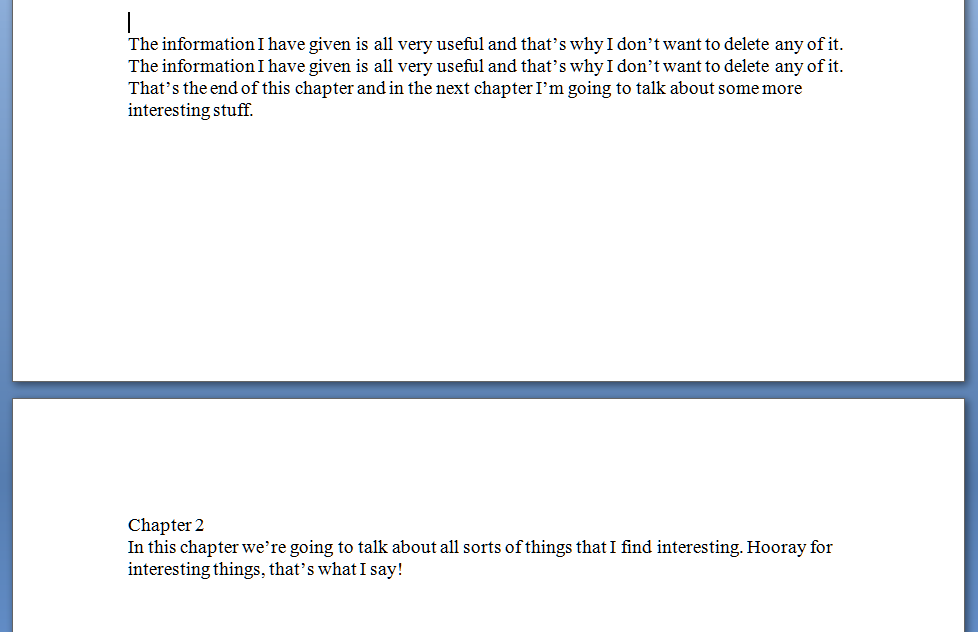
Today we’re going to talk about page breaks. If you’re writing a document that has sections, chapters, etc., you might well want to start a new chapter on a new page, and have it look something like this:
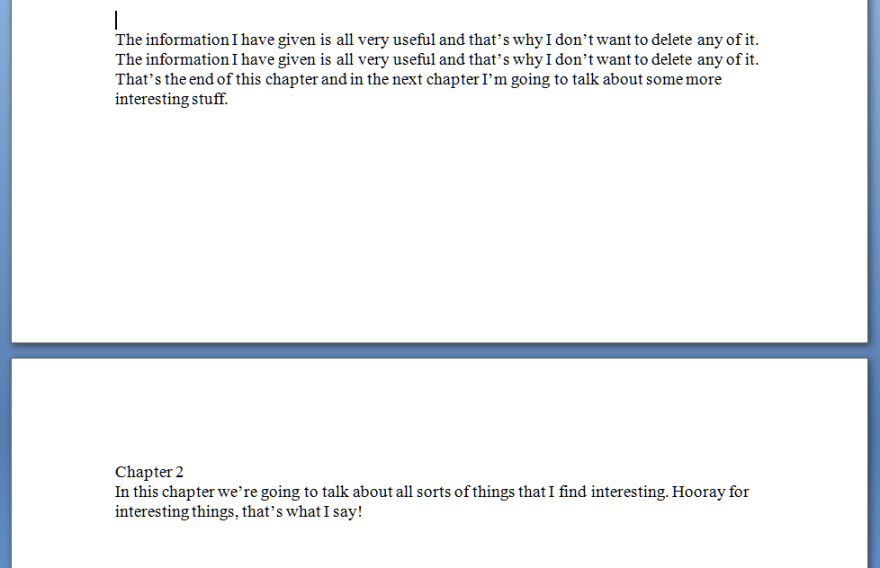
So far, so good – you’ve got your new chapter starting on a new page. But I bet you finished one section and hit the “Enter” key until you got to a new page, didn’t you? The way to tell is to hit a rather magical little button that shows all the formatting you’ve done.  In Word, you’ll find it in the Home menu; if it’s not there, play around with the display until you’ve found it and add it to the menu bar. Here it is:

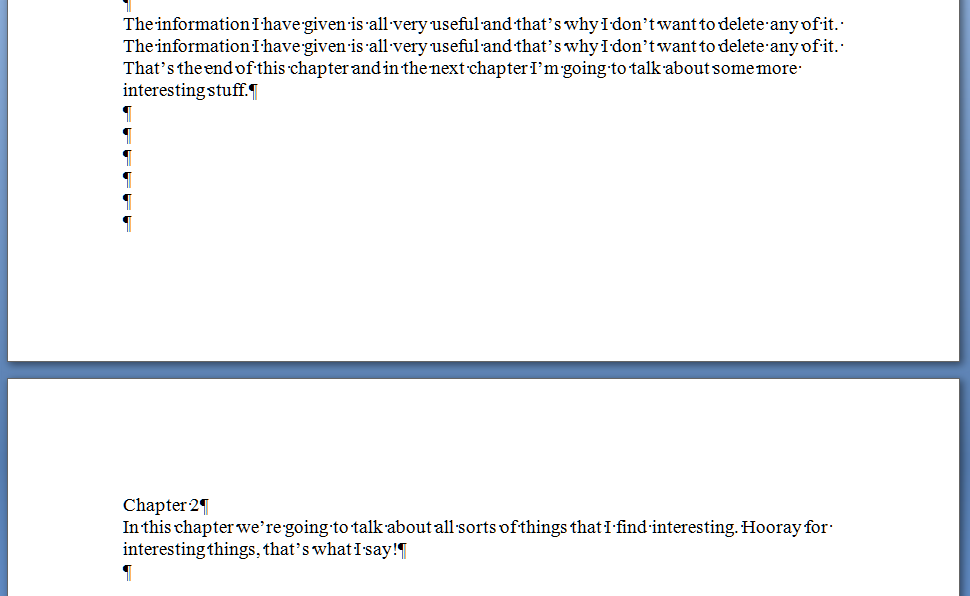
That’s actually the “paragraph” symbol or pilcrow used for centuries in manuscripts and printed books. Anyway, it’s ever so useful if you want to show what you’ve done to a document. Press it a second time if you want all the formatting marks to disappear again. So, pressing this with our document open shows the horrible truth – enter, enter, enter you’ve gone, six times, down the page …
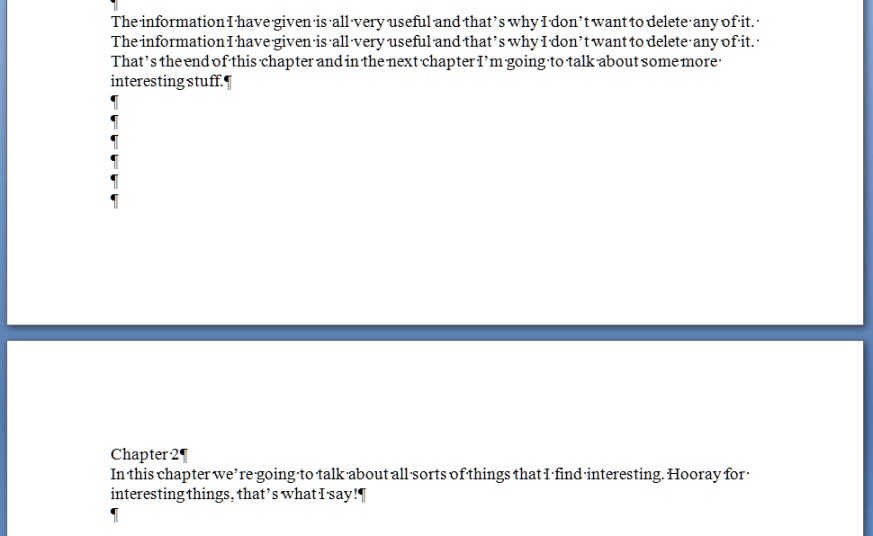
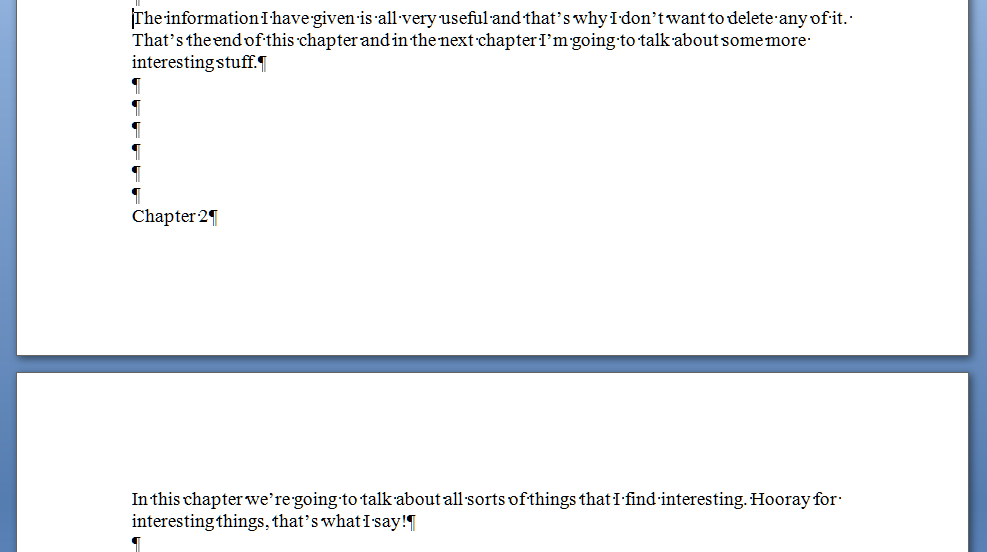
And that’s all well and good – until you change the text above the page break. You’ve done this and it all looks nice, then you notice that repeated line on page 1. Oh, well, you can just delete that. So you delete the repeated line, and the text on page 1 is now one line shorter – one line further up the page. Below the text, you hit Enter 6 times to make Chapter 2 start on the next page. Those six lines are below your chunk of text still, but your text is one line shorter than it used to be. So what happens … ?
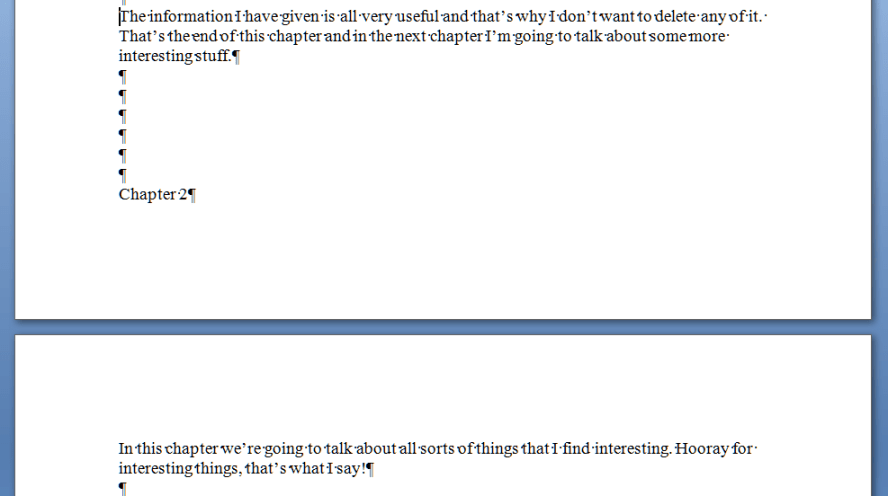
Disaster! Chapter 2 doesn’t begin on the next page any more! It’s crept up a line! And, similarly, if you’d added some lines of text to Chapter 1, this chapter heading would start part way down this page. Messy! And when you’ve submitted your work to an editor like me, you can bet we’ll be suggesting adding lines in or taking them away; when you get the document back the spacing will be all over the place (or I’ll have done it my way and made it tidy already … )

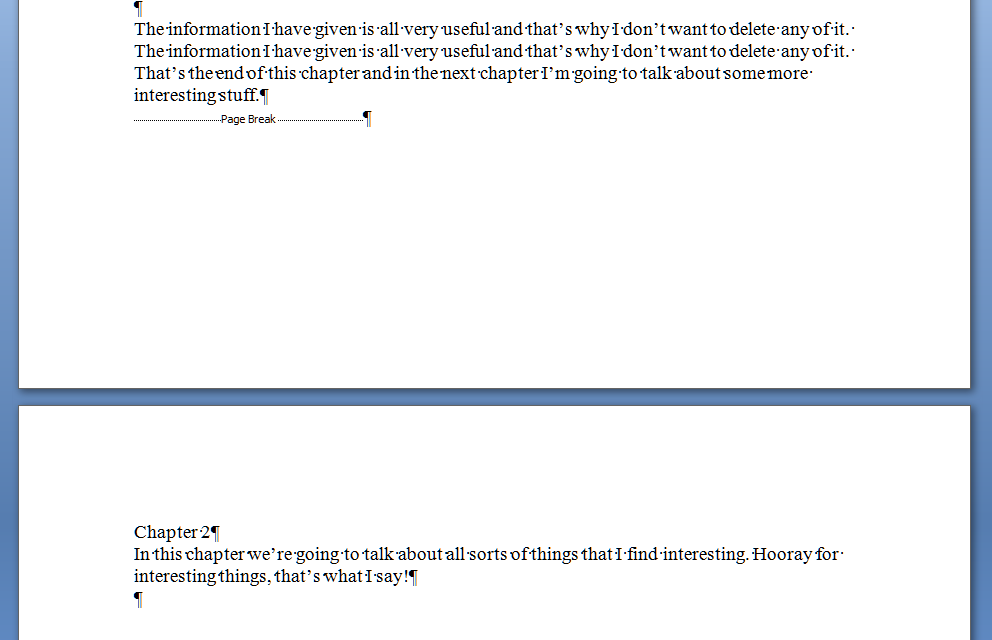
So how do you do it properly so this messiness doesn’t happen? Simple – you “force a page break”. Again, in all versions of Word, when you get to the place where you want to force a new section to start on a new page, press Control-Enter (or choose Insert – Page Break). Turning on your formatting display, and using our original text again, you’ll see this:
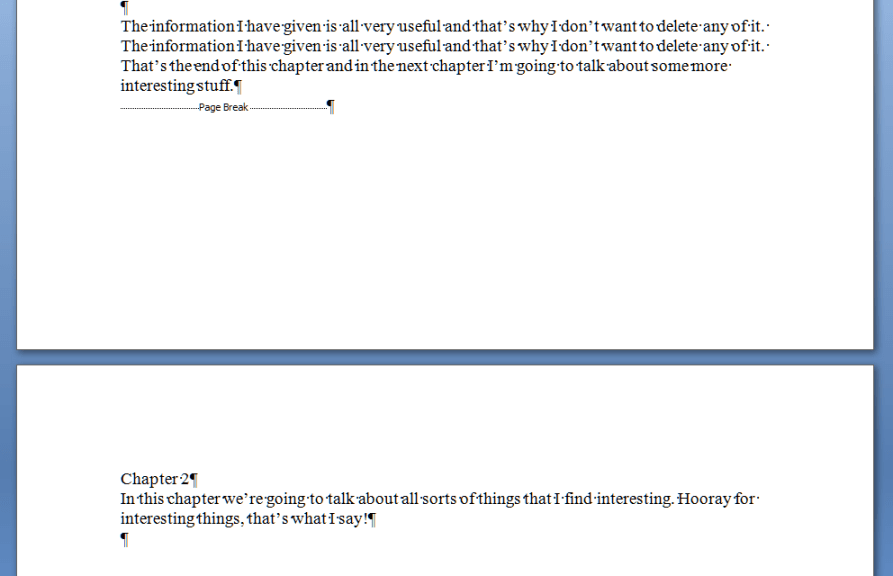
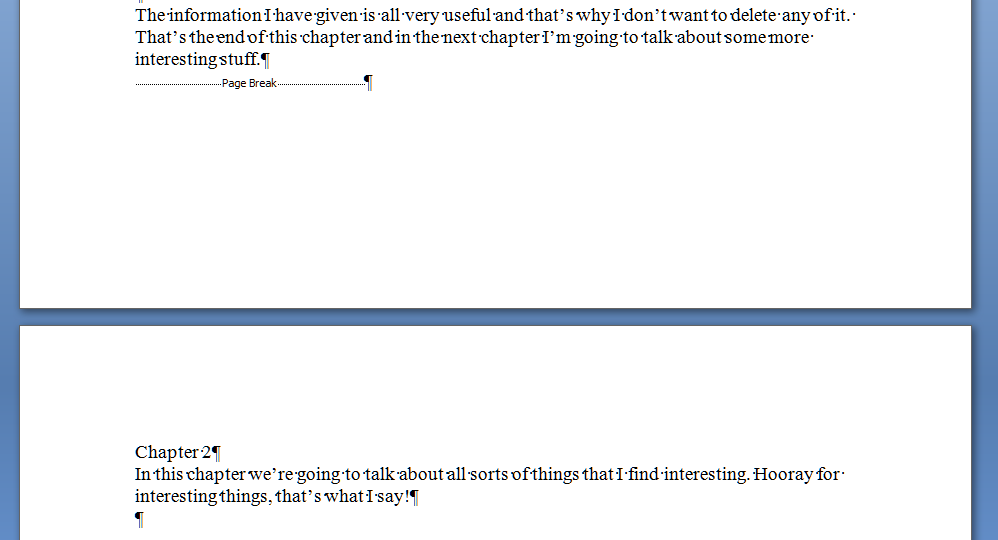
And because it’s a forced page break, it doesn’t matter what you do to the text above the break, the new text will always appear on the next page. Make the Chapter 1 text shorter again by deleting that extra line and you get this:
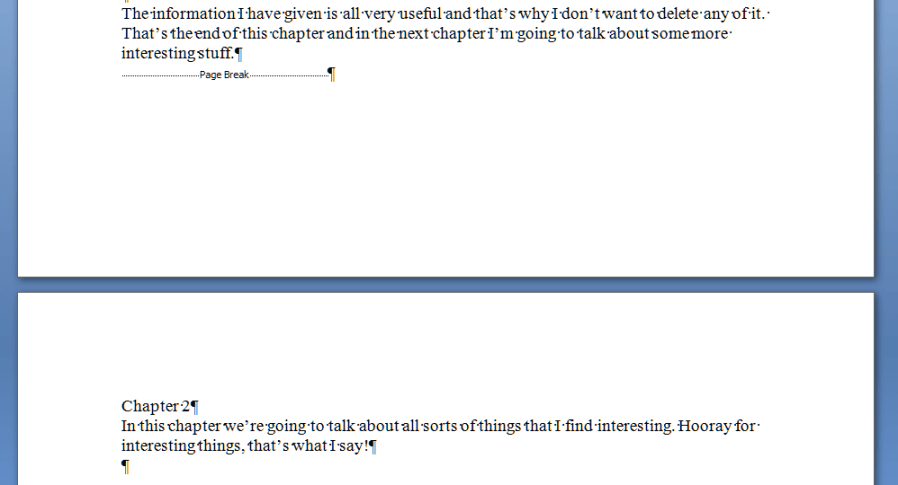
No hopping around – and even if you add so much to Chapter 1 that it goes onto the next page, Chapter 2 will just hop on down to the page after, automatically.

Of course, your document still looks like this:
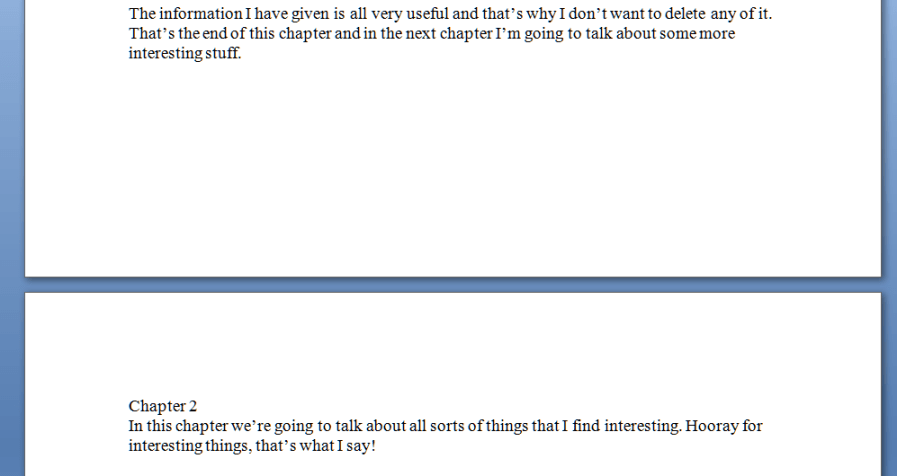
But you’ve done it all correctly, in fewer keystrokes, and you know that whatever you do with Chapter 1, Chapter 2 will always start at the top of its new page, nice and tidy, going where you need it to go.

I hope that’s helped – it’s a very common issue, which is why I’ve tackled it first. There will be more of these posts coming over the next few months – do pop a comment on this post if I’ve helped you, and let me know if there are any other issues you’d like me to look at.

Please note, these hints work with versions of Microsoft Word currently in use – Word 2003, Word 2007 and Word 2010, all for PC. Mac compatible versions of Word should have similar options. Always save a copy of your document before manipulating it. I bear no responsibility for any pickles you might get yourself into!

Find all the short cuts here

 
10 Comments

Posted by on November 23, 2011 in Copyediting, Errors, New skills, Short cuts, Word, Writing


Tags: , , , ,