RSS

Tag Archives: business

How do you start a career in transcription?

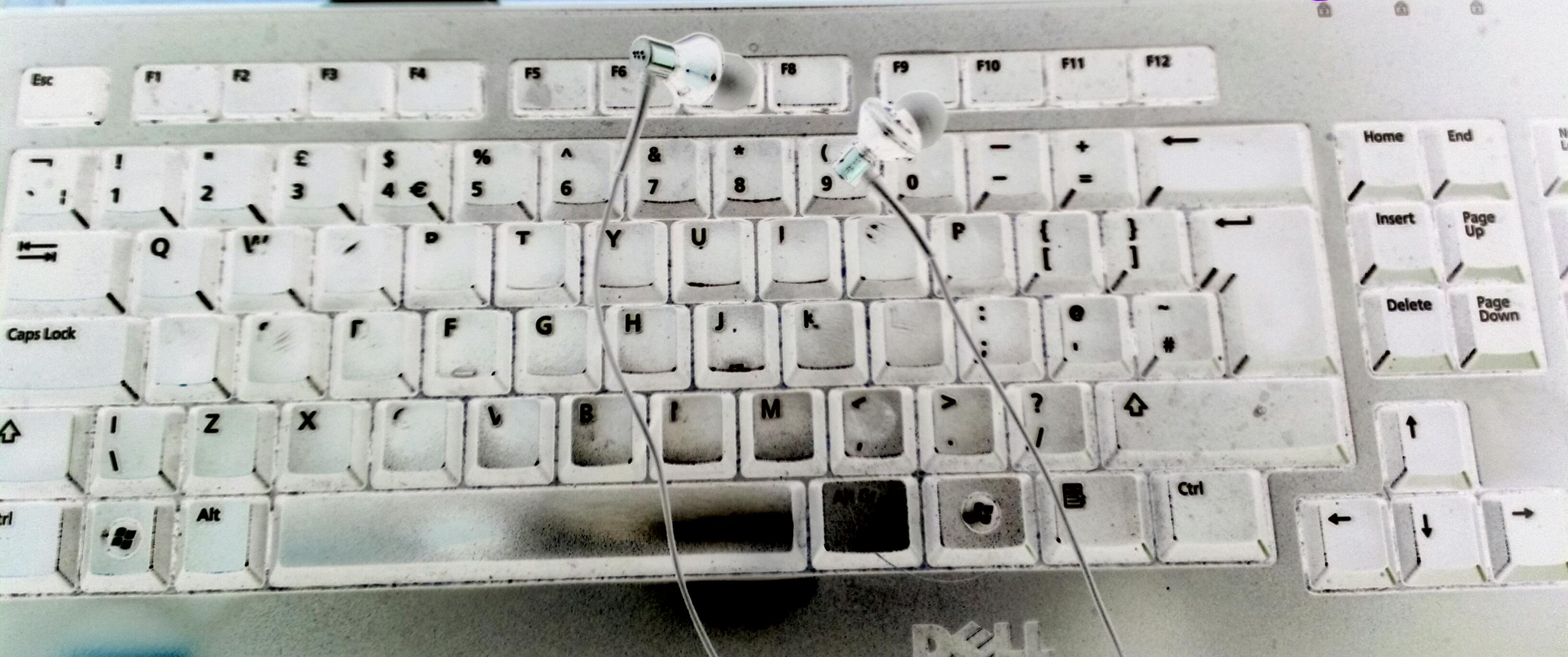
keyboard earphonesIn my article about why we still need humans to do transcription work, I promised to give you some insights into transcription as a career. Here are some pointers to give you an idea of what you need to know in advance, the skills and software you need, and ways to get work in this field – plus some pitfalls to avoid.

What is transcription?

I cover this in detail in another article, but basically transcription is what we used to call audio-typing – turning recordings of spoken words into documents containing those words written down. There is quite a lot of call for transcription work of various kinds as we’ll see in a moment. But the work basically involves putting on a headset or ear phones, and typing out what you can hear on a tape.

What kinds of transcription job are available?

Personally, I’ve worked on the following kinds of transcription job, which just shows how varied it can be:

  • Journalists interviewing musicians and actors
  • Someone interviewing their elderly parent in order to write a memoir for them
  • Academics and students interviewing subjects for their research
  • Students’ role-plays for learning how to provide phone counselling
  • Presentations at international conferences
  • Panels at conferences including questions
  • Discussion panels for market research companies
  • Podcasts by one person so they can provide transcriptions to their listeners
  • Podcasts of one person interviewing another
  • Free and paid-for telecasts (phone-in sessions where people listen to a speaker)
  • Free and paid-for teleseminars (as above but with questions and discussion)
  • Content for a book, dictated in the first instance before being edited

There are also specific roles that people can take on who have particular specialised skills such as legal proceedings or letters and medical transcription.

All of these clients have had different requirements in terms of the level of detail, time stamping, etc. but all have provided variety and interest!

Am I suited for transcription work?

In essence, the answer comes down to these three points:

  1. How fast do you type? You need to be able to type really fast to be able to make enough money (see below)
  2. How careful are you with your posture? (sounds odd, but sitting in one position typing like mad for hours is the highest risk part of my job for RSI)
  3. How good are you at using Word and its autocorrect features? (this makes a lot of difference to your speed – see the section on technology below)

The best way to find out if you’re suitable for this kind of work is to practise before you’re doing a paid job. Learn from me, here! I did train as an audio typist, with a foot pedal and a tape player back in the old days. So when a journalist I followed on Twitter asked if anyone offered transcription, I went for and got the job. Fine, I did lovely fast typing but I was using Windows Media Player to play the tape, switching windows to start, pause and rewind it. That first tape took me hours! I wish I’d known what I know now about technology and how to actually do it!

Technology for transcription work

There’s quite a lot to the technology for transcription, so I’ve written a separate article about working as a professional transcriber which includes loads of detail on this and other aspects.

In essence, you will need:

  • a word-processing package
  • software to manage your recordings
  • ways to receive large files – you need to know about dropbox, yousendit and other services

How do I work out if I’m suitable for transcription work?

If anyone asks me about how to find out if they’re suitable for transcription work I tell them to do this:

  1. Record an hour of general conversation, interviews, etc. from the radio
  2. Get the technology set up (see separate article) and transcribe it
  3. Work out how many minutes it takes you to transcribe one audio minute

I’d say you’re looking for at least a 1:3 relationship here. That’s 3 minutes to transcribe one minute of tape. Not long! you cry. But that means it will take 45 minutes to transcribe a 15-minute tape, or 3 hours to transcribe a 1-hour tape. Build in the fact that you need to take a break at least once an hour, and good old cash rears its ugly head.

Can I make money doing transcription?

Here’s the thing it all boils down to:

If you can’t type fast and use the technology to boost your speed, it’s not financially worthwhile to take on transcription work.

The standard industry rate for transcription is around £0.85 per audio minute. That’s £8.50 for a 10-minute file. If it takes you 1 hour to type out a 10-minute file, you’re going to make £8.50. Before tax. But if you can get two of those done in an hour, you’re getting £17.00 an hour – not so bad.

Some companies have standard rates and pay more. Personally, I stick to that rate for one to two speakers speaking clear English in a relatively quiet room, with a turnaround time that allows me some room for manoeuvre, and I add £0.10 per minute for urgent work, extra speakers, noisy tapes, etc. And if any of my music journalist clients are reading this, yes, I give fellow freelancers a discount (and other people a discount at my discretion, based on the quality of the tapes and the time it takes me to transcribe them).

There are internet job boards out there trying to hire transcribers for £0.10 per audio minute – honestly. The more people accept these prices, the more they will stay. I have more self-worth than that, and even when I was starting out, I’d rather do a transcription for free in return for a reference than do hack work for a corporation paying peanuts. Rant over!

How do I get transcription work?

There are loads of sources of transcription work. I have to say that my main one is personal recommendation – strings of journalists, etc. But it’s also worth trying the following:

  • Set up a saved Twitter search for “need transcriber” and contact people with an offer. This can work – it’s how I got my first transcription client!
  • If you are near a university that has a lot of research going on, ask to put up some posters offering your services. A lot of researchers conduct interviews and need them to be transcribed.
  • Tell your editing or other clients that you’re offering this new service – I’ve transitioned clients to and from transcription services.
  • Join reputable job sites like Proz which advertise transcription jobs at decent prices.
  • Use social media and tell all your contacts what you’re doing
  • Join transcribers’ groups on LinkedIn, etc. – there are often people looking to pass on overflow work

I would strongly suggest that you don’t just do transcription work full time. It’s very physically tiring, you can get RSI from all the typing and sore ears from the earphones (I’ve got a sore ear at the moment and I’ve been doing this for years!) so add it into the mix, and remember to take a break every hour of typing!

This article has helped you work out if you’re suited for transcription work and given you some hints and tips. Have you found it useful? Please comment if you have, and let me know how you get on!

If you want to learn more about Transcription as a career, buy my book: A Quick Guide to Transcription as a Career – buy from Amazon UK or visit the book’s web page for worldwide links and news.

Related posts in the series:

Why you need a human to do your transcription

Being a professional transcriber – software to use to help

Ten top tips for transcribers

 
119 Comments

Posted by on March 20, 2013 in Business, Jobs, New skills, Transcription, Word


Tags: ,

Why you need to be human to produce a good transcription

Suitably funereal transcription kitWhen I receive a recording for a new transcription client and tell them I’ve loaded it into my transcription management software, I’m sometimes asked if that does the transcribing for me. Um, no.

While there are of course software packages out there that are very good at working with a single voice dictating, even those can sometimes struggle. I know this, because I’ve edited work that has been dictated in this way – and it can often be rife with homophones.

Why use a human transcriber?

I’ve been providing transcription services for several years now. While a machine might be suitable for taking down the words of a single, non-accented speaker enunciating clearly into a good quality recording apparatus, with no background noise, no interruptions and no acronyms or jargon, the projects I’ve worked on have included some or all of these features:

  • High levels of background noise – interviews in cafes with espresso machines whooshing and spoons clinking in cups
  • People talking while they’re eating and eating while they’re talking
  • Interruptions from waiters / room service / other members of the band or group
  • High levels of tape noise leaving me straining to hear what anyone’s saying
  • Multiple speakers including many people with similar voices around a conference table
  • Overlapping speech
  • Non-native English accents or heavy regional accents
  • Very technical content – jargon and acronyms galore
  • Creative content – album names, track names, novel titles, band names, author names
  • Requests to provide the transcription missing out ums and ers through to smoothing the English to make it read as standard English

As a native English speaker specialising in working with music journalists and non-native speakers of English, I can cope with all of these, with some rewinding and checking. I doubt that the most sophisticated dictation software could do so, as yet. I might be wrong of course (let me know if I am!).

Understanding what’s being said on a transcription

The first issue is actually hearing and understanding what’s being said. I have a good ear and a native English speaker’s ability to predict what will come next in a sentence / how sentence structures work, plus my experience working with speakers of and texts in non-native English allows me to do this for native Arabic, Chinese, Eastern European language etc. speakers. My ear can filter out background noise where sophisticated software can only go so far. And I can hear around the clink of teaspoons or glasses chinking to grasp what’s being said.

Checking the content in a transcription

When one of my journalist clients sends me a tape, I check who the musician / band is and look them up (usually on Wikipedia for the general information, as their own websites are usually a bit harder to plumb for information). When I’m working on an international conference I will seek out or be given a conference schedule, list of attendees, etc. When I’m working with technical content I will look up information on that topic.

All this allows me to produce a transcription which the client will not have to check for themselves, or if they do check it (which I do recommend), there won’t be too much to change. And I won’t be embarrassed by too many mis-hearings. Just try popping a few names of country leaders, bands or albums into a Word document and running a spell checker and imagine what an automated dictation program would do with these terms!

Speech on a tape to words in a document

Very occasionally I’ll be asked to record exactly what the people on the tape say, including ums, ahs, repetitions and pauses. At the moment, I’m transcribing some roleplays for students learning how to operate a telephone helpline. Here it’s important to capture all the nuances of the conversation and I’m splitting the utterances into sections, numbering them, and including all the ums and ahs.

Normally, my clients will require some smoothing out.

  • Most of my journalists like to have an indication of when their subject slowed down or had to mull over something and ask me to include notes of those pauses.
  • Business people producing podcasts and telecasts often want a fairly accurate transcription, but smoothed out to eliminate ums, ahs, pauses and repetitions, so they have a good product to sell or include in packages for their clients.
  • Some international conferences want to avoid embarrassment for their delegates by having their English rewritten as I transcribe to appear as close as possible to native British (or American) English
  • I have worked with authors who start off with a tape and want it to turn into something they can publish as a book (this, unlike all of the other options, involves two processes: transcription and then heavy editing and rewriting).

Why should I use a human transcriber and not a software program?

2 topsI think I’ve answered that for you now. You should also consider using a human transcriber who’s a native speaker of the language you’re having transcribed: there are websites out there where you can find very cheap transcribers; they are often not going to be native English speakers and while they will get the gist of the tape down, I’d be unsure whether they could give you the service you needed.

I’ve written another article about how to get into transcribing as a job and how to prepare yourself for what is often a fun and rather creative area of work, and one about the technology transcribers use.

In the meantime, if you’re thinking of booking in a transcriber, do have a look at my page about my transcription services, and get in touch if you want to ask about what I can do for you. I hope you’ve enjoyed this insight into a transcriber’s work! Do leave a comment if you have …

If you want to learn more about Transcription as a career, buy my book: A Quick Guide to Transcription as a Career – buy from Amazon UK or visit the book’s web page for worldwide links and news.


Tags: , , , , ,

Paul Alborough

Welcome to a fab new Saturday Business Chat! Today I’m thrilled to feature my old friend, Paul Alborough, aka Professor Elemental, a rapper – but wait – in the Brit hop tradition, all Steampunk and Englishness and marvellousness.

Back in the day, we used to commute up to Barnet together. I’d be reading the latest tome from my TBR, and Paul would be scribbling lyrics on an A4 pad. One of the most memorable features of my time at that company was the off-the-cuff rap Paul did for me at my leaving tea. Since then, he’s devoted considerable time and effort to building his music career, and is now doing Professor Elemental stuff full time – well done, Paul! Let’s find out how he did it. And you HAVE to look at his videos. Remember Tone and his model dinosaurs? This stuff is just as cool. Don’t I know some excellent people!

What’s your business called? When did you set it up?

Professor Elemental is the name of the business and the character that I perform as. I have been working full time as the good Professor since January 2012.

What made you decide to set up your own business?

I was quite happy just rapping as a hobby to supplement my day job, then was lucky enough to enjoy a bit of success with it. As the amount of work as an emcee grew, so did my day job career (as a teacher), and I was forced to choose between the two. Inevitably, being a mad professor was more interesting than being a regular teacher.

What made you decide to go into this particular business area?

It was only as I got more into doing shows and realised that it was a possible way to make money out of rapping without being signed. I’ve always loved emceeing in it’s many different forms.

Had you run your own business before?

Nope. I have done a lot of rap workshops, but never as a full-time business.

How did you do it? Did you launch full-time, start off with a part-time or full-time job to keep you going … ?

I ran the two parallel careers for about a year. This was a very stressful in itself, but did allow me to keep the risks to a minimum when I finally made the jump into ful- time creativity. It feels a lot nicer risking everything when you have a bit of safety net either financially or in terms of other work.

What do you wish someone had told you before you started?

‘ITS LATER THAN YOU THINK! Sort your life out, you lazy sod!’ I would have liked them to have shouted that to me while shaking me by the lapels. I probably would have cried, but it would have been worth it.

What would you go back and tell your newly entrepreneurial self?

I am still pretty new I suppose- but I am definitely learning that people value you more if you value yourself. Both creatively and financially.

What do you wish you’d done differently?

Got started earlier and not been so pessimistic about my chances of doing this for a profession. I might have saved myself a few years of life wasted in call centres.

What are you glad you did?

Working with other people. Working for yourself doesn’t mean that you have to shoulder it alone and having a good accountant, amazing booking agent and brilliant folk to collaborate with makes the whole process more fun.

What’s your top business tip?

Acheiving your dreams is entirely possible. Particularly if your dreams are relatively modest.

Oh, and be nice to people at every level of your business. That really can’t be overstated.

How has it gone since you started? Have you grown, diversified or stayed the same?

I have diversified as much as possible. I’m trying to say yes to as many good things as possible and it’s leading to some brilliant, unexpected places. So far there’s been a comic, a web series and some most unexpected gigs.

Where do you see yourself and your business in a year’s time?

I’m thoroughly enjoying the freedom to take the professor character into some new and exciting places. There are a few things in the pipeline that might change my life completely. And if not, if things carry on just as they are, then I will be very happy indeed.

I don’t usually include people’s answer to the last question in the published interviews, but I had to here …

Are you happy for me to contact you in a year’s time from posting the interview, to see how you’re doing and conduct another short interview?

Yes, unless it has all gone wrong and I am destitute , living underneath Brighton pier. In which case another interview might be too depressing.

Somehow, I don’t think that will be the case! But isn’t it interesting that in the world of rap and the world of editing, we still like to do things carefully, have backup and do things nicely! Good luck to Paul / the Professor and his modest ambitions!

The Professor Elemental website can be found at www.professorelemental.com and I recommend taking a look at his rather marvellous YouTube videos. He’s on Facebook, and of course you can get in touch via email.

If you’ve enjoyed this interview, please see more freelancer chat, the index to all the interviewees, and information on how you can have your business featured.

 
8 Comments

Posted by on February 23, 2013 in Business, New skills, Small Business Chat


Tags: , ,

On tax

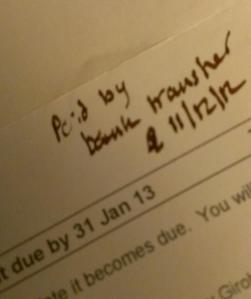
tax paidI paid my tax bill yesterday, as you can see from the accompanying picture. I have been thinking about this subject recently, as there has been a furore over Starbucks, Amazon, etc., as well as various celebrities and people who are (in my opinion) rich enough already, using loopholes and legal means to squirrel away as much money for themselves as they can, ignoring what taxes are for, what they pay for, and the benefit they bring to the society among which and from which they make their money.

I’m not going to get overly political here. No, I’m not a fan of the present government, and on how they are distributing public funds, but the fact that there are any public funds to distribute in the first place is down in large part to people who do pay their tax.

I’m actually quite annoyed (especially in the year where I must pay double tax because of the payment on account system) that other companies operating in the UK are behaving like this, and giving businesses a bad name, too.

I have been checking on a few companies that I use recently to make sure I am making the most ethical choices I can (hooray for Eat. and Lush!). And it struck me that I should make some sort of statement on my own position regarding tax.

Statement on Libro and tax

I confirm that Libro is a British entity fully subjected to UK taxes. I have no cross-border arrangements that transfer profits to lower tax countries.

I pay a fair amount of tax and I claim back what I consider to be fair (expenses like reference books, memberships of organisations and a small amount towards the heating and lighting of the part of the house occupied by my office).

I do not engage in any tax avoidance (that’s the legal one: it’s tax evasion that’s the “bad” one) practices, even were they to be officially legal. I do not claim for anything I do not have, and all payments, including cash payments and tips, are put through my books, recorded and entered into the calculations that work out my tax burden.

I operate in what I consider to be an ethical and fair way, and this extends to my relationship with HMRC.

Other posts about Libro and tax

I’m obviously quite interested in tax, as I’ve published these other two posts on the topic:

Why I do my tax return in April

Income tax payment on account


Thanks for reading – do share if you find this useful or interesting (there are many buttons just below) or tell me whether you’ve posted up a statement on your tax position if you’re a small or medium sized business.

 
Leave a comment

Posted by on December 12, 2012 in Business


Tags:

A quick note …

New subscribers to / readers of this blog might be interested in my more personal reflections on being a full-time self-employed person over on my personal blog, Libro Full Time. If you just want the business stuff, select the self-employment category from the cloud, or if you want everything (business stuff and book reviews), just take a look at the blog or the About page. Thank you!

 
Leave a comment

Posted by on October 12, 2012 in Business


Tags:

Top Ten Tips for Working with Clients

As a freelancer, I’ve spent three years (so far) learning how to deal with lots of different clients. I hope that these tips will help you get the most out of the relationship. If you work with freelancers, you might find this article useful, too.

1. Communicate

This is the top tip, and comes into many of the other sections. Be clear about what you do, how much it costs, and when you can do it. Communicate the way in which you work to your client up front. Keep on top of the project and let them know how it’s going. Tell them what to expect, then fulfil that expectation and communicate that you have done so.

2. Manage expectations

It’s always best, in my opinion, to promise low and deliver high. I always add a little time when I’m offering a deadline, and almost always exceed expectations that way. If you are going to miss a deadline, let the client know – this only usually happens when it’s the client who sets the deadline. I’ve only missed one deadline, by half an hour – but there was good reason for it, and I let my client know in advance.

If you’re undertaking a project for someone and they’ve not used a freelancer before, explain the process and what they can expect from it. If you need to tell clients about your terms and conditions, send those along with your initial quotation. If an urgent job will cost more, tell the client in advance.

If you can’t offer the service you would want to offer, a “no” said honestly and in good faith is better than a “yes” that isn’t meant. Your client will respect you more for it.

3. Keep to deadlines

If you promise to return a piece of work to a client by a particular date and time, do your utmost to do this. Work all night if you have set an unrealistic deadline (and learn from that!). When I started freelancing, I found that freelancers have a very bad reputation around this issue. Ignoring deadlines makes you look arrogant at best, incompetent at worst. It’s not hard to plan ahead, and it’s not hard to say no (eventually).

This also applies to invoicing. If I’ve arranged to invoice the client directly after finishing the work, I do so. If they are on a monthly invoice in arrears, they are sent their invoice at the end of the month. If this is a bit much, it’s something you can easily automate or outsource.

4. Treat your client as a human being

Even if your client is a huge faceless entity, you will be dealing with a person at that client. Remember that they’re a human being, with other concerns than you and the project you’re both working on. They may be trapped between you and their own boss or client (I work for several freelance journalists and translation agencies, for example) and may have other pressures. If they’re a student or a new member of staff, they may be unsure as to how to work with you!

5. Inform your client about your availability

If you’ve got a holiday booked, you don’t work on weekends, or you stop at 9pm at latest, let your clients know. When I book a holiday, I send an email to my main regular clients a few months before, remind the biggest ones a month before, put a note in my signature then set up an auto reply on my email. Out of courtesy, I do communicate with them by email when I’m away, but only to remind them I am away!

6. Have backup

For my major clients, I have colleagues who do the same line of work as me and can pick up work if I’m unwell or on holiday, or very busy with a pre-booked job. I also have a list of people I can refer clients on to if I can’t book them in myself.

7. Respect your clients

Professionally and personally. You’re the expert in what you do, but they’re the expert in what they do. Treat them as you would expect them to treat you. Be as robust as you need to be, but always be courteous.

If you feel the need to let off steam about a tricky client or project, please do it privately! I have a private group of fellow editors who I can ask questions and share good and bad days – and sometimes people do make us a bit cross, but just don’t broadcast this in public. It’s not very professional, and it can reflect on you very badly.

You may have specific points with this according to the industry you’re in. I personally avoid pointing out horrible grammar and spelling mistakes on signs and menus in public. Amusing as I find these, a lot of my clients are using English as a second or third language, have issues with their English skills, or are just not very confident, and the last thing I would want to do would be to be seen to be mocking less-than-perfect English.

8. Work with your client’s working methods

You have to be flexible if you’re going to be good at freelancing for different clients. They all have different requirements and ways of working, and my reaction to this can go from noting which transcription clients need a time stamp every 5 minutes and which need it every 10 minutes, to communicating via email, the phone or a face-to-face meeting, whatever the client prefers.

I do impose my own working methods on them to an extent, for example encouraging them to use comments and Track Changes to comment on texts I’ve produced for them. But if they choose not to do that, I’ll work with how they want to work.

9. Share the joy

I have a list of people who do what I do who I will recommend to any clients I can’t fit in. I don’t consider them as competitors – yes, we’re in the same line of business, but everyone gets work they can’t do for whatever reason, and I’d rather have a known person I can send them to, knowing they are likely to do a decent job. This saves clients (particularly students) from getting ripped off, and I think it presents a professional attitude to the prospective client, too.

10. Say thank you

I try to say thank you whenever a client pays me. I also thank them for being particularly good clients – the student who doesn’t automatically “accept all changes” but asks me questions about their English, the writer who’s produced an interesting book … and if a client has a product or service I think is particularly good, I’ll pop a link on my links page here and tell people about their book, service or product. It doesn’t cost anything to say thank you, after all, and it gives your client a great final impression of you!

I hope you’ve found these top ten tips for working as a freelancer helpful. If one has struck you as particularly useful, or you have others to suggest, please comment. And you might be interested in my top ten tips for clients working with freelancers!

Why not have a look at my other tips for freelancers, small businesses, etc. – roam around the right-hand sidebar or click on the links!

 
11 Comments

Posted by on September 19, 2012 in Business, Organisation


Tags: ,

Top Ten Tips for Working with Freelancers

As a freelancer, I come across all sorts of clients and all sorts of behaviour. If you want to get the best out of the freelancers you use, whether you’re a tiny company outsourcing to an accountant and a copywriter or part of a huge tech company with hundreds of freelance programmers on your books, these tips will help you get the most out of the relationship.

1. Communicate

This is tip number one, and feeds into so many others of the top ten. Be clear in your initial communications. Express your requirements clearly. If anything changes: the project, the deadline, the date you can deliver the project to them, your expectations – tell your freelancer. They’re not a mind reader: you need to tell them.

2. Manage expectations

If you commission a chatty, friendly blog post and you get a piece of corporate spin, did you really express what it was that you wanted? Again, freelancers are not mind-readers. A good writer can write in whatever style you want – but they do need guidance. Like a computer, a freelancer will absorb your instructions and produce output to the brief given.

A good freelancer will check what you want, and in some cases will send you over a questionnaire to fill in or have a chat with you over the phone. Use this opportunity.

3. Keep to deadlines

If you promise to deliver a project specification, a document, a set of keys, whatever, to your freelancer, on a particular day at a particular time, then either keep to that agreement or, if you can’t, let them know as far in advance as you possibly can. Everyone has sudden last-minute issues and no one minds that, but freelancers do mind booking in a job, possibly turning away other clients because that time is booked, then no work arriving.

Similarly, if your end deadline changes, keep your freelancer informed, give them the chance to adjust their schedule, and understand if they can’t. Perhaps you’re a journalist and your editor changes when they need that interview write-up – let your transcriber know as soon as possible and show willing to pay an urgent fee or make the deadline as flexible as possible.

This applies to payments, too. Make your company’s payment schedule clear in advance (no – “oh, yes, it’s a 60 day payment schedule; didn’t I tell you?” please) and make sure you pay on time or let the freelancer know if you can’t.

4. Treat your freelancer as a human being

This seems to apply especially in office-type services, such as editing and virtual secretarial services. Several colleagues have commented privately that they feel like some of their clients think of them as a piece of office machinery, like a printer or network cable, and are then scandalised when real life – an emergency, a holiday – intervenes. Just because you can’t see your freelancer doesn’t mean they don’t have a face and a life! (I’m lucky, pretty well all of my clients treat me well and even let me go on holiday occasionally!)

5. Inform your freelancer about your availability

If you’re going on holiday, or you don’t work Mondays, let the person you’ve commissioned know. They might have a question and not be able to get in touch with you. Leading on to …

6. Have backup

Is there someone else in your organisation who could pick up the reins with your freelancer(s) if you were to go off sick or go on holiday? I’ve had situations where my contact at a client’s office has gone out sick, and no one’s been told about the projects I’m working on or when I should be paid.

7. Respect your freelancer

Professionally and personally. They’re the expert in what they do, just like you’re the expert in what you do. You’ve hired them to do a job, so let them do that job. If you feel you know how to do whatever you’re asking them to do, remember that it might be a part of your job, but it’s their speciality. Of course it’s fine to ask questions, but if you’ve chosen right, from a recommendation or by checking out the freelancer’s references and experience, let them get on with their job.

Having said that, I’m pretty sure I’ve typed some terrible mis-hearings into transcriptions I’ve done for clients, but I’ve never (thankfully) seen them laughing about it in public. Don’t make assumptions about their private life – it’s polite to ask if they mind working through the weekend on your project, even if they’ve done so before. I don’t mind working odd hours for my clients, as I make up for it with long lunch breaks with gym sessions and a sit in the garden, but I appreciate it when they realise that I have a life, too!

8. Work with your freelancer’s working methods

Although a good freelancer will adapt the way they work to suit you to a certain extent, there are times when you need to fit in with how they work. For example, if a client needs to comment on a text I’ve produced for them, I request them to do so in Track Changes, rather than colouring in bits of text and writing comments in the text. It’s easier for me to work my way through the comments, saving the client time and money if they are on an hourly rate, and I will always take a moment to explain how to do it.

9. Share the joy

If someone does a good job for you, offer them a reference or testimonial. Tell other people about their services. I get most of my work through recommendations, and it’s a great way for clients to get freelancers they know will be good, and freelancers to get clients who are likely to go with them because their friend or colleague has recommended them.

A freelancer who knows you’ve recommended them on to your friends and colleagues will be more loyal to you. They’ll want to do a good job for you, so you recommend them again!

10. Say thank you

On the day I wrote this post, I’d been up since 5.30 am to turn around a very urgent project for a client. What really did make that worthwhile? The client coming back to me to say a big thank you. It really does matter; it doesn’t take a moment, and it cheers everyone up.

I hope you’ve found these top ten tips for working with freelancers helpful. If one has struck you as particularly useful, or you have others to suggest, please comment. And you might be interested in my top ten tips for freelancers, too!

Why not have a look at my other tips for freelancers, small businesses, etc. – roam around the right-hand sidebar or click on the links!

 
4 Comments

Posted by on September 12, 2012 in Business, Organisation


Tags: ,

Keep an eye on your stats

Do you ever look at your blog or website statistics? If you don’t, I’m going to show you why you should. If you do, do you get all you can out of them? Do you look at them actively or passively?

Note: this post uses examples from the WordPress.com statistics pages, because that’s the blogging/website platform I use. But all of the standard blogging sites, plus Google Analytics, Statcounter and other analysis tools will offer you similar information, with similar headings.

Why should I look at my statistics?

Looking at your statistics can help you tailor your blog to match what your readers want, and will also alert you to who is talking about you and where they are doing so. You can also measure the success of your attempts to build your audience through posting on social media and other blogs and sites. Here are some of the things you can find out …

  • Which posts or pages are people looking at a lot … and which ones are they ignoring?
  • Is there a kind of post that people are particularly interested in?
  • When do people read your posts?
  • How do people find you (social media, web searches … )
  • What search terms do they use?
  • Where do your readers go next – what links do they click?
  • Are people finding your site via other sites and blogs?

How do I find and view my blog / website statistics?

Usually you’ll have some kind of button or menu option called Statistics or Analytics. On WordPress, you will find a Stats option when you go into your blog, or you can click on the bar chart at the top of the screen. Once you’ve found them, you’ll find a screen something like this:

Now we’ve located our stats, let’s look in more detail about what they can tell us.

How do I tell how many times my blog posts have been viewed?

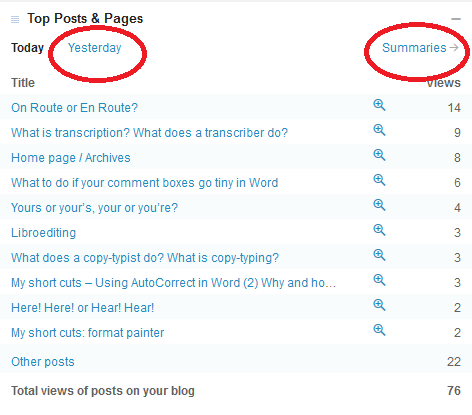
One of the important ones to look at is your most popular pages. We’re looking at one day here, and I can see that my blog post on on route or en route is, yet again, the most popular.

But I can also see what other posts and pages have been popular (and if I click on yesterday or summaries I can see previous days’ stats, while if I click on the magnifying glass next to the number, I can see all the views for that post). This is useful, as I can tell how I’m doing in the search engines, if it’s an older post, or whether my alerts are doing well, if it’s today’s post going up the ratings.

How do I tell how people have found my blog or website?

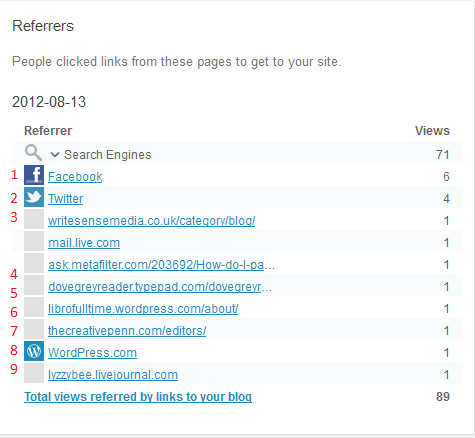
It’s very useful to know how people are finding your blog. You should have a section of statistics called something like referrers or referrals. Here are mine for a particular day.

You can glean all sorts of information from this. At the top you can see I get most of my hits from search engines (over 70 of that day’s hits so far), then Facebook (1) and Twitter (2), then a variety of websites and blogs that I’ll go through in a minute. This has changed – when you’re new to blogging, you’ll get most of your hits from Facebook and Twitter and other social media, as your friends will be looking at your posts and you will be promoting them on social media. As your blog gets indexed on the search engines, results will start showing up from them.

Looking at the pages from which your readers have come can be SO useful. Here’s what I can learn from this one:

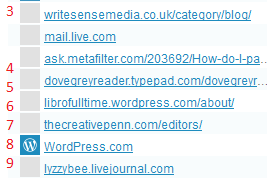
3 comes from one of the people I’ve featured on my blog blogging about my feature herself – a great link-back that Google will like indexing. 4 is from an answer I gave (with a link) on an expert site. 5 is from a comment I made on someone’s blog. 6 is from my other blog. 7 is from a list of editors a client added to her website (very valuable). 8 is from WordPress itself, probably someone surfing through tags, and 9 is from my old LiveJournal blog, where I post links to this blog/website.

All good stuff, and I can say thank you to people who have sent readers my way, or even find out when they’ve done so (all these links can be clicked, so I can see exactly what people have said). Now, what about those search engines?

How can I find out what search terms people have used to find my site?

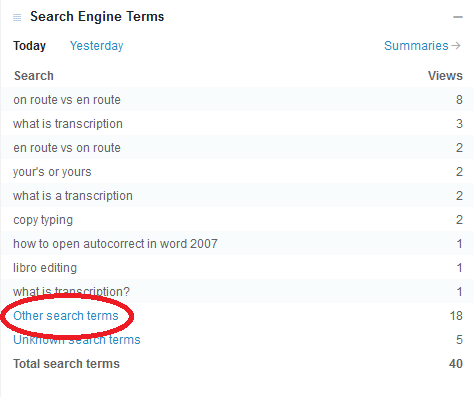
You should have a heading like Search Terms somewhere on your stats page. This offers a world of exciting information.

Clicking on Other search terms will give you the rest of the terms people have searched on – that they will only have tried once (or only one person has tried).

For a start, you can see exactly what people are searching for. It might be useful to change the wording on your blog posts to get further up the search results for a popular term. It’s also worth searching for these terms yourself and seeing where on the Google results page they appear. Another useful point is it can give you ideas for future blog posts. I noticed that someone had found me while searching for Autocorrect, which I had mentioned in a blog post. So then I wrote a post on Autocorrect itself, which has been quite popular.

It can also be quite amusing to see what people search for. Someone once came through to my blog having searched for “persuasive piece on children believing in the tooth fairy” – I think they may have been disappointed (they found me because I mention the tooth fairy in an example sentence explaining a word definition).

How can I see where my blog readers are?

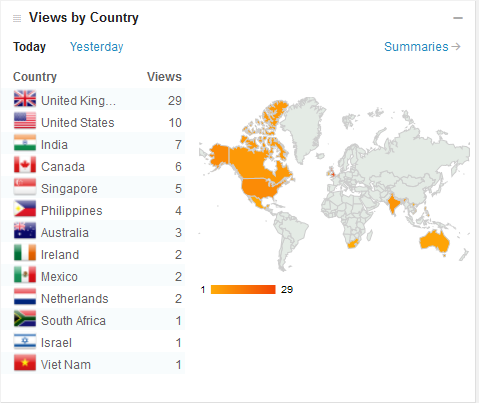
On WordPress you can see a rather nifty world map with the countries from which your visitors have come from highlighted.

This is more of a fun distraction than a useful tool, to be honest, but if you discover an anomaly, for example if you’re in the UK and you get a lot of visitors from Brazil, you could consider tailoring some of your blog posts for this market. I get a lot of international visitors, so I’m going to make sure I talk about my work with non-native speakers of English soon.

Is my website traffic increasing? What did I do to make that happen?

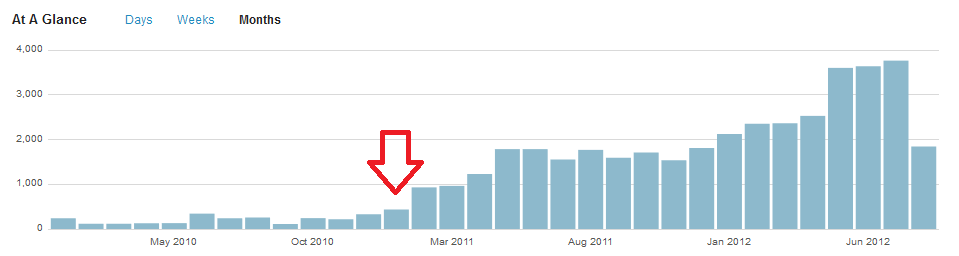
As well as today’s data, you can usually see a month or year’s worth, too. If I look at the traffic on my website and blog over time, I can see that it started increasing at the beginning of 2011.

What did I do at the time of that red arrow? Started writing this blog!

Do people read my blog more at the weekends?

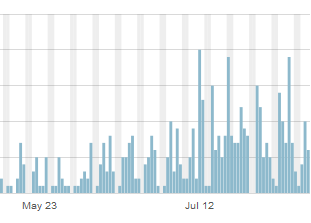
Looking at your daily traffic will show peaks and troughs. If your blog is more popular at the weekends, it might be good to post new content then. If I drill down into one of my blog posts, the ever-popular “What do I do if my comment boxes go tiny in Word?”, I can see that it’s not read very often at the weekends.

This says to me that office workers are looking for and using this post, so I can make sure I post more for that kind of audience and save other new posts for the weekends.

Where do my website visitors go when they leave my site?

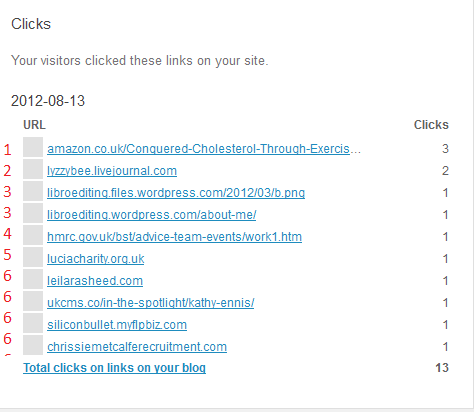
This is usually found under the heading Referrals, or maybe Click-throughs. Here’s a good representative one of mine from a few days ago:

Looking at clickthroughs from my website

You can see that the click-throughs fall into a few groups. 1 is my ebook, which I have linked to in a blog post and on the site itself. Hooray – my PR campaign is starting to work! 2 is a click to my Livejournal blog, linked to on my website. 3 is a pair of pages on this website, filed under my old url but I can see people are navigating around the site and sticking around. 4 and 5 are both links I have on blog posts; 5 is also on my references page. And all those marked 6 are websites of people I’ve featured on my blog, showing that I’m helping them get some traffic, too.

So there we go. Look at those statistics, whether you’re using WordPress or another host for your blog. And look at them actively: think about what they mean and how they can help you to find out how to tailor your blog to your audience and drive more traffic to your blog or website.

If you’ve enjoyed this post, please click on one of the share buttons below, or leave me a comment. Especially if you’ve had any amusing search terms recently!

 
5 Comments

Posted by on August 17, 2012 in Blogging, Business, New skills, Organisation, Writing


Tags: , , , ,

Happy Birthday, Libro!

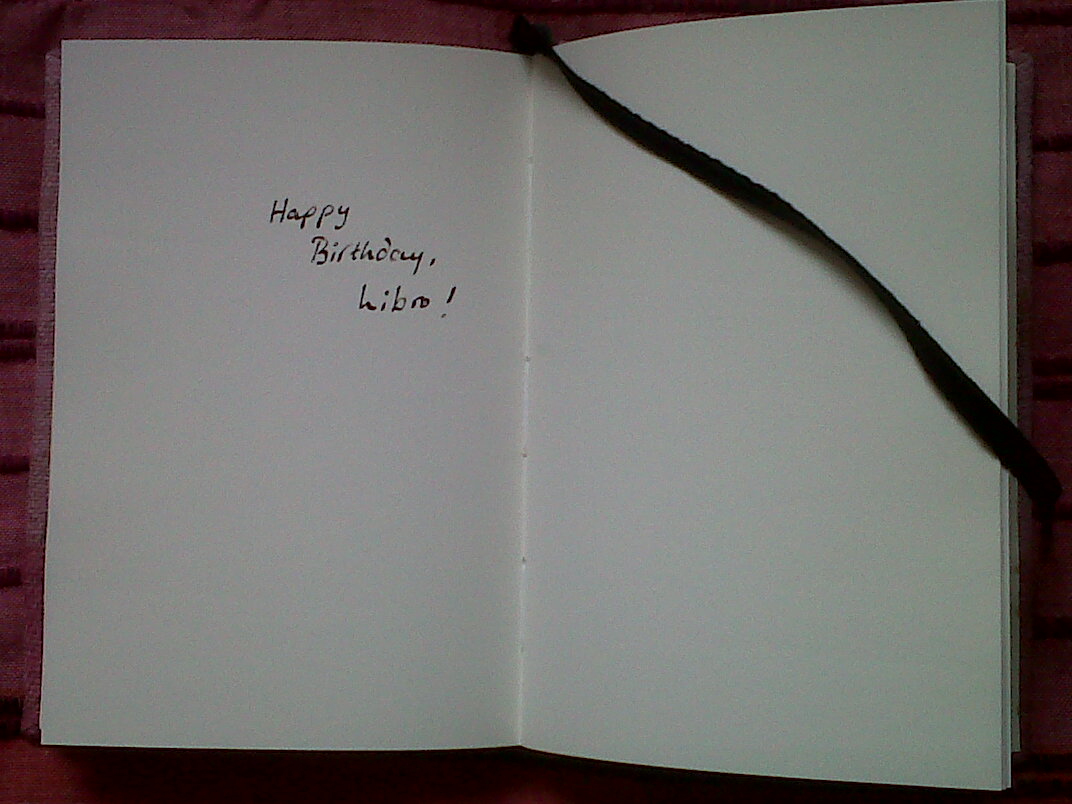
Happy birthday, Libro

I’m proud to celebrate Libro’s third birthday today! In August 2009, I really had no idea that I would be working for myself full time, doing such varied things as transcription, writing and editing as well as thesis proofreading, which is what I started out doing.

I am going to have a small celebration at some stage soon, perhaps with friends of Libro, perhaps just with Matthew. I was considering marking the occasion by buying myself something, perhaps a piece of jewellery. But then I had a better idea.

I’ve been doing Kiva loans for a while now: we’ve got two loans on the go and re-loan them as they get paid back. Now I’ve helped to fund five more women entrepreneurs (which means those loans will be on-going too and help more people as they get paid back). Kiva funds grassroots organisations that help people do small, sustainable things that will make a difference to their lives. Here are the groups and people I’ve chosen to donate to. I’ve also made a donation to LUCIA, a charity close to my heart, run by friends from the Library where I used to work, who do the same kind of work in Ethiopia.

So, I’ve helped these women:

These ladies are in Paraguay, where my friend Sandy spent her year out at University, and they make textiles, which is an interest of mine.

This lady from the Lebanon supplies special food for Ramadan – an appropriate time of year to lend to her!

This group of ladies in Mali (location of Timbuktu, twin town of Hay-on-Wye) have already had and repaid several loans.

This lady goes spear fishing to send her children to school. A bit different from sitting at a desk typing to afford to buy millions of books!

And this lady is from Georgia – I met someone from Georgia at the Social Media Surgery last month, so that seemed appropriate.

If you want to start using Kiva, you can have a FREE $25 Kiva loan to make to an individual or organisation: follow this link to sign up and get your first loan for free! (the management of Kiva have sponsored a certain number of free loans to encourage people to sign up).

Thank you for everyone’s support of me and Libro over these three exciting years. Here’s to the next three!

There had to be a cuppa and a bun somewhere in this post …

 
12 Comments

Posted by on August 1, 2012 in Business, Celebration, Ethics


Tags: ,

Sally Evans-Darby

Welcome to Saturday Business chat. It’s time for another new chat today, and we’re meeting Sally Evans-Darby from Write Sense Media, a very new business, which has only been going for a few months. Sally’s had some very nice things to say about this interview series: when asked if it’s OK to contact her in a year for a catch up, she said, “Absolutely – and thanks so much for this one! Great way to encourage people to reflect on their own businesses, but more importantly, to build up an information database of lots of different people’s experiences. It’s always so useful to read about others’ experiences in something you are thinking of trying out” – which is great for me to hear.

I do meet people who read all of these interviews and find them useful – if you’re one of them, do post to let me know! In the meantime, let’s find out what Sally has learned so far …

What’s your business called? When did you set it up?

Write Sense Media – launched in February 2012. The name was a suggestion from my other half and it just stuck. Write Sense Media offers proofreading, editing and writing services.

What made you decide to set up your own business?

I’ve worked both in-house and freelance as a proofreader and writer, but mostly in-house (read: full-time, 9-5 day job with ‘living for the weekend’ mentality and everything else that lifestyle comes with!). I had thought about being purely freelance before but just didn’t think I would be able to sustain it as a living. Then came a brainwave in the early part of this year where I realised that working freelance was exactly what I needed to be doing. Looking at my life and my career as a whole, I just couldn’t see myself always working in an office for an employer. There would have to come a time where I did the work I love (i.e. editing, proofing, writing) but for myself and with my own values/strategy rather than the views of my employer. So I thought, why not now? Life is short; I decided to just go for it.

What made you decide to go into this particular business area?

I’ve always been into words, whether that’s word-play, crosswords, finding out new words, learning about language. Plus, I’ve always been a mean speller! In primary school I remember the class being asked to look at what the difference was between an old map listing a village as ‘Bishop’s Lydeard’ and a new one as ‘Bishops Lydeard’. I was the only one who noticed the missing apostrophe in the new version. I guess you could say I’ve always had a knack for looking at words, the way they’re presented, and picking them apart.

I love words. As a lot of logophiles will say, I’m terrible with numbers – figures don’t make sense to my brain, but letters do.

I should mention too that I hadn’t realised until this year that there was a genuine career path budding editors/proofreaders can take. The internet is a wonderful resource in this respect. Browsing other proofreaders’ websites, including yours, Liz, made me realise there was a whole world out there of people who read, edit and write for a living – and I wanted to be part of it.

Had you run your own business before?

No – the idea of ‘running my own business’ has always been something I’m slightly sceptical about. I don’t see myself as the particularly entrepreneurial type and I worried about practical things like sustaining this in the long-term. But making the leap and deciding to have my own business was completely the right thing for me. I just had to realise that.

How did you do it? Did you launch full-time, start off with a part-time or full-time job to keep you going … ?

I still had a full-time job when I started up Write Sense Media, because I knew it was going to take time to build things up: create and add content to a website, start a blog, start networking, start making contacts with clients. I see my business as a huge round object that started off stationary, and which took a lot of effort and work to get rolling. Once it was rolling, however, its own momentum keeps it rolling. It’s just that initial struggle into being that every business must go through that means you have to keep a job at first, unless you’ve had the foresight to build up a nest egg beforehand.

What do you wish someone had told you before you started?

That it would take some time but I just had to hang in there and things would work out.

What would you go back and tell your newly entrepreneurial self?

To devote every spare hour I could to Write Sense Media. That I was on the right track and I just had to keep going.

What do you wish you’d done differently?

I wish I’d been able to devote more time to it and of course it would have been a luxury to not have to work full time at the same time.

What are you glad you did?

I’m glad I made my website one of my top priorities, and that I went to my brother, Scott Darby (http://scottdarby.com/), for his invaluable help with this. I’m not the most technical person, so him helping me with this was essential! I’m proud of the result and feel it represents me and my business well, so I’m glad I took the time to make this happen.

What’s your top business tip?

Be yourself. Don’t try to be someone you’re not – whether you’re using your ‘voice’ on the internet, phone, in person, always just be yourself. People respond to people who are human. Also never act desperate, even if you are!

How has it gone since you started? Have you grown, diversified or stayed the same?

So far, in the short time since I started Write Sense Media, my overall ‘vision’ has pretty much stayed the same. I expect things to change though in the future and am open to change. I’m ready to roll with the punches, and keep my business current and alive.

Where do you see yourself and your business in a year’s time?

I truly hope to see my business flourishing and for me to feel much more in control of my life! I hope to have a diverse client base and to have built up lots of long-lasting relationships. I hope to have been to a few SfEP (Society for Editors and Proofreaders) events and to have met other people working in the same field.

I do like “never act desperate, even if you are!” and I’m glad to have been something of an inspiration. It can indeed be frustrating starting up part time and not having all the time you want to devote to your new business, but it’s also a safer way to do it for those of us who are maybe not the traditional type of entrepreneur. Good luck, Sally, and I’ll look forward to seeing how you’re getting on in a year’s time!

Read Sally’s 2013 interview.

Oh, and for anyone who is curious about why I feature people you could see as competitors in this series; I’d rather see them as colleagues! And it’s worth remembering that much of the interest I get in my own blogs and website is generated by so-called competitors, something I talked about a few weeks ago.

You can find Sally’s website at www.writesensemedia.co.uk and, of course, email her.

If you’ve enjoyed this interview, please see more freelancer chat, the index to all the interviewees, and information on how you can have your business featured.

 
7 Comments

Posted by on July 14, 2012 in Business, New skills, Small Business Chat


Tags: , ,