RSS

Tag Archives: freelancing

Are you on top of your Terms & Conditions?

Are you on top of your Terms & Conditions?

Once you’ve been running your business for a while, it’s easy to let your Terms and Conditions just sit there idly, waiting for the next person to come along and half-read them. But a Terms and Conditions document should be a dynamic document which responds to (or hopefully pre-empts) changes in your market or things that your clients might do. My Ts & Cs have developed fairly reactively, based on issues I’ve had with customers, and I’ll admit that freely in order to save people from making the same mistakes!

How to stop overload

Even when you’re an experienced freelancer with a good handle on your workload, things can sometimes get A Bit Much. This happened to me just before our recent holiday (doesn’t it always!). I had promised two standard time turnarounds for two similar and large jobs, months apart. Both had negotiated and checked in through those intervening months, but not recently. Then – oh joy – they came in at the same time. Both of them. Within an hour of each other. And this tipped me into a situation where, although I didn’t miss any deadlines (of course), I was right up against my deadlines a couple of times, working flat-out, slightly too many hours a day, because those two promises had to be fulfilled and then the other work fitted around them.

The reason I couldn’t turn one of those jobs down? Well, I could have if it’d really wanted to, but it wouldn’t have felt professional. The problem was that I didn’t have anything in my Terms and Conditions that expressly covered this situation. So I got the job done, but I wasn’t that happy and had lost the relaxed and flexible lifestyle that I did this all for in the first place, working right up until the night before my holiday (I’m glad I’ve got holiday cover, anyway!).

Now I have a section in my Ts & Cs covering booking me in advance. This states that if a job is delivered to me late, I reserve the right to recommend the client on to another trusted editor (or transcriber or whoever) if I now can’t fit it in. No one likes turning down work, especially if it was booked in, but we have to retain our sanity and a rushed editor is never a good editor.

Interestingly, I read a post by a colleague, Adrienne Montgomery, about what happens if there’s a delay in submitting work to you and you have a gap in your schedule. I probably have a less-than-standard schedule because I tend to do lots of smaller projects rather than a few big ones, so I can always fill in gaps (with blog writing if nothing else, but that’s actually rare) but hit trouble when I get something in in the middle of other projects. But maybe that makes me more typical of freelancers as a whole.

How to firm up payment terms

Another example of learning from experience came when a client neglected to pay me. I had to call in a debt recovery company, and from them I learned that it’s customary to add in a paragraph to your Terms and Conditions that states that non-payers will be liable for your debt recovery company fees. You can’t claim those fees back from them unless you’ve put that in your Ts &Cs first, of course. So that’s gone in there, too.

Can you make people read your Terms and Conditions?

In my original negotiations, I always ask my prospective client to read my Ts & Cs and confirm they accept them. I’ve now tweaked that to say that sending in their document to me constitutes acceptance of my terms – this protects me if they claim they didn’t know they had to pay, etc., and might just lead them to read them. If you have ways of getting people to engage with yours, I’d love to hear them!

Other additions to Terms and Conditions

Your business will vary from mine. Mine are specific to my market and my clients, and the way in which I work. For example, I have a big section on how I work with students, in order to combat the issue of plagiarism – and to be seen to be doing so. This originally arose when a very early client complained that I hadn’t done as much rewriting of their essay as they’d hoped! I also have a section on corrupt files that releases me from having to fight with recalcitrant documents that won’t behave, and bits on plagiarism for writers other than students.

Check your Terms and Conditions now

Do yourself a favour and review your Ts & Cs regularly. I had my colleagues Laura Ripper and Linda Bates look over my additions and changes before I published them. As well as adding the sections on pre-booking and debt recovery companies, I firmed up a few other areas, too. It’s worth keeping on top of things.

Here are my Terms and Conditions – a work in progress, as I said. You may know me as an editor, transcriber, proofreader and localiser, but I also write business books and you can find out all about them here!

 
3 Comments

Posted by on April 15, 2015 in Business, Organisation


Tags: , , ,

How to leverage your social capital

handshakeHow to leverage your social capital, eh? What a lot of jargon! I thought you didn’t like jargon, Liz? – Well, I don’t, and that’s why I’m going to take a few minutes to explain what this little chunk of jargon means.

Social capital is a fancy term for the people you know and, to be blunt, the favours they owe you. You build it up through networking, doing things for other people, being a linking person, an information provider, a helpful person. You build it through knowing people, through having worked with people, through keeping in touch with people. Then, when you need it, something like karma springs into action, and the work you’ve put in comes back to you in bucketloads.

Now I’m sounding cynical as well as jargon-filled! Goodness me! Let’s break it down with some heavily disguised but based-on-reality examples, to show you that leveraging your social capital isn’t really the cynical and shallow procedure you might imagine, but a new way for an old process that is made easier to build and use through social media and our networked society.

Social capital gets leveraged, everyone goes away happy

Here are some examples of people leveraging their social capital to gain freelance jobs and repeat clients. Note that in NONE of these cases does Person A directly ask for something. Instead, the connections they’ve built up do it all for them.

Example 1: Person A, Bob, ‘meets’ Person B, John, online via a mutual interest group that’s applicable to the industry they’re both in. Bob is about to go full-time with his freelance career but doesn’t have many clients. John is a full-time freelancer of a few more years’ experience. He’s looking for people to recommend enquirers on to when he can’t fit them in. He’s also keen to get some holiday cover set up so he can go and play golf without worrying about his graphic design clients. They make friends and build trust – they even start to meet up to play golf together. When John gets yet another enquiry about leaflet design, it’s easy for him to recommend Bob. Bob worries sometimes that all of his jobs come through John’s recommendations, but soon he has his own string of client referrals because he does a good job. And when Bob goes on holiday, he passes John a big project that he hasn’t got time for – from a client originally recommended by John!

Who benefits: both of them. Bob gets new clients and builds his customer base. John has people he can refer clients on to and that all-important holiday cover.

Bonus social capital leverage: When Bob, now nice and busy himself, finds out that a friend he’s made at a networking event is looking for clients, not only can he recommend his own overflow to Tony, but he can advise John to, as well!

Example 2: Person A, Millie, used to work with Jeremy before they both left and went their separate ways. But they’ve kept in touch via Facebook and chat online every month or so. Jeremy moves between jobs and continents, so knows lots of people. When he hears from Simon, an ex-colleague in Australia that they’re looking for someone with the skillset Millie possesses, and that they don’t need someone on the spot, Jeremy puts Millie in touch with Simon, and they work on the project together.

Who benefits: both of them. Millie gets a job out of it, and Jeremy maintains contact with an ex-colleague and does them a favour, which could well be repaid in the future.

Example 3: Person A, Tim, meets person B, Shona, at a local networking event. They’re not in the same line of work at all, but they have a good chat and get on well. They say hello at a few other monthly events. One day, Tim is contacted by Sean, who wants to use him for a major new contract; he’s been recommended by Shona, even though she has no direct experience of his work (of course, Sean has checked out Tim’s website and references before contacting him). Not only does Tim get the job, but Sean recommends him on his website and to other clients of his.

Who benefits: In this case, it looks like it’s mainly Tim, however, he is so grateful to Shona that he goes out of his way to retweet and share messages Shona sends out on social media, and to introduce her to useful people at the networking events they attend.

How to build social capital

So, how do you build this social capital? Note that it’s not social MEDIA capital, although social media makes it easier to do. But you can build social capital through networking and more old-fashioned face-to-face contact, too. In both Examples 2 and 3, the initial contact was in person, and social media only comes into play to make the contacts between the people who want the work doing and lucky old Person A.

Building social capital shouldn’t be a cynical process, but a natural one that involves making a bit of effort. Ways you can increase your social capital include:

  • Getting out there – the more people you meet, the more people can help you
  • Telling people what you’re looking for – whether it’s announcing to your Facebook friends that your violin-making business is looking for commissions or joining a networking group and explaining what services or products you’re promoting
  • Making yourself memorable – whether you’re the “good hair lady” (true example) or the person who always brings cakes to the meetup, make yourself memorable in a good way
  • Making yourself easy to explain – this comes down to your elevator pitch. Do people know you as “the man who makes violins on commission” or “that music chap”? The more precise your description, the more likely you are to have people sent your way who you can actually work with
  • Being gracious – if someone is introduced to you who you can’t help (or with whom you’re not interested in working), see if you can recommend them on, or have a chat anyway. You need to leave a positive impression on everyone you meet if you possibly can
  • Do things for other people – this should go without saying, but I’m going to say it. More below on this one

It’s cynical to say that someone “owes you one”, and it can be far more complex than that, but it can’t be ignored: the more you help other people, the more they will help you in return. How can you do things for other people?

  • If they’re in the same business as you, see if you can pass overflow work to them
  • If they’re in a closely related business to you, mention them to your clients as someone who can help them – e.g. the violin maker might know a musicians’ agent who they can recommend to their clients
  • If they’re in a fairly different business to you, bear them in mind and mention them – e.g. the violin maker might be chatting to a musician and mention that he knows an event organiser who’s looking for entertainment for a summer party
  • If they’re in a completely different business to you, still bear them in mind and suggest them – e.g. the violin maker is chatting to a musician whose wife needs a web page to be designed
  • You could create a Links page on your website with links to known and trusted contacts in your field and others
  • You could put a poster for their event in your shop window or volunteer at an event they run
  • You could introduce a friend with a different kind of business to one of the networking events you go to
  • You could share tweets and Facebook posts by your contacts with your audience (you should be doing this anyway)
  • You could cross-guest-post on each other’s blogs

 What has worked for you?

Knowing and trusting people + getting out and about and meeting them face to face or online x helping people out yourself = increased social capital

Have you got good examples of your contacts creating opportunities for you with third parties? I’d love to hear about your successes and how they came about …

Further reading on this blog:

Reciprocity and social media

Networking and social media marketing

Networking for newbies

If you’ve enjoyed this post and found it useful, please comment below or use the sharing buttons to share it with your network. If you’re considering setting up a new business or have recently done so, why not take a look at my books, all available now, in print and e-book formats, from a variety of sources.


Leave a comment

Posted by on August 6, 2014 in Business, Social media


Tags: , ,

Developing your Business: Expanding into Regional Offices

Sneak preview of the image from my new bookWelcome to another expert post in my series on growing your business. Today we’re going to take a look at why it makes sense to have a physical presence around the country (or beyond), written for us by Juliet Martin, representing Regus. Linked to this post, you can read about small business owners’ own experience moving out of the home office here, and Sam Barnes’ post about what to consider when planning to move outside the home here. Juliet’s going to share with us the value of renting offices in different places.

Advantages of Renting Corporate Settings around the Country

Today’s ever-growing business world is taking with it the ability for any one enterprise to be localised in a particular place. This means you should at least consider setting up new branches or virtual offices in multiple locations across the nation. Even though you will have to then manage a number of settings, you will gain plenty of benefits in the long run. Adapting to these modern, global times will provide you with the following five corporate advantages.

A commercial building

It pays to have more than one branch for your business Image

1. Access to Local Resources

If you produce any kind of goods, you may find that the various materials and components required are sourced from multiple areas around the country. For example, you may find the following are located in different regions:

• Mines
• Factories
• Ports
• Plantations
• Refineries

By opening up small branches near each of these facilities, you will then give your company greater access to a range of materials and services directly from the source. This means you won’t have to rely on a third party to bring these essentials to you.

2. Lowering Your Monthly Rent

Believe it or not, it may actually be more cost-effective to run a number of bare-bones offices around the country than a fully functional corporate setting in a single location. After you have negotiated to reduce the rent of your many branches, you can then look forward to even more savings thanks to the smaller and more compact premises that your company is now working from. If you can simplify how your work settings are planned out, eliminating excess features and only renting what is necessary, you can streamline your outgoing cash flow and still benefit from a number of corporate environments located around the country.

3. Honing Your Corporate Marketing

One difficulty that any localised business has is that its target audience is fairly limited, being restricted to a single geographical area. You can get around this by working from several different locations across the country. In general, people will wish to work with a business that has a presence in their neighbourhood because:

• It provides a local face to the company
• Contacting the enterprise is much easier
• Delivery times won’t be needlessly long
• Employees will be much more relatable

By branching out across the nation, you can tap into a wider consumer base than ever before, enabling you to find additional customers and boosting your sales to help cover the rental costs of your various corporate locations.

4. Added Convenience for Clients

Another advantage to the consumer is that it is far easier for them to come and visit your workplace if you are found scattered across the country. To cater to all your client’s needs, rent some office space at business centres around the nation. This will give them additional convenience as they can deal with your company in a number of ways thanks to your now local business setting. For example, they should be able to:

• Visit your office without driving for hours
• Post parcels and letters to you cheaply
• Phone without expensive long distance rates

There are times when your clients want some personal attention. In these cases, email won’t suffice. Video conferencing can be difficult to set up properly too. A better solution is just to have a local branch available so they can arrange for an appointment with you or a company representative without having to go through a lot of hassle to get there.

5. Broadening the Talent Pool

Lastly, by making the effort to rent corporate premises around the country, you will then have access to a greater range of skilled workers for your business. The truth is that having the right resources is crucial to helping you identify new talent. In this case, the resources in question are your local offices which can then tap into the growing number of potential candidates found in those local regions. People may not want to relocate to another city to work with your company so having multiple branches will give them a reason to sign on with you even though your main office is found halfway across the nation! In this way, you can increase the sheer talent within your organisation and grow your products and services accordingly.

As a brief recap, we can see that renting workplaces across the country can indeed provide many benefits to any enterprise. These advantages include the following:

1. Ease of access to national resources
2. More cost-effective rental payments
3. Effective locally targeted advertising
4. Increased consumer convenience
5. Wider talent pool for new employees

We would recommend that you get out there and expand your business operations as soon as possible to reap all of the above rewards. By occupying some of the best corporate spaces around the country, your company can grow and your customers will get even better service as a result! To make the process easier, get in touch with a provider such as Regus for assistance on renting suitable spaces at cities or regions you have interests in.

Author Bio: Juliet Martin is from Regus, a global office space solutions provider. Founded in 1989, Regus is a global organisation that aims to provide only the best office spaces and meeting venues to all kinds of businesses.

This post is part of my series on growing your business. Read more here and read about my own business journey in my books.

 
1 Comment

Posted by on June 11, 2014 in Business, Guest posts, Organisation


Tags: , , ,

Developing your Business: Moving Into Office Space – How, When and Why?

Sneak preview of the image from my new bookAs part of my series on growing your business., we’re taking a look today at the expert’s view on moving into office space. You can read about other people’s personal experience of moving out of the home office here, and today I’m delighted to welcome Sam Barnes from Easy Offices, who is going to run through things to think about when upgrading from your home office from an expert’s perspective.

Many people choose to start their businesses from home. It’s cheap, convenient and comfortable. For some businesses, that’s all that’s required and they never feel the need to break out of the home office. For the majority of businesses though, office space becomes an essential as revenues grow. We’ve helped all manner of businesses find office space, from single person start-ups to massive corporations. However, there’s no doubt that with the advice you’re about to read, the process of selecting and moving into your brand new office, will be made substantially easier.

Why does my business need office space?

Your office space is the centre of your business.

Without offices, you’re running the risk of not being taken seriously by other businesses or consumers. Imagine if the next time you wanted to go the bank you ended up at a home, not an office. Commercial premises are a necessity of business.

The practical side of getting your own office space is extremely important too. You’ll have your own phone systems, postal address and meeting space. All of these things will be vital as you grow your business, providing the infrastructure that will drive you forward.

When should my small business move into offices?

This is a slightly more difficult question to answer. There are lots of reasons that you might need to look into choosing office space:

•    You’re outgrowing your existing office space.
•    You’re taking on more staff.
•    You need a meeting room for clients.
•    There are too many distractions at home.
•    You’re unsatisfied with your current office space.
•    You need better facilities, i.e. better internet, private rooms, reception area etc.

There could be hundreds more reasons on this list, but the vast majority of office moves are instigated by a lack of physical space, specifically when taking on more staff.

If you find yourself thinking, on more than one occasion a day, that a bigger office would make your work more effective or allow your business to grow more easily, then I would say it’s time to take the plunge!

As your revenue grows, you’ll find that justifying the cost of an office becomes easier and easier. Having the cash to be able to fund an office move is an absolute necessity.

How do I go about choosing office space?

There are three main kinds of office space available to small businesses in the current market:

1.    Co-Working Office Space

Co-working spaces can be a great fit for some businesses. They’re the cheapest of the three main options available. Essentially you’ll rent a couple of desks in a room or part of a larger office. This gives you the ability to separate your work and home lives while keeping costs low while your businesses is in the early stage of development.

You’ll never know who you might be sharing with and you can make some amazing new businesses contacts while sharing office space. We’ve heard lots of fantastic success stories about relationships formed in shared environments. Equally you’ll want to know before you choose a certain office, what kinds of businesses you’ll be working alongside. If you need a really quiet environment, make sure those around you feel the same.

You’ll also have access to shared mail, printing and catering facilities.

If you’ve only got a couple of staff and you work as one well-oiled machine, a co-working space would be ideal.

2.    Serviced Office Space

Serviced office space is more expensive than co-working office space, but not quite as expensive as a full-blown office lease.

It’s the perfect choice for companies with a few staff who need room to grow. You’ll have a dedicated space for your business (no co-working here). You’ll have all the kitchen, printing and mail facilities that I mentioned before, plus some added features. These normally include security, some kind of reception area, cleaning services and usually the ability to rent extra infrastructure such as improved internet connections.

You’ll get to put your own stamp on things too! The simple branding of your office through posters, mugs and pens can turn the feeling in your office from start-up to established business.

A fantastic choice for businesses growing quickly who know they’re going to need space to meet clients and further expand their operations.

3.    Office Lease

The only option for larger businesses, an office lease lets you rent an entire office. This is necessary when your business has outgrown your existing solutions or needs to centralise.
As this post relates to small businesses, I won’t go into too much detail here. What I will say is that you’ll need to be making substantial revenues before choosing a fully leased office. The costs involved are substantially higher than serviced or shared offices.

Some Top Tips for Choosing Office Space

Here are a few questions that you’ll need to ask yourself before making your choice to move offices:

•    Price – Can you afford it?
•    Space – Does the office you’re looking at give you enough room for meeting clients and working as a team?
•    Infrastructure – Do you need a dedicated phone line and Internet? Does the office you’re interested in office this as a service or do you have to organise it yourself?
•    Facilities – Can you and your staff park here if they drive? Are the kitchens clean?

They might sound like simple, fairly obvious questions, but if you fail to take one of these things into account you’ll be paying for it for months to come.

The best advice I can give you when attempting to choose an office space, is do your research.

Start out with a list of criteria that you need from your office. If any one of the office spaces you go to look at doesn’t meet even one of them, keep looking. There’s a space out there for everyone!

sam barnesSam Barnes is from Easy Offices.

The company works tirelessly to help businesses of all shapes and sizes find the perfect office space for their needs. He is interested in everything small business related with a particular interest in marketing. He works in the digital marketing sphere.

Outside work, he’s an avid football fan, with Arsenal being his lifelong obsession. He also has a passion for music and film. He’s currently rattling through the IMDB top 100 as a personal challenge.

You can also find Easy Offices on Twitter.

This post is part of my series on growing your business. Read more here and read about my own business journey in my books.

 
1 Comment

Posted by on May 28, 2014 in Business, Guest posts, Organisation


Tags: , , ,

10 things that you can do to prepare for self-employment

Things to do today bookI’ve been going through these points with a few friends recently, and it struck me that it would be useful to write them down.

Here’s the situation: you know you’re going to be going self-employed / become a freelancer, but that time hasn’t come yet for whatever reason. Maybe you’re working out your notice, maybe you’re waiting to hear when you’re going to be made redundant, maybe you’re in negotiations, maybe you’re moving to a new city and will be setting up there.

Whatever the precise situation, you have some time now to prepare for the future. Use it wisely and you can hit the ground running (sorry for the cliché) and be in the best possible position to start picking up work and collecting clients.

1. Do any local courses and register as self-employed

Whatever country you’re in, you should be able to look into going self-employed, make sure you have all the paperwork and details you need, perhaps take a course (in the UK, the HMRC courses are now run online) and even register as self-employed (you need to do this within x time of your first income from self-employment, so why not sort it out now?). ALso remember that if you want to submit your tax return online, there’s a separate process to do that and you need to do it as early as you can (more info here).

2. Get business cards

These don’t need to be complicated. They can just include your name, email address and phone number and maybe a website url (see Point 3). Get them from a relatively inexpensive site like VistaPrint (I get mine done there, you can tweak them to not include the VistaPrint logo and get relatively good quality).

In time, you can get fancy cards with logos. You don’t want to be in the situation where you attend training on setting up your business, meet a potential contact and don’t have a card, or be passing out your wife’s card with your name scribbled on the back. Be ready to meet opportunities.

3. Set up a website

Get the basics up now so you have somewhere to point people. It doesn’t have to be fancy: just one page with your contact details, an idea of what you do and a photo will do for now. You can expand on it later on. This is also a place where you can collect testimonials and start building your reputation.

If you use a platform such as WordPress, you can buy your domain name from them, so you don’t  have “WordPress” in the URL. But I don’t think that matters as much as it used to, so if you’re not sure that you’re going to be self-employed long term, by all means just register the liz.wordpress.com type URL.

If you haven’t thought up your business name and haven’t got time to sort out a URL and any hosting issues, there’s no harm in writing up the text for your first pages so you have it to hand when you’re ready to set up the website.

Do not, at this stage, get tempted into paying thousands of pounds for an all-singing, all-dancing website. You don’t that at this stage, and you will end up radically changing your website in the first year of trading anyway. Save up for that until you know exactly what you want. This point is about web presence and having somewhere to point to right now.

4. Start reading up and doing research

I recommend reading a couple of small business books and also picking out some blogs to follow. Choose a couple in your line of business and a couple of general business blogs. You might even start interacting on the comments and asking advice, even making some small business friends.

5. Work out some basic terms and conditions

This is the one that most small business people find trips them up in the first years of trading. Certainly, my terms and conditions have been forged through mistakes, panics and worries. I really wish that I’d had statements on what I will and won’t cover in terms of subjects, specific information for students, information on how I invoice and when I expect payment, etc., set out somewhere. I meet many people who learned this the hard way.

To get these together, it’s worth looking at other people’s in your industry, or turning to services like those of the Federation of Small Businesses, who offer members template customer agreements and terms & conditions.

6. Get your finances in order

The two basic points here are:

a. Make sure that you have a separate bank account to run your business through. This can be an untouched current account, again, you don’t have to have a fancy and expensive business account to start off with, but make sure you can keep the business separate from your personal money. Your accountant will thank you for this, and it will make it easier come tax assessment time, too.

b. Make sure that you have some living money for those early days. Tighten your belt now, if you can, and put aside as much money as you can. The general recommendation is three to six months’ worth of basic living money (rent/mortgage and bills) put aside to see you through. By going part-time, I got myself a year (of very basic living) ahead of myself. It just gives you that breathing space.

7. Set some targets

While you’re working out what your basic living expenses are for Point 6, it’s worth setting some targets for your monthly earnings. Make them cumulative, so that if you have a bad month, you can still see that you’re doing OK. For example, if you want to earn £24,000 per year after tax, you’re going to need to earn at least £32,000 before tax. That’s £2,666 a month. If you earn £4,000 in January but only £1,350 in February, it’s useful to know that you’ve made just over £2,666 a month on average.

I like to set three targets a year: one to cover basic living expenses, one comfortable one and one to aim for, as this gives you room to expand faster but not on just impossible target.

8. Get to grips with social media

You’re going to end up using Twitter, Facebook and LinkedIn as a business person, you can’t help it. So get to grips with them now before you’re faced with a Twitterstorm after an unconsidered Tweet!

9. Get testimonials

While you still have access to colleagues and even perhaps clients who might be able to give you a testimonial, ask them for it. If you have a LinkedIn account set up, you can use that to request references. If you’re doing bits of the same work you’ll be freelancing in for free, ask for testimonials.

Always ask if you can use the testimonial on your website, and check if it’s OK to put the person’s name and company next to the testimonial (the more traceable the reference, the more powerful it is).

This way, you’ll start off with some visible backup and proof that you are who you say you are. Going into a different industry than the one you’re employed in? Keep it general – everyone likes a cheerful, reliable hard worker, don’t they!

10. Speak it out loud!

Tell people what you’re doing. Not a million people, not everyone all at once, and of course there may be situations at work where you can’t talk about it. I know how powerful it was when I started saying “I’m going to go full time with my business by this time next year”, and I’m sure that it helped me to do that.

————-

Thank you for reading my top 10 tips for preparing for self-employment. Have you got any more? Do you madly agree or wildly disagree with any of them? Do post a comment and if you’ve found this interesting, please do use the share buttons to share this on whatever social media channel you fancy – it all helps to help people!

If you’re considering setting up a new business or have recently done so, you will find plenty of careers resources on this website (click on that link or surf around the category cloud in the sidebar). Or why not take a look at my books, which have loads of information about starting and maintaining a freelance career.

 
3 Comments

Posted by on February 26, 2014 in Business, Organisation, Social media


Tags: , ,

How to set up a WordPress blog 2: adding pages to make it into a website

Following on from my posts about how important it is to have a website for your business and on setting up your WordPress blog (which you need to read before reading this if you’re a novice), in this article, I’m going to show you how to add pages to your WordPress blog to make it into a website.

This is what I did when I created this website that you’re reading this blog post on right now. I’m going to use my special test WordPress blog to show you what to do, and also the inside workings of this blog for the more complex aspects. Read on to find out how to set up web pages on your blog, and first of all, why you would do that.

What’s a WordPress page and why do I need them?

A page is a static, unchanging screenful of information, for example what you see when you go to my About page on this blog, or my page about my Business e-book on my writing blog. Where a blog post is written, published, moves down the blog page and is superseded by new blog posts, like a diary, a web page is fixed, stays the same and is visible whenever you visit its home. Where a blog is like a diary, a web page is like a passport photo or a lawn sign.

Why do you need one? Well, when someone reads your blog, they’re going to be bound to want to know something about you – that’s why pretty well all blogs have an About or Home page. And if you run a company, it’s advisable to put together a page, or a set of pages organised into some kind of structure, that tell readers about what you do, how you do it, what it costs, etc.

Website readers have a low attention span. They want to read a bit of stuff then move on. Many of them don’t even like scrolling down to see what’s lower down on the page. So a) they’re not going to want to search or scroll through your blog to look for information, and b) they don’t want everything on one web page. My website is quite wordy; imagine what it would be like if all that information you can access along the top menu bar was all on one page.

So, you’re convinced that you need at least an About page. You understand the difference between pages and posts (pages = static; posts = constantly updated diary type affair). Let’s find out how to set up a page on WordPress.

How do I set up a Page on WordPress?

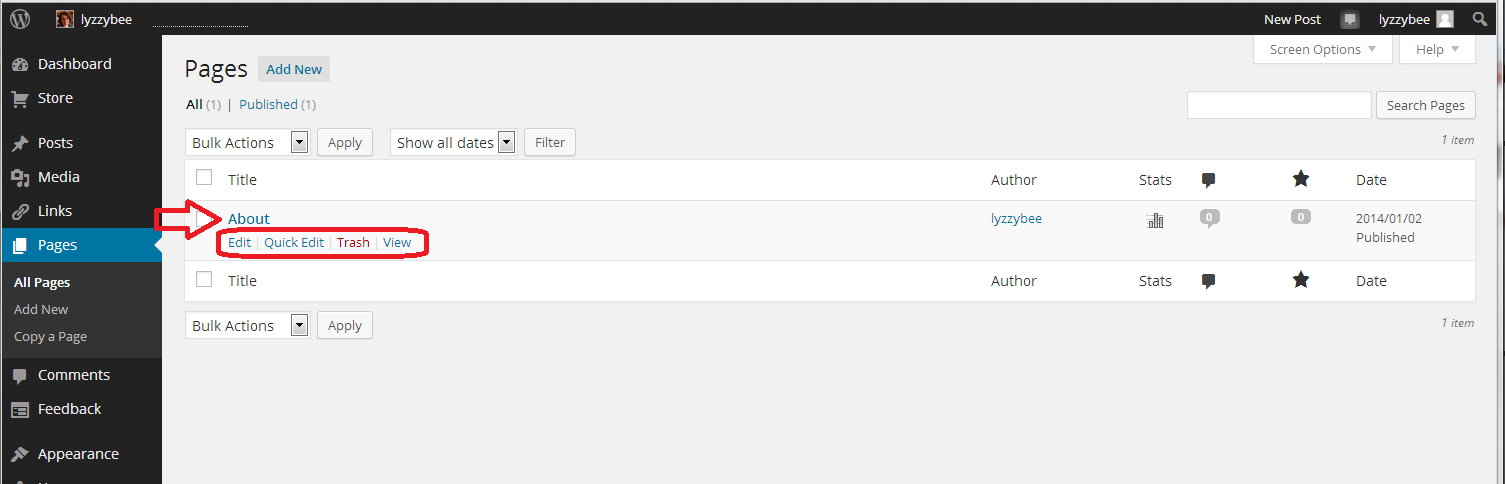
You access Pages from the Dashboard (click on your blog name or the little house icon next to your blog name on your Stats page to reach it). Once in the Dashboard, go down to Pages, click, and choose All Pages. This allows you to see what pages are already there – and once you have some, you can edit them from here.

1 pages

Why have I gone here first rather than hitting the New Page option? Because every new WordPress blog has an About page set up already, to get you started.

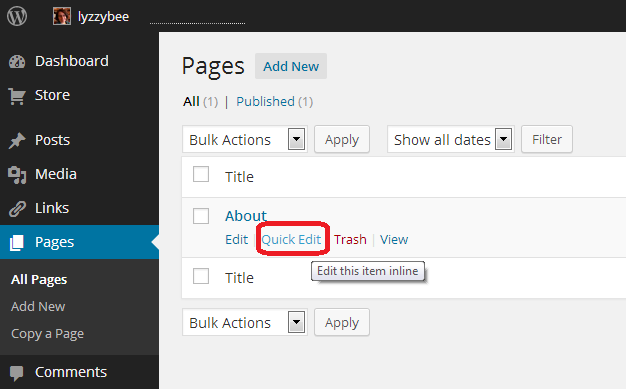
In the All Pages view, you can see all of the pages that you have set up, and hovering over the page title with your cursor allows you to Edit, Quick Edit, Trash or View them. Here, we’re going to Edit

2 about

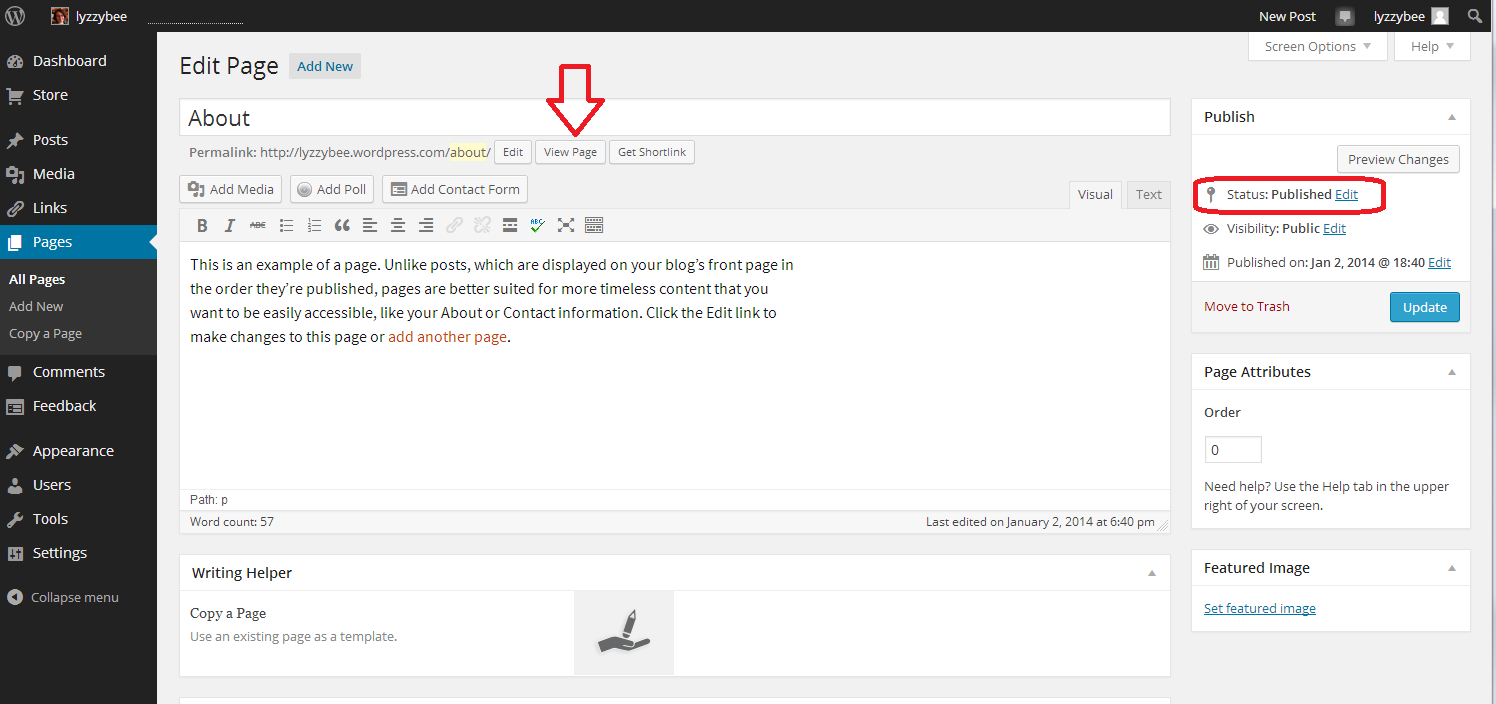
When you click Edit, you’ll arrive at a screen which looks very like the one that you use to create a new blog post. However, it has Edit Page at the top, and some Page Attributes to the side.

You can see that you have a title area (which includes the word “About” and a text area, which also contains some text at the moment.This can all be edited and customised just how you want it.

You can also see here that the Status is showing as Published. That  means it’s live on the Internet for all to see …

3 about

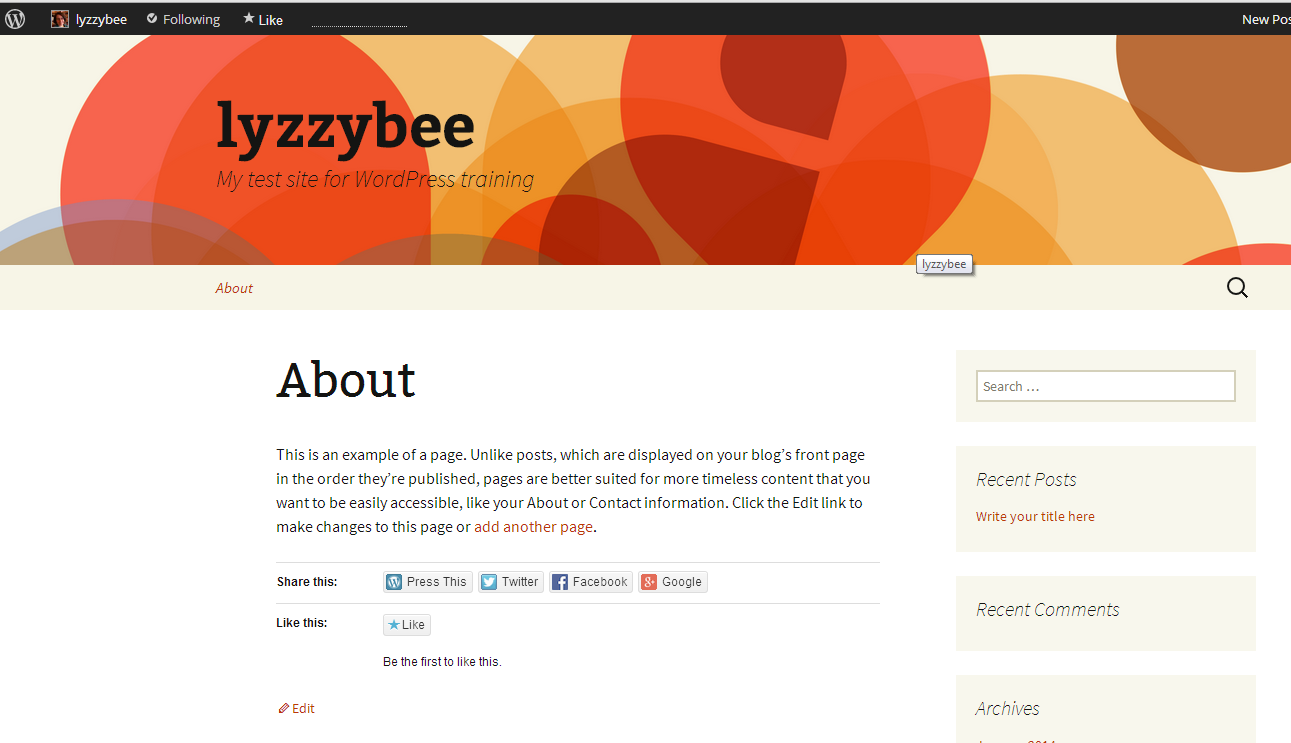
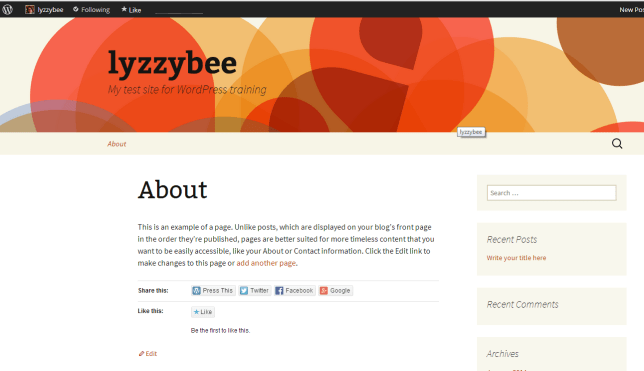
Want to see what this page looks like? Click on the View Page button just under the title …
4 about

This is likely to open in a new window – if it doesn’t, hit the back button on your browser to get back, or the Edit button at the bottom (or top, depending on your theme).

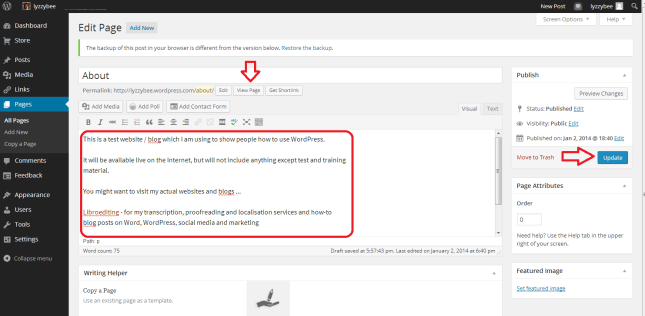
If you want to edit the text, which I do in this case, just delete the text that’s there and add some new. When you’ve edited it as you wish, hit the Update button to save. Then use the View Page button to have a look at the changes. Note: I’ve added hyperlinks here – here’s an article explaining how to do that
5 about

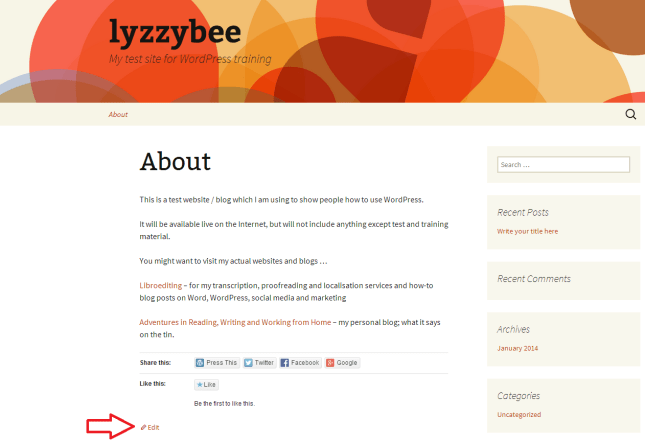
When you look at the page on the blog, there is all your new text, including the hyperlinks:
6 about

How do I set a web page to be my landing page / front page?

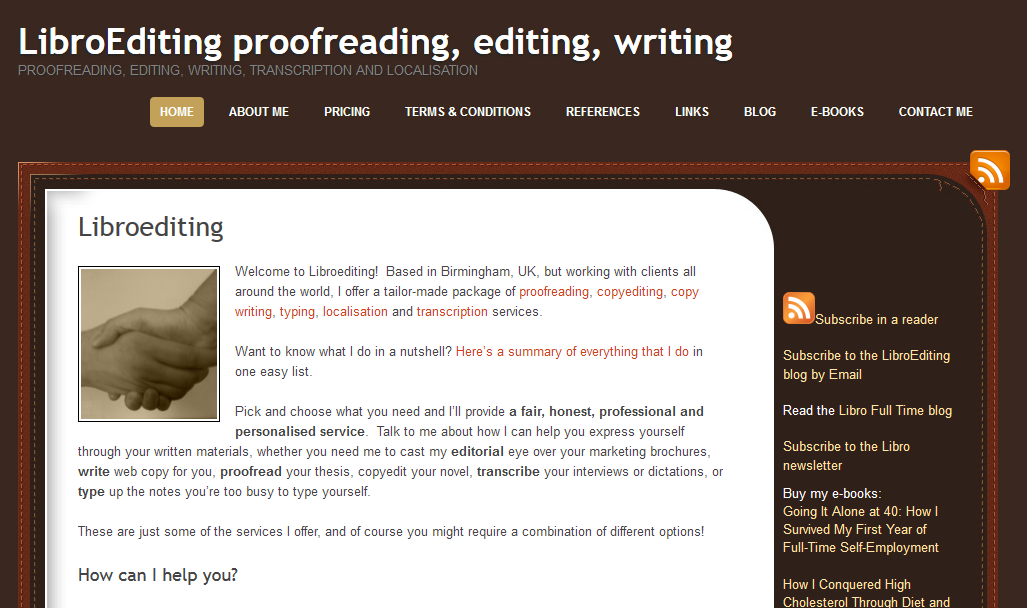
In some circumstances, you might want a static page to be the home page / landing page / front page that a visitor to your URL will always see. I do that with this website – whenever you go to www.libroediting.com, you will see my Home page. However, visit www.librofulltime.wordpress.com and you’ll see the latest blog post I’ve published, and you’ll need to click on the top menu to see a static page about you. It’s all about what you choose to do.

I’d recommend that if you are primarily blogging, with just one or two pages about you and your background, leave the landing page as the blog. If you’re promoting a company, product or service, and your blog is supporting that and driving visitors who you want to buy from you, choose to display a static web page when a visitor arrives.

Here’s how you tell WordPress to show visitors a page, not your latest blog post.

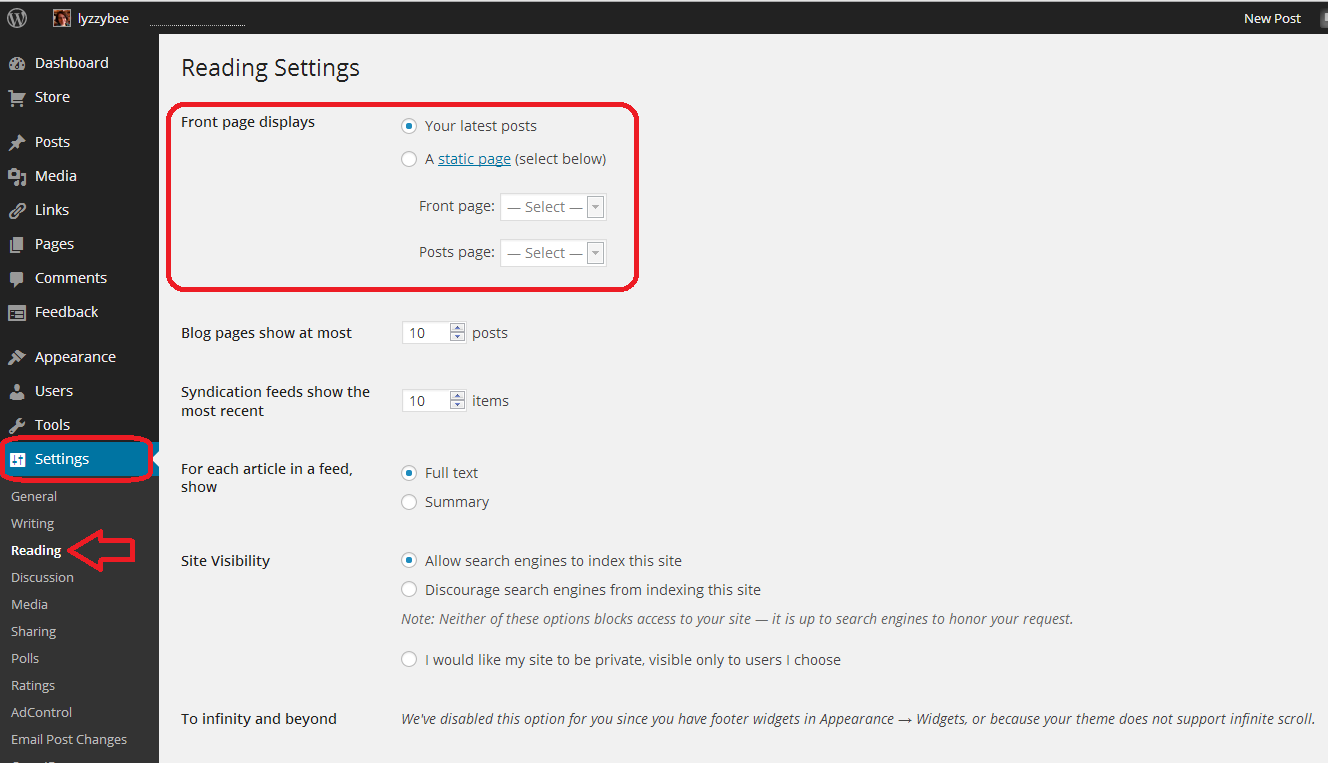
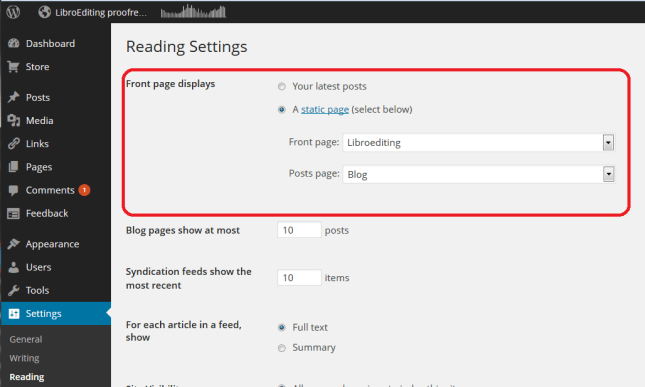
Go to the Dashboard, choose Settings, and then Reading. Right at the top of the page, you have a section entitled Front page displays. You have the choice of Your latest posts (i.e. your blog) or A static page. If you click on that radio button, you will be asked to choose a page to display.

7 set page as front page

I have chosen not to do that for this test website/blog, mainly so that I can change it if I’m training people face-to-face, but here’s how this Libroediting site is set up. I have chosen Libroediting as the front page, and Blog as the posts page. That means that any visitor will, as you’ve seen if you clicked the link above, see my Home page on their initial landing on the site.
8 set page as front page

How do I add a new Page to my WordPress website/blog?

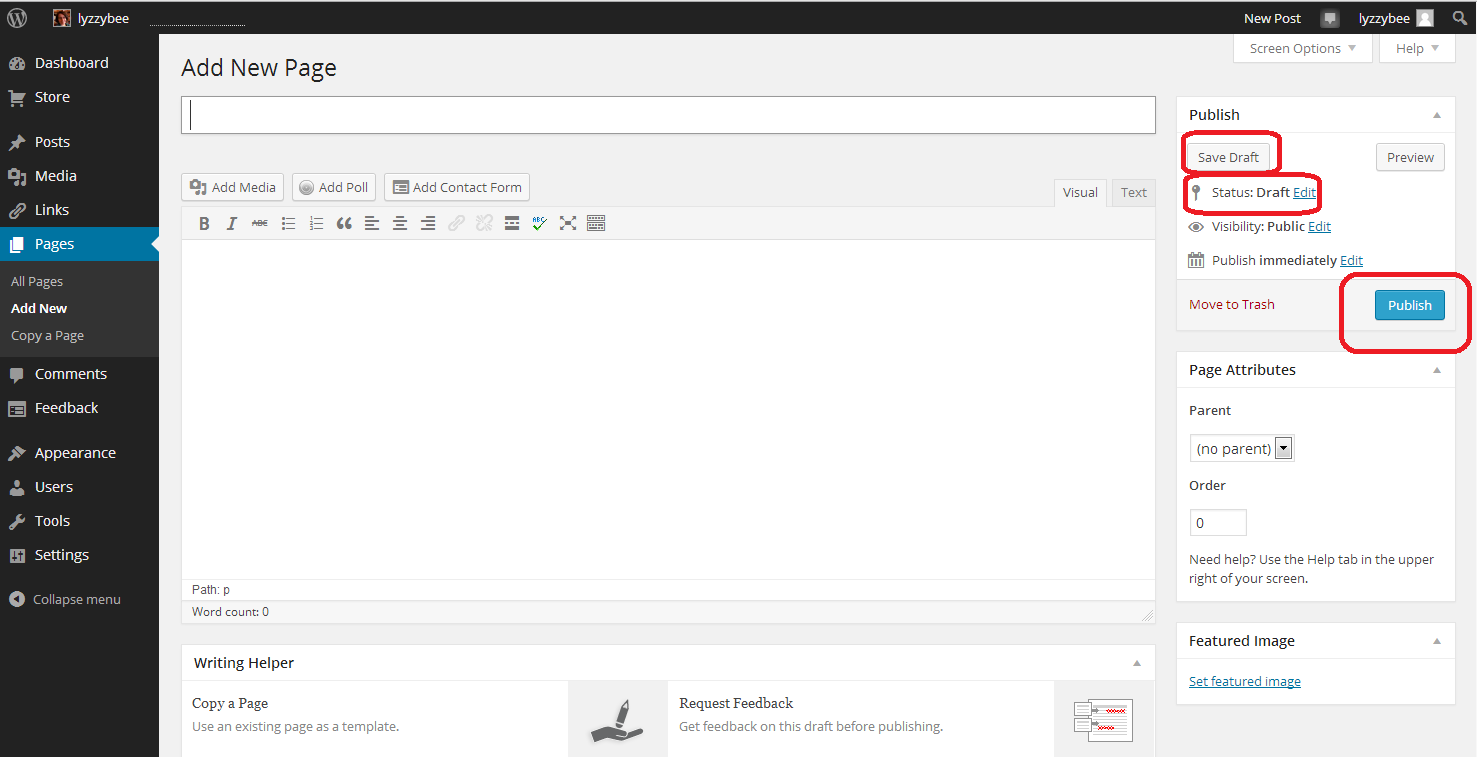
If you want to add a brand new page, revisit the Dashboard and choose Pages – Add New. Note, you can Copy a Page, too. This will give you an exact copy of a page you already have – more useful for posts, but if you have special formatting that you’ve set up, or you’re splitting the text on a page over several new pages, it’s worth doing that. Click on Add New

9 add new

… and you will find yourself in a completely blank editing page. Note that now the Status reads Draft, and you also have an option to Save Draft. Please press this very, very regularly, so you don’t lose your draft posts. When you’ve finished adding the text for your new page, hit the Publish button to make it live (or you can leave it in Draft form if you want to work on it further; just do remember to Save Draft).

10 add new

How do I view and edit my pages?

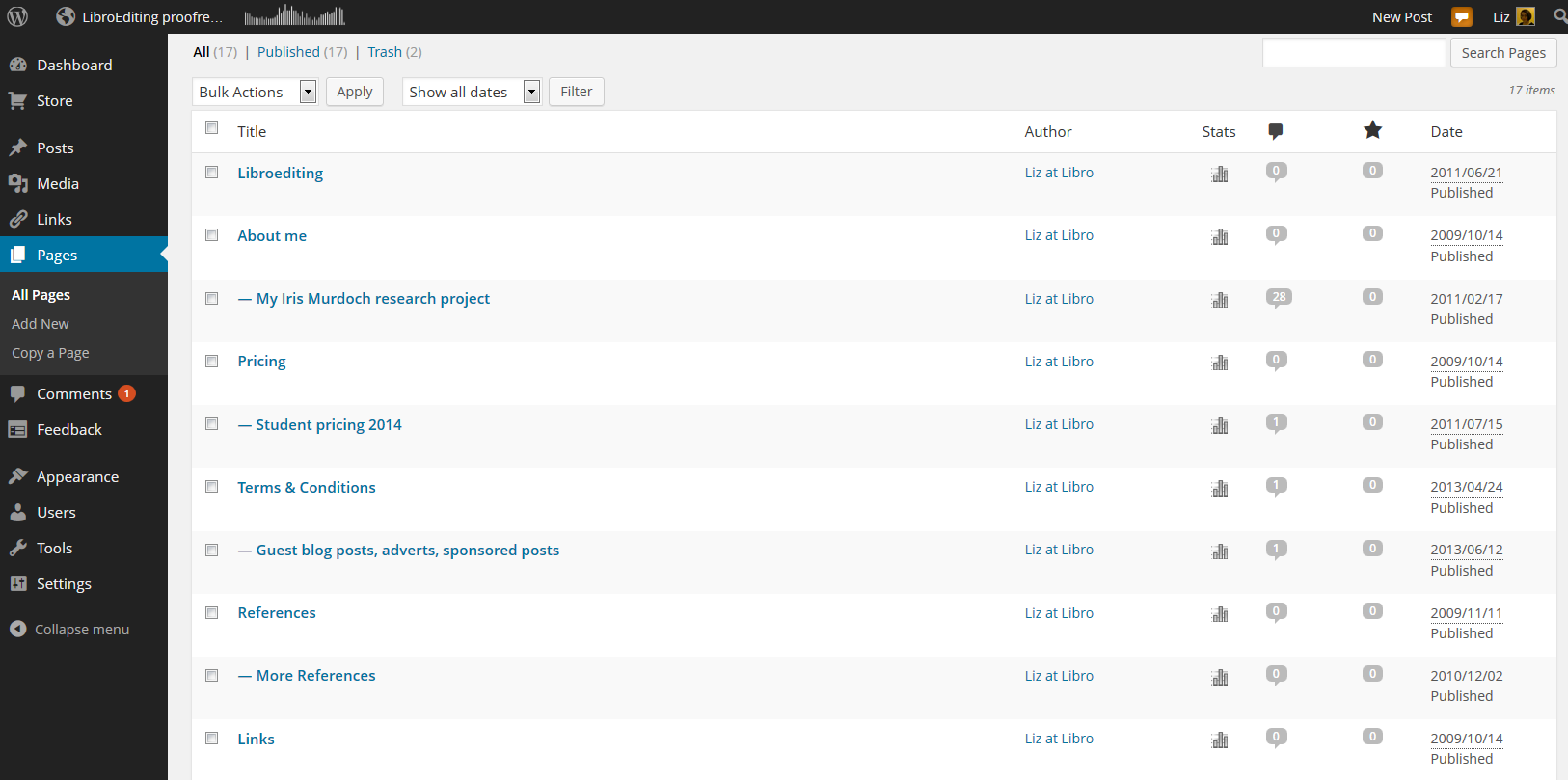
You can view all of your pages by going to the Dashboard and choosing Pages – All Pages. Here is part of my page list for this website. If you hover over any page title with the cursor, you’ll get the Edit / Quick Edit / Trash / View options to allow you to make any changes you want to. If you have any pages in Draft form, not yet published, you’ll see Draft next to All / Published / Trash and you can click to see all of your draft as opposed to published pages.
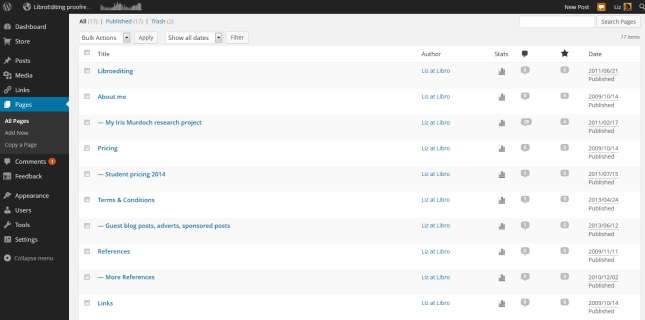
11 pages

Useful pages that I would recommend including on your business website are:

  • About me (with a photo)
  • Services
  • Prices
  • Testimonials / references
  • Contact me (with a contact form)
  • Blog
  • Links (links to colleagues and recommended websites – always kind to do)

How do I change the order in which my pages appear? How do I create sub-pages?

It’s good to be able to control what order that top menu and any side menus appear in. As you get more pages published, you might find there are too many for the menu to display, and it starts to look a bit messy. You might want to arrange pages in sub-categories, under other main pages.

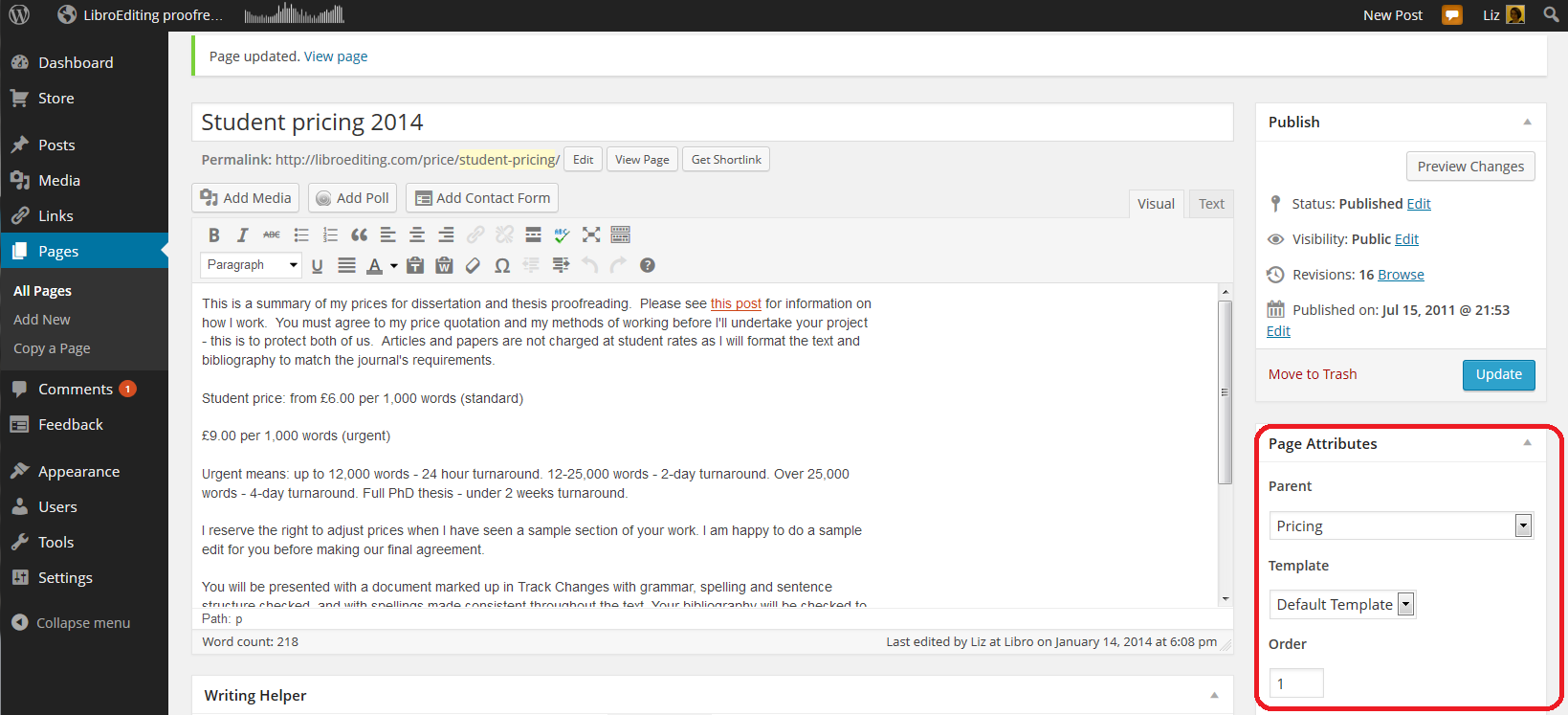
The place to do this is in the Edit screen for your page (click on Edit when viewing the page or select Dashboard – Pages – All Pages and click on Edit for the particular page). You will notice a section called Page Attributes. Here, we’re looking at my Student pricing 2014 page, which is a sub-page of my Pricing page. Note that I’ve chosen a Parent page from the drop-down menu of all of my pages. When you’ve completed all changes, press Update to save them. You can also choose the order … see below …
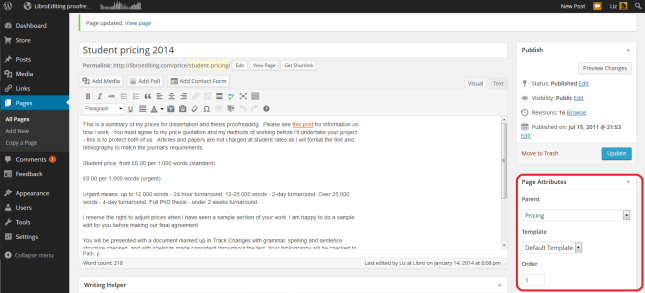
12 sub pages

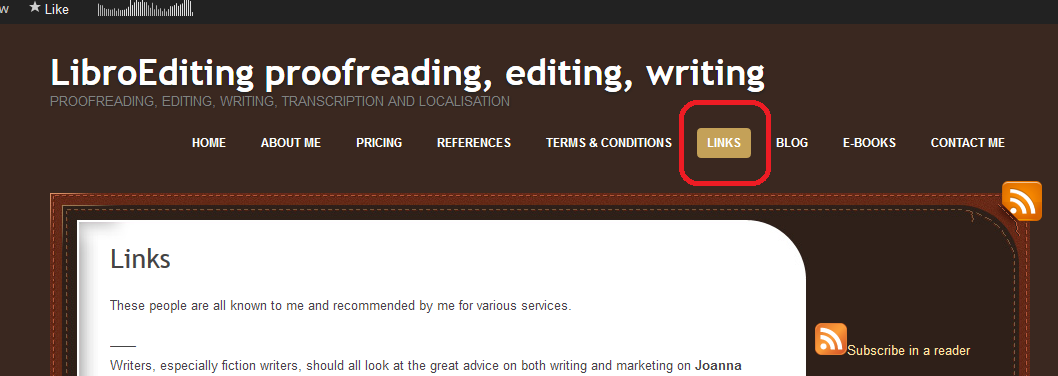
It’s nice to have your landing page on the left and your About me quite prominent, with other pages such as Links down the order a little. That same Page Attributes area allows you to choose a number to define the order the pages appear in on your menus. Here, I’m giving my Links page number 6. I press Update and view the page …

13 page order

Looking at the page itself, you can see that the page name is number six in the list of pages along the top!

14 page order

Note: not all designs of WordPress blog have the menus automatically along the top. But they should appear at the top or down the side. Play with the choice of design if it’s not where you want it to be, or add a menu to the side bar, which we will learn about another day.

How do I do a quick edit?

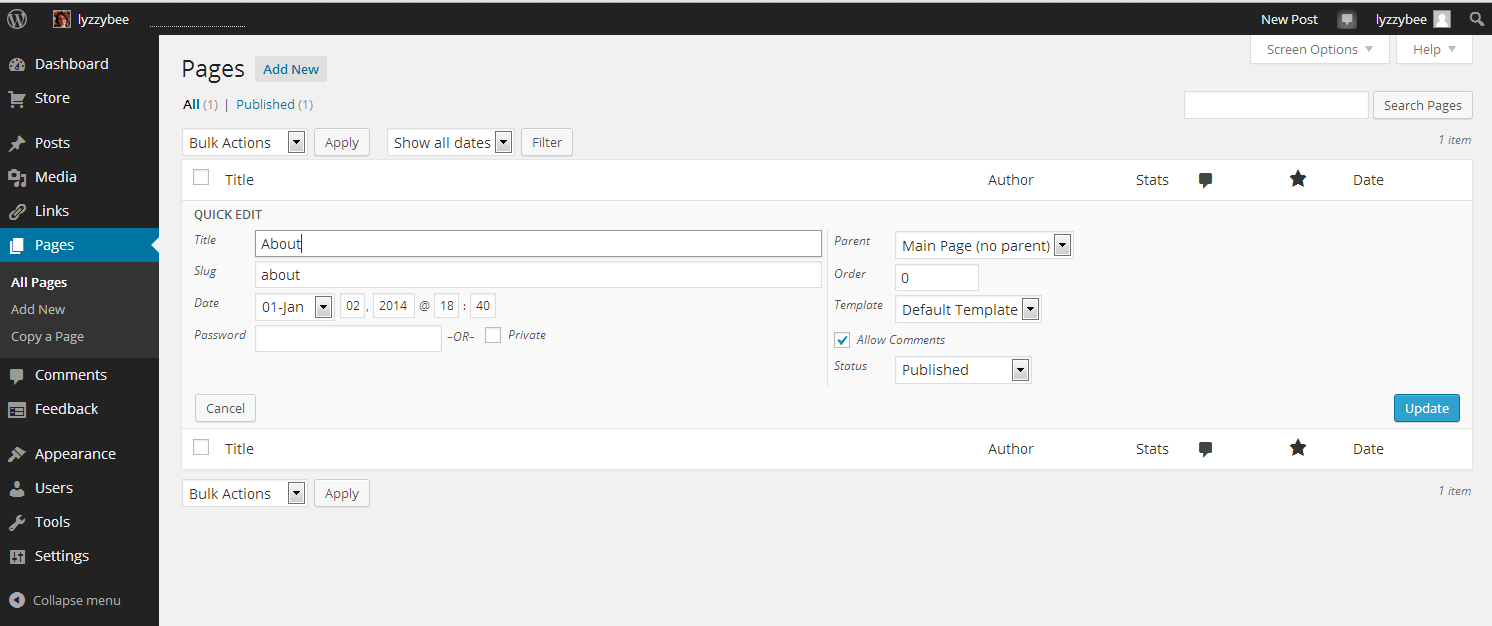
If you just want to change the title, page order or other attributes for a particular page, view All Pages, hover over the page title and choose Quick Edit.

15 quick edit

You will get a limited number of options, but this can be a quick way to do an update. Click Update to save.

16 quick edit

In this article, we’ve learned how to add web pages to a WordPress blog to make it into a website, using WordPress.com hosted by WordPress itself. These basic ideas should be the same on self-hosted WordPress sites.

I hope you have found this article useful. Please share using the share buttons below, or post a comment, and do please let me know if you use this article to help you to set up your own blog, and post a link below!

Related posts on this blog:

WordPress 1 – the basics – joining and setting up a blog

WordPress 3 – adding images to your post or page

WordPress 4 – adding slideshows and galleries of images

WordPress 5 – linking your blog to your social media

WordPress 6 – sharing buttons

WordPress 7 – adding an avatar picture

Is it worth having a website for my business? – the big question (and the answer’s Yes!)

Adding links to blog posts – how to do it on the major blogging platforms (and email)



Tags: , , ,

Is it worth having a website for my business?

websiteIn my networking adventures and other travels in the world of small business, I come across quite a few people who don’t have a website. To be honest, I’m a bit shocked when this happens. Unless you’ve got a constant set of clients, with new ones on the horizon to fill in any gaps if you lose one, then you’ll want to be findable.

When you think about getting the roof done, or finding a cleaner, or sourcing flowers for an event, or buying a product, where do you look?

Online.

Even if you look for a tradesperson on a Yellow Pages style website, I bet you like to have a URL to click through to, to look at their details. Right?

If you don’t have a website, even a single page with your name / company name and information about yourself, then what will people find when they search for you?

How do people search for companies, products or services?

People come to my website in one of four ways:

  • They search for my name
  • They search for my company name
  • They search for something that I do
  • They search for the answer to a question (“is it en route or on route?” “How do I repeat the header row of a Word document on every page?”)

This is what would happen if I didn’t have a website:

  • If they search for my name, they’ll find my Twitter or Facebook feed, or photos of me socially, or mention of me on forums. All fine, but they’d probably rather find either my Facebook or my company information in one place
  • If they search for my company name, they will find my Facebook or Twitter feed, however, those mention and feed back to my website, as they’re not enough in themselves to maintain interest and get me business
  • If they search for something that I do, they’ll find someone else’s website and if they’re looking for someone to do that work, they’ll hire that someone else
  • If they search for an answer to a question, someone else will answer it, and if they’re looking for someone to work for them, they’ll hire that someone else

This is what happens because I have a website:

  • If they search for my name, they’ll find my website and my other feeds, which all link together. They’ll find out what I do and if they want to talk about work, they can contact me
  • If they search for my company name, they’ll find my website, find out what I do, and possibly hire me, getting in touch via my contact form
  • If they search for something that I do, they’ll find my website, find out that I do that, find references from people who I’ve done that for before, and possibly hire me – getting in touch via my contact form
  • If they search for an answer to a question, if I can answer it, they’ll find out that I know what I’m talking about, and note me for later or sign up to receive emails when I post, and might hire me in time, or ask me a question or engage with my blog

The bare minimum

As a bare minimum, you should have a page somewhere that includes …

  • Your name
  • Your company name (if it’s different)
  • A list of your services or products – make sure that you mention all of the forms of the things you do on that page (so I would include transcriber, transcription services, editor, editing, etc.)
  • References from satisfied customers
  • A way to get in touch with you – a contact form, a phone number (most people like to see this), an email address
  • Professionally produced text – by which I really mean have someone check it for typos and spelling mistakes. Those will seriously undermine your reputation and send people running from your services – whatever they are

It’s a good idea to have your company name in the url for your website, but personally I don’t hold it against small companies if they have the word blogspot or wordpress in their URL – you don’t need to pay extra to have that if you don’t want to.

You can use a Facebook page as your company web page, however I would hesitate to ONLY use something that changes so often and is as unpredictable as Facebook. A company Facebook page is better than nothing, however!

Optional extras

You can add these extras if you want and if they add value. If you find that you’re getting a steady stream of enquiries via your simple website, and they turn into paying customers, then only add these items if you can see a clear value in doing so, rather than doing it out of vanity or because someone’s persuaded you to buy their service.

  • A URL that’s just your company name – you will have to pay for this, probably renewing annually
  • A professionally designed website – there are so many “themes” on offer that look as good as professional websites.
  • A blog – this is GREAT for driving people to your website and setting you up as an expert in your field. If you only do one of these things, write a simple blog
  • Someone to write web text and blog posts for you
  • Search Engine Optimisation – a professional can ensure that you’re showing up in the search engines etc. But shop around – this can be expensive and there are lots of things you can do to SEO your site on your own (just have a little search engine search and see what you can find)
  • A shopping cart and catalogue – very useful if you’re producing craft items or any tangibles – but you can sign up to services like Etsy and eBay which will do this for you

The big caveat

It’s really important to have a web presence so that people can find you.

It’s really important to be super-vigilant, because unscrupulous companies prey on small businesses’ lack of expertise in this area.

  • Always ask around fellow small business owners or someone whose website you admire and see who they use
  • If someone offers to make you top of the search engine results, ask what other sites they’ve worked on (always ask for references anyway) and do a search for yourself
  • If someone offers to revolutionise your website and make you a millionaire overnight, they’re probably over-selling. Ask for references
  • If someone offers to build your website make sure – no, MAKE SURE – that you will be able to edit and update the text and pictures on that website whenever you want to. Never hand over the full ownership of your site to another person such that you can’t update it yourself.

If you haven’t got a website, and you haven’t got a steady stream of new and regular customers giving you a good income stream, I really do suggest that you get a website!

Read more here about growing your business, have a look at my advice on blogging and social media, read about how to set up a WordPress blog and website (starting with this post) and read about my own business journey in my book, Going It Alone At 40.

Related posts

WordPress 2 – adding pages to create a website

 
11 Comments

Posted by on January 13, 2014 in Blogging, Business, New skills, Social media


Tags: , , , , , ,

How do I get freelance work?

This article shares some ways that I’ve found successful in getting proofreading, editing, localising and transcribing work. It’s applicable to all forms of freelance work but doesn’t look at getting a full-time employed job in publishing or for another large organisation.

It’s also worth noting here, in response to some of the early comments on here, that this is a suite of options and you wouldn’t expect to do them all at the same time. Once you’ve built up 1 and 2, you can pick and choose depending on what your career path is – and it’s important to indulge in some planning from the start. Thank you to my commenters for helping this to be a better and more useful post!

1. Make sure that you say what you do on your website

Many of your clients will come to you after doing a Google search. Remember: people will take the easy option. Why bother to search on lists and in directories if you can just stick a search in Google.

So it’s worth making sure that your website …

  • Includes a clear list of all of the services you offer
  • Includes a blog which is updated regularly – this really helps your position on the search results
  • Is Search Engine Optimised in general (there is an art to this, but make sure you include your keywords regularly, write lots of natural reading text and include keywords in page / post titles and headings)
  • Includes a picture of you and ways to contact you – a contact form is always good for this

Oh yes – do make sure that you HAVE a website. Even if it’s just one page, I really do think that in all industries, from carpentry to computer programming, people expect you to have some kind of web presence, and may well give up the search there and then if you don’t, even if you’ve been recommended by name by someone. I know that I do that when I’m looking for services …

2. Make sure that people know what you do

An awful lot of my early clients came through friends of friends and social networks. Obviously, don’t bombard your friends by begging them to refer you, but make sure the following are covered:

  • If you have a company Facebook page, include a list of your services
  • Include your services on your Twitter profile
  • Mention what you do on social networks every now and again (a good way to do this is to mention what you’ve BEEN doing “This month I’ve edited this, transcribed that and localised the other”.
  • Make sure peers in one area know you cover other areas, too (if you do), e.g. I make sure that my editing chums know that I transcribe as well
  • Consider setting up a newsletter and making sure you mention all of your services
  • Update your clients with any new services you’re offering

3. Join industry groups and publicise yourself through their directories

I gained early clients through being in a member directory associated with a copyeditors’ email list. Friends do well by being listed on the Society for Editors and Proofreaders’ website. My roofers are listed on a government-accredited tradespeople’s website. All of these are places where people will look for accredited and proved suppliers.

4. Advertise on general directories and websites

A hint: don’t bother with paid ones when there are so many free directories and websites!

Ask around your peers as to what they find useful. I am on Freeindex and get a few enquiries a month. Join as many as you want, but do make sure to update your profile if you change your services, fees, etc.

If you’re in a trade like roofing or plumbing, it’s worth looking at council and government approved listings and the paid directories, as people do search these first, but beware putting too much money in at first.

Again, for trades, local print directories and especially business association directories can be good. I have a free listing in our local business association one, which has never brought me any work, but I always try to find local tradespeople who are members, and other people will do this, too.

5. Use industry-specific freelancer sites

I’ve had a look at general websites like freelancer.com, elance.com and oDesk and personally, I don’t think they’re worth it. A lot of people on those will undercut and take any job at the lowest price possible. Many of the sites have “tests” which are actually a test of your understanding of the site itself, not your ability as a writer, editor or whatever.

*Edited to add: while I don’t find these useful, a couple of people have mentioned Elance to me as a good one to try that has got them decent jobs, so it’s worth looking at that.

However, there are industry-specific freelancer sites which are worth it. Again, ask your peers for recommendations. The one that’s got me the most work is proz.com, which is a site for translators where you can put up a profile and, if you pay for membership, that profile will be sent to people looking for freelancers, and they will contact you direct. This has paid back the membership fee for me tens of times over, because I work with translators into English, and offer localisation, which is related to translation.

You can also look for people looking for particular skills and freelancers and then pitch to them.

Take note, though: with anything you pay for, do assess each year whether you’ve got that fee back, and more. Only continue paying if you’re getting a good return on your investment!

6. Advertise (selectively)

I’m not a big fan of paying out for adverts. Most of the other methods I talk about here are free. But there might be specific advertising channels that will work for you.

When I was starting out, working as a proofreader on theses and dissertations, I put up some posters around the university where I worked, recruiting colleagues who were also students to put them up in common rooms, etc. (free, except for printing costs and a few coffees!) and I advertised in the university staff newsletter, which went to tutors and supervisors. The costs were low, even to non-staff, and I did get the money back.

As with using websites that you pay for, do check your return on investment and keep an eye on the outgoings.

7. Use social media proactively

This one particularly applies to Twitter, although LinkedIn can be used in this way, too. Search for people looking for your services on Twitter. Reach out to potential clients directly. I have got paid work using this method and, even better (see below), I’ve got clients who have gone on to be big recommenders this way, too.

No one minds one, polite Tweet if they’ve asked for recommendations for a good plasterer or translator and you fit the bill. Don’t hassle people and don’t blanket-tweet; do tailor your response to the person you’re contacting.

I’ve written a separate article on searching for freelance jobs on Twitter, with a worked example.

8. Seek recommendations and referrals from clients

The best way to get new clients is through word of mouth. The two main advantages?

  • It’s free!
  • If person A recommends you to person B, and person B gets in touch with you, they are far more likely to convert into a paying customer than someone who’s randomly got in touch with you through an ad or Google search.

You do need to be a bit proactive about this, though …

  • Make sure that your clients know you’re looking for more clients just like them
  • Say thank you whenever you find out someone’s recommended you
  • Ask clients for references to put on a reference page on your website (this makes enquirers more likely to use you as you come recommended by lots of people)

I have several clients who act as “nodes” for me, recommending me either individually or via blog posts and pages on their websites.

9. Seek recommendations from your peers

Your peers fall into two groups:

  • People who freelance or run small businesses like you, who you might meet in online groups or at networking events
  • People in the same industry as you, who you might meet in the same ways

It’s important not to see people in the same industry as you as competitors – you’re much better off considering one another as colleagues. When I was starting out, I was passed what turned out to be a major client by a proofreader friend who wanted to stop working at weekends and in the evenings. So I did evening and weekend cover for them. Now I’m established, I much prefer to be able to recommend potential clients who I can’t take on to another qualified person who I know will do a good job.

When you’re starting out, it’s worth forging (genuine) relationships with people in your industry who are more established. They may well have the odd customer they want to pass on, or have too much business and be looking for people to recommend on to. Nowadays, I pass quite a few people who I can’t accommodate on to a core set of five or so recommended proofreaders, writers and transcribers. I also keep a note of people in allied industries such as book design, graphic design in general and indexing, so I can pass people to them with a relevant recommendation, rather than just leaving them hanging.

You can also profit from either teaming up with peers in different industries – for example, I’ve worked with web designers on projects where they’ve written the website and I’ve provided the content, and I’ve done proofreading work for virtual assistants who don’t offer that service themselves.

I haven’t got many clients directly through networking, but I met an author at an event who went on to recommend my transcription services to a fellow author, who now uses me for transcription and editing, AND recommends me on her website!

10. Go cold calling and door-knocking

Some people do cold calling and door-knocking, where they literally call people on the phone or walk up their front paths and ask them for work. For a start, I don’t think that works in the service industry. I know some editors cold call publishing companies, and I’d love to know how that works out for them.

Personally, I feel this takes a LOT of investment. Cold calling requires a list, which takes time and research or money to get, and taking time out to walk up a lot of paths is a fairly hefty investment, too. It might be more worth looking at trade directories or local directories before you take this path – but do share your stories if you’ve had other experiences!

Edited to add: as people have kindly shared their experiences, I’m adding a note here to say that cold calling can be useful if you’re targeting a specific and maybe narrow group of clients. Fellow editors, for example, have gained work for publishing houses or journal publishers by taking this route. As my client base is more individuals and other small businesses and freelancers, this approach wouldn’t work for me. But if there’s a group of companies that you can identify as a good fit, by all means approach them with a call or letter, cold, as it were.

———————

How do you get freelance clients? Can you recommend any other ways, or do you use any of these? Do let me know whether you try any of these successfully as a result of reading this article!

Related posts of interest on this blog:

Thinking of going freelance (1) – some initial points to think about

Thinking of going freelance (2) – how to organise yourself once you’ve got going

How do I decide to who work with? – choosing companies to associate yourself with

How to turn a new customer into a regular customer

What’s the best mix of customers to have?

How to make more money in your freelance business

Searching for jobs on Twitter

When should I say no?

 
17 Comments

Posted by on December 16, 2013 in Business, Jobs, Organisation, Social media


Tags: , , ,

Developing your business: what next?

Sneak preview of the image from my new bookSo, you’ve got through the start-up phase, you’ve got a decent business going, and you’re still getting enquiries from prospective new customers. You might be earning enough to be thinking about optimising your tax situation or even going VAT-registered. What do you do now?

You have various options: in this post I’m going to run through the main ones, then in the weeks to come, I’m going to be featuring some expert advice from solicitors and accountants, business consultants and the like, who will talk us through the options, AND real-life examples from people who’ve been there and done it and can share their experiences.

In summary, here’s what you can do:

  • Go full time if you’re not already
  • Outsource tasks to other companies
  • Turn yourself into a Limited Company
  • Get VAT-registered
  • Employ people
  • Contract out to other freelancers
  • Go into partnership with someone
  • Expand into premises – an office or workshop
  • Do nothing

Going full time with your business

If you’re not already full time, and you’re feeling pressured by having a day job and your own business, it can be very worthwhile going it alone. I’ve written a whole book on the subject, but I know lots of people who’ve done this: it can be hard to decide when to jump ship, but very rewarding when you do! Read Laura Ripper’s experiences of going full time here.

Outsourcing

Outsourcing means getting someone else to do tasks such as

  • Admin
  • Finance
  • HR
  • Sales
  • Telemarketing

Outsourcing the admin and sales effort allows you to devote your time to working at the actual tasks that form the core of your work. More billable hours should mean more money coming in, and you can accommodate more clients. You can find articles on the Libro blog about tasks that you can outsource and how to work out whether it’s worth it. And here’s an article that includes real-life experiences of the values of ousourcing.

Becoming a Limited Company or going VAT registered

Both of these options have reputation and tax implications. Some clients in some industries find that dealing with a Limited Company or someone with a VAT number represents solidity and safety (of course, sometimes, it can be a disadvantage, for example, to be VAT registered yourself if most of your clients aren’t and won’t be able to claim the VAT back that they pay to you). Becoming a Limited Company can protect you legally and save you some tax (legally and ethically).

Read the expert’s view on becoming a Limited Company.

Employing people, contracting out work or going into partnership

These all involve getting other people into your business to share the workload. Some companies will contract out to people who do the same thing – for example, I work for a company that deals in proofreading for students, They send the work to me and pay me when I invoice them, and they invoice the customer for a bit more. If you go down this route, it involves a lot of admin on both sides, but means that you can have multiple people working for you without going down the employment route and bringing in profit on their work without doing that work yourselves (there are laws about when someone’s an employee, though, so it can get tricky). You can read more about employing people here and a case study here.

Going into a partnership involves a legal setup but can be useful if you have complementary skills.You have to think carefully about who you do this with, though, and issues like where you’ll work and who is responsible for what.

Employing people involves a lot of legal stuff and means that you’re responsible for other people’s income and taxes, but there are freelance HR companies out there that can help.

Added examples of this kind of area including offering franchises in your business to people and taking on an apprentice. Franchising has a lot of rules and regulations but allows you to replicate your brand and success with managers in place to run the businesses, and apprentices are given external training as well as working with you.

Moving into business premises

If it feels like you’ve outgrown your home office and you want more room for making the goods you sell, or you want to separate home and work life a bit better, then moving into premises can be the next step. This does involve costs, although there are offers out there that give you secretarial and reception support which can be very useful. It can look more professional if people visit you, too. Beware the treadmill that leads to getting  more office space / employing more people / getting more space / employing more people, with your overheads going up and up, unless you have a steady head and a good accountant! But it does work very well for some people.

Here are some people’s stories of how and why they did this and how it all went. We also have an expert view on how, when and why to move into office space and one on expanding into regional offices.

Doing nothing

I have to admit that this is my approach. Why? Mainly because what I do is so linked to me, my style of editing, my relationship with my clients, and because I like being my own boss, beholden to no one and responsible for no one. I’ve also looked at what some peers in other businesses have done, and realised I’d rather keep my simple model (plus most editors work like this). But I have done this:

  • Contracted out my accounting to allow me to devote my time to work, not admin
  • Developed robust business routines for the same reason
  • Optimised my customer base to give me a good mix of work and a good income stream (read more)
  • Worked on developing passive income streams (read more)
  • Developed a network of people to whom I can refer new business or the occasional bit of overflow work from regular customers

———————

I’ve talked here about some ways to grow your business. I’ll be featuring tips from experts and case studies from people who’ve been down these paths over the coming weeks. I still have some slots free, and I’d love to have a range of opinions and experiences for each topic: if you’re an expert on these areas or a business person who’s gone down any of these routes, please have a look at this post on precisely what I’m looking for, and get in touch!

Have you enjoyed reading this post? I love to read your comments, and you might be interested in some more of the posts in the Careers and Business areas of this website …

Related posts:

Case study: going full time

Expert view: outsourcing

Case studies: outsourcing

Expert view: becoming a Limited Company

Expert view: employing people

Case studies: employing people

Expert view: moving into office space

Expert view: expanding into regional offices

 
13 Comments

Posted by on November 25, 2013 in Business, Organisation


Tags: , ,

When should I say no?

Say noWhen you work for yourself, especially when you’re starting out, it’s all too easy to say “Yes, please!” to every job that comes your way. But it’s a good idea to start saying “No, thank you” early on – not to everything, but to certain kinds of job. What you say no to depends on where you are in your career and what your schedule’s looking like, but here are my top jobs to turn down …

Note, with all of these, it’s often OK to say “yes” to one of the kind of job, just to see. But you’ll probably find yourself saying no later on!

What to say no to early in your career

  • Working for free. Caveat. If someone asks you to work for free AND they are an influencer who is likely to recommend you on AND they agree to give you a reference AND you’ve got time to do it without turning down paid work, then go for it.
  • Doing something you feel uncomfortable about. It’s good to push yourself into new areas. That’s not what I’m talking about here. I’m talking about content farms or writing essays for students, if you’re an editor (see this article for more on this kind of thing), or anything on the wrong side of your ethical line. Just because you’re just starting out and you’re a bit desperate for work doesn’t mean you should go against your own morals.
  • Doing something way outside your normal line of work. I think it’s a good idea to consolidate your reputation in one area and then branch out from there. By all means try something out, but if you don’t like doing it or it doesn’t fit, say no next time.
  • Working again with rude, pushy or unreliable clients. If someone’s rude to you on the first job you do for them, or they don’t pay when they say they will, it’s OK to say no next time. You are worth more than that, and a difficult client now will always be a difficult client. Demanding, fine; rude and pushy,  not fine. Don’t let your self-worth get undermined before you get started.

What to say no to at the mature stage of your business

  • Anything that will  overload you. If you find yourself saying, “Well, I could fit this in if I don’t sleep on Thursday night” or “Well, if person x doesn’t send me their chapter on time I could do this”, it’s probably time to say no and recommend someone else.
  • Small jobs that don’t look like they’ll turn into regular customers. Cruel but true – the smaller the job, the more noise to signal (admin to work) there will be. Pass the little ones on to your newer colleagues who need to build up their portfolio.
  • Discounts. You should be experienced enough to stand by your pricing. You will have discounts worked out for various sectors (I give them to students and individuals) but at this stage, you shouldn’t be in the business of buying work, and that’s what this is doing. If your prices are fair, don’t offer discounts except in exceptional circumstances.
  • Regular clients who don’t match your needs. Maybe they don’t pay well / on time or are difficult to deal with or have time scales that don’t match your own – sometimes it’s time to say goodbye and pass them on to another recommended practitioner.

What to say no to throughout your career

  • Any job with “danger” flags. To me, the main one here is “We’ve been through a lot of people and haven’t found the right partner yet” or “I’ve had problems with my previous editor / roofer / plumber”. By all means, check what the problem was. There are bad examples of every job out there, and you can be the one to fix the problem. However, if there’s an on-going pattern of problems, or they can’t be specific about what went wrong last time, my advice is to avoid.
  • Any job where you need to spend a lot of time learning a new system or skill UNLESS you really do have the time to do that and it’s going to be useful for lots of work in the future. I have had to turn down jobs that involve learning a new kind of translation software recently – I knew I had time to do the work, but not to learn the software. Best to tell the client up front!
  • Any job that goes against your moral code – however much of a dip or a bad patch you’re going through, however much it comes from a current client, if you feel uncomfortable doing it, don’t do it. (I had that situation a little while ago – I said no, I said why, they were fine with it and are still working with me.)
  • A client with unrealistic expectations. If someone expects me to write their book from their notes in a small space of time but call it (and charge for) proofreading services, or think you can transcribe 10 hours of tape in 12 hours, they are likely to be turned down. Setting and managing expectations is a whole nother post, of course …

——–

It’s great to say yes and it’s great to be busy – but it’s also vital to be able to say no and to be able to keep your busyness to a decent level. If you’re going through a dip in your mature business, go back to those early stage nos, and keep firm about them!

Oh, and although I do say no fairly regularly, I do almost always refer the prospect on to a recommended colleague who might have the time / capacity / skills to help them better. Which makes it a win-win-win – the client will come away with a great impression of you, your colleague will have a new prospect, and you will feel reassured that you’ve done the right thing and not left them without any support.

What do you say no to in your line of work? Have I missed any? What has been your experience of saying no to customers?

Related posts from Libro

Careers index

How do I decide who to work with?

What’s the best mix of customers?

How to make more money in your freelance business

 
14 Comments

Posted by on November 11, 2013 in Business, Copyediting, Ethics, Jobs, Organisation


Tags: , ,