RSS

Tag Archives: learning

Refute or rebut?

Rebut and refute are a bit like confound and confuse – closely related but still subtly different meanings. I was at a translators’ meetup at the weekend (linked to a website/community I use to get proofreading and localisation jobs) and we were talking about how there are often 2 words in English for one concept (often one Anglo-Saxon and one Romance) and there are also subtle shades of meaning expressed by slightly different words, which would need longer phrases in other languages. Anyway: rebut or refute?

Rebut something is to claim or prove to be false. It comes from an archaic sense of driving back or repelling, which gives it a subtle difference from refute.  When you rebut something, it’s a rebuttal. I prefer that word to refutation, for some reason.  Rebut comes from Anglo-Norman …

… whereas refute comes direct from the Latin. To refute is to prove a statement or the person advancing it to be wrong.  So it’s more a discussion than a direct refusal and shoving back, which is what rebut feels like to me. Refute is often used nowadays in the sense of denying a statement or accusation. However, this use is not accepted by traditionalists – it’s marked as being “disp.” (disputed) in my New Hart’s Rules, so we won’t go there!

So, two similar words, two similar concepts, two slightly different emphases or shades of meaning. This is what keeps English rich and creative and keep these pairs alive!

You can find more troublesome pairs here and the index to them all so far is here.


Tags: , , ,

Themself or themselves?

They used to just be a plural word, referring to a number of people and having the standard reflexive form of themselves“There were many people in the queue. They were all told to help themselves from the buffet”.

But we are seeing more and more usage of they and them as a singular, to avoid clumsy uses of  he/she or him/her followed by himself/herself. Then, by extension from the him – himself or he – himself formation of the reflexive, people are starting to use themself as the reflexive. “If a child is confident, they may be able to help themself to water”.

This does seem to be sensible, and it’s something I think I’ve used myself (there’s another one!) in the past. However: no more! Because, having been asked about this via Twitter, I looked it up and found that actually themself is not regarded as “good English”. And we like good English on this blog, don’t we?

So the reflexive of singular they and them is themselves, and my above example should read: “If a child is confident, they may be able to help themselves to water”.

An easier one, I suppose, in that one is correct and one is incorrect – you don’t have to remember different usages, just not to use themself. Make that we don’t have to remember …

You can find more troublesome pairs here and the index to them all so far is here.

 
3 Comments

Posted by on January 13, 2012 in Errors, Language use, Troublesome pairs, Writing


Tags: , , ,

Counsellor or councillor?

Counsellor and councillor are very commonly mixed up – you find them everywhere, from non-fiction books to blog posts and all points in between. I suppose both of them try to help people – but they are different words for different things, and they need to be kept separate and understood as such.

A councillor is someone who sits on a council. So, local councillors are those people we elect to sit on the city council and run bits of our lives for us. Oh yes, let’s not forget our capitalisation rules in all the excitement: Councillor Broomfield sits on Libroville City Council. She is a councillor who sits on a city council.

A counsellor is someone who provides help with personal problems. They give counsel, they counsel you. Maybe that’s the way to remember it, as you can’t council someone. Can you? You go for counselling with a counsellor (I have seen the two spellings being mixed up even in that context) and maybe that’s the way to remember it.

If anyone has any nifty ways to remember these differentiations, do post a comment!

You can find more troublesome pairs here and the index to them all so far is here.

 
2 Comments

Posted by on January 9, 2012 in Errors, Language use, Troublesome pairs, Writing


Tags: , , ,

Weary or wary?

Weary or wary seems to me to be an odd pair to mix up – sorry if you do this and don’t think it’s odd, but they just seem so different. Having said that, I do keep seeing them being mixed up, so this will probably be helpful!

I see weary being used where it should be wary more than the other way round; I have a feeling that perhaps a memory of leery is getting into it, and then the pronunciation means the writer goes for the word that sounds like leery. Who knows. Anyway, here we go:

Weary means tired. And to weary of something means to be reluctant to experience any more of it. “I’m weary, because I’ve worked 10 hours today” (this is not literally true, don’t worry!). “I’m weary of writing Troublesome Pairs posts and I don’t think I’ll do it any more” (this, also, is not true).

Wary means cautious about possible dangers or problems. It’s linked to beware, and maybe that will help people to remember it. “I’m wary of dogs after being bitten a few times”, “I’d  be wary of going down that dark alleyway if I were you.”

Let’s see if we can use the two in the same sentence … “She was weary of being wary, jumped into the middle of the pack of dogs … and got bitten.”

Sorry, dog lovers – please feel free to substitute any other biting animal in these sentences!

You can find more troublesome pairs here and the index to them all so far is here.

 
5 Comments

Posted by on January 6, 2012 in Errors, Language use, Troublesome pairs, Writing


Tags: , , ,

Confound or confuse?

I’ve been working my way through the last of Gill’s massive list and this is one of the final ones … I have had some more suggestions here and there, though, so the supply won’t run out just yet!

So, today we have confound and confuse.

To confuse someone is to make them bewildered or perplexed – “He confused her with his rapier wit until she would agree to anything”.”1% fat or 99% fat-free? I’m confused”. In a linked way, it also means to make something less easy to understand – “He confused all the issues with each other until it was impossible to understand his arguments”. And it also means to identify wrongly – “Is that Busted? Oh – I’ve confused them with McFly.”

Now, confound does carry a meaning of to surprise or confuse,  but it’s more used in the sense of proving something wrong or causing it not to work, defeating a plan, a hope or an aim “Her hopes of living off her savings were confounded by the low interest rates”; “Ha! With my intelligence and wit, I have confounded your dastardly plot!” A useful and flexible word, it can also mean to mix up with something else: “in his formula, x is confounded with y, and that makes it come out wrong”.

Special bonus word: to confute – is to prove to be wrong (shall we do confute and refute next time?)

So, a simple rule – confuse if you want to perplex or mix up; confound if you want to ruin the dastardly plans. Got that?

“She was confused by the bright lights, and he confounded her plan for escape by tripping her up.”

That’s probably the last troublesome pair for 2011 – will anybody be on the internet reading blogs next Friday?

You can find more troublesome pairs here and the index to them all so far is here.


Tags: , , ,

Top Time Management Tips: For Santa … and You!

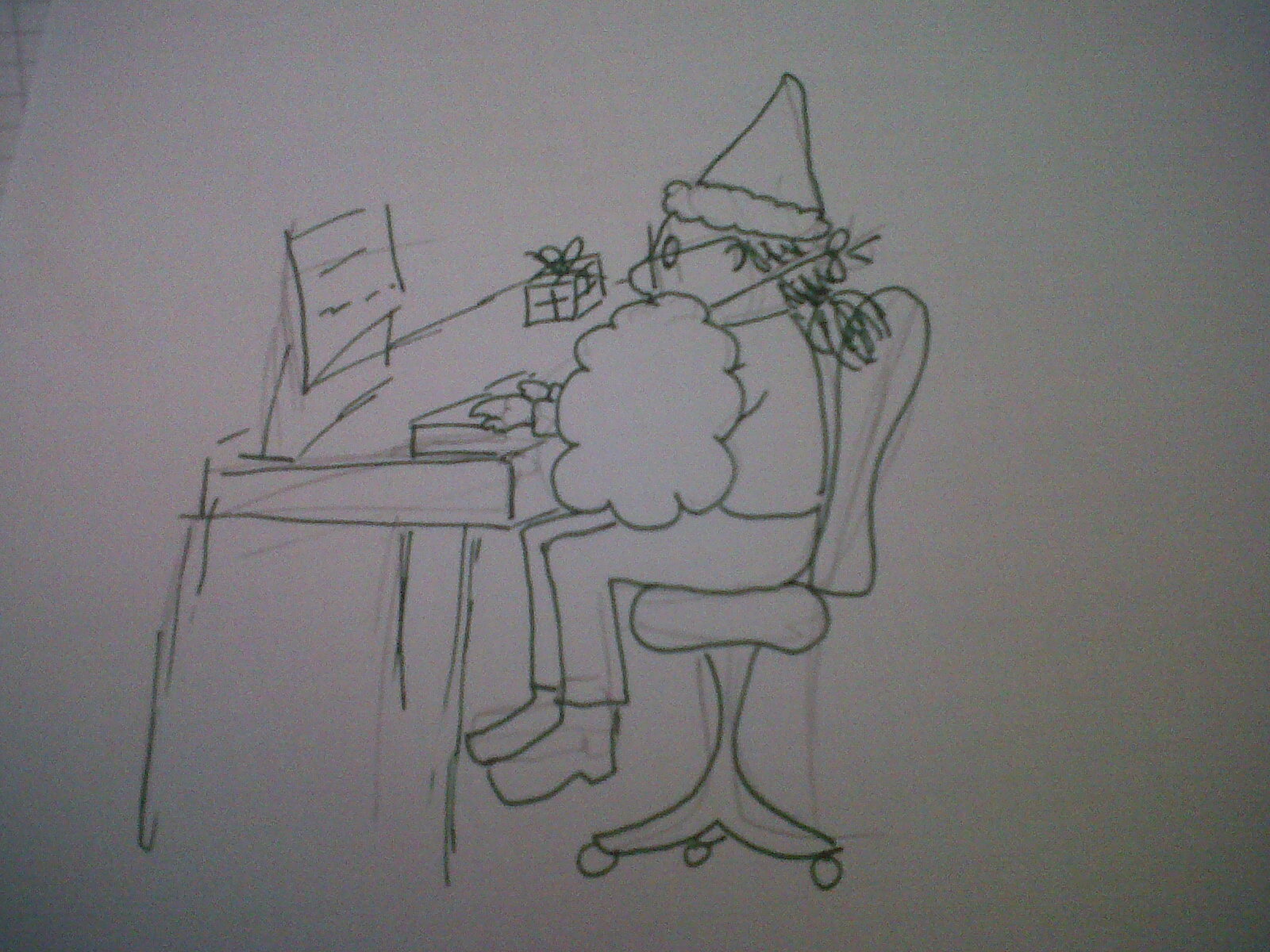
Cartoon of Liz dressed up as Santa

Liz or Santa?

This time of year is a busy one for Santa, but maybe not for you. Maybe you’re off work for the seasonal holiday now, on vacation from your studies, or your clients are on holiday so you are too, by extension. Maybe it’s time to have a bit of a think about how you’ll manage your time more successfully in the New Year. As it’s Christmas, as well as sharing some tips on time management in general, I’m going to relate them to Santa’s life, too. If you’re reading this, F. Christmas, I hope they’re helpful!

Work to your strengths

I think this and the next point are key. You should know by now when your good – and not so good – times are for concentrating and getting things done.  The key is then to arrange your day to match these peaks and troughs, aligning your work patterns to your personal patterns. This is easier when you work for yourself, but is manageable when you’re employed, too. I hope Santa’s best late at night, as his main workflow is obviously when he can zip through the dark skies! I’m best in the early mornings, so now I like to get a chunk of work done before breakfast, and when I was working, I liked to start as early as I could. I have a slight lack of concentration after breakfast, so I am scheduling in some down time or some smaller, achievable tasks for then, and I’m hopeless after lunch – but I can work fine if I have a big deadline, so I either work to a deadline there or accept it’s not a great time and do something else. People think ‘larks’ can be annoying and smug, but I’d love to be able to work late into the night. I know I will make mistakes then, as I’m not a ‘night owl’, so if I have a big project to push through, I’m more likely to get up extra early. When are your good and bad times? How can you tweak your work schedule to get the most out of them?

Blocks of time

This is the other important one, in my opinion. Say you’ve got presents to wrap, letters sent to the North Pole to read, and deliveries to make. Don’t hop from one to the other: put aside a block of time to concentrate on one thing and that thing only, whether it’s catching up with emails for half an hour, spending 15 minutes reading Twitter, or putting in an hour on that big project. When I was a training manager I learnt (from theory and experience) that people can’t concentrate for more than 45 mins to an hour at a time, so make sure you work in a 5 minute break after each hour-long block. If you have something that you don’t fancy doing, set a timer to 30 or even 15 minutes and do just that thing for at least that length of time. Often you will get into the swing of things and may be able to carry on longer.

No distractions

When you’re concentrating on one thing, don’t let the others distract you.  Santa doesn’t screech to a halt just above your chimney to answer his elf and safety hotline, and if he does, he needs to stop doing that (wear and tear on the reindeer, for a start!) There’s rarely something that won’t wait an hour. Phone calls, OK, but if you really need to concentrate, turn voicemail on, too. I keep my BlackBerry on my desk: it alerts me if an email comes in and I can very quickly check if it looks urgent without opening and reading it on my PC – works for me! Doing something wholeheartedly for that block of time will work far better than swapping to something else part way through.

Lists and priorities

It seems so obvious, but write a to-do list, either at the end of each working day, or the beginning of the next one. I split mine into work to do, work admin and other – as someone working from home there is always something like posting letters to do, and even if you work with other people you may need to pop out on an errand. As for Santa, well, his to-do list will vary according to the season, but I doubt there’s ever only one task, even on Christmas Eve (stock up on reindeer fuel, schedule toilet stops, get red suit dry-cleaned … ). I tend to write one set of lists then actually order the things for the day, with closer deadlines taking priority over more distant ones (I use a Gantt chart to record those).

Not all time is billable time

I record my billable hours in a diary every day. That’s hours I’ve worked on projects that I’m getting paid for. I can then see how much I’m making per hour, per day and per week, to make sure I’m on track with my targets. Santa needs to get a certain number of presents delivered to a certain number of houses per hour. But I’ve learnt that, just because you’re sitting at your desk for 7 hours, you’ll rarely do 7 hours of billable work (unless you’re a lawyer or suchlike and every single task is assigned a project code). You’ll have emails to answer, blog posts to write, social media to engage with, toilet breaks – and if you work at home, that mid-afternoon shower, gym session, answering the door to salespeople … Even Santa has to refuel the reindeer and restock that sleigh. So don’t beat yourself up and feel unproductive if you haven’t done 7 hours billable work in 7 hours at the desk. But do use chunks of time for the non-paid work and even take a note of it to see where you can refine the process.

Systematise

This is a posh word for putting systems in place – whether on paper or using the computer and various bits of software. Santa has a production line of elfs taking care of gift wrapping and labelling. When I do a transcription, I upload the tape into my software and create and save the Word document. Every time I finish a project, I put it on my invoice spreadsheet, generate and send the invoice (or add the line to the client’s monthly cumulative invoice) and change the colour of the red line on my Gantt chart. Morning, lunch and evening I check my bank balance and enter anything that’s come in or gone out on my spreadsheet. On the last day of the month I prepare and send my monthly invoices. If you have systems you don’t have to think about, you won’t waste time reinventing the wheel every time you come to do something.

Take advantage of other people’s peaks and troughs

I know that not many of my clients are up early, so when I’ve dealt with anything that’s come in from America or Asia overnight, I will have a good few hours without interruptions to get on with projects on which I need to concentrate. I also know that a lot of emails are likely to come in just after lunch – both from awakening North Americans and other people who seem to work hard in that hour or so. Santa, of course, needs to take advantage of his clients’ hours of sleep. So I can plan around that, and also use other phenomena, like the gym being quieter and more pleasant to visit (and more efficient to get round) in the daytime – the other Saturday I got what amounted to a free personal training session because I went early and no one else wanted the Lower Body Workshop class on the mats!  Use your knowledge and experience to take advantage of what you know about how other people work – and use it to help you be more efficient.

Build in breaks

If you’re working in an office as an employee, the Working Time Directive (or your country’s equivalent) comes into effect, telling you when to take rest breaks and how long you should work for in a day/week. If you’re a student, self-employed, or packing presents in your own Lapland factory, it’s harder to make yourself do this. But it’s vital to take breaks, to get yourself moving, get away from the screen and revitalise yourself. I recommend taking some exercise every day – be it a gym trip, a run, a walk in the park or some energetic hoovering. You’ll get a better perspective on things, too – I’ve written many blog posts while out running that I couldn’t think up in front of the computer! And get away to eat something at lunchtime, rather than snaffling a sandwich at your desk.

So, I hope these tips have helped you – and Santa – plan your time a bit more efficiently and use it more effectively. If you have any more tips, I’d love to hear about them!

 
10 Comments

Posted by on December 21, 2011 in Business, New skills, Organisation


Tags: , , ,

That, Which or Who?

That, which or who? This is a set of words that I see used incorrectly all the time, especially using “that” instead of “who” (although there are a few debates, it’s normally quite clear). I’ve also been asked for help on that/which a number of times, and I have to admit that I wouldn’t have been able to reel off the rules without checking it. Of course, I do check all of these, even when I think I know the answer, just to make sure I’m giving you the correct information!

So, to start off, you can use that OR which if you are introducing clauses that define or identify something (the fancy name for these is “restrictive relative clauses”) and it doesn’t seem to matter which – it’s a question of style preferences or what feels better in the sentence (wouldn’t you know: another one without a proper rule!) So: “A book which aims to explain all human life”, “a book that aims to explain all human life”.

Which is officially used (instead of that) if the clause gives additional information. “The book, which costs £15, has sold 1000 copies”.

Although it’s not officially specified in my reference books, I would therefore use them like this:

– If you’re just saying what the book (or whatever) does in general, use that: “these are the books that will tell you about the stars”.

– If you’re explaining something in comparison with something else, use which: “This is the book which explains all human life, unlike this other one, which just explains about men”.  The way to remember this? “Which is which?”

Moving on to who, we use who when we’re talking about a person or something that’s personified such as a group of people or a named animal. “The man who said yes”, “The proofreaders, who were all a bit pernickity”, “Felix the cat, who was very naughty” (and possibly, “the cat, who was very naughty”, if it’s a specific cat, but “the cats that lived in the barn”, “the cat that I saw on my way to work, which was white with a grey tail … “).

Things do get a bit confusing when you get to a group of people, as a group is non-personified, but the people are – you can do it either way but someone will argue with you, whichever path you take (“The group of men who were going to the ball”, “The group of men that was going to the ball” – I prefer the former, personally. Remember to make the verb agree when you do this – it depends whether you’re referring to the singular group or the plural members of the group).

You can find more troublesome pairs here and the index to them all so far is here.

 
4 Comments

Posted by on December 16, 2011 in Errors, Language use, Troublesome pairs, Writing


Tags: , , ,

Networking for Newbies

A while ago I wrote a short guest post on networking for another blog but I had a lot more ideas that I wanted to fit in.  Now I’m full-time with Libro, I can hopefully go to more networking events, as they are a good way to meet new people, discuss new ideas and, well, get out of the house! And I’ve had actual, qualified success in making money from business I’ve gained, not from someone I met at a networking event, but from someone they met afterwards.  So I highly recommend popping a bit of networking into your marketing and social mix, and here are my top tips for networking …

Networking can be a scary and daunting idea. We all know we need to do it … but how, where and why do we do it, and what can we get out of it, and bring to it?  Here are 10 handy hints for making networking work for you, all tested by me, myself – and I certainly didn’t think I was a natural networker when I started out! Here are my top tips for successful networking.

Do be scared … but realise everyone else is too!
Walking into a room full of people you don’t know is daunting to all but the most extrovert of people. The key to conquering this fear is knowing that 90% of the people around you, even people who have been to the event before, are at least a little apprehensive, too.  So, first of all, be understanding if people seem a bit aggressive or over-wordy or, indeed silent. Maybe it’s just how they are when they’re nervous. And secondly, let yourself off the hook if you do the same. Take a deep calming breath, look around you calmly, and chat to someone.  Ask them about themselves – that old one, but it does really work.

Dress for success
You don’t always need to be all suited and booted, but it’s worth finding out from the event organiser what kind of outfits people normally turn up in (of course, “what you usually wear to work” isn’t always suitable if you normally work from a home office … ). Most of us feel more comfortable when we fit in with the crowd, and knowing how to pitch your outfit is part of that. It goes without saying – doesn’t it? that you should be ironed and mud-free and your hair shouldn’t be standing on end unless it’s supposed to.

Try before you buy
There’s a huge variety of networking events and organisations out there. Some of them charge a fee to be a member of their club. That’s fine – but most of them will let you try out a meeting or two before you commit to that expensive membership. Take advantage of this, try a few different local meetings before you join up, and you’ll know you’ve spent your money in the right place.

Diversify
The huge range of networking events available means that there’s one – or more – to suit everyone. From a national organisation to a hyperlocal event, from market sector-themed meetings to Women in Business, try out a few and see what you like – and try to visit a range of different ones every month. Of course, there are also online networking groups; forums, LinkedIn groups, etc. Give those a go, by all means, but do try and get out and about – especially if you work alone all day! If you’re chatting to someone at a networking event and you seem to get on and have similar views, ask them which other meetings they go to. Other ways to find out more include social networks, including meetup.com, Facebook and Twitter, notices in your local library, and articles in business magazines. People are usually fine to tell you about the other ones they go to and might even arrange to meet up with you first to take the edge off that first entrance into the room.

Go local
I recently joined my local High Street Business Association.  I’ve got a small ad on their website, a listing in their directory and I’ve already been to a breakfast meeting at a local café.  You’ve always got something to talk about when you’re all local!  And you might be able to help your local community too, with fund-raising events, Business Enterprise Zones and mentoring schemes.

Keep at it
Most networking events happen regularly and some take a while to work your way in to. Some might have different attendees every time, some might  have lots of familiar faces every month, and some might have a mix of the two. I’d suggest that you need a little time to get used to the particular group and how it works – plus repeat appearances will keep you in people’s minds.

Don’t expect to make direct sales: do expect to get recommendations
You may well not sell your services to the people you meet at a networking event. Sometimes you might even meet a rival business who – gasp – does the same as you! Just because you’re not going to get a sale doesn’t mean you shouldn’t talk to these people. You can talk about general business matters, get all sorts of tips and hints … and you don’t know who they know … I’ve won a few clients now through people I’ve met at networking events. One lady recommended me to a contact on Twitter, after I’d met her at a Social Media Café.  It’s always worth actually asking people to think of you if they come across anyone who needs whatever it is you do.

Do team up with “rivals”
I have a small network of other editors who I can rely on to pass work on to if I’ve got too much to do. Similarly, they pass work to me or recommend me if one of their clients comes to them with something in which I specialise.  So if you meet someone who’s in a similar line of business to you, don’t bristle and walk away, but think how you can benefit one another.

Connect people
Don’t just think about what you can get out of these events. If you meet enough different people, chances are that you’ll meet someone and realise you know just the person that can help them. If they’re both at the event, take the time to introduce them. They’ll both thank you for it – and remember you. At a recent networking event, a local film-maker I’ve known for a while described me (in front of a group of other people) as an “oracle” and made sure everyone knew how I was always introducing him to interesting and useful people. Great word of mouth marketing!

Follow up
You will undoubtedly come back from networking events with a fistful of business cards. Don’t just shove them in your filing cabinet, your pocket, or your handbag (or man bag!). Get them all out when you get back home, and go through them. Email everyone you met, even if you don’t think you’ll get a direct sale from them, to say that you enjoyed meeting them, and establish that contact. You never know when one of you might come in useful to the other one. My friend and fellow small business owner Alison Mead of Silicon Bullet has just published some excellent tips to use at this stage: read her blog post here.

I hope you’ve enjoyed these tips and that they prove to be useful to you. Do give networking a go – more than one go, in fact, so you can get used to how it all works. In no time, you’ll be striding confidently in to the room, greeting familiar faces, making other people feel comfortable, and making useful contacts and/or helping other people.

 
8 Comments

Posted by on December 14, 2011 in Jobs, New skills


Tags: , ,

Till, ’til or until?

Another troublesome pair from my friend Gill’s enormous holiday list – if you have any more you’d like me to look at, do let me know …

Today we’re looking at till (or more properly, ’til, although the Oxford Dictionaries no longer include a listing for ’til) and until, which I do see being used interchangeably by both native and non-native English speakers (this is quite rare, actually: most of the pairs I’ve been talking about are usually only found in native English speakers, in my experience. Non-native English speakers have all sorts of other common issues, but  not these.) (That gives me an idea for a new series of posts!).

Anyway: till and until. I have consulted the dictionaries and reference books and … they are the same. They mean up to a particular point in time or an event that is being mentioned (“He wasn’t able to take any holiday days until Christmas”), but in a sense that’s more concentrated on that particular date or event, as opposed to a word such as by which is more about the period itself. (“He was told to take all of his holiday by Christmas but he didn’t manage to do it until the gap between Christmas Day and New Year’s Eve”; “You can’t play on the Playstation until you’ve finished your homework”).

Until is considered to be more formal, occurring more often in written English. Till is, wouldn’t you know it, more informal, and occurs more in spoken English. Till is also used as a noun (a cash register or a glacial deposit) or a somewhat archaic agricultural verb to do with preparing the soil before planting a crop.

However, there is one important distinction: you always use until when starting a sentence.

“She gave him the pills till he felt better” or “She gave him the pills until he felt better” but always: “Until he felt better, she continued to give him the pills”.

You can find more troublesome pairs here and the index to them all so far is here.

 
6 Comments

Posted by on December 9, 2011 in Errors, Language use, Troublesome pairs, Writing


Tags: , , ,

Biennial or biannual?

This is a perennial (ha, ha – see what I did there?!) mix-up and it’s worth just setting these words down for everyone – but I would maybe even advise that you don’t use them yourself, limiting yourself to using the explanation rather than the word. Then no one will be confused, and no one will turn up for a biennial party that they think is biannual!

Biennial means occurring every other year.  So a biennial event might happen in 2010, 2012 and 2014. It won’t happen more than once in a year, and it won’t happen in the years in between.

Biannual means occuring twice a year. Usually regularly – so you might have a biannual event taking place in February and August every year, for example, six months apart. So a biannual event will happen twice a year, every year, so in our above example, twice in 2010, twice in 2011 … twice in 2014, etc.

There are more of these words floating around too – for example, bimonthly.  The dictionaries and other reference materials do actually suggest avoiding these, in order to avoid mistakes, and to use “every two months” instead, and as I mentioned above, I think this is a good precept by which to go. So that biennial event can become an event that happens every two years – then we all know where we stand.

You can find more troublesome pairs here and the index to them all so far is here.


Tags: , , ,