RSS

Tag Archives: writing

Fewer or less?

One of the biggies, here: fewer or less? Many people, including a good friend of mine, get absolutely incensed when these are used incorrectly (leading to the spectacle of several well-educated, intelligent ladies self-correcting nervously when they make a slip in front of her: she probably doesn’t warrant this fear any more than I warrant the fear people apparently have of making a typo in a response to this blog!)

Anyway, it’s quite simple …

Fewer is used for countables.  Less is used for mass nouns denoting things that can’t be counted – uncountables.

So – it should be “5 items or fewer” on that supermarket checkout sign.  Less coinage has been produced this year, but there are fewer coins.  Less hair has been cut off this time, but I have fewer grey hairs than he does.

The Concise Oxford English Dictionary is reassuringly stern on this one: “The use of less with a count noun (“less people”) is incorrect in standard English.”  That’s told you!

You can find more troublesome pairs here.


Tags: , , ,

Top tips for dissertations and theses

It’s right in the middle of dissertation season, and thousands of students will be hard at work putting together both undergraduate and postgraduate dissertations.  I work with many students  – including lots of people whose English isn’t their first language as well as native English speakers.  I love working with students – helping someone out at the beginning of their career, supporting them in their writing and helping them improve their English and writing skills (of course I’m careful not to help TOO much – see this post for how I avoid plagiarism!).

Over the years I’ve worked with almost a hundred students getting ready to submit dissertations and theses.  Although I didn’t end up completing my Library Master’s (I moved away from the population I was researching!), I supported my partner through his (and proof-read it; perhaps the hardest thing I’ve ever proof-read.  Cognitive neuroscience!) and am working on my own research project at the moment. So I’ve called upon my experience and that of the “hive minds” of Facebook and Twitter to put together some top tips for getting that dissertation or thesis researched and written.  Thank you to everyone who contributed!

The start – reading, topics and supervisors

It’s vitally important to choose a topic you’re interested in and can commit to – even for a shorter undergraduate dissertation.  For a PhD, you have to almost be obsessed with your topic, otherwise, when the going gets tough, it’ll be easier to give up.  Meg1987 (via Twitter) agrees with this from an undergraduate perspective: “Start early and make sure it’s on a subject you don’t mind taking over your life!” and tutor and supervisor Gill Rose agrees: “Choose a topic you are really interested in.  Then, when you get completely demoralised, your interest will keep you going (oh yes it will).

The proposal can be an important part of the process; this isn’t usually needed at undergraduate level, but you’ll usually have to think up your own topic from Master’s level onwards.  Gill recommends keeping it simple: “Making it complicated does not show your superior knowledge, you usually just get tied up in knots”, and is more keen on the students showing that they can take a research methodology and apply it to a real-life situation than seeing intellectual fireworks.  And if the thing changes between proposal and writing up? Linda Bates, who recently gained a doctorate from Cambridge University, reassures us: “By the end of your first term or first year or whenever, your actual work won’t bear much resemblance to whatever is in your research proposal. But that’s the nature of research and not something to worry about (unless it’s so far away from the proposal that you have to send an entirely new proposal to your funding body in order to keep justifying their payments…)”

It’s worth having a look at some books on writing a thesis / dissertation.  I’ve personally found Gary Thomas’ “How to do your research project” (London: Sage, 2009) very helpful, although it’s more for the humanities/social sciences/education fields.  You’ll be based at a University – so use the library – subject specialists will have recommended purchases that they consider to be useful, and these books can give you a good base from which to start.

A word on supervisors.  Yours is usually chosen by their specialism as well as their teaching role, so they know something about your subject or its background.  Zoe Toft (via Twitter – playbythebook) stresses the importance of a good, honest relationship with your supervisor, right from the start, adding: “It’s important not to be afraid of criticism (as a student) or acknowledging areas where you’re not an expert if you’re a supervisor – which happens more often than supervisors like to admit!”

Concentration and keeping going

So, you’ve had a chat with your supervisor, you’ve submitted your proposal and had it accepted (or chosen your subject) – now what? How do you get down to the work?

Linda Bates acknowledges the need to maintain contact with the outside world: “The internet is a real friend/foe dichotomy: in subjects like English where you can spend 3-4 years working on a PhD without having to speak to a single person, it is valuable to use [social media] to interact with peers” but warns that it mustn’t be allowed to get out of control.  I tend to turn off Twitter, etc., if I’m really concentrating on something, with a half hour break at the end for chatting and catching up with emails.

When I’ve got a big project to concentrate on, I try to make myself just sit down and DO SOMETHING, whatever that something is, for a set amount of time.  Some people structure their time management around half hour blocks, some, such as Ali Noakes, suggest longer time periods (Ali’s just finished an Occupational Therapy degree):  “It helped me to set aside a block of time, such as a day, rather than jumping between assignments. I needed to become immersed in it. We occupational therapists call it occupational flow.”

And Laura Stevens simply says: “Set yourself deadlines and stick to them.”

Keeping records

I talked about referencing in another post.  It’s so important to make a note of the books, journal articles and websites you’ve referred to as you go along.  You can use specialised software for this or just keep a spreadsheet going – or even a notebook! This will solve a lot of problems when you come to write up.

Back up your work regularly, preferably onto a pen drive or an external hard disk (or you could email it to yourself if you’ve got enough bandwidth on your email account).  And keep control of the versions – if you make a lot of changes, number the versions of each chapter as you go along, so you know which is the most recent one.

Chaletfan says, via twitter, “don’t put a superbly edited print out in the bin. I’ve *totally* not just done this.”

Writing skills and writing up

So, it’s the end of the project, and it’s time to write it up.  Or is it? Should you write as you go? One thing I was always taught was that your introduction and conclusion, at least, should be written such that a reasonably intelligent and well-educated person can understand what you’re saying.  So keep it clear, explain the acronyms, and don’t make assumptions about the readers’ prior knowledge (this also means you can use a general proof-reader, like me, rather than someone very specific to your field, unless it’s something very highly specialised, like maths).

A dissertation or thesis will usually include the following sections: Introduction – Literature Review – Design and Methodology – Findings – Analysis and Discussion – Conclusion.  Gary Thomas, in his book referenced above, suggests allocating the following amount of the work to each section: Introduction 5% – Literature Review 30% – Design and Methodology 15% – Findings 15% – Analysis and Discussion 30% – Conclusion 5%.  Break your total target word count down in these proportions and you’ll have a guide to how much to write for each section.

Zoe Austin-Cope recommends (for a dissertation) “Start writing the thing at least three weeks before the deadline, not two.”  This certainly applies to making sure you’ve got all the text in the right places and that the document works as a whole, and in many cases you can work like this.

There’s also a case to be made for writing up as you go along. Arthur Lugtigheid told me how he did this:  “When you’re doing experimental work, write as you go along. It will save you so much work later. I find writing very difficult, almost like starting a painting – where do you put your first brush stroke? Once I get going I find it easier and easier and when you have something to work from as a first draft things get very easy. But you need to get there first. I start with a rough outline – and I find that for me, getting to a first draft requires ‘verbal diarrhoea’ stages, where I just write whatever comes up. I then structure this into a more coherent story. It’s a bit like polishing a gem piece by piece.”  He goes on to detail: “I always start with the methods while I’m actually working on the experiment. Then you write results. You might argue that the introduction is important to write first, but that’s not true at all. In practice, what you want to mention in the introduction largely depends on what you find in your results and how you write your methods. The discussion is always written last, but before your abstract.”  Gill Rose, working in a different discipline, agrees that it’s best to plan it out then fill in the sections in general before going into more detail: “If you have not been given a structure to work to, organise one of your own. Don’t feel you have to do one section before moving on to the next. Much better to do an initial plan, then fill out each section a bit, then get down to the detail; that way, you are better able to see what should go where.”

I agree, too – my research consists of a case study and then a questionnaire-based study.  I’m writing about my methodology as I formulate the theory behind it into the appropriate terms, as well as getting information for the case study in two halves: one half is already written up and the other is awaiting further input.  Meanwhile, I have a lot of the theoretical background of the main study done, and am able to do this while I’m waiting for the rest of my questionnaires to come in.  It’s good to know I am learning how to code up the questionnaire results before I actually have to do it!

Other tips

I would say this, I know – but do have someone read through your work before you submit it.  Even if you can do without a proofreader (really a copyeditor but it always seems to be called proofreading in this context: you all read the blog and know the difference, anyway), then have a friend or family member read it through for any glaring errors.  We all make mistakes and we all get tired, and this can prevent you from submitting a piece of work containing the sentence “More things that could be researched on this are more things” (real-life example, not drawn from any of my clients!)

Treat yourself! Save up supermarket rewards and treat yourself to a nice meal.  Studenthood often goes with poverty, so this can be a real bonus. Also, and I can’t stress this enough: look after yourself.  It can be a really frazzling experience writing a dissertation or thesis.  Make sure you get: Enough sleep.  Enough good food (not junk). Enough exercise.  Even though I’ve got a job, a business to run and a research project to work on, I always prioritise the gym and running. I see so many students, especially if they’re in a new country, grappling with a Master’s course, or they’re on the long haul of a PhD, running themselves into the ground, getting thinner and paler (or fatter and paler), short-tempered and wild-eyed. When someone gives me the final version of their precious chapters, I usually email them: “Now have a good meal and go to sleep!”  Pay special attention to good nutrition and having enough sleep.  You don’t need to turn into a gym bunny, but go for a walk – and do get out of the house at least once a day!

I hope these fairly general hints and tips, backed up with information from people who know about the process first hand, prove helpful. If you have more tips to offer, please do put them in the comments!

All my posts to do with students can be found here.

 

Tags: , , ,

What I’ve been up to in June

Before I tell you what Libro has been up to in June, I wanted to mention the results (so far!) of my user survey.  Last month, I posted a survey in order to get some feedback on how my blog was going, what people thought of the content, how often I posted, how often I told people about what I’d posted, etc.  The poll is still running, but I’ve gathered together some interim results, and am making some changes as a result.

14 people have been kind enough to respond to the survey so far. I know this doesn’t lend itself kindly to statistically significant results, but I have drawn out some trends. As regards the content of my blog posts, reactions were varied, with the guest posts and these “what I’ve been up to” posts attracting the most extreme likes and dislikes. But … these weighed each other out. For every person who didn’t like so much detail about what I’ve been doing, there was someone who wanted more of that! So the content of my blog posts is going to stay pretty much the same.  After all, when I promote a post, you get an idea of what it’s about, and can choose whether to click to read further.

Although the majority thought I was doing it just right, slightly more people thought I advertised my blog posts too much than too little.  Most of those people were people who accessed the posts through Facebook.  So I’ve cut down on the number of times I promote my posts on Facebook (and I now post about them more often to the people who’ve “liked” my Libro page, on the grounds that they have actually signed up to know stuff about Libro, than to my friends list), with maybe slightly more on Twitter, as people do miss great chunks of Tweets through the day.

Quite a few people thought I posted articles a bit too much during a typical week.  I did get a bit over-enthusiastic for a while, especially with similar, marketing-type posts.  And I know I posted two articles yesterday, plus this one today – but those two were on very different, and not very Libro-centric, topics.  So I have listened, and I have cut down and varied things a bit.  Each week, you should see one or two “troublesome pairs”, a main post on a Wednesday about a topic that’s important to Libro, over the next few weeks, something for the students instead of a troublesome pair on a Friday, and a freelancer interview on a Saturday.  With the odd extra cafe review or Iris Murdoch update.

There’s still time to fill in the survey, so please feel free to do so if you haven’t already. And I really appreciate those of you who took a moment to fill in the survey and add your comments!

What I’ve been up to in June

Trying to get this a bit closer to the end of the month than I managed for May …

I’ve had a good, busy and varied month. I worked on some tender documents for a company that provides these for other companies trying to get contracts with local authorities etc. (although I just do the proofreading at the end, this ties in with the contract writing work I used to do in London – everything comes in handy one day!); continued working for my lovely regular customers; helped someone write an introduction to a book; copyedited parts of two PhD theses and a couple of dissertations; worked on an e-book on marketing; transcribed some tutor-student interviews; proofread a Kindle version of a book; did a substantive copyedit on a novel.

If you want to know what any of these tasks involve, the blog posts in the what do I do category should help.

In other projects, I sorted out my libroediting domain names so my web address is now http://www.libroediting.com and my email address liz@libroediting.com; gained a logo in a skills swap with a graphic designer (I wrote her some marketing letters) and sorted out a dedicated mobile phone for Libro. I also helped out at another Social Media Surgery and attended a great Social Media Cafe at the end of the month, where I met some lovely new people and introduced some old and new friends to one another.  I’ve also started publishing a series of interviews with fellow freelancers; I plan to revisit them all in a year’s time to see how they’re getting on.

And I collected some lovely quotes for my references page!


Tags: , , , , , , , ,

Relative or relation?

As with most of these pairs, this idea came from one of my readers: how to distinguish between relative and relation.  Well, basically, it’s a subtle one!

I looked these ones up in the Oxford Concise English dictionary. Relative is defined as “considered in relation or in proportion to something else”.

Relation is defined as the way in which two or more people or things are connected or related.

I see this as relative being about a comparison, and relation about a similarity.

So, you can say, “the relation between rain and snow is that they are both wet and cold; relative to snow, rain is wetter but less cold”.

As regards the other main meaning, a relative is a person connected to another by marriage or blood (I’d add or adoption or arrangement there to cover adoptions, step-families, etc.) and a relation is defined simply as “a relative”. Your sister is your relation, and also your relative.

Always nice to have some subtlety on a Monday …

You can find more troublesome pairs here.


Tags: , , ,

Discreet or discrete?

I’ve noticed this particular pair getting mixed up a lot recently.  In a book I was reading on butterflies (a good book, well researched and well copyedited apart from this one point), in blog posts, in things I’ve been editing … all over the place.  I try not to get too annoyed by mistakes, especially common ones, but this one has been jumping out at me, so it’s obviously asking to be written about!

Something that’s discreet is careful and prudent.  It fades into the shadows and doesn’t make a show of itself; it doesn’t offend.

Something that’s discrete is something that’s separate and distinct.  It has specific uses in maths and science, and, although it is seen in everyday speech and writing, it might be better to just go ahead and use “distinct” instead.

Some examples: “She wore a discreet grey hat with a small feather.” “We can have an affair, but we’ll have to be discreet about it so no one finds out.” The  examination has several discrete, non-overlapping sections, all of which must be passed.”

Really, if you feel that you want to use this word, you probably want to use “discreet”.

For more troublesome pairs, choose the phrase in the category cloud to the right, or click here.


Tags: , ,

On plagiarism

So … plagiarism.

We tend to think of plagiarism as “copying” – picking up chunks of text out of a book (then) or good old Wikipedia (now) and putting it in our essays and claiming it’s all written by us.

But plagiarism is really “passing other people’s work off as our own”, and this includes a lot of other things as well as copying out of books.

I’m going to talk about some examples and also about how I work with students to make sure I retain their authorship while helping them with any problems they might have with their writing.

Plagiarism includes:

  • Not citing your sources.  In example 1, below, the author has claimed something but not said where they got it from.  All sources need to be cited and you can have a look at my article on referencing to see how to do that.
  • Copying.  You need to either put other people’s words into your own words, or quote them directly (within the text for short quotations, as an inset block of text for longer ones) and then reference them.
  • Having another person write your work for you.  Very occasionally I get asked to rewrite an essay.  A lot of companies prey on students’ academic worries and fears and try to sell them essays.  If you buy and use someone else’s work like this, you are plagiarising and lying.  Any qualification you gain from this has not been gained legitimately or legally.

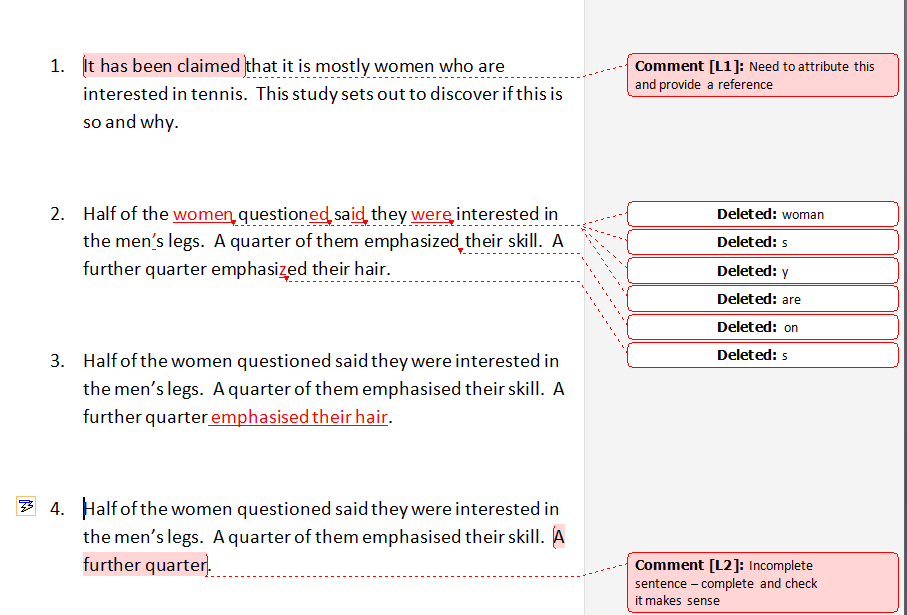
So, when I work with an essay, dissertation or thesis, I am very careful not to rewrite anything but only to tweak grammar, punctuation and spelling and suggest where things should be sorted out.  The following image shows a few examples of how I work, and one of how I DON’T work.

In Example 1, the author has not quoted their source and I’ve inserted a comment to remind them to do so.

In Example 2, there’s quite a lot wrong with spelling and grammar, but you can see that the author knows what they’re talking about.  I’ve amended their mistakes, but again that’s all tracked, so they a) can see what they’ve done wrong and b) have to choose whether to accept the change themselves.  By the way, the ‘s’ is changed in emphasized to make it consistent.  I’ll do a post about s and z another time.

In Example 3, a Very Bad ProofReader has seen something missing and decided to add it in.  In this case, rather than a few missing words, it’s a concept or part of the explanation of the actual results that’s missing.  This is a small example – but the author has not written that and the proofreader shouldn’t have.  I’ll suggest adding a word or two, but I wouldn’t complete something missing from the actual substance of the research or discussion.

Example 4 shows how I’d handle that same sentence.  No re-writing, no suggesting – I’ve just highlighted and told them something’s missing.  I’ll do the same if a sentence is mangled, incoherent and just doesn’t make sense.  But I don’t write my clients’ words for them, and students shouldn’t expect their proofreaders to do so (most don’t!).

 
16 Comments

Posted by on June 29, 2011 in proofreading, Students, Writing


Tags: , , , , ,

Referencing for academic writing

It’s dissertation season, in the UK at least, and so I thought I’d talk a little bit about some topics that are important to students, whether you’re doing your undergraduate dissertation or a postgraduate Master’s dissertation or PhD.  I’ll cover referencing this time, and then something on planning, structuring and handy hints. If you’ve been through the process and have any hints and tips to share, do get in touch so I can weave them together into a useful document.

So: referencing.  We reference (or cite) what we’ve read when writing an essay or thesis in order to avoid plagiarism and demonstrate that we’ve read around the subject and know what we’re talking about.  There are two aspects to referencing:

  • recording what you’ve read and referred to
  • referring to it appropriately in the text and bibliography of your dissertation

Recording what you’ve read

Putting together your references and bibliography is so much simpler if you keep a note of what you’ve read and consulted as you go along.  In the days of my Library and Information Studies post-grad, it was all done on card index cards.  Now there are lots of different options, including software like EndNote and Reference Manager.  For my research project, I’m just keeping a list on a spreadsheet in Excel.

The information you need to note:

  • Author’s full name.  Editor(s) if appropriate
  • For books: full title of the book.  Full publisher information for the book (you can find this on the bottom of the title page, or the back of the title page), including publisher name, location and date published
  • For chapters in books: Full title of the chapter and a full citation for the book, too (see above)
  • For articles in journals: Full title of the article.  Full title of the journal.  Page numbers for the article
  • For everything: page numbers for any direct quotations or sections you are going to refer to heavily
  • For websites: full URL and date you accessed the web page

Obviously, this is easy to do at the time; just note down the details and off you go.  Much, much harder to reconstruct after the event.

Referring to what you’ve read / citing

Now we’re talking about how you refer to what you’ve read and quoted in the text of the document you’re writing. The most important thing to do here is …

  • CHECK WHICH REFERENCING SYSTEM YOUR ORGANISATION PREFERS YOU TO USE!

This is hugely important.  Get it right first time, and you’ll pop all the references in easily.  Get it wrong, or don’t bother to check, and you’ll be going through and through the thing, fiddling around with the references, when you should be spending your time refining your arguments and putting your thoughts across.  Or you’ll be paying someone like me £x an hour to sort it out for you!

Referencing systems include Harvard Referencing, APA (American Psychological Association), MLA (Modern Language Association).  They all differ in how they ask you to present the information you collected above within your text.

For example, you could be expected to add a footnote number to each quotation in the text, with either a full bibliographical citation in the footnote section or a shortened reference there and a full bibliographical citation in the bibliography.  Or you could be expected to put Smith (2001) in the text and supply a full reference in the bibliography.  Or you might be putting a number in the text, referring to a numbered list in the bibliography.

A full bibliographical citation looks something like this:

Smith, J.L. (2001) The correct way to do referencing.  Birmingham: Libro Publications.

Jones, A.B. (2001) “Me and my essay”, in Smith, J.L. The correct way to do referencing.  Birmingham: Libro Publications.

Robinson, X. (2009) The different forms of citation.  American Journal of Footnotes 33 (1): 202-204.

But it doesn’t always, and the citation method does affect how this looks.

Always, though: ALWAYS, the bibliography is in alphabetical order by author’s surname.  It can take ages to sort this out if it isn’t!

How to conform to each referencing system?  That’s a long, long post that no one would want to read! Your academic institution should provide you with links to reference materials about their preferred system, and, if not, the dreaded Wikipedia does do a good summary of most of the common ones.

Good luck – and happy referencing!


Tags: , , , ,

Lineage or linage?

I’m going through the replies to my original post asking for troublesome pairs people want me to explain.  I’ll try to cover them all in the fullness of time, so watch this space!

This feels like quite an obscure one, but I’ve been asked, so I’ll answer!

Your lineage is your ancestry or pedigree.

Linage is the number of written or printed lines.

In the spirit of trying to write at least one example that uses both of the words discussed in the post: “How much linage do you need to write out the Earl’s lineage?”

For more troublesome pairs, look at the category cloud to the right, or click here.


Tags: , , ,

Client or customer?

This is a bit of a funny one, to be honest, but someone asked me to do a post on it, and I do try to help!  So what is the difference between a customer and a client – or, indeed, is there one?

Again, thanks to my Oxford resources for helping me work this through – examples are my own.

According to the Concise Oxford English dictionary …

A “client” is a person who uses the services of a professional organisation or person.

A “customer” is a person who buys goods or services from a shop or business.

So, really, a customer buys things and a client buys services …  I suppose a good way to differentiate it is: a client is NOT someone who buys an apple from a greengrocer, and you could buy an accounting software package from an accountant as a customer, but most people would say you’d still be their client for their services (even though the dictionary suggests otherwise); if you were just buying the package, you’d be a customer of their re-selling arm.  As clear as mud?

Maybe we should just stick with: customers for goods; clients for services.  Using the dictionary selectively but not going against it. I call the people I work for clients, by the way.

And an added bonus: “clientele” is the collective set of clients!

For more troublesome pairs, have a look at the category cloud to your lower right, or click here!


Tags: , , ,

Libro update for May

I’m a bit late publishing this May update, but feedback says that people like these, so here goes!

May was a good month, with a nice mix of regular customers and new ones.  I’ve been doing lots of new blog posts, too, starting off my “troublesome pairs” series where I help differentiate between words that people often confuse, and doing a series of posts explaining exactly what the different parts of my job entail, which I’m giving the category “what do I do?“.

As regards paid work, I’ve got up to all sorts of things …

Copy-edited blog posts for an artist, a physiotherapist and a training specialist.

Written up short pieces and longer articles for a website featuring local businesses.

Proofread one ongoing academic client’s essays, gone over a successful PhD candidate’s changes, and worked on some shorter essays for undergraduates and dissertations for postgraduates.

Copy-edited a biography for a local small press.

Proofread a business document for a regular client.

Completed various projects for my regular physiotherapist, translator and magazine designer clients.

I’ve booked in a few students for their dissertations – that work will start to hot up in the next month or so.

I’ve also helped out at another Social Media Surgery, which is always fun and worthwhile, and been on a course to learn how to publish on Kindle and sell the resulting book via Amazon.

Coming up – things are getting lovely and busy in June – I’ve got some new customers, including another translator, more transcriptions coming in; I’ve started putting together a series of interviews with other freelancers, which I’ll be publishing weekly from next Saturday, and I’ve already had a couple of very busy days and hit all my targets!

 
Leave a comment

Posted by on June 15, 2011 in Business, Jobs, What Do I Do?


Tags: , , , , ,