RSS

Category Archives: Errors

How do I change the colour of text in Word?

How do you change the colour of the text in your Word document?

Why would I want to change the colour of the text in my document?

You might want a section of the text to stand out, to match your company branding or to look attractive on a menu or other display document. It’s easy to change the text colour to do this.

Note: don’t use changed text colour to alert your proofreader/editor to something you want to do – read this article to find out why.

How to change the text colour using the menu bar

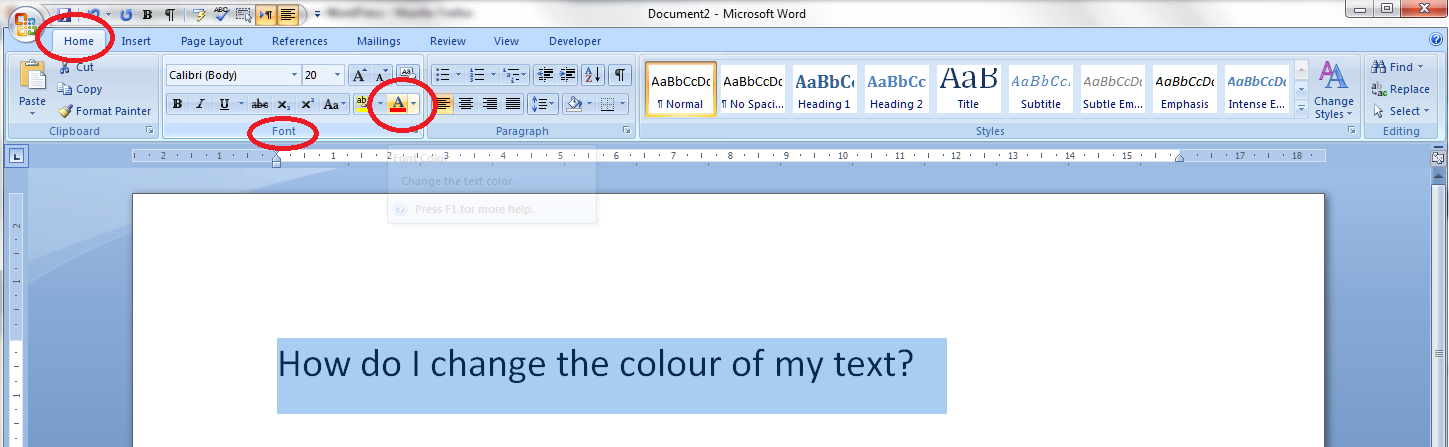
You can find the text colour button in the Home tab, in the font section of the menu bar:

1 colour in menu

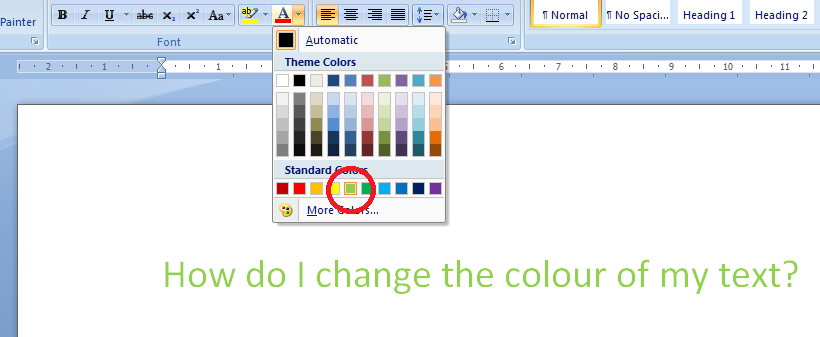
Make sure the text that you want to appear in a different colour has been highlighted. Locate the letter A with a red underline and click on the down arrow to the right of the letter to access the Colour menu:

1 colour template from menu

To see how to use this palette, hop down past the next section and join me at “How to select your colour”.

How to change the text colour using right click

You can do a lot to a chunk of text by highlighting it and right-clicking. Try that on some text now by highlighting it then right-clicking over the highlighted text:

2 colour in right-click

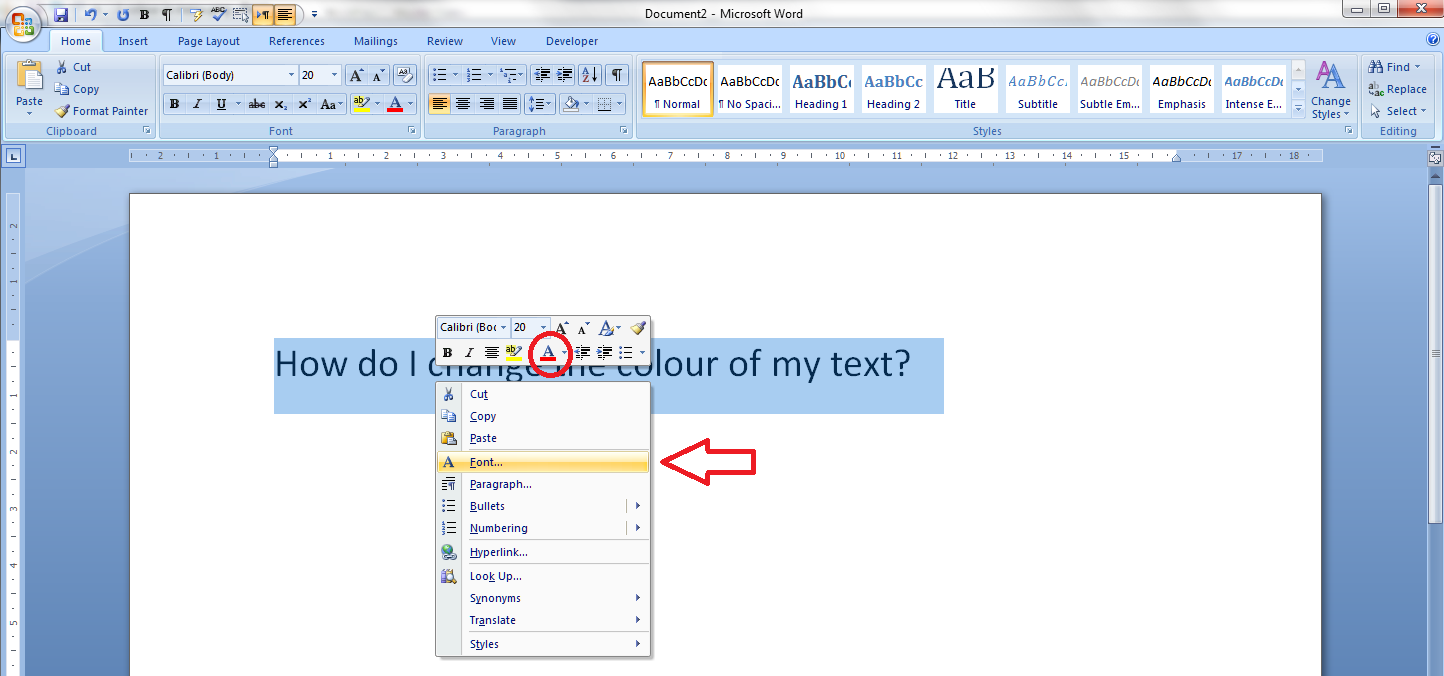
You will now find not one but two ways to change the text colour – a button with an A underlined in red (circled) and a Font menu (arrow). If you click on the button, you’ll get to the same point as in the section above. Click on Font for now ..

3 colour in right-click

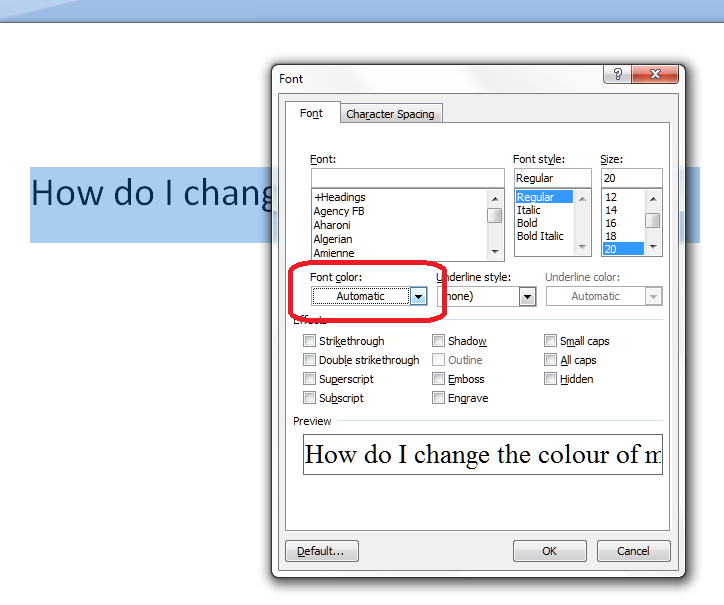
In the Font menu, you’ll find all sorts of things you can do to your font – very useful if you want to apply particular effects to the highlighted section of text. For now, we’re going to use the drop down arrow under Font color to select our font colour:

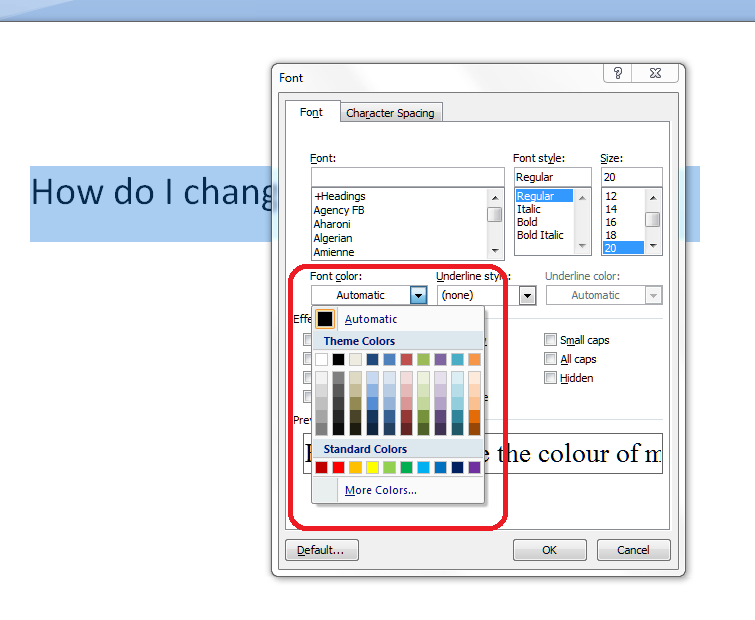
4 colour template in right-click

We’ve now got a choice of basic colours, with common ones at the bottom. Click, for example, on the first green, and your highlighted text will turn green, although you’ll need to press the OK button to make that change stick:

5 change colour

How do I choose a custom colour for my text?

You can, of course, go even more customised than this. In both ways to access the menu, you’ll find the words More colors… at the bottom of the palette:

6 more colours

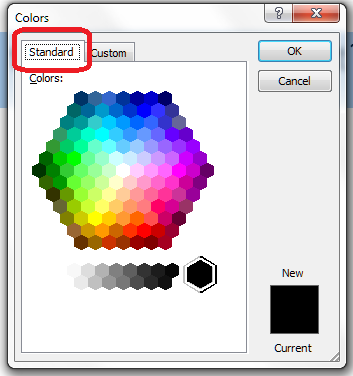
Clicking on this option will give you the Customise colours dialogue box, with two sets of increasingly customisable colour palettes to choose from. First of all, we have Standard colours:

7 more colours standard

You can see that we’re on the Standard tab here: there are plenty of colours and shades of grey to choose from, and you click on the colour and press OK to accept it. Or, if you’re feeling really adventurous, you can select the Custom tab

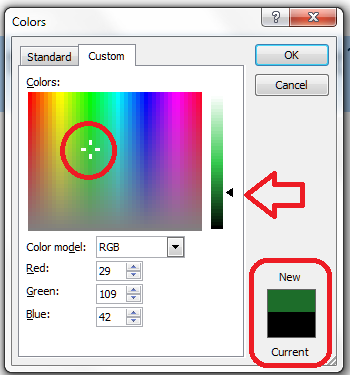
8 more colours custom

… and have a huge range of colours to choose from. Here, you can click on the colour and then move the arrow up and down to adjust the amount of black in the colour, and it handily shows you the original and new colours at the bottom of the dialogue box.

Now you know how to change the text colour in Word to an almost infinite number of colour choices. You can use the same button or right-click and font option in Excel and PowerPoint, too.

———————

This is part of my series on how to avoid time-consuming “short cuts” and use Word in the right way to maximise your time and improve the look of your documents.

Please note, these hints work with versions of Microsoft Word currently in use – Word 2003, Word 2007 and Word 2010, all for PC. Mac compatible versions of Word should have similar options. Always save a copy of your document before manipulating it. I bear no responsibility for any pickles you might get yourself into!

Find all the short cuts here

 
Leave a comment

Posted by on June 26, 2013 in Errors, New skills, Short cuts, Word, Writing


Tags: , , , , , , , ,

Peer or pier?

English spelling is rife with these short words that sound the same and cause trouble. Just look at pare and pear and pair, or bear and bare, or peek and peak. But just like those, these two are very different, and their meanings don’t overlap at all!

To peer is to look with concentration or difficulty – “I peered at the dusty manuscript in the dim light”. It also means to be just visible – “the sun was peering around the side of the mountain” (the origin of this meaning may be from appear in 16th century dialect). A peer is a member of the nobility in Britain and Ireland, or a person of same age, status, rank or ability as oneself *my peers in the business world are a group of women who set up businesses a few years ago when they were around 40″. As an extension of this, it can mean simple equal (in quality) – “as an editor, he has no peer”.

A pier is any long narrow structure e.g. leading out to sea for boats to more on or for entertainment, or projecting from an airport terminal giving access to planes. It is also the pillar of an arch or pillar supporting a bridge, wall between windows or adjacent openings. Its origin is unknown.

“I peered at the pier through the mist as my peers danced away, celebrating their business success with some peers of the realm.”

You can find more troublesome pairs here and the index to them all so far is here.


Tags: , , ,

How to search for almost anything in Microsoft Office, other software and web pages

Today we’re going to learn about the wonders of Ctrl-F and how it can help you to search for text almost anywhere.

We’re going to look at an overview of the basics in this article, then I’ll go into more detail on advanced searching and replacing in another one.

What does Ctrl-F mean?

Ctrl-F is shorthand for “press the control key and the F key at the same time“. It’s the way in which key combinations are expressed. You will have one or two Ctrl keys on your keyboard (I have two) and it’s usually easiest to press Ctrl, hold it down, then press F.
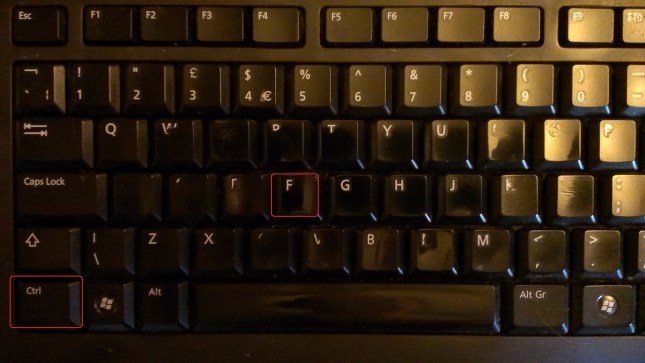
keyboard

If you’re looking at a  Word, Excel or Powerpoint document, a web page or, in fact, many other things, you will now be able to search for text in that document, on that page, etc. Let’s go through the different places you can use this.

Searching in Word 2007 using Ctrl-F

Word is one of the places where searching is most useful. It also offers the largest range of options for searching, and we’re just going to look at the most common today but watch this space for an article on advanced searching.

I use Ctrl-F to …

  • Search for a place in a text by a word in its heading
  • Search for tables / figures and references to them in a document to make sure they match up
  • Search for chapter headings in a book / thesis when I want to check they have a consistent style
  • Search for a name to check how it was spelled last time

and many other things.

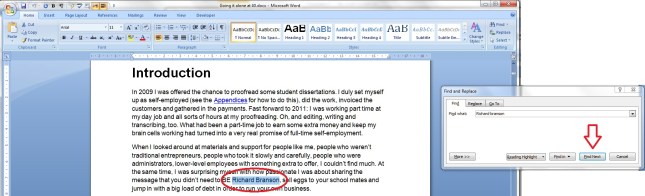
When you have a Word document open, to bring up the search dialogue box, press the Control key and the F key at the same time. You’ll then be presented with the basic search box:
Word 1

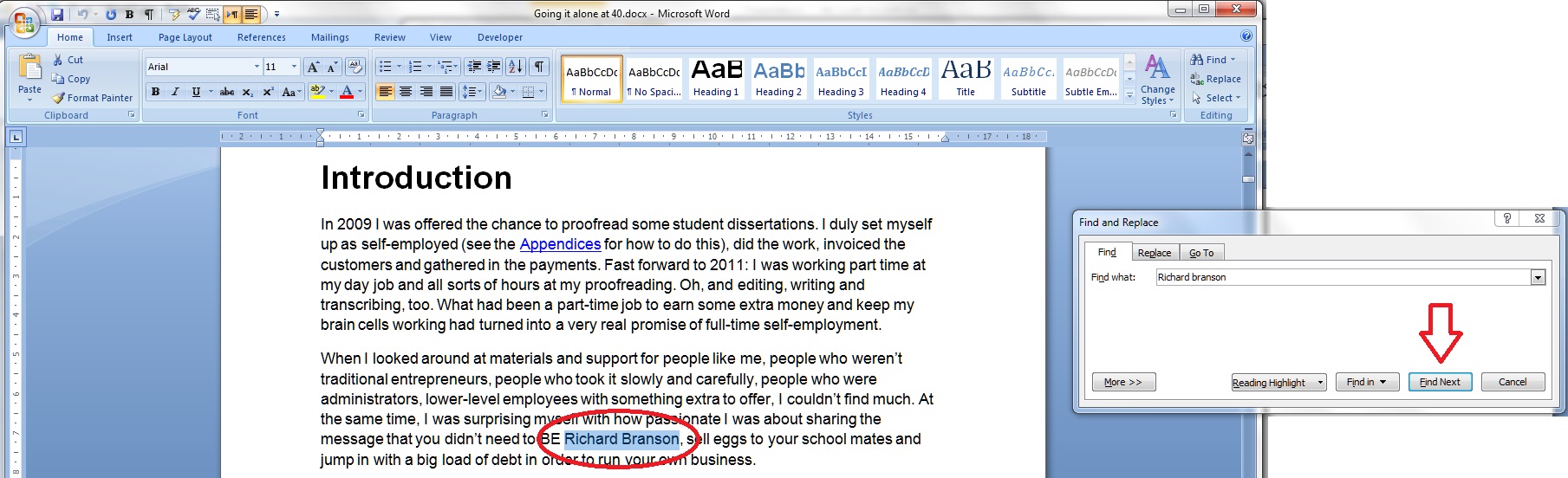
It will usually appear to the side of the document, so as not to obscure the text. Enter the text you wish to search for, in this case Richard Branson, and press the Find next button (or the Enter key). Word will highlight the text you’re looking for.

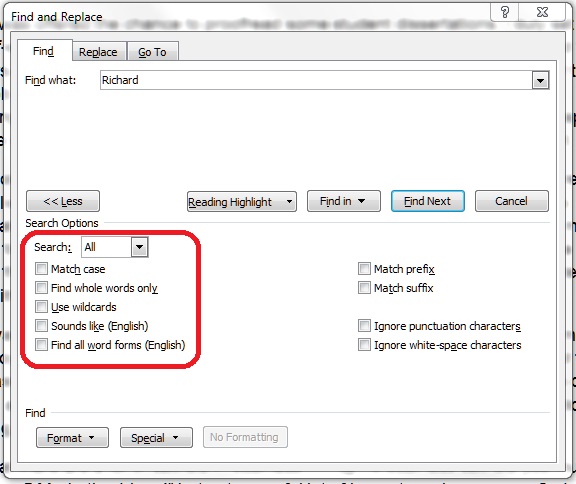
That’s great, but what if you want more accurate searching? Press the More >> button for more options:
Word 2

Here, you have options to match the case, find whole words only, etc. For the moment, we’re going to concentrate on just these two (see the article on advanced searching for the other options).

If you choose Match case, it will search for only those words in the exact same case as the one in the search box. If you choose Find whole words only, it will look for only that text, not that text included in a longer word. We’ll have a look at how that works in just a moment.

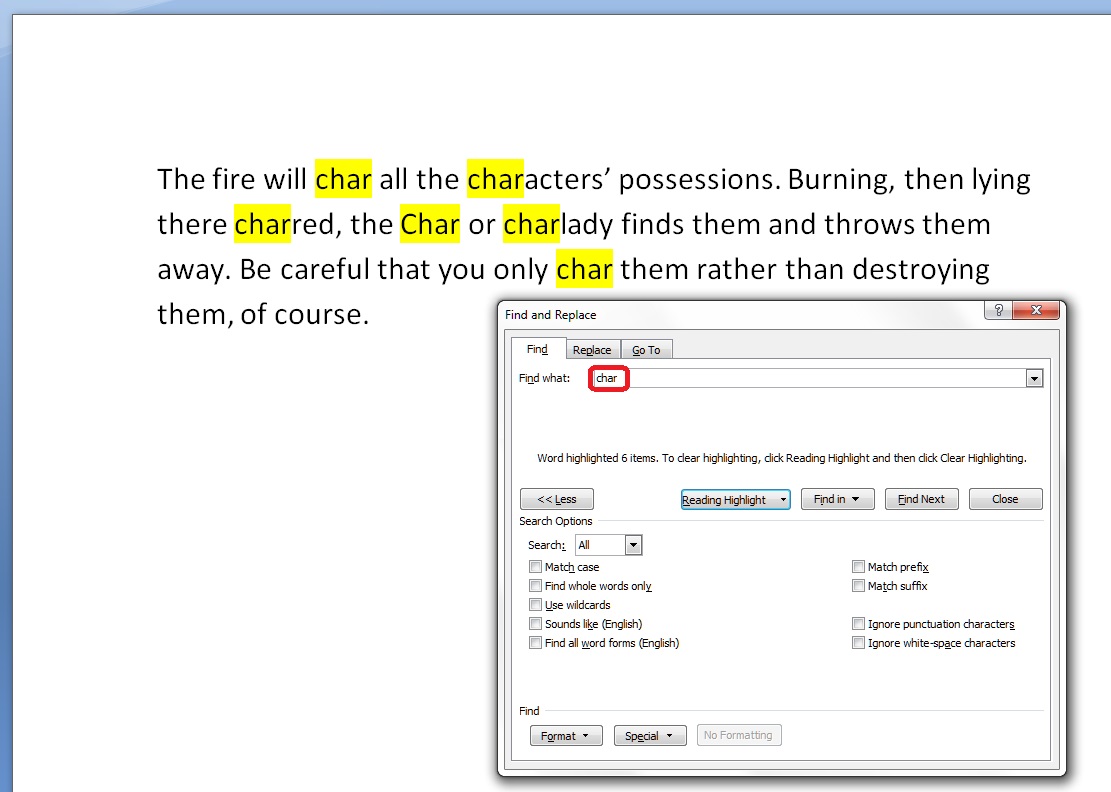
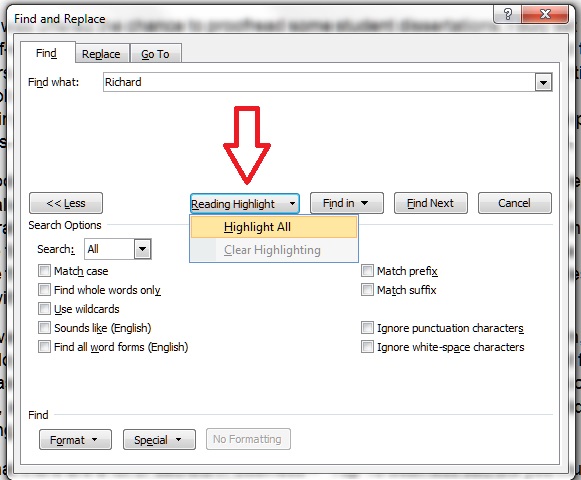
Moving along the options, we have a Reading Highlight button. This will highlight all of the instances of your search word in your document. I find this useful if I’m writing a text to use for Search Engine Optimisation purposes and want to see how many times I’ve included a particular phrase:
Word 3

Note: if you change your search term, you will need to Clear Highlighting before highlighting again, otherwise all of the original highlighting is shown.

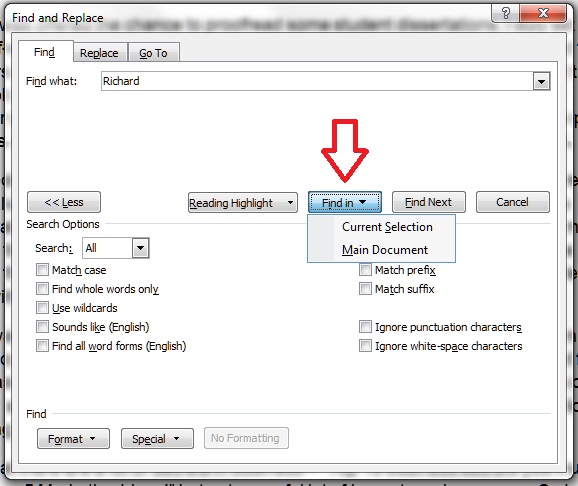
The next option is Find In. This is useful if you only want to search a particular part of the text for your word. Highlight the section in which you want to search, and then choose Current Selection (or, if you’ve got a section highlighted for some other reason, choose Main Document.
Word 4

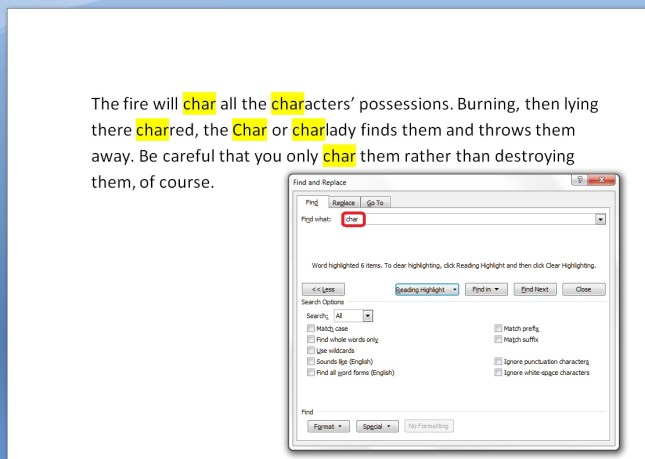
Let’s have a look at some of these options in practice, using a rather odd paragraph I made up for illustration purposes:
Word 5

Here, I’ve just searched for char, not worrying about any additional options. You can see that it’s found char, but also character, charlady and Char, because I didn’t specify that I wanted only the word form “char”.

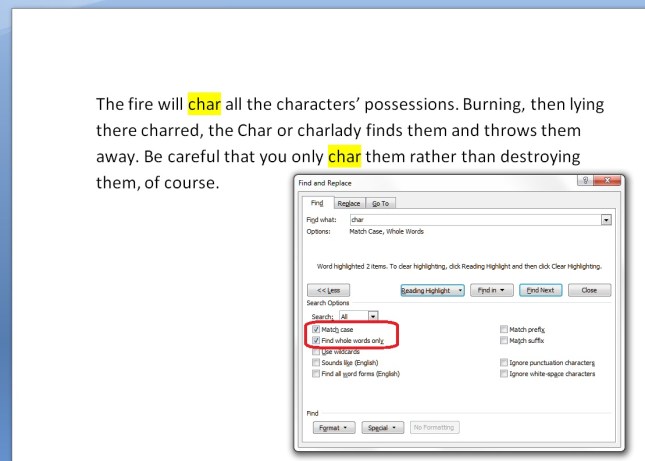
If I want to only find “char” in the text, I need to tell Word to Match case and Find whole words only. Then I will get the desired result:
Word 6

Searching in Word 2010 using Ctrl-F

Of course, they went and changed this to make it more useful and user-friendly in Word 2010 … I was a bit flummoxed when I first tried to use it, but you can get back to the dialogue box we’ve looked at above, and there are some additional useful features.

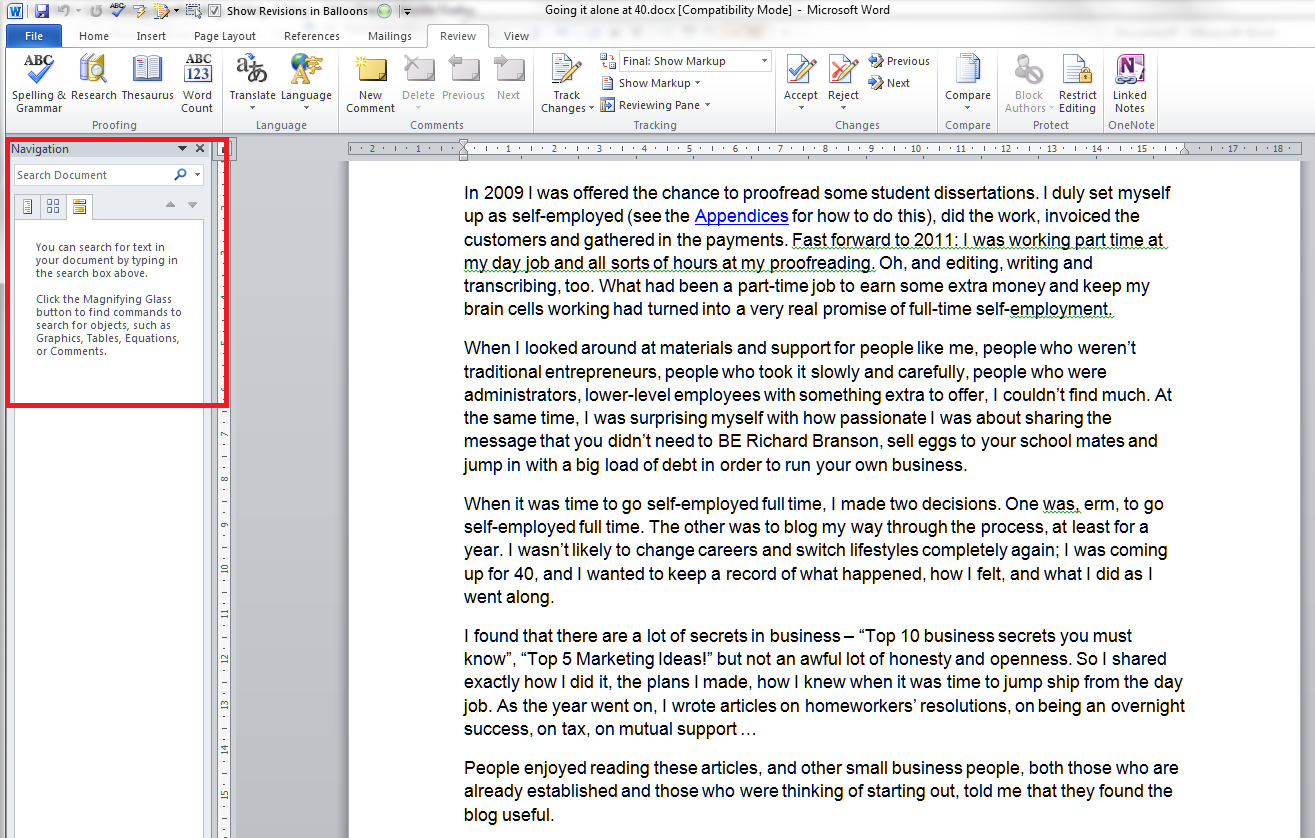
In Word 2010, if you press Ctrl-F, you’ll be given a Navigation pane to the left-hand side of the document:
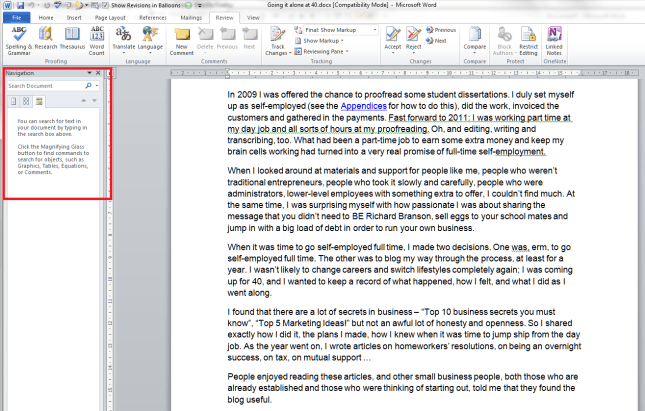
Word 7

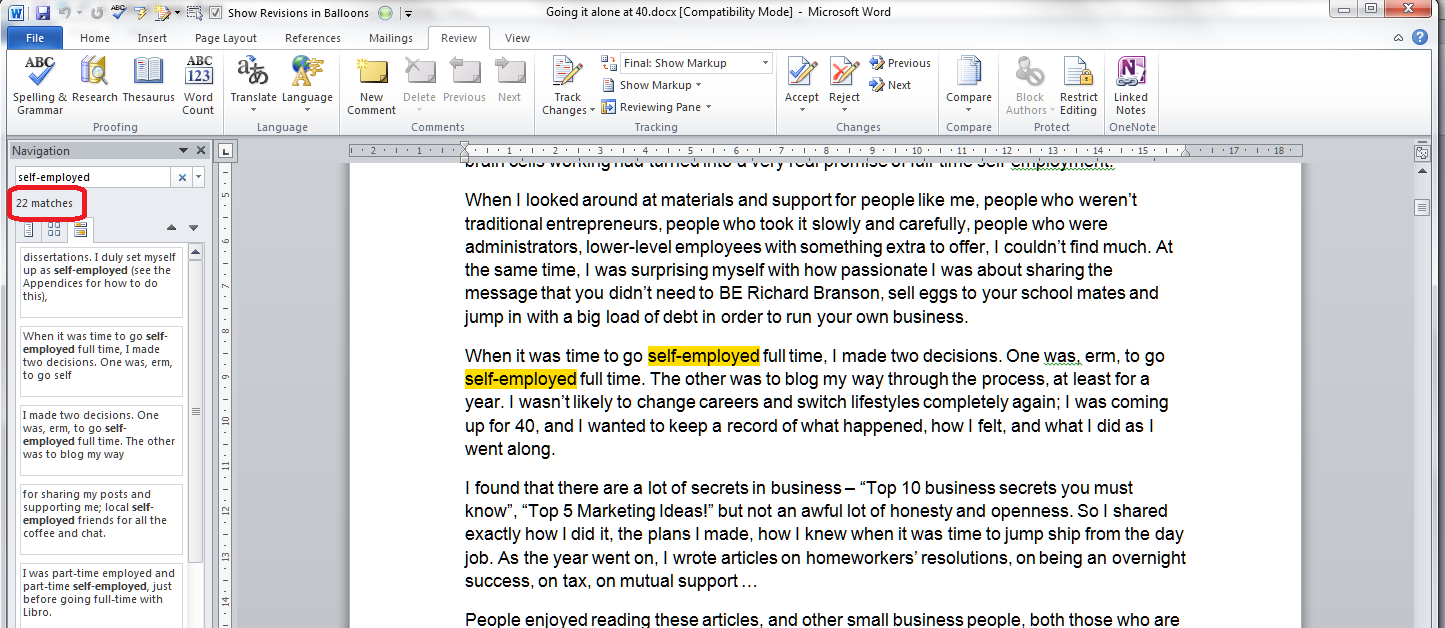
Put your search term in the box and it will automatically highlight all of the instances of that word in the document, give you the number of times it appears, and list all the instances so you can click and visit each of them:
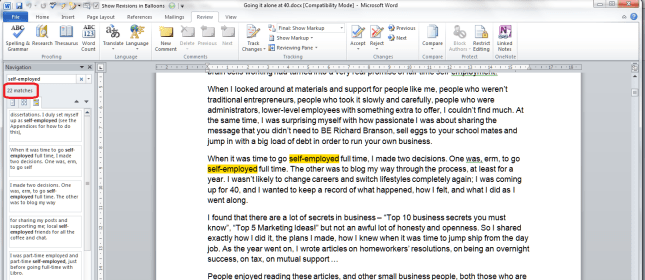
Word 8

This is handy, and although you can do more things here to do with looking at the whole document, you can’t immediately refine your search to whole words only, match case, etc. But you can get to that familiar dialogue box.

Click the down arrow next to the search box and you’ll be presented with a list of options. We’ll look at the advanced ones next time.
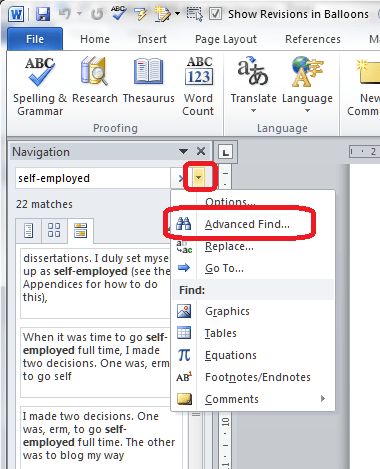
Word 9

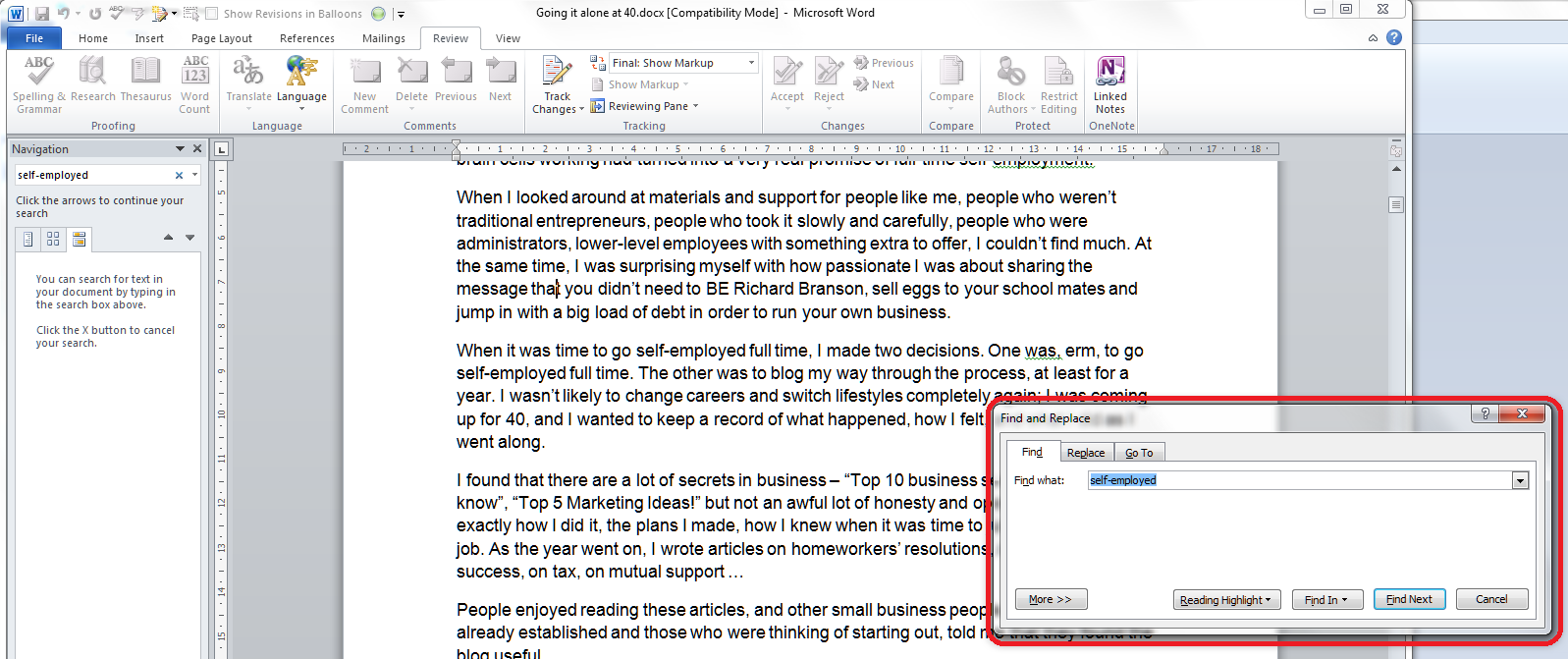
For now, select Advanced Find, and a familiar dialogue box will pop up …
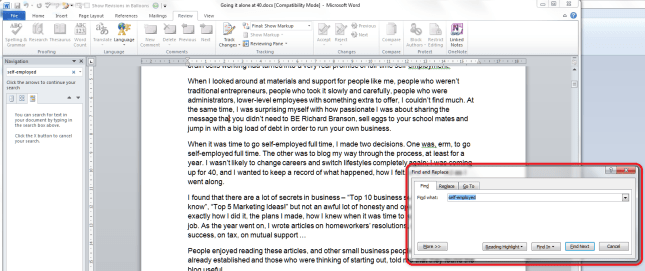
Word 10

Searching in Excel using Ctrl-F

All of the other software in Microsoft Office uses Ctrl-F, however to a more limited and less customisable degree. In Excel, pressing Ctrl-F will give you this dialogue box:
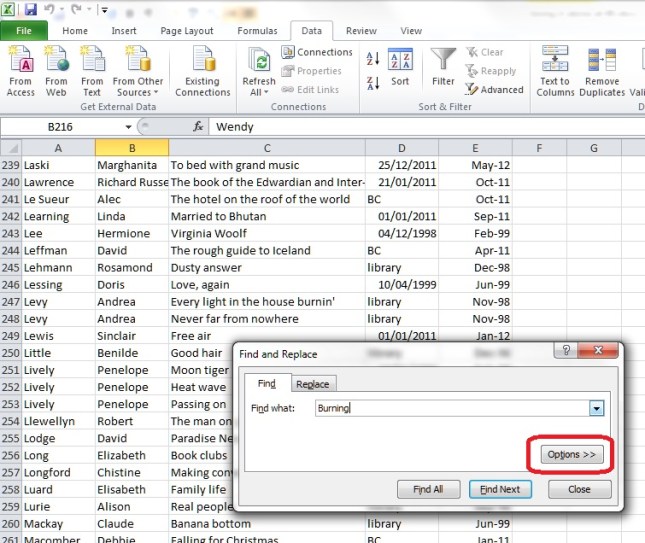
Excel 1

Press the Options button and you have some options for where you search and the form of the word:
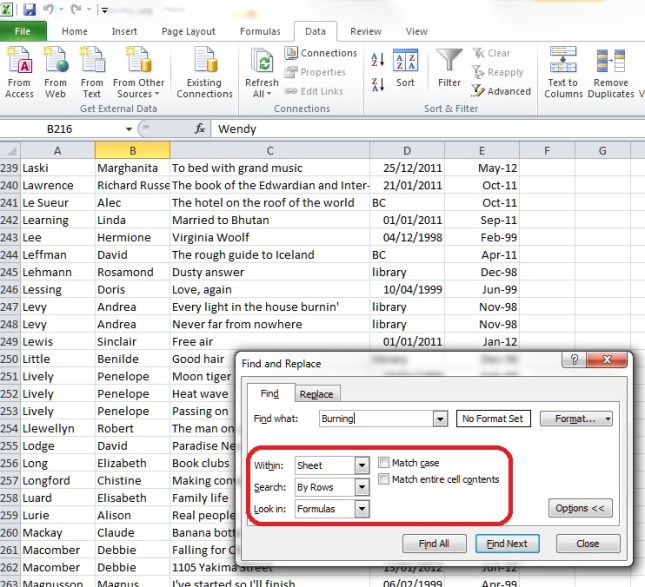
Excel 2

This works the same in Excel 2007 and 2010.

Searching in Powerpoint using Ctrl-F

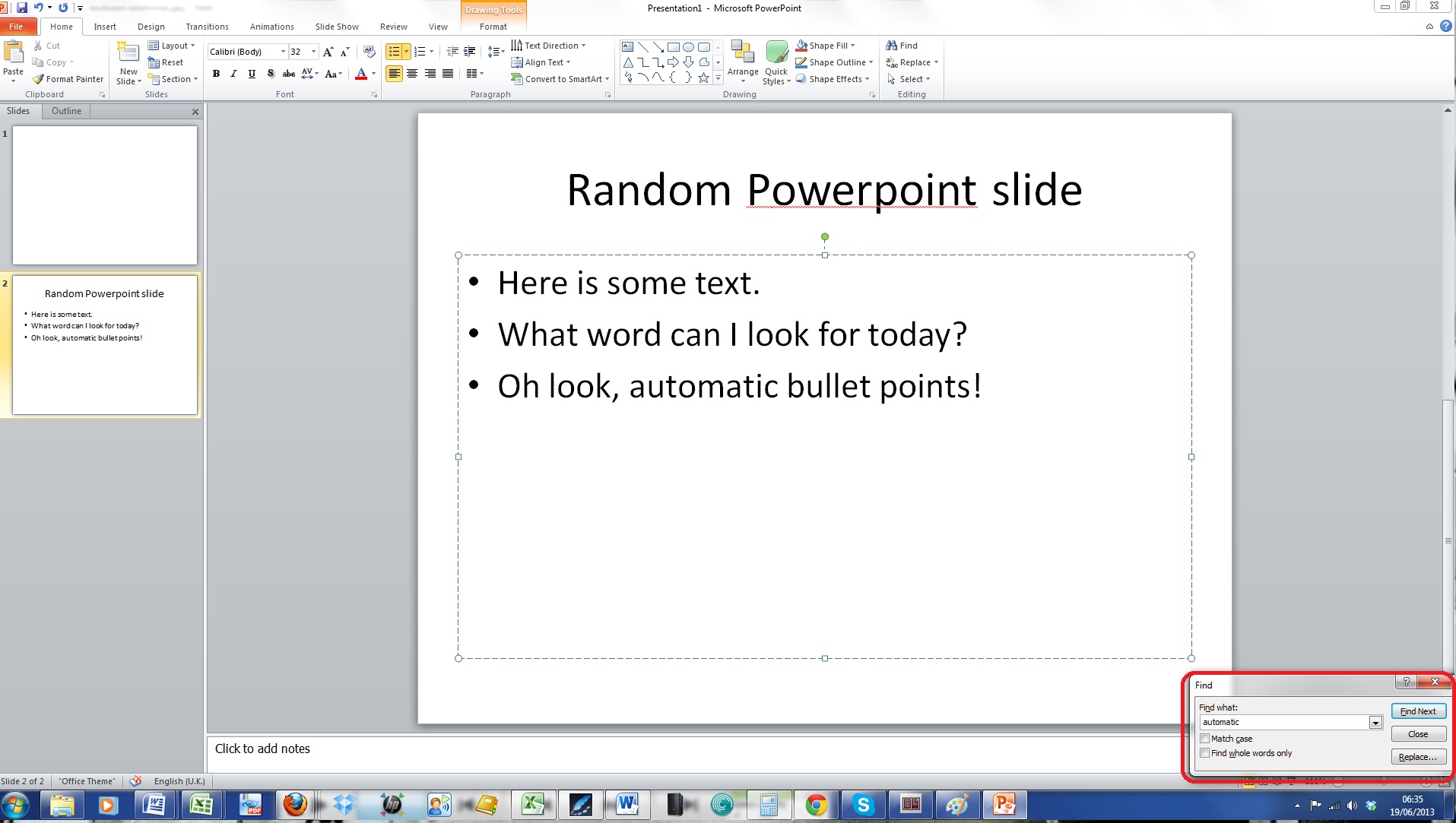
In Powerpoint, Ctrl-F gives you a small dialogue box:
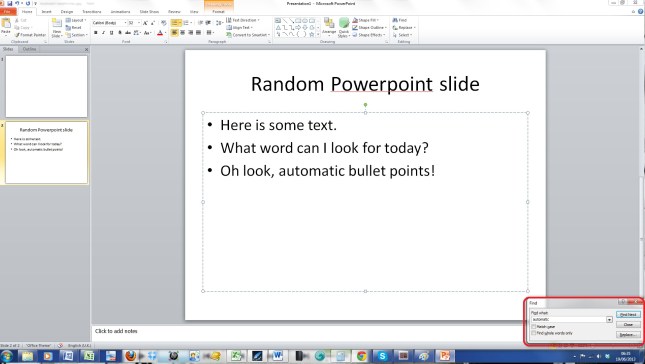
Powerpoint

Again, you have enough options to be useful, but not the range of options you find in Word, and again, this works the same in Powerpoint 2007 and 2010.

Searching on web pages using Ctrl-F

I find this so useful, especially if I’m searching my own web pages for a word I’ve used or maybe misused (I used this a great deal in the great proof-reading to proofreading change I made a few years ago.

This varies according to the browser you’re using, but hitting Ctrl-F will always bring you up a search box of some kind:
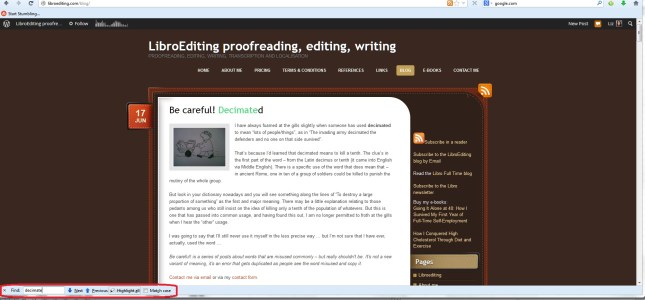
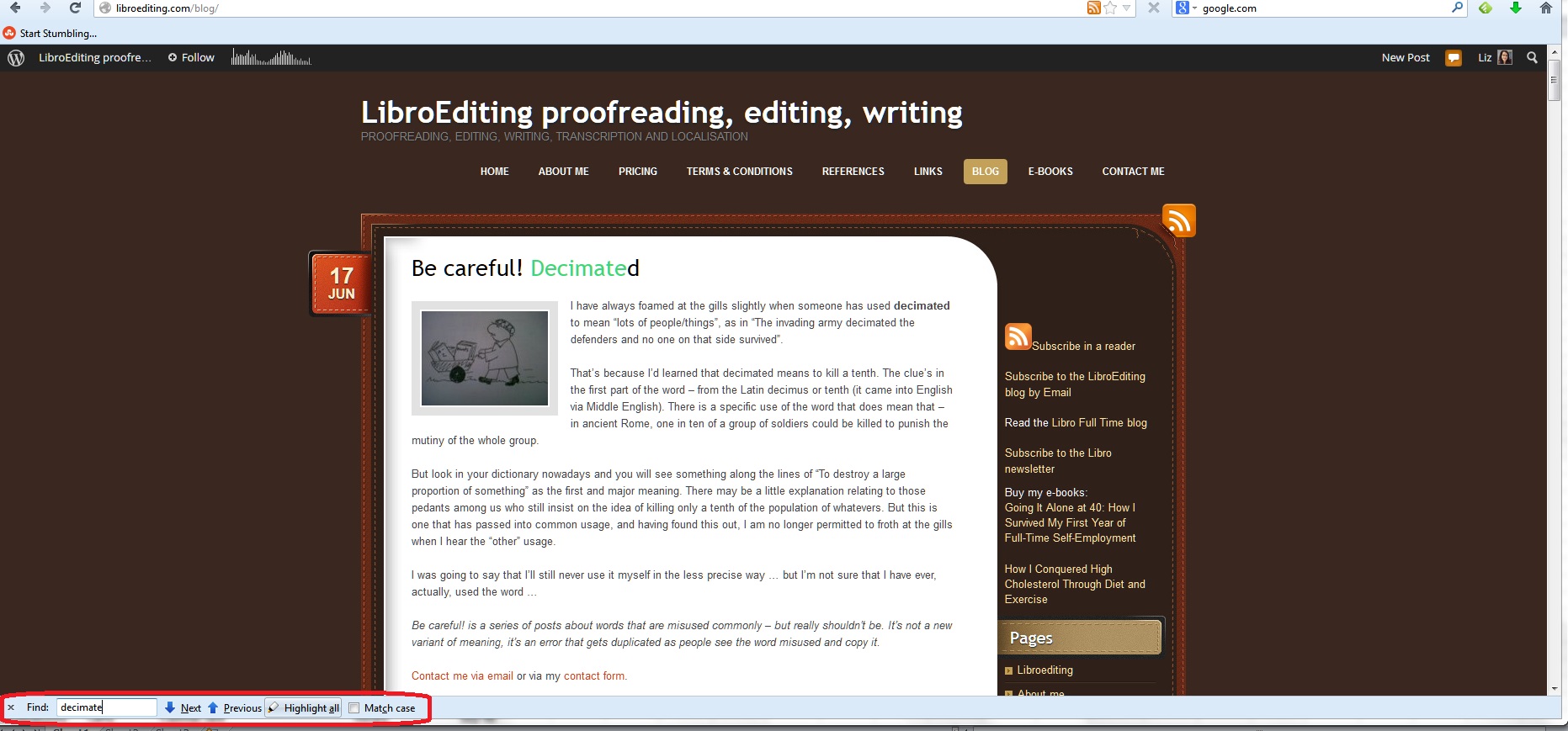
website

  • In Firefox, the search box appears at the bottom of the screen and gives you the option to highlight all and match case
  • In Chrome, the search box appears at the top of the screen and gives you the option to search whole word only and match case
  • In Internet Explorer, the search box appears at the top of the screen but doesn’t give you any options

Please note that these options might change in future as the browsers are updated.

How to search a PDF using Ctrl-F

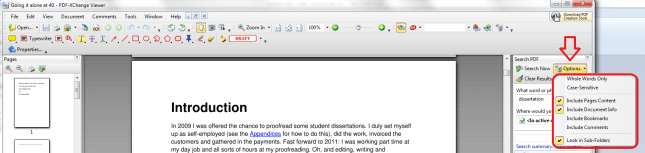
One of the few things that you can’t search using Ctrl-F is a pdf document. However, most readers (I use PDF-Exchange), as well as having their own search functionality on the page, will allow you to use Shift-Ctrl-F to search!
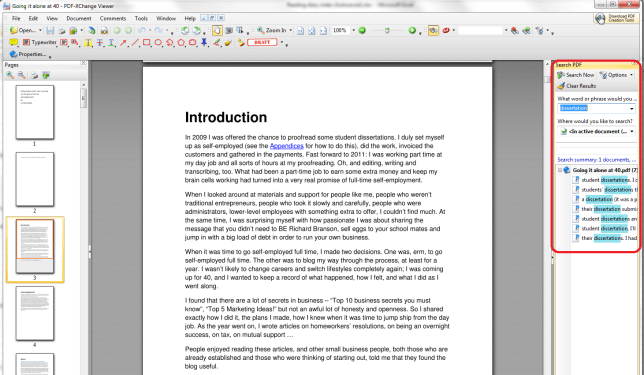
pdf 1

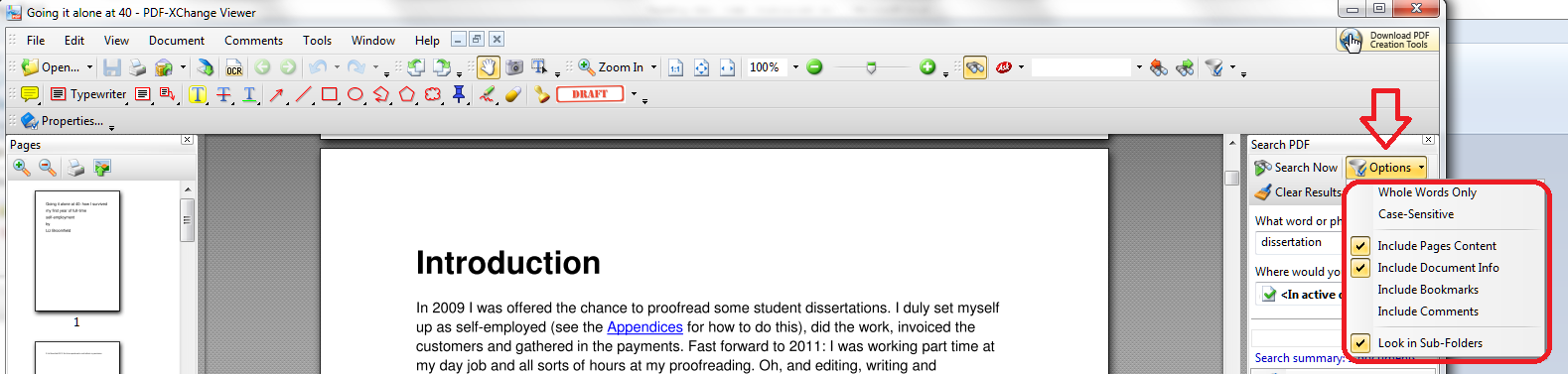
You have some options:

pdf 2

And it works in a similar way in Adobe, too.

If this doesn’t work, there is always a search function in your pdf reader itself, for example:
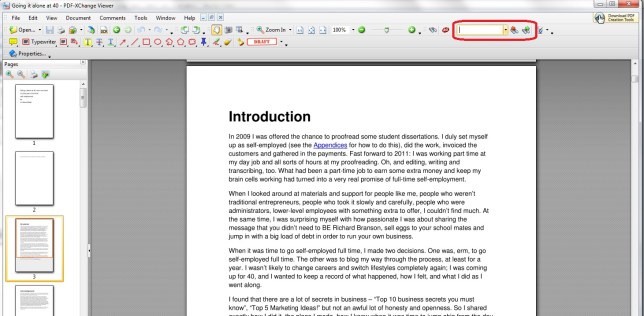
pdf

Searching anywhere using Ctrl-F

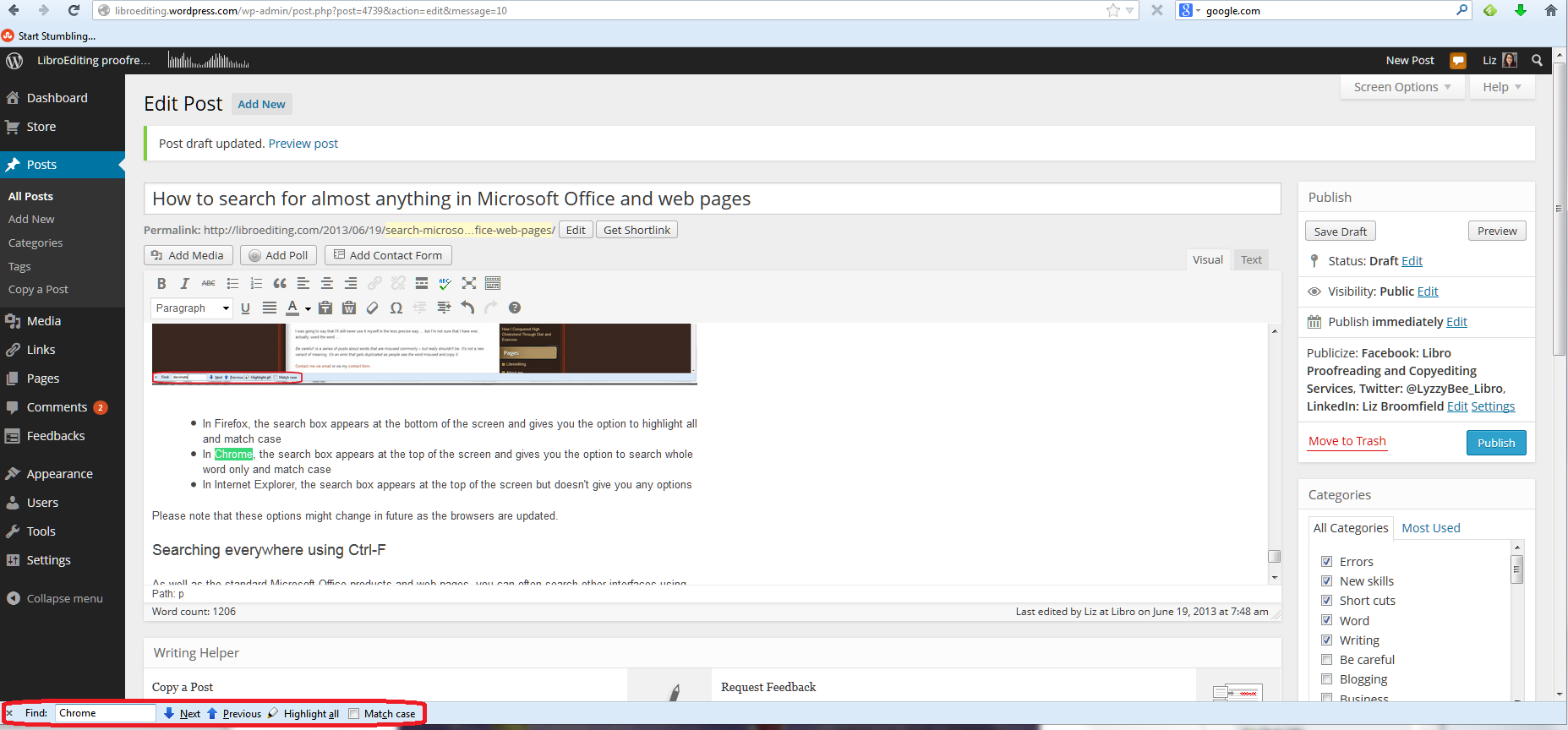
As well as the standard Microsoft Office products and web pages, you can often search other interfaces using Ctrl-F, too. For example, because my WordPress interface uses the web browser, I can search for words in posts I’m writing:
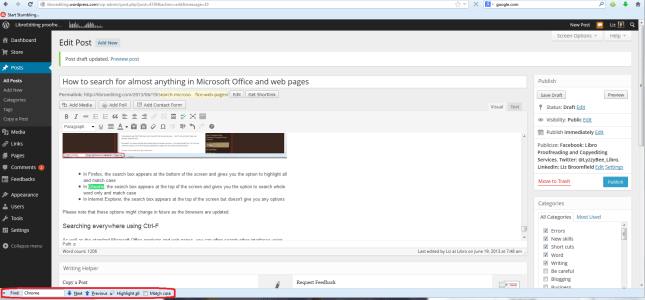
Wordpress

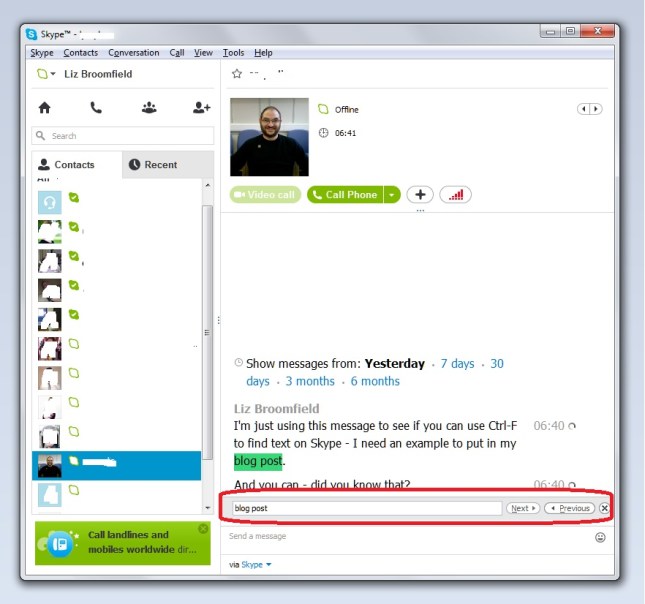
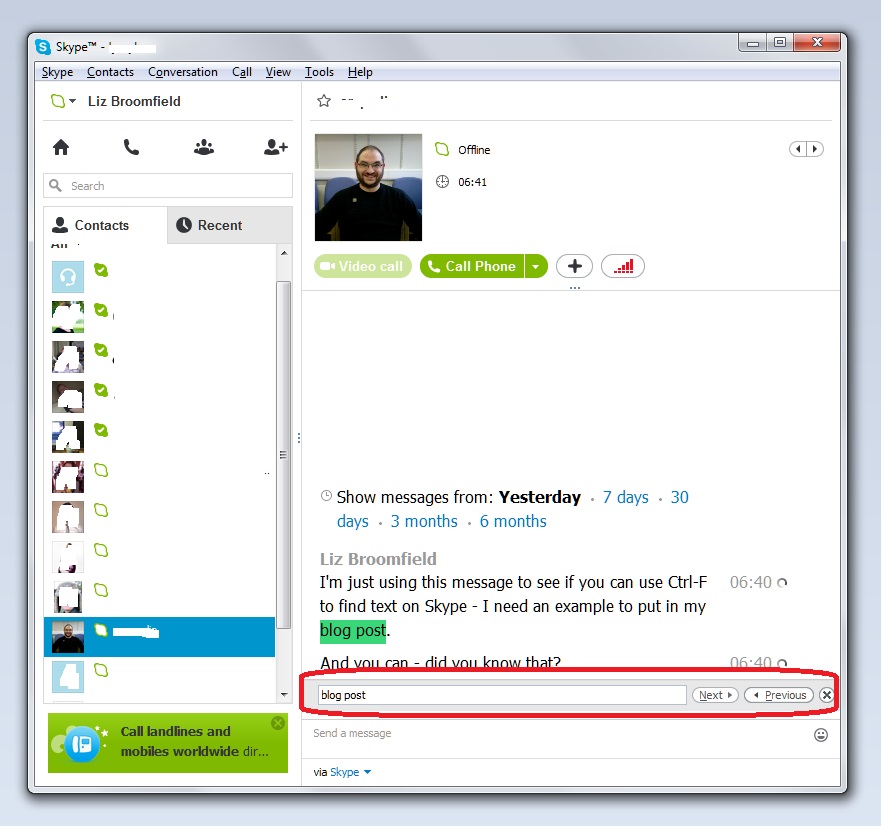
I can use it in Skype:

Skype

And I’ve even tried it in my transcription management software, ExpressScribe, and you can use it there, too!
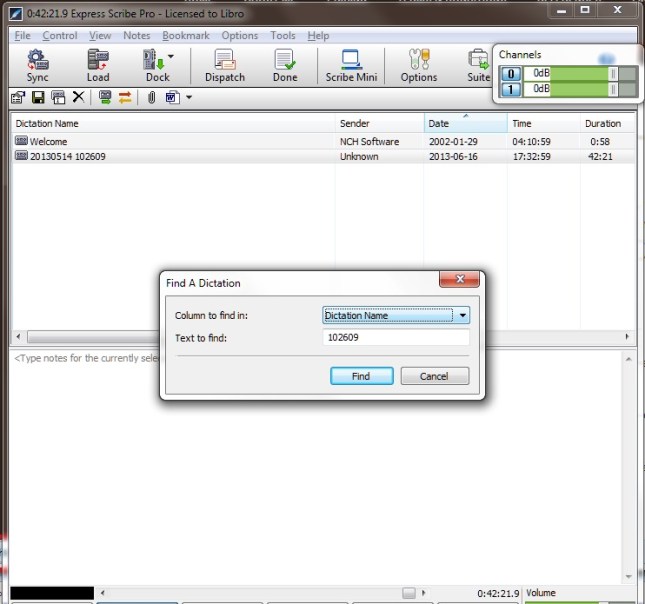
express scribe

Today we’ve learned about how to use Ctrl-F to search almost anywhere in any type of document or application.

Coming soon – advanced searching in Word and Search & Replace / Go To.

———————

This is part of my series on how to avoid time-consuming “short cuts” and use Word in the right way to maximise your time and improve the look of your documents.

If you’ve enjoyed this post and/or found it useful, please take a moment to comment (I’ll just ask you to provide a name and email address; you don’t have to sign in to WordPress) and share the post using the buttons you can see below. Thank you!

Please note, these hints work with versions of Microsoft Word currently in use – Word 2003, Word 2007 and Word 2010, all for PC. Mac compatible versions of Word should have similar options. Always save a copy of your document before manipulating it. I bear no responsibility for any pickles you might get yourself into!

Find all the short cuts here


Tags: , , , , , , , ,

Be careful! Decimated

I have always foamed at the gills slightly when someone has used decimated to refer to “lots of people/things”, as in “The invading army decimated the defenders and no one on that side survived”.

That’s because I’d learned that decimated means to kill a tenth. The clue’s in the first part of the word – from the Latin decimus or tenth (it came into English via Middle English). There is a specific use of the word that does mean that – in ancient Rome, one in ten of a group of soldiers could be killed to punish the mutiny of the whole group.

But look in your dictionary nowadays and you will see something along the lines of “To destroy a large proportion of something” as the first and major meaning. There may be a little explanation relating to those pedants among us who still insist on the idea of killing only a tenth of the population of whatevers. But this is one that has passed into common usage, and having found this out, I am no longer permitted to froth at the gills when I hear the “other” usage.

I was going to say that I’ll still never use it myself in the less precise way … but I’m not sure that I have ever, actually, used the word …

Be careful! is a series of posts about words that are misused commonly – but really shouldn’t be. It’s not a new variant of meaning, it’s an error that gets duplicated as people see the word misused and copy it.

Contact me via email or via my contact form.

 
23 Comments

Posted by on June 17, 2013 in Be careful, Errors, Language use, Writing


Tags: ,

Marinade or marinate?

This one was suggested to me by my friend, Laura Creaven. I do like it when people suggest Pairs to me – so keep them coming, everyone!

Here we have two cooking terms which look oh-so-similar – but one is a noun and one is a verb!

A marinade is a mixture of oils, spices and vinegar in which we soak meat, fish or other proteins such as quorn or tofu, so that they soak up the flavours.

To marinate is to soak such items in such a mixture.

But wait: what’s this? The dictionary also has a verb, to marinade, which means … to marinade.

So you can marinate or marinade your slab of tofu or your fish, but you can only soak them in a marinade.

You can find more troublesome pairs here and the index to them all so far is here.


Tags: , , ,

Wave or waive? Waver or waiver?

After a short hiatus, the Troublesome Pairs are back! Today we’re looking at one that I see getting mixed up very often one way round, and not so often the other way – which is actually often the way.

A wave is a movement back or forth – whether it’s a hand, water or something in one’s hand that’s waving (“She gave the steam train a big wave as it chuffed past”). It’s also the signal made by that movement. The verb means to move back and forth while remaining itself fixed position (“I always wave at steam trains, and other kinds of train, too”; “She waved a stick at the dog to attract its attention”). Other meanings follow the movement of a wave, e.g. a light curl in the hair or what the dictionaries rather soberly call a ridged mass of water. It can also be a sudden increase in a phenomenon eg. a wave of copy-cat head shavings.

To waive, on the other hand, and this is the one that gets written “wave” quite often, is to refrain from claiming or insisting on – “Because you don’t have much income, I will waive my fee”, “he waived his right to anonymity”. A waiver is an act or instance of waiving a right or claim or a document recording this – “Before you drive this steam train, please sign this waiver to absolve us from blame if you get covered in soot”. A waver, however, is someone who’s waving.

“He waved the waiver in glee – ‘I don’t have to pay the fee!'”

You can find more troublesome pairs here and the index to them all so far is here.


Tags: , , ,

Justification in Word documents

Today we’re going to learn about the different kinds of justification that you can use in Word documents, and why we would choose to use the particular options.

What is justification?

Justification is the way in which your text is set out on the page. A margin is justified if all of the words on that margin are aligned vertically. For example, this article uses left justification: all of the lines of text start in the same place on the left, unless I manually indent them using tab or bullet points, and all of the ends of the lines present a ragged appearance on the right.

How do I set the justification in my Word document?

You will find the justification menu under the Home Tab, in the Paragraph Section – four little buttons with indications of what the text will look like:

1 justification menu

You can see four little buttons, in order from left to right: left justification, centre justification, right justification, full justification.

To set the justification for text that you have already typed, highlight the text and press the appropriate button. To start typing in a particular layout, press the button, check that it’s gone orange, and then start typing.

Left justification

Left justification means that all of the lines of text are lined up on the left hand side, but are ragged on the right:

2 left justification

Full justification

Full justification is very common and does look neat, although it can have some issues, as we find when we try to type text in a column or table using this form of justification:

3 full justification

Right justification

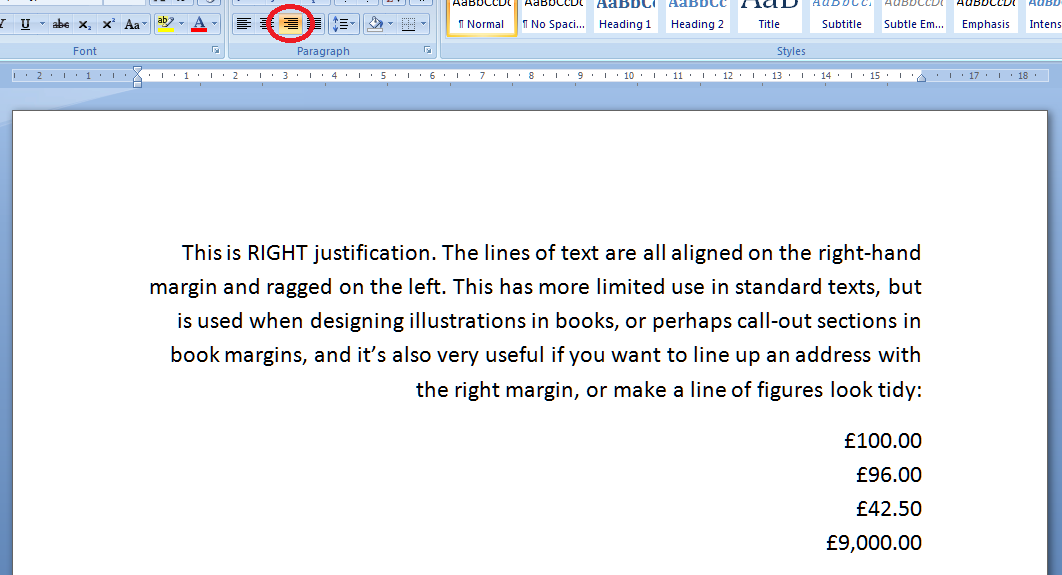
Right justification can look a bit odd in a text (and can be confused with the right-to-left text direction, which would of course use this as standard rather than left justification). However, it is extremely useful if you want to line up a list of numbers or prices so they look lovely and neat. This works in tables and columns of course, too, and makes it so easy to make things look tidy.

4 right justification

Centre justification

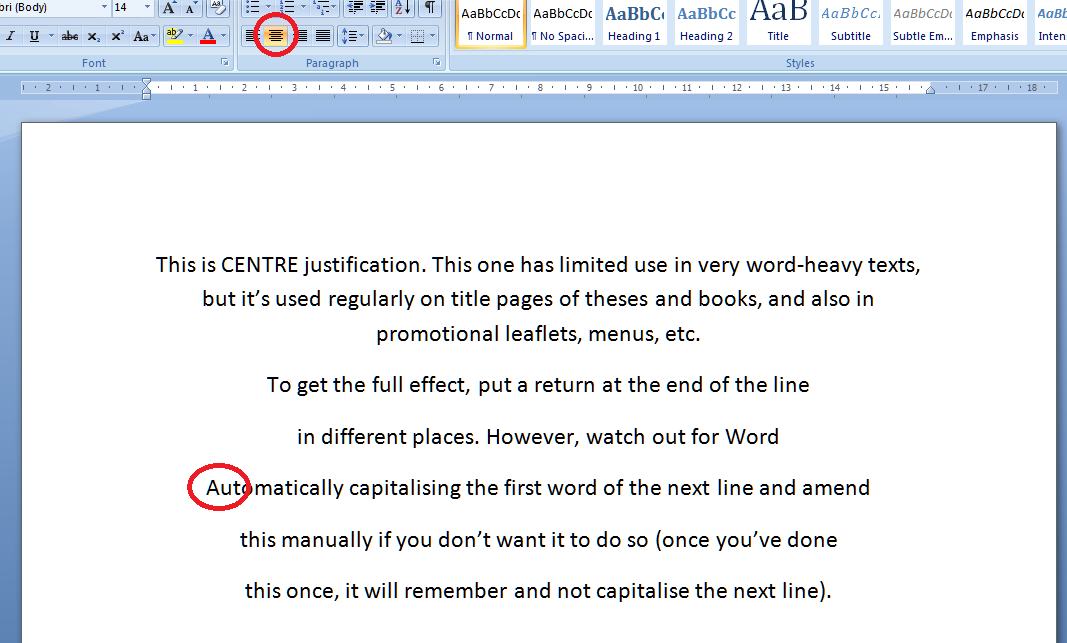
Centre justification is hardly ever used in anything but a heading, a poem, maybe, or something with a special design like a menu. But if you want to do it, here it is. One thing you need to watch out for is that if you hit the enter key to make a new line in order to get the effect or layout that you want, Word will helpfully capitalise the first word on the next line for you (see circled text below). However, at least in Word 2007 and Word 2010, if you change this to lower case once, it will leave it on lower case the next time! Clever Word!

5 centre justification

We’ve learned in this article about what justification is, the different kinds of justification, their advantages and disadvantages, and when you might want to use them.  I hope you’ve learned something useful here!

This is part of my series on how to avoid time-consuming “short cuts” and use Word in the right way to maximise your time and improve the look of your documents.

Please note, these hints work with versions of Microsoft Word currently in use – Word 2003, Word 2007 and Word 2010, all for PC. Mac compatible versions of Word should have similar options. Always save a copy of your document before manipulating it. I bear no responsibility for any pickles you might get yourself into!

Find all the short cuts here

 
6 Comments

Posted by on April 24, 2013 in Errors, New skills, Short cuts, Word, Writing


Tags: , , , , , , , ,

How to add line numbers to a Word document

This article explains the correct – and incorrect – way to add line numbers to a Word document. Why would you want to do that? Read on and find out! This works for Word 2007, Word 2010 and Word 2013.

Why do I need to add line numbers to a Word document?

I was inspired to write this post after my colleague Katharine O’Moore Klopf mentioned that she’d been asked to do this by the editors of a journal for which she was editing an article. Presumably they wanted to be able to refer to particular line numbers in their criticism of the piece.

Transcriptions will sometimes have line numbers, if they’re going to be discussed in detail, and we can probably all recall from our dim and distant pasts working on critiques of poems and plays which had 5, 10, 15 etc. in the margins.

So these are all reasons for adding line numbers to a Word document.

How NOT to add line numbers to a Word document

If you find the need to add line numbers, it’s kind of natural that you might think – oh, I’ll just make the whole document into a numbered list. Well, to do this you would have to put a return at the end of each line to make it into a new line. Then you would highlight the whole text and add numbered bullets. But, oh, look what happens:

1 what you don't do

The numbers push the lines across and they run over onto the next line; all possibility of right justification is lost; and heaven help you if you want to insert or delete any text once you’ve done it!

So, don’t do that.

How to add line numbers to a Word document – the correct way (Word 2007, Word 2010 and Word 2013)

Line numbering and its options can be found in Word 2007 and Word 2010 in the Page Layout tab, in the Page Setup area. There you will find Line Numbers:

2 menu

Click on the arrow next to Line Numbers to bring up its Options menu:

3 numbering options

It will automatically be set to None – choose Continuous and see what happens to your paragraphs …

4 continuous

Line numbers have automatically appeared, but the formatting of the text, its justification etc., remain as they were. This menu also allows to you to choose whether to restart the numbering at the beginning of each page, or each section, or to suppress the numbering for the particular paragraph your cursor is in.

Line numbering options in Word

You also have a number (sorry!) of options to choose from in order to customise your line numbering. You reach these options from the last item on the Line Numbering menu

5 options menu

… although when you click on this option, you are taken into a general dialogue box for Page Layout:

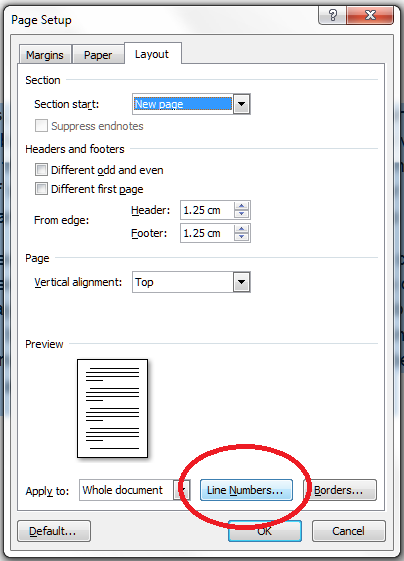
6 options menu line numbers

and you need to click on Line Numbers… at the bottom, which will finally give you a list of options:

7 options menu line numbers

To go through the options in order …

  • Add line numbers – this gives you the chance to add or remove them at this stage
  • From text – the distance between the text and the number. Click on the arrows to choose the distance (I usually just use Auto)
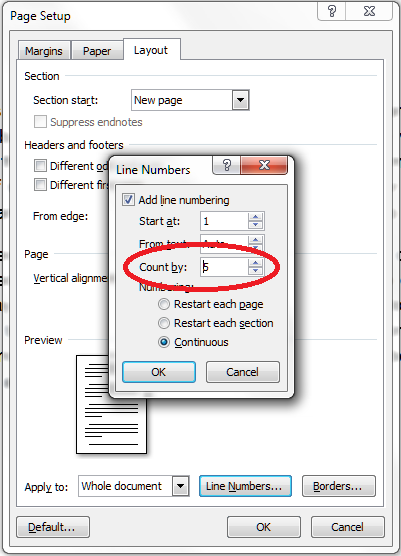
  • Count by – this allows you to display only every x number. I don’t think “Count by” is a particularly useful way to describe this, but scroll down to see it in action
  • Numbering Restart each page / Restart each section / Continuous – this repeats the options you found on the first screen, but it’s useful to have them here if you’re generally messing around in the Page Layout menu and don’t want to go out of it to set your line numbering

Whatever you choose on here, click OK twice to get out of this dialogue box and the Page Layout one.

How do I produce a line number every five or ten lines?

You may remember from literature lessons at school that poetry and plays often have every 5th line marked. You can do this in Word by choosing that Count by option in the Line Numbering Options menu (see above for how to get to it).

Set the number to 5 …

8 count by 5

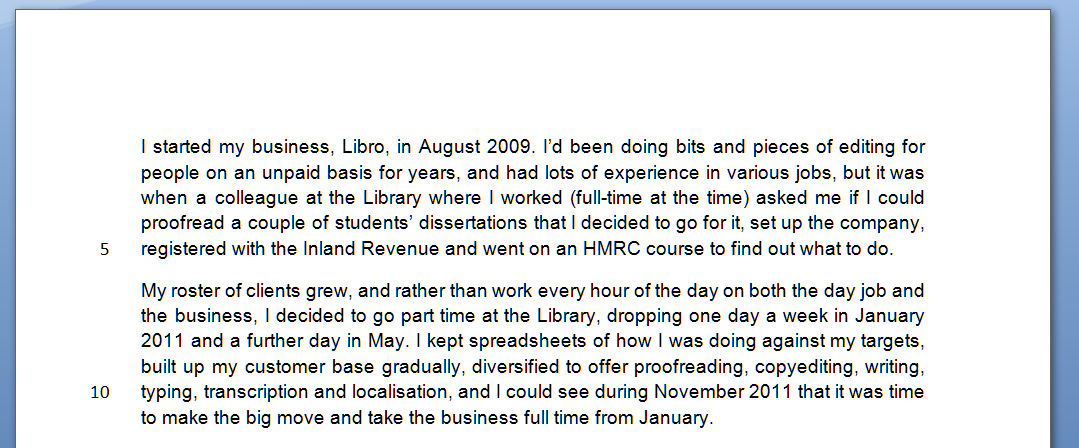
… and as if by magic, when you return to your document after choosing OK – OK, you will find every fifth line numbered:

9 counted by 5

Working in Word 2003

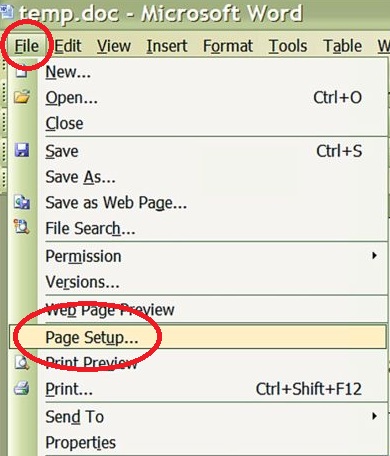
In Word 2003 you will need to follow these menus: File – Page Setup:

W2003_01

Choose the Layout tab in the dialogue box and the Line Numbers button. Choose to Apply to the Whole document or This point forward. Click on Line Numbers:

W2003_02

Tick Add line numbering and choose to Restart each page/section and Continuous. Click OK twice to accept – in this dialogue box you also find the options Start at, From text and Count by that are explained above.

Thanks to Katharine O’Moore Klopf for the Word 2003 screen shots and instructions.

Copying and pasting a document with line numbers

It’s come to my attention (thanks to a commenter on this post) that it’s not possible to copy and paste text with line numbers into a new blank document.

This is because the line numbers function actually displays a feature of your document (much like if you turn on paragraph marks) but the line numbers are not a part of the document itself.

If you want to transfer your line numbers into another document, you can do this in one of two ways:

  1. Save As the document to make an exact copy (with a different file name) and then add your other text around it
  2. Copy and paste your text into a new document and add the line numbers again

At least we know now …

—-

This article has explained why you might want to add line numbers to your document, and how to do it. If you found this useful, please post a comment, share and like this article! Thank you!

This is part of my series on how to avoid time-consuming “short cuts” and use Word in the right way to maximise your time and improve the look of your documents.

Please note, these hints work with versions of Microsoft Word currently in use – Word 2003, Word 2007, Word 2010 and Word 2013 all for PC. Mac compatible versions of Word should have similar options. Always save a copy of your document before manipulating it. I bear no responsibility for any pickles you might get yourself into!

Find all the short cuts here

 
53 Comments

Posted by on April 17, 2013 in Errors, New skills, Short cuts, Word, Writing


Tags: , , , , , , , , ,

How to add and remove hyphenation in a Word document

This article explains how to add and remove hyphenation in a Word document, and how to work with the options you have in the hyphenation menu.

Why would I want to add hyphens to a document?

This issue doesn’t normally come up with standard documents where the text is in a smallish size and extends across the entire width of the page. In fact I hardly ever see it in the work I do, and was only reminded of it when a client had accidentally set automated hyphenation in part of his document that happened to contain long words. Where did all these hyphens come from, I wondered.

It is useful, however, if you are working with columns, say in a table, or for a newsletter you’re publishing, or some other part of a document where you want to have a narrow band of text running down the page. If you just put your text in your column and don’t justify it on the right hand side, you will end up with a very ragged look:

3 without justification or hyphenation

In fact, as you can see (marked by the arrow), one word is just too long for the line and splits at the last letter, something which doesn’t obey any of the standard rules of hyphenation (I bet this has happened in your tables – it has in my clients’).

Maybe we can neaten it up by applying Right Justification

4 with justification without hyphenation

Oh no! In its effort to make everything tidy, Word has carefully inserted huge spaces between words (unlike someone typesetting properly on a computer or by hand, it doesn’t space out the letters in the words so much as just add massive spaces). And poor old Mr Long Word is still dangling a letter onto the next line.

This looks pretty horrible, doesn’t it. Adding automatic or manual hyphenation is the way forward.

How do I add automatic hyphenation to my Word document?

To work with the hyphenation options, we need to be in the Page Layout tab, and the Page Setup area, and there you’ll find Hyphenation (with a little pop-up box explaining it). This is the case in Word 2007 and Word 2010. In Word 2003, you need to select the following menus: Tools > Language > Hyphenation.

1 menu

If you click on the arrow to the left of the word Hyphenation, you get a menu that looks like this:

2 drop down hyphenation menu

You can choose here between None, Automatic and Manual, and then have some options, too. We’ll look at those options in a moment.

What happens if I add automatic hyphenation to my document?

If you highlight the text and then select Automatic from the Hyphenation menu, Word will automatically insert hyphens into the text to break the words in sensible, permitted places (there is a whole art to this which I will discuss another time. I’m not sure which exact rules Word follows, but a quick look shows that it’s pretty good). So if your text is right justified, you’ll get this:

5 with justification and hyphenation

You can see here that Word has hyphenated all of the longer words that previously caused those big gaps, and made the text an awful lot tidier.

You can do this on unjustified text, too:

6 without justification and with hyphenation

but I personally think that this still looks a bit messy.

How do I remove automatic hyphenation?

To remove automatic hyphenation when you find it in a document and don’t want it, highlight the offending text and choose None from the Hyphenation menu in Page Layout > Page Setup:

2 drop down hyphenation menu

All of the automatic hyphenation should disappear.

How do I use manual hyphenation in my document?

If you choose the manual hyphenation option, based on where your cursor is placed at the time you select this option, Word will give you a choice of where and whether to hyphenate your words:

7 manual hyphenation

(here we can see our unhyphenated text, with the cursor on “demonstrate”). Once you’ve clicked on Yes or No, it will hop along to the next word that’s a candidate for hyphenation.

Why shouldn’t I just hyphenate totally manually?

Of course, you can just look for gaps and manually type a hyphen in the middle of the word, and it will split over two lines. However, this is a concrete character that you’ve inserted into the word, and so if you change the wording in your text so that the offend-ing word no longer comes at the end of the line, you’ll retain the hyphen charac-ter and get artefacts like the ones you can see in this para-graph. Much better to automate the manual process, so to speak …

What are the hyphenation options?

If you click on the Hyphenation Options at the bottom of the Hyphenation dialogue box, you are given a few choices:

6 hyphenation options

Working from the top …

  • Automatically hyphenate document – does what it says on the tin
  • Hyphenate words in CAPS – you may not want to split long acronyms, etc. – if not, then untick this box
  • Hyphenation zone – this is the maximum space allowed between a word and the right hand margin. Increase this number and the hyphenation zone becomes wider – and you will have fewer hyphens. A lower number will give you more hyphens
  • Limit consecutive hyphens to – allows you to prevent Word from hyphenating at the end of every line – best adjusted once you’ve set hyphenation and seen what it looks like
  • Manual… – gives you another way to get to the Manual Hyphenation feature

——————-

In this article we’ve learned why we might want to apply automatic hyphenation to a document, how we do it, how to remove automatic hyphenation, and the options that are available in the hyphenation menu.

This is part of my series on how to avoid time-consuming “short cuts” and use Word in the right way to maximise your time and improve the look of your documents. Do like and share as much as you can, and/or leave me a comment if this article has been useful to you.

Please note, these hints work with versions of Microsoft Word currently in use – Word 2003, Word 2007 and Word 2010, all for PC. Mac compatible versions of Word should have similar options. Always save a copy of your document before manipulating it. I bear no responsibility for any pickles you might get yourself into!

Find all the short cuts here

 
32 Comments

Posted by on April 10, 2013 in Errors, New skills, Short cuts, Word, Writing


Tags: , , , , , , , ,

Why has my proofreader not edited my bibliography?

editsWhen you hire a proofreader to work on your thesis or dissertation, you can expect them to make suggestions on changes to layout, consistency in headings, capitalisation and titles, grammar, spelling, word forms and sentence structures, up to a point (past that point being considered plagiarism). But in a few cases, you will find that your proofreader has not worked on your bibliography.

I’ve written this article to explain why I might not have worked on your bibliography. Different proofreaders / editors will go to different extents to work on your content. I tend to have a light touch, because I want to protect myself – and you – from any whisper of a hint of possible wrong-doing. Passing someone else’s work off as your own is the basic definition of plagiarism (whether that’s not referencing a quotation from a source or asking someone to rewrite your text considerably), and unfortunately, some bibliographies need an amount of work which, if done by your proofreader, would constitute them doing work that you should be demonstrating you can do.

PhD theses and Master’s dissertations are not just assessed on their content and novelty. One of the things the student needs to demonstrate is that they are able to create references and a bibliography which has the requisite amount of detail and is consistent in its presentation of that detail. So, if I change too much in your bibliography, it will appear that you understand and have applied knowledge that you actually haven’t done.

We all know that bibliographies are a bit of a pain to get right. But you need to demonstrate that you can get it right, and if I get too much of it right for you, it’s not you that’s done the work at the end of the day.

It can be hard to understand the rules of creating and laying out a bibliography. Of course, it’s the last thing you want to mess about learning at the end of however many years of study and writing up. That’s why I don’t leave my clients stranded – I will tidy up 1-5 pages of the bibliography and provide guidelines on how to make the rest of it consistent, so that it’s your work that shines, and not mine.

I want to protect my clients and myself from any accusation of plagiarism, so if I find I have a very inconsistent set of entries in front of me, and I’m going to need to change something in more than about 1 in 5 entries, I will send the bibliography back to you unedited, with notes explaining why and what you need to do (and now, linking to this article). I don’t do this because I’m running out of time, or I’m lazy, but to make sure that you’re showing your abilities to your examiners in the best light possible, to make sure you get the result at the end of your postgraduate course that you deserve.

Related posts on the Libro blog: On plagiarism, Referencing, Referencing for academic writing, Resources for students