RSS

Category Archives: proofreading

Top tips for dissertations and theses

It’s right in the middle of dissertation season, and thousands of students will be hard at work putting together both undergraduate and postgraduate dissertations.  I work with many students  – including lots of people whose English isn’t their first language as well as native English speakers.  I love working with students – helping someone out at the beginning of their career, supporting them in their writing and helping them improve their English and writing skills (of course I’m careful not to help TOO much – see this post for how I avoid plagiarism!).

Over the years I’ve worked with almost a hundred students getting ready to submit dissertations and theses.  Although I didn’t end up completing my Library Master’s (I moved away from the population I was researching!), I supported my partner through his (and proof-read it; perhaps the hardest thing I’ve ever proof-read.  Cognitive neuroscience!) and am working on my own research project at the moment. So I’ve called upon my experience and that of the “hive minds” of Facebook and Twitter to put together some top tips for getting that dissertation or thesis researched and written.  Thank you to everyone who contributed!

The start – reading, topics and supervisors

It’s vitally important to choose a topic you’re interested in and can commit to – even for a shorter undergraduate dissertation.  For a PhD, you have to almost be obsessed with your topic, otherwise, when the going gets tough, it’ll be easier to give up.  Meg1987 (via Twitter) agrees with this from an undergraduate perspective: “Start early and make sure it’s on a subject you don’t mind taking over your life!” and tutor and supervisor Gill Rose agrees: “Choose a topic you are really interested in.  Then, when you get completely demoralised, your interest will keep you going (oh yes it will).

The proposal can be an important part of the process; this isn’t usually needed at undergraduate level, but you’ll usually have to think up your own topic from Master’s level onwards.  Gill recommends keeping it simple: “Making it complicated does not show your superior knowledge, you usually just get tied up in knots”, and is more keen on the students showing that they can take a research methodology and apply it to a real-life situation than seeing intellectual fireworks.  And if the thing changes between proposal and writing up? Linda Bates, who recently gained a doctorate from Cambridge University, reassures us: “By the end of your first term or first year or whenever, your actual work won’t bear much resemblance to whatever is in your research proposal. But that’s the nature of research and not something to worry about (unless it’s so far away from the proposal that you have to send an entirely new proposal to your funding body in order to keep justifying their payments…)”

It’s worth having a look at some books on writing a thesis / dissertation.  I’ve personally found Gary Thomas’ “How to do your research project” (London: Sage, 2009) very helpful, although it’s more for the humanities/social sciences/education fields.  You’ll be based at a University – so use the library – subject specialists will have recommended purchases that they consider to be useful, and these books can give you a good base from which to start.

A word on supervisors.  Yours is usually chosen by their specialism as well as their teaching role, so they know something about your subject or its background.  Zoe Toft (via Twitter – playbythebook) stresses the importance of a good, honest relationship with your supervisor, right from the start, adding: “It’s important not to be afraid of criticism (as a student) or acknowledging areas where you’re not an expert if you’re a supervisor – which happens more often than supervisors like to admit!”

Concentration and keeping going

So, you’ve had a chat with your supervisor, you’ve submitted your proposal and had it accepted (or chosen your subject) – now what? How do you get down to the work?

Linda Bates acknowledges the need to maintain contact with the outside world: “The internet is a real friend/foe dichotomy: in subjects like English where you can spend 3-4 years working on a PhD without having to speak to a single person, it is valuable to use [social media] to interact with peers” but warns that it mustn’t be allowed to get out of control.  I tend to turn off Twitter, etc., if I’m really concentrating on something, with a half hour break at the end for chatting and catching up with emails.

When I’ve got a big project to concentrate on, I try to make myself just sit down and DO SOMETHING, whatever that something is, for a set amount of time.  Some people structure their time management around half hour blocks, some, such as Ali Noakes, suggest longer time periods (Ali’s just finished an Occupational Therapy degree):  “It helped me to set aside a block of time, such as a day, rather than jumping between assignments. I needed to become immersed in it. We occupational therapists call it occupational flow.”

And Laura Stevens simply says: “Set yourself deadlines and stick to them.”

Keeping records

I talked about referencing in another post.  It’s so important to make a note of the books, journal articles and websites you’ve referred to as you go along.  You can use specialised software for this or just keep a spreadsheet going – or even a notebook! This will solve a lot of problems when you come to write up.

Back up your work regularly, preferably onto a pen drive or an external hard disk (or you could email it to yourself if you’ve got enough bandwidth on your email account).  And keep control of the versions – if you make a lot of changes, number the versions of each chapter as you go along, so you know which is the most recent one.

Chaletfan says, via twitter, “don’t put a superbly edited print out in the bin. I’ve *totally* not just done this.”

Writing skills and writing up

So, it’s the end of the project, and it’s time to write it up.  Or is it? Should you write as you go? One thing I was always taught was that your introduction and conclusion, at least, should be written such that a reasonably intelligent and well-educated person can understand what you’re saying.  So keep it clear, explain the acronyms, and don’t make assumptions about the readers’ prior knowledge (this also means you can use a general proof-reader, like me, rather than someone very specific to your field, unless it’s something very highly specialised, like maths).

A dissertation or thesis will usually include the following sections: Introduction – Literature Review – Design and Methodology – Findings – Analysis and Discussion – Conclusion.  Gary Thomas, in his book referenced above, suggests allocating the following amount of the work to each section: Introduction 5% – Literature Review 30% – Design and Methodology 15% – Findings 15% – Analysis and Discussion 30% – Conclusion 5%.  Break your total target word count down in these proportions and you’ll have a guide to how much to write for each section.

Zoe Austin-Cope recommends (for a dissertation) “Start writing the thing at least three weeks before the deadline, not two.”  This certainly applies to making sure you’ve got all the text in the right places and that the document works as a whole, and in many cases you can work like this.

There’s also a case to be made for writing up as you go along. Arthur Lugtigheid told me how he did this:  “When you’re doing experimental work, write as you go along. It will save you so much work later. I find writing very difficult, almost like starting a painting – where do you put your first brush stroke? Once I get going I find it easier and easier and when you have something to work from as a first draft things get very easy. But you need to get there first. I start with a rough outline – and I find that for me, getting to a first draft requires ‘verbal diarrhoea’ stages, where I just write whatever comes up. I then structure this into a more coherent story. It’s a bit like polishing a gem piece by piece.”  He goes on to detail: “I always start with the methods while I’m actually working on the experiment. Then you write results. You might argue that the introduction is important to write first, but that’s not true at all. In practice, what you want to mention in the introduction largely depends on what you find in your results and how you write your methods. The discussion is always written last, but before your abstract.”  Gill Rose, working in a different discipline, agrees that it’s best to plan it out then fill in the sections in general before going into more detail: “If you have not been given a structure to work to, organise one of your own. Don’t feel you have to do one section before moving on to the next. Much better to do an initial plan, then fill out each section a bit, then get down to the detail; that way, you are better able to see what should go where.”

I agree, too – my research consists of a case study and then a questionnaire-based study.  I’m writing about my methodology as I formulate the theory behind it into the appropriate terms, as well as getting information for the case study in two halves: one half is already written up and the other is awaiting further input.  Meanwhile, I have a lot of the theoretical background of the main study done, and am able to do this while I’m waiting for the rest of my questionnaires to come in.  It’s good to know I am learning how to code up the questionnaire results before I actually have to do it!

Other tips

I would say this, I know – but do have someone read through your work before you submit it.  Even if you can do without a proofreader (really a copyeditor but it always seems to be called proofreading in this context: you all read the blog and know the difference, anyway), then have a friend or family member read it through for any glaring errors.  We all make mistakes and we all get tired, and this can prevent you from submitting a piece of work containing the sentence “More things that could be researched on this are more things” (real-life example, not drawn from any of my clients!)

Treat yourself! Save up supermarket rewards and treat yourself to a nice meal.  Studenthood often goes with poverty, so this can be a real bonus. Also, and I can’t stress this enough: look after yourself.  It can be a really frazzling experience writing a dissertation or thesis.  Make sure you get: Enough sleep.  Enough good food (not junk). Enough exercise.  Even though I’ve got a job, a business to run and a research project to work on, I always prioritise the gym and running. I see so many students, especially if they’re in a new country, grappling with a Master’s course, or they’re on the long haul of a PhD, running themselves into the ground, getting thinner and paler (or fatter and paler), short-tempered and wild-eyed. When someone gives me the final version of their precious chapters, I usually email them: “Now have a good meal and go to sleep!”  Pay special attention to good nutrition and having enough sleep.  You don’t need to turn into a gym bunny, but go for a walk – and do get out of the house at least once a day!

I hope these fairly general hints and tips, backed up with information from people who know about the process first hand, prove helpful. If you have more tips to offer, please do put them in the comments!

All my posts to do with students can be found here.

 

Tags: , , ,

What I’ve been up to in June

Before I tell you what Libro has been up to in June, I wanted to mention the results (so far!) of my user survey.  Last month, I posted a survey in order to get some feedback on how my blog was going, what people thought of the content, how often I posted, how often I told people about what I’d posted, etc.  The poll is still running, but I’ve gathered together some interim results, and am making some changes as a result.

14 people have been kind enough to respond to the survey so far. I know this doesn’t lend itself kindly to statistically significant results, but I have drawn out some trends. As regards the content of my blog posts, reactions were varied, with the guest posts and these “what I’ve been up to” posts attracting the most extreme likes and dislikes. But … these weighed each other out. For every person who didn’t like so much detail about what I’ve been doing, there was someone who wanted more of that! So the content of my blog posts is going to stay pretty much the same.  After all, when I promote a post, you get an idea of what it’s about, and can choose whether to click to read further.

Although the majority thought I was doing it just right, slightly more people thought I advertised my blog posts too much than too little.  Most of those people were people who accessed the posts through Facebook.  So I’ve cut down on the number of times I promote my posts on Facebook (and I now post about them more often to the people who’ve “liked” my Libro page, on the grounds that they have actually signed up to know stuff about Libro, than to my friends list), with maybe slightly more on Twitter, as people do miss great chunks of Tweets through the day.

Quite a few people thought I posted articles a bit too much during a typical week.  I did get a bit over-enthusiastic for a while, especially with similar, marketing-type posts.  And I know I posted two articles yesterday, plus this one today – but those two were on very different, and not very Libro-centric, topics.  So I have listened, and I have cut down and varied things a bit.  Each week, you should see one or two “troublesome pairs”, a main post on a Wednesday about a topic that’s important to Libro, over the next few weeks, something for the students instead of a troublesome pair on a Friday, and a freelancer interview on a Saturday.  With the odd extra cafe review or Iris Murdoch update.

There’s still time to fill in the survey, so please feel free to do so if you haven’t already. And I really appreciate those of you who took a moment to fill in the survey and add your comments!

What I’ve been up to in June

Trying to get this a bit closer to the end of the month than I managed for May …

I’ve had a good, busy and varied month. I worked on some tender documents for a company that provides these for other companies trying to get contracts with local authorities etc. (although I just do the proofreading at the end, this ties in with the contract writing work I used to do in London – everything comes in handy one day!); continued working for my lovely regular customers; helped someone write an introduction to a book; copyedited parts of two PhD theses and a couple of dissertations; worked on an e-book on marketing; transcribed some tutor-student interviews; proofread a Kindle version of a book; did a substantive copyedit on a novel.

If you want to know what any of these tasks involve, the blog posts in the what do I do category should help.

In other projects, I sorted out my libroediting domain names so my web address is now http://www.libroediting.com and my email address liz@libroediting.com; gained a logo in a skills swap with a graphic designer (I wrote her some marketing letters) and sorted out a dedicated mobile phone for Libro. I also helped out at another Social Media Surgery and attended a great Social Media Cafe at the end of the month, where I met some lovely new people and introduced some old and new friends to one another.  I’ve also started publishing a series of interviews with fellow freelancers; I plan to revisit them all in a year’s time to see how they’re getting on.

And I collected some lovely quotes for my references page!


Tags: , , , , , , , ,

On plagiarism

So … plagiarism.

We tend to think of plagiarism as “copying” – picking up chunks of text out of a book (then) or good old Wikipedia (now) and putting it in our essays and claiming it’s all written by us.

But plagiarism is really “passing other people’s work off as our own”, and this includes a lot of other things as well as copying out of books.

I’m going to talk about some examples and also about how I work with students to make sure I retain their authorship while helping them with any problems they might have with their writing.

Plagiarism includes:

  • Not citing your sources.  In example 1, below, the author has claimed something but not said where they got it from.  All sources need to be cited and you can have a look at my article on referencing to see how to do that.
  • Copying.  You need to either put other people’s words into your own words, or quote them directly (within the text for short quotations, as an inset block of text for longer ones) and then reference them.
  • Having another person write your work for you.  Very occasionally I get asked to rewrite an essay.  A lot of companies prey on students’ academic worries and fears and try to sell them essays.  If you buy and use someone else’s work like this, you are plagiarising and lying.  Any qualification you gain from this has not been gained legitimately or legally.

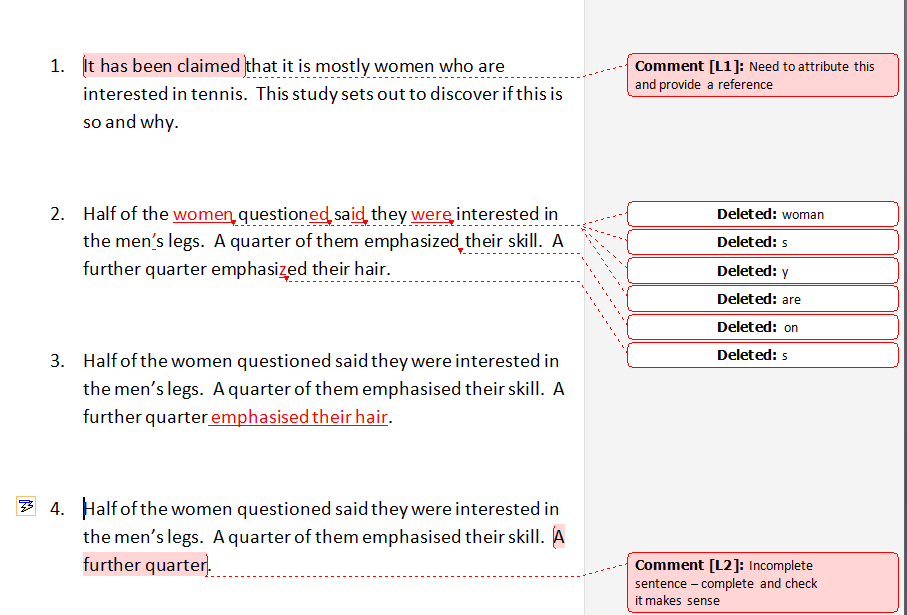
So, when I work with an essay, dissertation or thesis, I am very careful not to rewrite anything but only to tweak grammar, punctuation and spelling and suggest where things should be sorted out.  The following image shows a few examples of how I work, and one of how I DON’T work.

In Example 1, the author has not quoted their source and I’ve inserted a comment to remind them to do so.

In Example 2, there’s quite a lot wrong with spelling and grammar, but you can see that the author knows what they’re talking about.  I’ve amended their mistakes, but again that’s all tracked, so they a) can see what they’ve done wrong and b) have to choose whether to accept the change themselves.  By the way, the ‘s’ is changed in emphasized to make it consistent.  I’ll do a post about s and z another time.

In Example 3, a Very Bad ProofReader has seen something missing and decided to add it in.  In this case, rather than a few missing words, it’s a concept or part of the explanation of the actual results that’s missing.  This is a small example – but the author has not written that and the proofreader shouldn’t have.  I’ll suggest adding a word or two, but I wouldn’t complete something missing from the actual substance of the research or discussion.

Example 4 shows how I’d handle that same sentence.  No re-writing, no suggesting – I’ve just highlighted and told them something’s missing.  I’ll do the same if a sentence is mangled, incoherent and just doesn’t make sense.  But I don’t write my clients’ words for them, and students shouldn’t expect their proofreaders to do so (most don’t!).

 
16 Comments

Posted by on June 29, 2011 in proofreading, Students, Writing


Tags: , , , , ,

Virtual Assistant or Website Designer? I can help!

If you’re a busy Virtual Assistant (VA) you know that there are some jobs you need to give that personal touch … but others that are more routine and can be outsourced.  If you’re designing websites, often the design and functionality is your forté and you could outsource the copy writing, either because it frees up some of your time, or because it’s not your speciality.

I provide all sorts of services, from copy writing through to copyediting, proofreading, transcription and copy typing.  Here are some ideas for projects I could help you with.

For VAs:

  • I can take routine copy typing or audio typing off your hands
  • I can pick up overflow work when you’re really busy
  • Maybe you prefer not to work weekends but have a valued customer who needs a rush job completing – I work weekends and can let you know availability very quickly
  • I can help you offer services like copy writing or copyediting/proofreading which are outside your usual skillset, allowing you to offer an all-round service to your clients

For website designers:

  • I can write new copy for your clients, based on existing websites and marketing materials or from going through a questionnaire with them
  • I can polish ideas your clients already have into coherent and useful web content
  • I can proofread the final website (including checking links)
  • I can insert keywords into the web content in a natural way to help with the SEO

I don’t need to contact your clients direct; I’m happy to work through you.  And my standard agreement means there’s no worry about me “poaching” your customers – I’m more than happy to work with you long term to satisfy your clients’ needs.  You won’t be employing me, simply outsourcing some of your work; I’ll invoice you an agreed amount per hour and you can invoice your clients whatever you want to!

Talk to me today about outsourcing some of that routine work and getting on with the things that you do best, and that differentiate you from other VAs and web designers.

Have a look at what a copyeditor and proofreader does; see references from my satisfied clients.

Contact me via email or via my contact form.


Tags: , , , , , , , , ,

What does a proofreader do?

When most people think of “proofreading”, they are actually thinking of copyediting, which I’ve discussed in a previous post.

Proof-reading is, officially, checking proofs of a publication just before they are published.  So when I’m proofreading, I’m effectively looking for different things to when I’m copyediting.  For a start, the document is often different – for example, when I’m working on a magazine or book, the text I copyedit is usually presented to me in a word processing programme like Word, whereas the proofs come in pdf format.  That’s because that’s how, essentially, they will go to the printer, so they represent the final, finished form of the book or magazine.

All of the grammatical, punctuation and spelling stuff should have already been covered by the copyeditor, and the facts checked by the copyeditor, editor, author or fact-checker (whether or not I’m one of these people in the project too).  What I’m now looking for is inconsistencies and errors in how the text and the surrounding “business” appears on the page.  So I’ll check for …
for books and magazines:
– page numbers being sequential and starting at the right point
– pictures having captions and the captions describing the correct picture
– widows and orphans – individual words or lines which get left alone on either the previous page to the main text (e.g. if a paragraph starts at the bottom of the page or, worse, there’s a short phrase introducing a quotation or the beginning of a text box) or the page afterwards (the last few words of a paragraph or text box, for example)
– changes in font size that weren’t intentional
– the contents page or list matches what’s there in the publication
for books in particular:
– the running headers being correct, i.e. one has the publication name and the other has the chapter title (for the correct chapter)
– chapters all starting on a right-hand page as you hold the book open
– all extra material (bibliographies, index … ) included and in the right order

As it’s in pdf format at this point, I’ll use my software to annotate the pdf and then send it back to the client.  Sometimes I’ll get a second look at it once these corrections have been made.

And that’s what a proofreader does.


Tags: , , ,

On (not) crossing the line

I had another learning experience last week. I offer a proofreading and copyediting service to students, but obviously I have to be really careful about authorship and plagiarism. Plagiarism is not just “copying”; it also encompasses “passing off someone else’s work as your own”. Now, I’m sure none of my clients would intend to do this. Usually, I’m tweaking spellings, word usage, the occasional sentence re-write – I do everything in “track changes” in Word so the client can see what I suggest and make their own decision about what to change and whether to change it or not. That means they retain their own authorship. People in the know with whom I’ve discussed it are fine with this approach and it just gently helps the meaning come through.

But just sometimes, there’s a piece of work where I feel uncomfortable with the amount I’m suggesting and working on. For “working on”, read “re-writing”. I did always wonder where the line was drawn; well, it turns out that with this one, I *should* go for gut reaction (unlike in my previous post, where I thought I couldn’t do the work, but it turned out I could). If my gut reaction says that I’m crossing the line where your work is concerned, I will – politely – turn it down and return your work to you without corrections. There are probably people who wouldn’t act like that, but I very firmly believe in doing what is right, above doing what is profitable. Work on which someone is given a grade should be their own work.

Of course, if you’re not a student and you want me to re-write your mangled metaphors, your tortured text, your slippery sentences, then bring it on!

 
14 Comments

Posted by on July 5, 2010 in Ethics, proofreading, Students, Writing


Tags: , , ,