RSS

Category Archives: Writing

New ways to navigate the resources on the Libro blog

I’ve built up loads of information on all sorts of topics on this blog over the past few years, so I thought it was time to put together a resource to help you find what’s most useful for you. I ran a poll, people said yes, so I did it!

I put this new guide together about a week ago, and it’s proved popular so I thought I’d let you know about it quickly.

I’ve put together one simple resource guide with three main sections:

  • Resources for business – these include posts on how to set up a small business, things to do to grow your business, hints on networking, motivation, etc.; then some information about tax and finally an additional link to my small business interviews (note that business formation and tax posts are relevant to the UK although the rest of it will translate anywhere)
  • Resources for students – how to write an essay or dissertation, plagiarism and quoting sources, and lots more to come
  • Resources for Word users – all sorts of tips and hints to make your documents more consistent and easy to write, change and navigate, including tabs, margins, headings, contents pages and more obscure matters like how to put text in alphabetical order. Also includes a few notes on PowerPoint and other applications,

The whole resource guide offers a good way to find out what you need to know – do have a look and a play around, and let me know if you’ve found anything particularly useful!  I’ll be adding both resources and entries to the resource guide as I go along, of course. Watch this space …

And of course, we still have the index to the Troublesome Pairs and index to all the Saturday Small Business Chat posts.

I hope you enjoy the resource guide and indexes, and the resources they guide you to!


Tags: , , , , , , , , ,

How to count the words in a PowerPoint 2007 presentation

I recently needed to know the word count in a PowerPoint presentation. In my case, this was because I charge my clients by the word, in the main, and needed to know how much to charge someone for editing her PowerPoint text. But I’m sure it will be useful in other cases, too, for example if you’re a student with a word count target.

And it’s NOT obvious. Plus it’s different in Word 2007 and Word 2010, of course.

So, this is what you do …

How do I count the words in a PowerPoint 2007 presentation?

Open your document and click on the big Office button in the top left (1)

Click on Prepare (2) (like that’s obvious!) then Properties (3). This will give you some of the document properties in a bar along the top (these vary according to how you set up your document in the first place):

And because nothing ever shows you what you want immediately, you then need to click on Document Properties then choose Advanced Properties from the drop down. Then, finally, you get …

A lovely dialogue box with all the properties you could ever want, including the word count.

Please note, these hints work with versions of Microsoft Powerpoint 2007, for PC. Mac compatible versions should have similar options. Always save a copy of your document before manipulating it. I bear no responsibility for any pickles you might get yourself into!

Related posts:

How do I count the number of words in a PowerPoint 2010 presentation?

How do I count the number of words in a PowerPoint 2013 presentation?

Find all the short cuts here


Tags: , , , ,

Diffuse or defuse?

Two more words that look similar and sound similar but mean different things. Will there ever be an end to these?

To defuse means to reduce the tension or danger in something. This could be a physical something, like a bomb, or a less concrete thing, like an argument or a situation. “To defuse the fight situation that was building up, Tom jumped forward and kissed Dave on the nose.”

To diffuse means to spread out over a wide area. It’s what one of those room scenter things does, in the concrete form. Again, there’s an abstract – you can diffuse an idea and help it spread around the world. Diffuse, the noun, means spread out over, well, a wide area. The group of people from Kent was diffuse now, a few in each neighbourhood. The adjective can also mean lacking in clarity: “That was a bit of a diffuse argument you presented there” – the sense is carried over in the idea of it being all over the place, spread out, rather than precise and targeted.

If you defuse an idea, you render it harmless, eliminate it. Fewer people will hear about it. If you diffuse it, you spread it to more people.

You can find more troublesome pairs here and the index to them all so far is here.


Tags: , , ,

Wander or wonder?

This Troublesome Pair was suggested by a reader of one of my previous posts. Do keep your suggestions coming if there’s one you are confused about yourself or notice other people mixing up!

Wonder and wander is probably another pair that gets mixed up because the two words sound (fairly) similar, or exactly the same in some accents.

To wander is to move around aimlessly, to walk or move in a leisurely manner through or over an area. You might “wander lonely as a cloud” across the Lake District, for example (thanks to Wordsworth). A wander (the noun) is an aimless walk.

To wonder is to feel curious or desire to know, or to feel wonder, as in surprise and admiration caused by something unfamiliar, unexpected or beautiful (wonder (noun) being that feeling). “The sunset caused a sense of wonder in the onlookers”; “Mary wondered where her lamb had got to”.

To distinguish the two: “Mary wandered all over the farm, wondering where she had left her lamb”.

You can find more troublesome pairs here and the index to them all so far is here.


Tags: , , ,

How to put text in alphabetical order in Word

I was inspired to write this post after having to put yet another student’s bibliography into alphabetical order. I know the quick and easy way to do this – but I don’t think a lot of people know that you can do this!

So, you’ve got your bibliography, and you’ve been very good and followed the rules for setting it out (I’ve used Harvard method here) but it’s not in alphabetical order by author surname, and, except in certain cases,* it really should be.

*A very few referencing systems ask for the bibliography to be in the order in which the references appear in the text. I’ve hardly ever had to deal with them. But I like completeness!

So, a lovely list of books but not in order by the authors’ surnames. How can we resolve this without swapping all the lines around?

First, highlight all the text you want to alphabetise. Then, make sure you’ve got the Home tab at the front. See that little button you’ve never even seen before, next to the paragraph mark?

Press the A-Z button and up pops a dialogue box.

There are all sorts of ways in which you can order the text, which are very similar to the ways you can order text and numbers in Excel. You can even specify whether what you’re sorting has a header row (I’m not sure why you’d want to do that, as you can just exclude the header row when you’re doing the highlighting, but I suppose it would be useful if you realise you’ve accidentally highlighted the headers too). I’ve sorted by Paragraph, Text, and in Ascending Order here, and to be honest, that’s what I always do. Click on OK, and look what you get:

Here’s our bibliography in order by author surname with just a highlight of the text and a few clicks – much quicker and with far less risk of human error than doing it manually.

Note: if your results come out a bit odd and have split your entries up into two halves, reverse your alphabetising by either hitting Control-Z or the Undo button, and check there aren’t any pesky hard returns hiding out in the middle of paragraphs (the best way to do this is to click the Paragraph button, to the right of the A-Z button and look out for bent arrows signifying carriage returns). Get rid of those and alphabetise again to your heart’s content!

This is part of my series on how to avoid time-consuming “short cuts” and use Word in the right way to maximise your time and improve the look of your documents.

If you have enjoyed this post and found it useful, please click on the “share” buttons below or tell your friends and colleagues about it! Thank you!

Please note, these hints work with versions of Microsoft Word currently in use – Word 2003, Word 2007 and Word 2010, all for PC. Mac compatible versions of Word should have similar options. Always save a copy of your document before manipulating it. I bear no responsibility for any pickles you might get yourself into!

Find all the short cuts here


Tags: , , , ,

ise or ize?

Having a Bank Holiday is no excuse for avoiding the big questions: so here we go with -ise and -ize. We’re talking here about whether you use organisation or organization; analyse or analyze.

Now, people assume that -ise is British and -ize is American, but that isn’t exactly the case. And – of course – it isn’t that simple, either. The one thing that is vitally important, however, is being consistent within a document or documentation.

In British English, either -ise or -ize is acceptable (most people don’t seem to know that. Oxford University Press, for example, use -ize in their house style. If you’re writing articles for journals, it’s important to check for house style on this). In American English, however, it’s -ize all the way. Well, nearly all the way.

Ise is obligatory in some words, and I have to thank New Hart’s Rules for putting this all in one place as an easy reference. So, -ise rather than -ize is obligatory when:

  • it forms part of a larger word element, such as -cise (cutting: excise), -vise (seeing: supervise), -mise (sending), or -prise (taking) [if you can think of any examples of the last two with that meaning, please let me know – I presume they are words coming from the French roots mener and prener but apart from that I’m stumped for examples that include the meaning sending or taking]
  • it corresponds to a noun that has an s in the stem: advertisement – advertise; television – televise

Common words that must use -ise in American and British English:

advertise, advise, apprise, arise, chastise, circumcise, comprise, compromise, demise, despise, devise, (dis)enfranchise, disguise, enterprise, excise, exercise, improvise, incise, merchandise, premise, prise (open), revise, supervise, surmise, surprise, televise

When we move on to the -yse / -yze debate, it’s much more simple: -yse in British English, -yze in American, so analyse vs. analyze, etc.

This issue comes up a lot for me, because I work with many students who, although studying in the UK, have American English as their standard language in Word and use American spellings throughout. Except when they don’t. If they mix them up, as they invariably do, well, I used to ask which they preferred but now I just pick the most common version they use and tell them that I’ve done that.

But the most important things are to

  1. Obey house style, if there is one (particularly important if you’re writing journal articles)
  2. Be consistent.
  3. If you are quoting from a source which uses a different spelling from your required one (e.g. you are working with -ise and it uses -ize), leave the word in the original form in which it was printed in a direct quotation. See more in my posts on quoting sources [coming soon].

You can find more troublesome pairs here and the index to them all so far is here.


Tags: , , ,

What I got up to in March

Welcome to my March round-up of what I’ve been getting up to. Do you find it useful/interesting/inspiring reading these posts about the life of an editor / writer / transcriber / small business person? Do leave a comment, click on the share buttons or share my notifications on various social media locations if you do!

Being self-employed full time

Libro continues to go from strength to strength and I’ve settled into a nice routine of enough work to keep me nicely busy (and to keep the wolf from the door) while having the flexibility to pop to a networking event or just a walk in the park with a friend.

Editing, writing, transcribing, proofreading

So, work-wise I have had a busy and interesting time.

I edited a really interesting set of EU documents for a French company that was new to me, and apart from that it was pretty well all regular customers all month.

I am working with some Master’s students through their courses, giving them feedback about their English and offering ways to improve it, as well as proofreading their essays. This is really rewarding, as I see them taking on board what I suggest and their English improving. It’s also interesting to see how their ideas for their dissertations start to take shape.

I did the usual writing for some commercial clients, including finishing off writing a library of 50 x 500 word articles for one particular client who wanted to build up a library of information on their website that would also boost their SEO (Search Engine Optimization). It’s a challenge to build up that many words on a network of inter-related subjects, including making sure there was room for plenty of linkage to help the visitor navigate through the information on offer, but I enjoyed being able to make it genuinely informative for the reader as well as useful for the client in terms of driving people to their website and keeping them there for as long as possible

I proofread a few PhDs or parts of PhDs, including some really interesting ones in the social sciences. I always tend to learn about what I’m editing, so it’s nice when it’s something I genuinely find interesting (luckily, I can find something of interest in pretty well everything I work on … otherwise I think I would probably be in the wrong job!)

I picked up a new localisation client or two and will be working with at least one of them long term: localisation is a nice intellectual challenge, as it’s not just about turning color into colour but really thinking about how British and American English work and getting right into the guts of the text.

I’ve worked with the usual translators, too, including on some interesting annual reports of companies (yes, I sign a lot of Non Disclosure Agreements) and at the end of the month I went into hermit mode as I had another big project from my main transcription clients, so typing away like a demon with headphones jammed into my ears (and then going to the gym to row out my stiff shoulders) has been the order of the day.

Networking, videos, blogging

In non-billable hours news, I featured in this video by Enterprise Nation extolling the virtues of networking and, in particular, the Twitter event #watercoolermoment, which is a gathering of home workers at 11 am on weekdays to have a chat about this and that – just like you might do in a “real” office. I also redesigned this website and blog – I really love the new look, what do you think?’

I’ve added some new posts to my series of articles about using Word, which are hopefully useful to students, writers and administrators alike, and my series of interviews with fellow small businesses is building nicely – there’s space in May if you’d like to take part!

Oh, and for a while now, my monthly newsletter has been only five sentences long so do sign up here for a quick read!

In more sociable news, I helped at the city centre and local Social Media Surgery sessions, and attended Social Media Cafe as usual (I wouldn’t miss that for the world). My local “notworking” group Kings Heath Home Workers group has a few more members and I’ve been meeting up in a cafe with a local friend once a week. I have also resolved some pressing issues around time management which I’ve talked about over on the Libro full-time blog.

Coming up – taxes and a new financial year

It’s the end of the financial year this week, and the end of mine, too. I am looking forward to getting my tax return done so I know how much of my earnings I can keep and how much is going to the taxman – although this year I will start Paying On Account, so will have to give him a lot more than usual – in fact double! Watch this space for a great guest post explaining all that later on this week. I have more transcription to do, more students to work with, more of the same – and I bet I love it as much as I did this month!

Libro offers copyediting, copy writing, proofreading, transcription, typing and localisation services to other small businesses, individuals and corporations. Click on the links to find out more!


Tags: , , , , , ,

Fair or fare?

I saw this one at the weekend – it’s another one where people know the difference between the two words but sometimes get into a pickle with phrases (see rein, rain or reign, peak, peek or pique, bear or bare or cue or queue for more examples of this issue).

So, fair means “just or appropriate” and “treating people equally” and “moderately good” as well as “blond(e)”, and the adverb fair means “in a fair manner”. So, “I said I will give all applicants fair treatment and judge them solely on their ability”; “Yes, the process was fair and everyone was treated appropriately”. “It’s not FAIR”, of course, too, when you expect to get something and you don’t. A fair is also a public entertainment made up of stalls and attractions, but I don’t think that is the version that gets confused.

Phrases associated with fair include fair and square (honestly and accurately); fair game (a reasonable target).

Fare, however, has a few disparate meanings, which is probably how the confusion creeps in. It refers to the money paid for a journey on public transport – “have you got change to pay the bus fare to get into town?”. It refers to a range of food – “traditional English fare is available at the pub”. And it is used in the sense of to perform in a specified way – “he fared badly in the local elections”. The archaic meaning of travel also survives in farewell (fare thee well, travel well).

So none of them are a fayre (that’s just a pseudo-archaic spelling of fair), and you fare badly, you don’t fair badly, which is the one I tend to see.

You can find more troublesome pairs here and the index to them all so far is here.


Tags: , , ,

Homogeneous or heterogeneous?

Well, I have to admit that I don’t often see these two mixed up as such, but because they look quite similar, there is a need, in my opinion, to have a quick and easy way to distinguish them laid out. And that’s what these Troublesome Pairs are for, after all. I do monitor how many searches I get on the pairs, and it’ll be interesting to see how many people search for these in a search engine and come through to here. (If you have a website or blog, statistics are your friend, and can give you surprising results, too!)

Anyway …

Homogeneous means of the same kind, consisting of parts all of the same kind (it is also the name for a chemical process involving substances in the same phase, i.e. all liquids or all gases, if that helps you remember it). It comes from the Greek for same race or kind. Yes, the same as homosexual. The way I remember this is that homogenised milk is the one where the cream is mixed into the milk rather than sitting on the top (that made me feel a bit nauseous for a moment, as I only drink skimmed milk, myself!)

Heterogeneous, on the other hand, means diverse in character or content (a heterogeneous chemical process is one involving substances in different phases, e.g. mixing a gas with a liquid, in case that helps you remember). It comes from the Greek, again, for other race/kind. And, yep: heterosexual.

Note the spelling, by the way: -geneous, not genous. Not even if you’re in the US, I believe.

So a word pair and a pair of prefixes defined for you today: extra value!

You can find more troublesome pairs here and the index to them all so far is here.

 
1 Comment

Posted by on March 30, 2012 in Errors, Language use, Troublesome pairs, Writing


Tags: , , ,

How to quote sources without plagiarising

I work with a lot of students, and one of the things that seems to be an issue is how exactly to use your sources when you’re writing an essay. So I thought it was time to write some notes to help you.

How will this article help you?

This article will help you to avoid plagiarism. I’m going to take a text I’ve written and re-write it in some different ways. Because, and this is important, if you just take text from somewhere else and dump it into the middle of your essay … that’s plagiarism. Plagiarism is serious. It’s passing off someone else’s work as your own. And most academic departments use plagiarism detecting software. If they run your work through the software and it shows you’ve plagiarised,  you may well have marks deducted or the whole essay may be returned unmarked.

What’s wrong with just cutting and pasting stuff I’ve found?

I know that in most cases, you don’t mean to plagiarise. You’re pushed for time, you’re often not writing in your native language, and it’s easy to take that text and put it into the essay. But these are the reasons you shouldn’t do it:

  1. It’s morally wrong to plagiarise.
  2. You won’t gain an understanding of the text if you just paste it into your essay.
  3. You will get caught.

How do I use source material in the correct way?

There are two ways to use source material you’ve found in your research:

  • use direct quotations, which you’ll need to indicate using quotation marks ” … ” or ‘ … ‘
  • talk about what the author has said, but put it in your own words

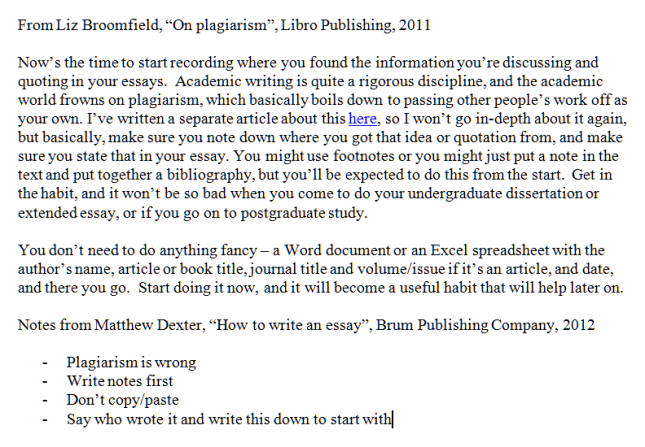
So, how do we do it. Here is a passage I’ve copied from one book and some notes I’ve made from another one. These are the sources for my essay.
Using quotations to talk about your source

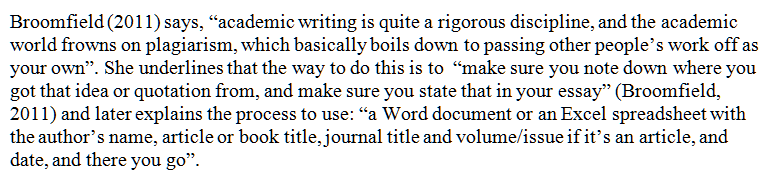
This is direct quotation. A simple example:

Mary says “I am going to the park”

I write: “Mary said, ‘I am going to the park'”

An easy way to talk about your source material is to use quotations. You don’t need to re-write what the authors say, however you do need to show you understand what you’re talking about and to link the quotations in a sensible way – you also need to make sure they’re all within quote marks and referenced properly. With the notes you’ve taken (above) you might end up with something like this:
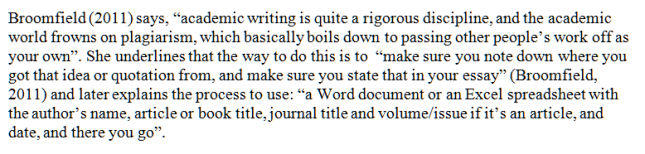
So what I’ve done here is take sections from the text, put them in quote marks, noted where they’re from, and linked them appropriately so it’s clear I understand what I’m talking about.

Note that if you start off in the present tense, “Broomfield (2011) says that there are … ” you need to continue in the present tense; if you start off in the past “Broomfield (2011) said that there were … ” you need to stick with that. You can pop into the present tense if you are talking about a universal truth rather than something rooted in the time frame, so “Broomfield (2011) said that people are always likely to plagiarise” but “Broomfield (2011) said that the results of her study were not clear and she was not able to draw conclusions from them”.

Rewriting source text to talk about what the author is saying

This one is slightly more tricky. You need to do “indirect quoting”, or reporting what the author said. Simple example again:

Mary says “I am going to the park”.

I write: “Mary said that she was going to the park.”

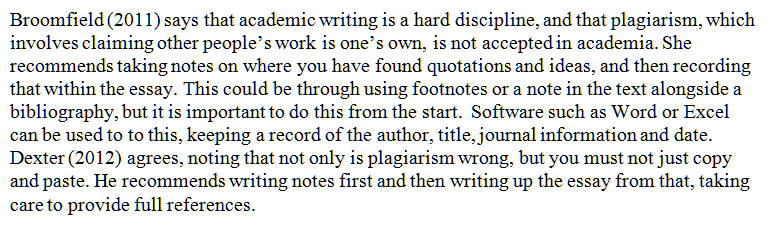
What we have to do here is retain the sense of the original, while writing it in our own words. Here’s what I came up with. Note that I can now use the notes I made on Dexter, too, as I don’t have anything in his words but can talk about what he said and I noted down:
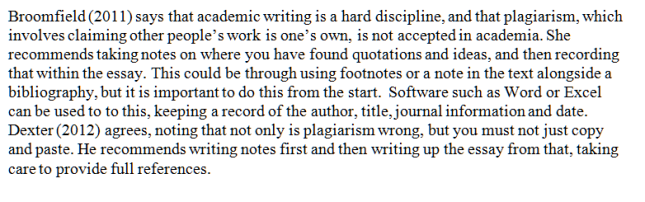
Here I have used a number of different techniques. In no case, though, do I use more than a couple of the original source’s words exactly as they appear in the original. Instead I do this:

  • using synonyms: “hard discipline” instead of “rigorous discipline”
  • simplifying the words but getting the same sense across: “involves” instead of “basically boils down to”
  • reporting what the source said and using that to link the essay together: “she recommends using”
  • expanding on what the source says: “This could be through” rather than “you might”
  • summarising and synthesising (summing up and putting together) “Software such as Word or Excel could be used”, and “keeping a record of the author, title, journal information and date”.
  • Introducing the other research but linking it to the first idea: “Dexter (2012) agrees … “
  • Expanding notes into full sentences: the notes taken on the Dexter text.

Oh: please note here that you use “Broomfield (2011) says this is the case ” or “According to Broomfield (2011) this is the case” but never “According to Broomfield (2011) says this is the case” – I see that last one all the time.

Combining direct and indirect quotation

Of course, the best way is to combine them – some direct quotations, some reported speech or indirect quotations. This has the benefit of breaking up the text a bit, giving some interest, and allowing some use of the authors’ words to save having to rewrite everything.
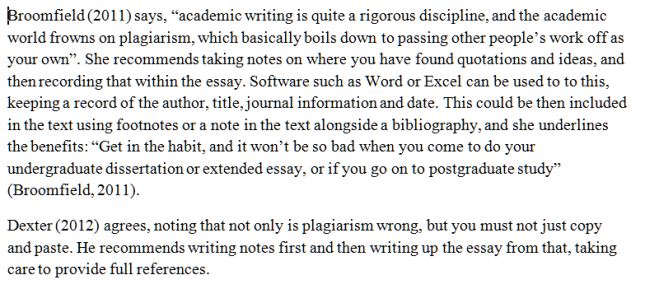
Note that here I have shuffled around the order of what the first author says, too.

Rewrite, don’t copy and paste

I hope I’ve now managed to explain

  • What plagiarism is (see more in this post)
  • Why it’s not a good idea
  • Different ways to avoid it
  • Direct and indirect quotations
  • Some tips on how to rewrite text

Please do let me know if you’ve found this useful – or if there is more detail you’d like to know about. And do share using the buttons below if you’d like to tell your friends and colleagues about this information.

If you want more … here is a whole article on plagiarism, here is one on essay writing in general and one on writing dissertations and theses, and if you click on the students or writing or Word categories in the right hand column of the blog, you’ll get loads more hints and tips.

 
10 Comments

Posted by on March 28, 2012 in Ethics, New skills, Punctuation, Students, Word, Writing


Tags: , , , ,