RSS

Tag Archives: skills

Networking for Newbies

A while ago I wrote a short guest post on networking for another blog but I had a lot more ideas that I wanted to fit in.  Now I’m full-time with Libro, I can hopefully go to more networking events, as they are a good way to meet new people, discuss new ideas and, well, get out of the house! And I’ve had actual, qualified success in making money from business I’ve gained, not from someone I met at a networking event, but from someone they met afterwards.  So I highly recommend popping a bit of networking into your marketing and social mix, and here are my top tips for networking …

Networking can be a scary and daunting idea. We all know we need to do it … but how, where and why do we do it, and what can we get out of it, and bring to it?  Here are 10 handy hints for making networking work for you, all tested by me, myself – and I certainly didn’t think I was a natural networker when I started out! Here are my top tips for successful networking.

Do be scared … but realise everyone else is too!
Walking into a room full of people you don’t know is daunting to all but the most extrovert of people. The key to conquering this fear is knowing that 90% of the people around you, even people who have been to the event before, are at least a little apprehensive, too.  So, first of all, be understanding if people seem a bit aggressive or over-wordy or, indeed silent. Maybe it’s just how they are when they’re nervous. And secondly, let yourself off the hook if you do the same. Take a deep calming breath, look around you calmly, and chat to someone.  Ask them about themselves – that old one, but it does really work.

Dress for success
You don’t always need to be all suited and booted, but it’s worth finding out from the event organiser what kind of outfits people normally turn up in (of course, “what you usually wear to work” isn’t always suitable if you normally work from a home office … ). Most of us feel more comfortable when we fit in with the crowd, and knowing how to pitch your outfit is part of that. It goes without saying – doesn’t it? that you should be ironed and mud-free and your hair shouldn’t be standing on end unless it’s supposed to.

Try before you buy
There’s a huge variety of networking events and organisations out there. Some of them charge a fee to be a member of their club. That’s fine – but most of them will let you try out a meeting or two before you commit to that expensive membership. Take advantage of this, try a few different local meetings before you join up, and you’ll know you’ve spent your money in the right place.

Diversify
The huge range of networking events available means that there’s one – or more – to suit everyone. From a national organisation to a hyperlocal event, from market sector-themed meetings to Women in Business, try out a few and see what you like – and try to visit a range of different ones every month. Of course, there are also online networking groups; forums, LinkedIn groups, etc. Give those a go, by all means, but do try and get out and about – especially if you work alone all day! If you’re chatting to someone at a networking event and you seem to get on and have similar views, ask them which other meetings they go to. Other ways to find out more include social networks, including meetup.com, Facebook and Twitter, notices in your local library, and articles in business magazines. People are usually fine to tell you about the other ones they go to and might even arrange to meet up with you first to take the edge off that first entrance into the room.

Go local
I recently joined my local High Street Business Association.  I’ve got a small ad on their website, a listing in their directory and I’ve already been to a breakfast meeting at a local café.  You’ve always got something to talk about when you’re all local!  And you might be able to help your local community too, with fund-raising events, Business Enterprise Zones and mentoring schemes.

Keep at it
Most networking events happen regularly and some take a while to work your way in to. Some might have different attendees every time, some might  have lots of familiar faces every month, and some might have a mix of the two. I’d suggest that you need a little time to get used to the particular group and how it works – plus repeat appearances will keep you in people’s minds.

Don’t expect to make direct sales: do expect to get recommendations
You may well not sell your services to the people you meet at a networking event. Sometimes you might even meet a rival business who – gasp – does the same as you! Just because you’re not going to get a sale doesn’t mean you shouldn’t talk to these people. You can talk about general business matters, get all sorts of tips and hints … and you don’t know who they know … I’ve won a few clients now through people I’ve met at networking events. One lady recommended me to a contact on Twitter, after I’d met her at a Social Media Café.  It’s always worth actually asking people to think of you if they come across anyone who needs whatever it is you do.

Do team up with “rivals”
I have a small network of other editors who I can rely on to pass work on to if I’ve got too much to do. Similarly, they pass work to me or recommend me if one of their clients comes to them with something in which I specialise.  So if you meet someone who’s in a similar line of business to you, don’t bristle and walk away, but think how you can benefit one another.

Connect people
Don’t just think about what you can get out of these events. If you meet enough different people, chances are that you’ll meet someone and realise you know just the person that can help them. If they’re both at the event, take the time to introduce them. They’ll both thank you for it – and remember you. At a recent networking event, a local film-maker I’ve known for a while described me (in front of a group of other people) as an “oracle” and made sure everyone knew how I was always introducing him to interesting and useful people. Great word of mouth marketing!

Follow up
You will undoubtedly come back from networking events with a fistful of business cards. Don’t just shove them in your filing cabinet, your pocket, or your handbag (or man bag!). Get them all out when you get back home, and go through them. Email everyone you met, even if you don’t think you’ll get a direct sale from them, to say that you enjoyed meeting them, and establish that contact. You never know when one of you might come in useful to the other one. My friend and fellow small business owner Alison Mead of Silicon Bullet has just published some excellent tips to use at this stage: read her blog post here.

I hope you’ve enjoyed these tips and that they prove to be useful to you. Do give networking a go – more than one go, in fact, so you can get used to how it all works. In no time, you’ll be striding confidently in to the room, greeting familiar faces, making other people feel comfortable, and making useful contacts and/or helping other people.


 
8 Comments

Posted by on December 14, 2011 in Jobs, New skills


Tags: , ,

An Emotional Business

I was talking with a friend the other day about “owning” and accepting your emotions, and as the conversation sloshed around in the back of my mind, it started me thinking about emotions in business.

Running a small business, especially, I assume, if you’re fairly new to the game, can be a really emotional business. There’s the high when you get that first big customer, or actually have to pay tax on your first year’s income (I’ve made enough to pay tax! Maybe that’s just me … ); the low point when work gets a bit sparse; the utter cringing horror when you make a mistake – sure, no one likes to make mistakes when they’re an employee, but it seems so much worse when it’s your own business, utterly your responsibility, your own customer who’s personally chosen you to work with …

It’s important to acknowledge these emotions rather than let them boil away unnoticed. Running a business can be stressful at the best of times – good stress or bad stress, it’s still stress – and having stuff you haven’t taken out and given the light of day can make you stuck and hold you back.

Here are a few ideas which might help deal with those emotions in a constructive way:

  • Be happy. Yes, do acknowledge those good times. Celebrate in your newsletter, Tweet about it, tell your friends (but see below). Also, make this last and cash in on it. If a customer has praised you, ask if you can quote them on your references/testimonials page. Then you’ve got that happy time forever. I also save emails with praise on them so I can revisit them in quieter moments.
  • Be decent and do the right thing. If you’ve made a mistake, instead of dwelling on it, do something. First of all, do the right thing. That means apologising, in writing or on the phone, if you’ve messed up a job for someone. Don’t bluster, excuse and hide: just state what you’ve done, honestly, how sorry you are, and what you will do to put it right. You would appreciate a supplier or other company who did that, wouldn’t you?
  • Use your mistakes constructively. Early on in my career with Libro, I didn’t have such strong Terms and Conditions as I have now. So when I “under-delivered” in a client’s opinion (I didn’t rewrite their essay, which of course I shouldn’t have done), they complained and withheld payment, criticising me fairly strongly for what I had done (or hadn’t done). I felt awful for longer than I should have. Then I used the experience to a) firm up my terms and conditions so new clients would know what to expect, and b) inspire a blog post or two!
  • When you’re at a low point, realise it’s a low point and you will come back up. I keep a record of jobs and income per month, and my billable hours per week. I can see it dips, and I can see that some weeks I don’t do so many billable hours; but then I can see, now I’ve run the business for a few years, that these dips are temporary and it always comes up again. Every business area has cycles; keeping records helps identify these and reassure you that it’s not the end of the world.
  • Have something other than the business. Yes, your friends, your partner, your kids, the lady in the supermarket are interested in your business. But do they need to live the business alongside you? Keep some other interests if you possibly can – I’ve temporarily lost my ability to read so many books, but then again most of my work involves reading of some kind: but I’ve made the effort to keep on with the gym and running; it’s kept me sane and given me something else to think about / concentrate on / talk about (but I know I’ve been bad about this at times: sorry, friends/M!)
  • Be honest with your peers. Gather a group of people around you who also run their own business / work from home / work in the same area. This is a group of people who understand the highs and lows, who you can celebrate the highs with – but also be honest about the lows – and they will be too, and you can support each other. I was most despondent about a tricky potential customer a few months ago. I went along to my usual monthly networking event, not feeling that positive about going and having to be all jolly and upbeat. I ended up talking to a few people about my problem; they gave me excellent advice and more than one opened up about issues they were struggling with.

So, be honest, be decent, try to keep your perspective, and acknowledge the highs, lows, blahs and whoo-hoos!

 
2 Comments

Posted by on November 30, 2011 in Blogging, Business, Ethics, New skills, Organisation


Tags: , ,

My short cuts – proper page breaks

As promised in my original post, I’m going to write some quick guides to things you do when you’re writing documents which you think are a short cut but actually cause more trouble than they’re worth.

The idea of this series isn’t to criticise people, just to show you how to do things in a more formal way which will actually make things easier for you in the long run, especially if you’re dealing with a larger document like a dissertation, a thesis, a funding proposal, a workbook, a technical guide …

Please note: these examples can look rather wide. I want them to be as near full-size as possible, so you can see exactly what I’m doing. If you’re looking at this post on a monitor, you should be able to scroll across to see the full image. If you’re viewing on a tablet, some of the screenshot may be cut off: hopefully you can see enough to get an idea of it, or you should be able to select the image to view it separately.

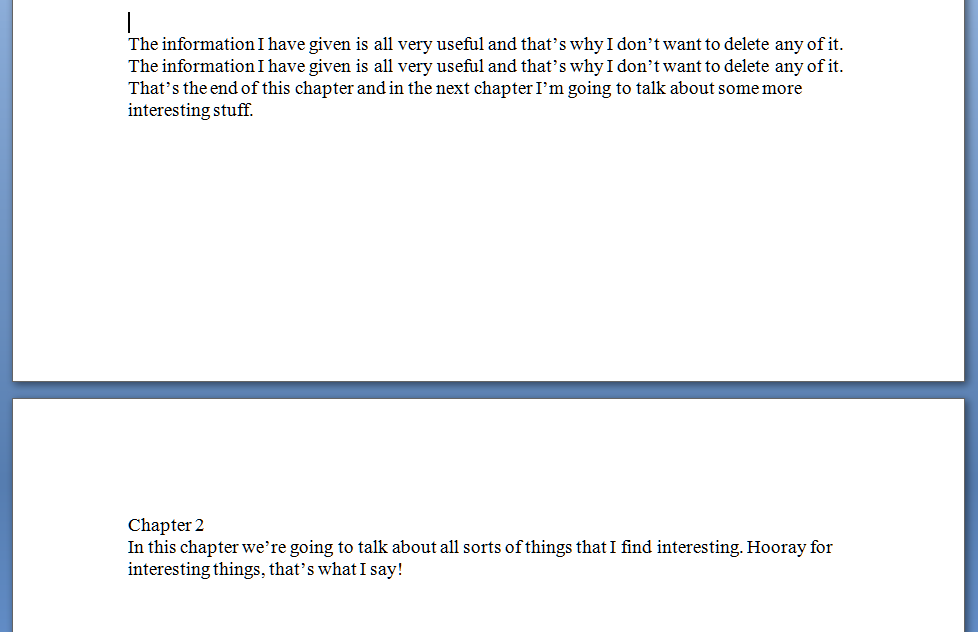
Today we’re going to talk about page breaks. If you’re writing a document that has sections, chapters, etc., you might well want to start a new chapter on a new page, and have it look something like this:

So far, so good – you’ve got your new chapter starting on a new page. But I bet you finished one section and hit the “Enter” key until you got to a new page, didn’t you? The way to tell is to hit a rather magical little button that shows all the formatting you’ve done.  In Word, you’ll find it in the Home menu; if it’s not there, play around with the display until you’ve found it and add it to the menu bar. Here it is:

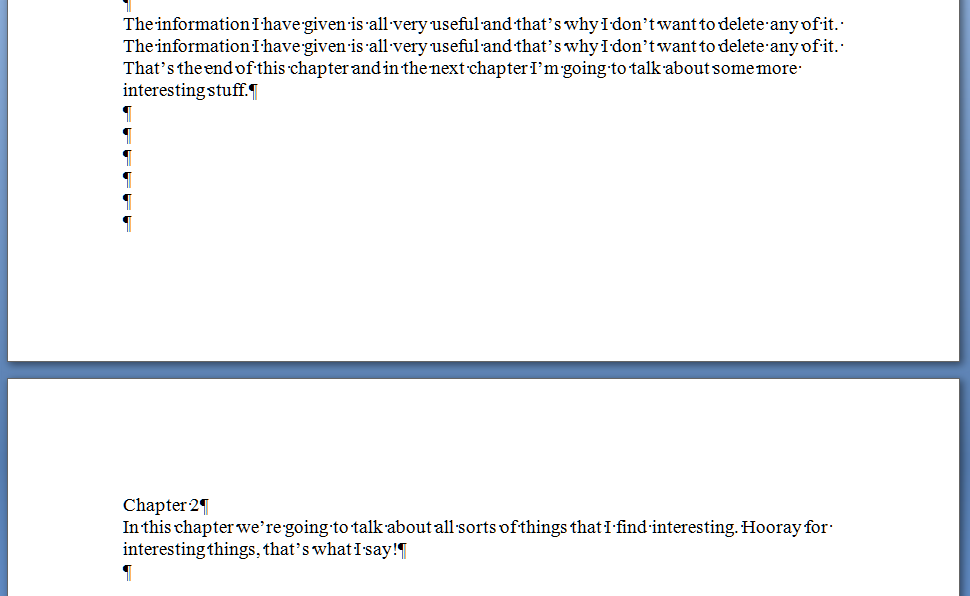
That’s actually the “paragraph” symbol or pilcrow used for centuries in manuscripts and printed books. Anyway, it’s ever so useful if you want to show what you’ve done to a document. Press it a second time if you want all the formatting marks to disappear again. So, pressing this with our document open shows the horrible truth – enter, enter, enter you’ve gone, six times, down the page …

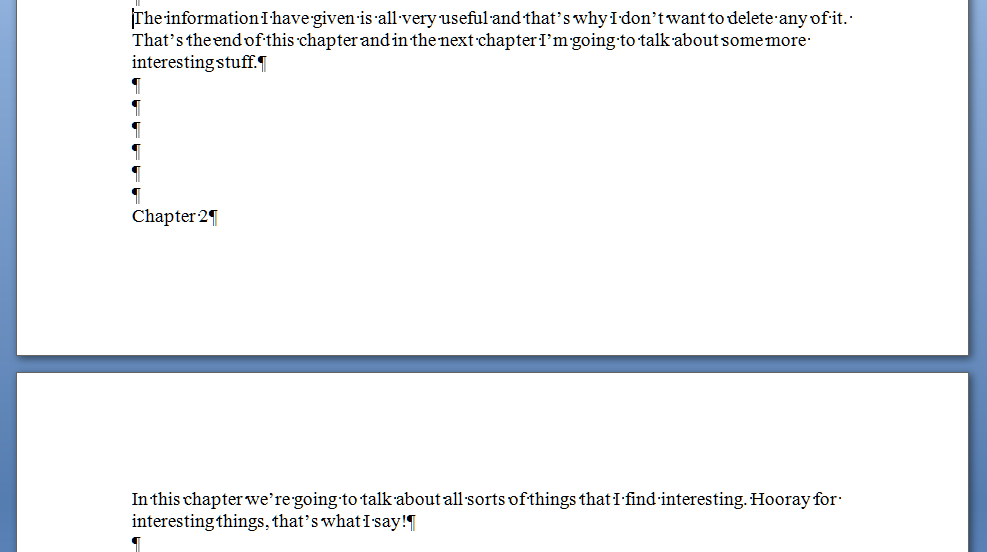
And that’s all well and good – until you change the text above the page break. You’ve done this and it all looks nice, then you notice that repeated line on page 1. Oh, well, you can just delete that. So you delete the repeated line, and the text on page 1 is now one line shorter – one line further up the page. Below the text, you hit Enter 6 times to make Chapter 2 start on the next page. Those six lines are below your chunk of text still, but your text is one line shorter than it used to be. So what happens … ?

Disaster! Chapter 2 doesn’t begin on the next page any more! It’s crept up a line! And, similarly, if you’d added some lines of text to Chapter 1, this chapter heading would start part way down this page. Messy! And when you’ve submitted your work to an editor like me, you can bet we’ll be suggesting adding lines in or taking them away; when you get the document back the spacing will be all over the place (or I’ll have done it my way and made it tidy already … )

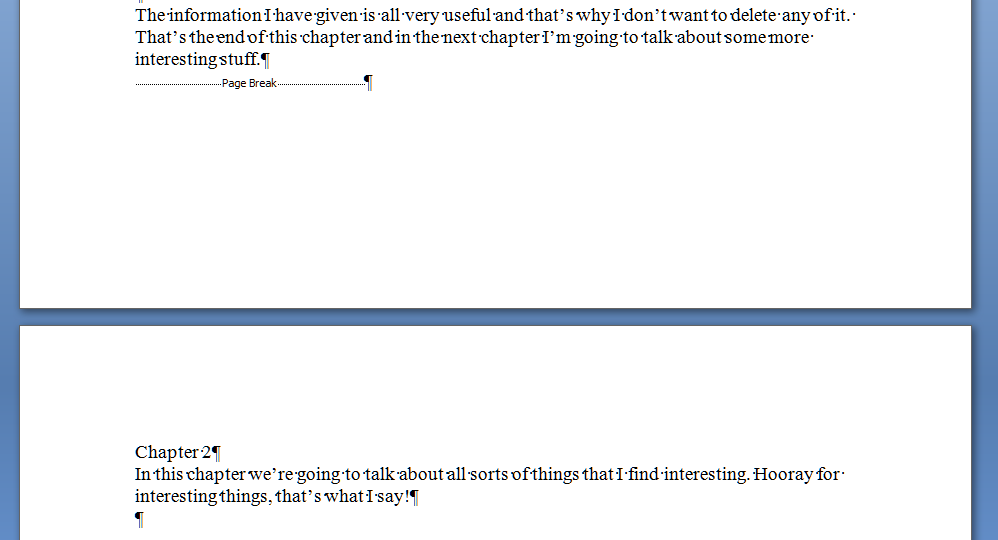
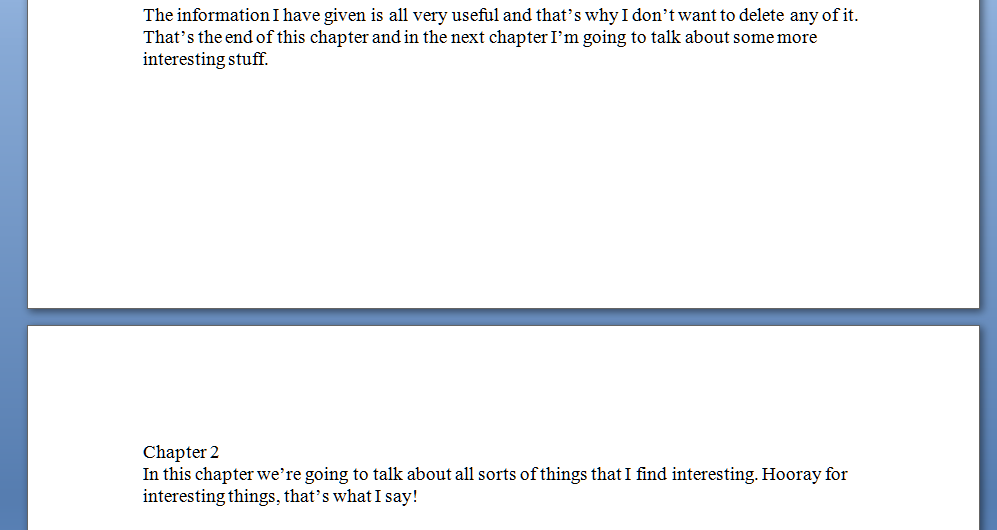
So how do you do it properly so this messiness doesn’t happen? Simple – you “force a page break”. Again, in all versions of Word, when you get to the place where you want to force a new section to start on a new page, press Control-Enter (or choose Insert – Page Break). Turning on your formatting display, and using our original text again, you’ll see this:

And because it’s a forced page break, it doesn’t matter what you do to the text above the break, the new text will always appear on the next page. Make the Chapter 1 text shorter again by deleting that extra line and you get this:

No hopping around – and even if you add so much to Chapter 1 that it goes onto the next page, Chapter 2 will just hop on down to the page after, automatically.

Of course, your document still looks like this:

But you’ve done it all correctly, in fewer keystrokes, and you know that whatever you do with Chapter 1, Chapter 2 will always start at the top of its new page, nice and tidy, going where you need it to go.

I hope that’s helped – it’s a very common issue, which is why I’ve tackled it first. There will be more of these posts coming over the next few months – do pop a comment on this post if I’ve helped you, and let me know if there are any other issues you’d like me to look at.

Please note, these hints work with versions of Microsoft Word currently in use – Word 2003, Word 2007 and Word 2010, all for PC. Mac compatible versions of Word should have similar options. Always save a copy of your document before manipulating it. I bear no responsibility for any pickles you might get yourself into!

Find all the short cuts here

 
10 Comments

Posted by on November 23, 2011 in Copyediting, Errors, New skills, Short cuts, Word, Writing


Tags: , , , ,

… but you still have to BUY a lottery ticket OR, making your own luck

In my time as a small business owner, and indeed, ordinary woman on the street, using social media, I’ve had a few noteworthy examples of how being in the right place, at the right time, within the world of social media such as Twitter and Facebook, can reap dividends for your business and personal development.

Of course, being in the right place at the right time is important In Real Life, too.  I picked up a few new clients at the book launch for a novelist client – because she was there, her book was there, my cards were there, and I was there. But social media runs round the clock, doesn’t involve dressing up, and doesn’t only happen at set times.

Yes, I’ve been lucky. And yes, I’ve probably missed as many opportunities as I’ve grasped – after all, who can keep up with all of the tweets by all of the people they follow? But here are some things that have happened to me in the last couple of years …

Client A tweeted one late evening (afternoon for her) that she was looking for a copyeditor. She was in the US, I’m in the UK, so the time difference was important. In fact, I found this tweet by re-running a saved search – see below. But there she was, and there I was, within 2 minutes of her tweeting. So I tweeted back. She sent me one project, then became a regular client. Then she recommended me to someone else, who I would NEVER have reached on my own, who is now another, larger, regular client.

Client B was stuck for a transcriber. She’s a journalist and interviews people regularly. Help – she needed a transcriber. Could anyone recommend one? At the time, transcription wasn’t even one of my core offerings. But I trained in audio typing and had done work with tapes over the years, so I got in touch. Again, I happened to catch her a few minutes after she’d posted, so I got in first. And, a year on, she’s another of my cherished regular clients. And has given me lovely references and recommended me on – via Twitter, of course!

And a personal one. Libro had been a bit quieter this week than it had been of late. So I had time to look at Twitter during my working day. I noticed one of my favourite running magazines was asking if people were booked in to do a particular race. And because I struck while the iron was hot, I ended up reviewing it for them!

How to create your own luck

All these three examples did depend on luck and good timing to a certain extent. But they also depended on me doing certain things to help create that luck and good timing:
–    I have a presence on social media, backed up with a website where people can find out more information about me, and linked to that website via my profile. So I’m already there, active and tweeting or updating my status, and anyone finding me for the first time can see I’m legitimate, busy and (hopefully) useful.
–    I follow people who are interesting to me and linked to my interests in some way.
–    I ran searches on Twitter in my areas of interest (“need proofreading”, “need transcriber”, etc.), saved them (did you know you could do that?) and run them regularly (even when I’m busy!). Then I contact anyone who looks like they might appreciate my help. Not aggressively or spamming, just asking politely if I can help and directing them to my website.
–    If I see an opportunity, I go for it. When I asked to review the race, I then had second thoughts, worrying that I’m not a good enough runner to review for them. But I’d already put in for it, and when I asked the contact at the magazine, she reassured me that my kind of runner was just the kind they wanted!

To win the lottery, you have to buy a ticket. Get on to social media, get them to serve your purposes, and see a whole new world of lucky chances open up! Go on … create your own luck!

Libro offers copyediting, copy writing, proofreading, transcription, typing and localisation services to other small businesses, individuals and corporations. Click on the links to find out more! Contact me via email or via my contact form.

 
4 Comments

Posted by on November 16, 2011 in Business, Jobs, New skills, Organisation


Tags: , ,

Proofreading as a career – some pointers

Sometimes I feel that people think “proofreading and editing” is one of those things that anyone can do, that’s a good fall-back position if you’re looking around for something to bring in a few pounds.  I think it’s a common misconception that if someone is well-read and good at spelling, that’s going to transfer into something out of which they can make a career.  There is a bit more to it than that, and as I’ve had several people ask about it, it’s got to the point where it feels useful to put something down that I can direct future enquirers to.  So, if you’re thinking about being a proofreader and you don’t know quite what it entails, read on …

Get your terms right

If you think you want to be “a proofreader” then you probably don’t know what one is.  Sorry to be blunt!  But a proofreader is a very specific kind of job, where you check materials that are just about to be published.  It’s not going through a manuscript for a novel and commenting on it (that’s copyediting) or making suggestions on changes (that’s substantive copyediting) or checking the facts in an article (that’s fact-checking) or writing up an article from bullet points (that’s copy writing).  For more on all this, see my post on proofreading and copyediting or my skill set series.   OK: so what you want to be is a copyeditor.

Get the skills

It’s not that easy correcting someone’s grammar and making their sentences work.  Sometimes, it isn’t actually that much fun.  Of course I enjoy it, but see below for why it takes a particular kind of person. And you do need to have the theory behind the practice solidly backing you up.   One way to get the knowledge is to go on a course.  Do not look at any other courses apart from those run by the Society For Editors and Proofreaders or the Publishing Training Centre.  Yes, there are lots of other courses advertised in the paper, etc.  These are the two that the industry in the UK recognises, that publishers send their editors on.  The courses and exams are quite expensive, but so are the other ones.  SfEP has a useful test on its website that might help you decide whether you’re suited for this work.

An admission: I’m not a member of SfEP and I don’t hold their qualifications.  But, and this is a route you will need to take too, I have lots and lots and lots of experience.  Most of that experience, pre-Libro, was unpaid – editing and indeed proofreading for local publications, author friends, typing theses back in the old days before everyone had a computer.  Writing.  Writing press releases and marketing material.  Working with UK and US English.  I’m nearly 40.  Most of my working life has involved this kind of stuff.  Oh, and the English Lang & Lit and Library and Information Studies degrees helped a bit, too.

If you go into this business, you will still need to take specific tests from prospective clients, even if you have qualifications.  I tend to pass these tests with flying colours, so I can get away with not having the exams.  If I was doing this again, and I didn’t have any experience, I would take those exams.  I’m going to learn Indexing one of these days.  I’m going to take the courses and exams for that: oh yes!

Are you suited for the work?

You might want to have a look at my previous post on deciding if you’re suited to freelance work at this point. In general, freelancing in whatever area you choose will have common points.  Particular to editing are the facts that: you can’t usually do it with other people around, as it’s really concentrated work; it can be a bit repetitive if you’re working on one huge text or lots of things on the same subject (if you get into student work, clients tend to recommend you on within the same course); you really don’t get to choose the subject you’re working on, and it’s fairly rare to be something that you’ll be interested in on its own merits. There are plus sides to these points, of course: if you enjoy being alone, the first is fine, and you can take your marketing work, blogging, etc., to the local cafe; it can be soothing to press on with the same thing hour after hour; and you get to learn an awful lot about an awful lot of subjects, which can be handy for pub quizzes and the like!

And you’ve got to be happy to do this, day in and day out.  You might have to miss a cinema trip with your friends.  You might be poorly – but there’s not really sick pay as such (we’re lucky to have the NHS in the UK, of course – in other countries this point is even more important). Again, these are general points. In summary from the editing side of things: you need to be good at concentrating; nit-picky; good at going for hours with no distractions; good at finding odd topics interesting enough that you’re not wandering off to Twitter every five minutes; good at keeping to deadlines (it’s often someone else’s deadline you’re affecting if you run over time).

Dealing with clients

OK, I do have great clients who come through recommendation and send me work reasonably regularly.  But I still had to prove myself to them in the first place, and I still have to send in my invoices on time and do the work when I say I will.  You will need to be able to justify what you’ve done to someone’s work, make their work demonstrably better, come in to their deadlines, keep them informed.  It’s not just a question of sitting nicely at a desk and playing with a sentence or so, just like gardening isn’t all wandering around in a big hat with a trug, snipping at a rose every now and again. You need to market yourself, be cheeky, throw business cards at all and sundry – you can’t just sit back and expect the work to come to you.  Which brings me to my next point …

Building things up

It’s over two years since I launched Libro.  Only now am I thinking of going full-time.  Much of my work comes through repeat business (hooray for repeat customers) and recommendations.  But that’s hard work in itself.  If someone is kind enough to recommend your services to a friend, you have twice the pressure: do a good job for the client and make sure you don’t ruin their trust in the original client who recommended you.  You have to do a really good job to get these recommendations, in the copyediting that you do and in the customer care and marketing that you do.

I have found myself diversifying over the years, so I now do transcription, writing, localisation from US to UK English and all sorts of other things. Do you have skills you can add in to your basic offering, that form a good portfolio (copyediting and clowning might work, but would be difficult to market, perhaps).  The other way to go is specialisation.  I’ve done this with my localisation work, building a reputation as someone who is good at turning US into UK English, and I know copyeditors who are very well-known in their field of, for example, editing medical journal articles.  But you need an outside speciality you can bring to bear on your copyediting work if you want to go down that route (for example experience in other jobs, your previous education …).

Is this for you?

So, a summary.  If you really want to make a go of a proofreading career, which we now know is actually a copyediting career, you need to:

  • enjoy working on your own
  • have a high attention span and a very high boredom threshold (I’m not saying that the work is boring: I love it; some people would be bored silly by it)
  • write a very high standard of English (oh yes, and everything else that you send out into the world has to be perfect or people will spring on it with glee!)
  • do a fairly expensive course or have demonstrably high levels of experience
  • be prepared to work very hard
  • be prepared to work on stuff you do not find interesting
  • be prepared to do all the usual freelance stuff of losing your weekends and evenings “just to turn this project round”
  • be prepared to do marketing and customer care and maths stuff as well as playing with the order of words to make the most elegant sentence
  • have other skills you can diversify into
  • or have a very particular skill you can specialise in

I don’t want to put people off, I really don’t.  But hopefully this has given you some insight into the kind of person you need to be to do this kind of work, and the kind of work it actually is.  Think of copyediting as a positive choice rather than a fall-back position, and you’ll be fine. Drift into it, and you might get some work and payments, but you might be happier somewhere else.


Tags: , ,

What does a copy-typist do? What is copy-typing?

Do you have sheaves of handwritten notes from a training course or presentation you’ve attended? Maybe you like writing longhand and have completed a novel. You will find a copy-typist useful if you have a lot of typing to do from handwritten documents, especially if you don’t type very fast, or you just don’t have the time to sit down and type it up.

These days, I usually work from scanned handwritten documents, rather than the documents themselves, although I will happily accept the documents on paper too. Quite often, my copy-typing projects come via Virtual Assistants, who can easily outsource a single project like this to someone like me, if they don’t have time to do it themselves or would rather be doing something only they can do for their client.

I’ll then type it up – I usually correct spellings and put in the punctuation as I go, but I don’t have to, it depends what the client wants me to do!

I started off my freelance career years ago, typing up people’s PhD theses from their handwritten versions. It surprises me that, x years later, I still type for people; but there’s obviously still a need for it, and it’s a good thing to outsource.

Other useful articles on this blog

Copy-typing hints and tips 1: What it is, what it looks like and how to charge

Copy-typing hints and tips 2: How do I do copy-typing work?

 
24 Comments

Posted by on October 4, 2011 in Business, Jobs, Skillset, What Do I Do?


Tags: ,

Essay tips for new students

This time of year, rather than January, always seems like the start of a new year to me.  I suppose I was at University, then working at a University, then studying again, working in library supply where the renewal cycle was at this time of year, then back to working at a University.  I’ve also started at University twice (undergraduate and postgraduate), and my partner, Matthew, undertook a Master’s degree a few years ago.

So, I’m going to talk today about some hints and tips for new students on coping with those first essays.  I’d like to broaden this out, too – so if you have any questions on this topic that I don’t cover here, please either post a comment to this post, or contact me via email or via my contact form, and then I’ll write a follow-up post in a question and answer format.

Starting at University or College can be really daunting. You have to get to grips with a new environment, a new place to live, new people around you … and what’s likely to be a new way of doing academic work, too. I know some A-level courses encourage students to do some research in a bigger library, but I also know from running library tours at my part-time job, that many of you won’t have been in a big academic library before, and might need a few hints and tips. So, here we go!

Use all the resources you’re offered

Your library is the main place for this. At the beginning of term, you’ll have the opportunity to go on a library tour. Take that opportunity to familiarise yourself with the library, and with the staff and where to ask for help. You’ll find where the books are for your course, and how to operate the photocopier, self-issue machines and other bits and bobs of technology. If you miss the tour schedule, many libraries offer downloadable audio tours, or other ways to help you orientate yourself.  Library staff may offer training sessions and hands-on work with databases and other resources you may not have come across before.

Seek out the support and information that’s been put together to help you.  This may come from library or departmental staff.  At my university, study skills modules are available on the student portal part of the website. This is quite common and gives tried and tested advice, in far greater detail than I can go into here, on how to maximise your study skills and learn how to learn, and write those essays.

Don’t fear your essay … or your library

Your university library might look big, and you may not have used a large, academic library before, or even have been inside one – but in reality, most of your books are going to be in just one or two locations in that big building.  You’ll need to get used to the classmarks on the spines of the books – usually made up of letters and numbers, like PR 1234.A6, these are simply a way of making sure books on the same subject are shelved together. Your library should have paper or online guides to where books at a particular range of classmarks are shelved, and once you’ve looked up a book, checked its classmark and found it, you’ll find other books on the same subject shelved alongside it.  Electronic resources are ever so easy: access them online whenever, and from wherever, you want to.

Regarding your essay … the tutors are not out to trick you. They want to see you succeed, not fail. Yes, they want to push you and help you learn, but the essence of University work is finding out, following your interests – it’s far more flexible and enjoyable than all the cramming of facts into your head that you did for your A-levels. If you get stuck, ask for help (see below). If the department offers more resources about writing essays, use them. If your tutor makes lots of comments on your work, don’t be downcast, but use them to learn for next time.

Plan, plan, plan

If you’ve just done your A-levels, you’ll be more used to doing coursework than I was when, fresh from batches of 3 hour exams, but no coursework, I suddenly had to learn how to plan an essay! It’s a cliché, but don’t leave it to the last minute. You will (believe me) remember the hell of pulling a 24 hour session on an essay on Middlemarch, but you won’t remember anything about the book or what you wrote, and you’ll go right off coffee for a bit. When you get each course outline, there’ll be a note of what coursework is due and when. Note all these down once you’ve chosen your courses, and then plan time to spend on each essay.

When you’re researching and writing your essay, write a plan. Just like you did in your exams (right?).  Now it’s all on Word, type in the headings – introduction, conclusion, the bits in between. Do some mind-mapping or write out a plan, however you like to do it. But plan the essay, even make a note of how many words you need for each section, and it’ll be all broken down into bite-sized chunks that are much, much easier to face.

For more information on essay-writing, by the way, you might want to look at this post, which is mainly for those writing dissertations and theses, but has some useful points, too.

Use some different resources

When you were at school, you probably used textbooks, the texts themselves if you were studying humanities subjects, the internet (Wikipedia? Don’t use Wikipedia now, please!).  Now you have a huge wealth of information at your fingertips: books, e-books, journals, e-journals, databases of articles … Make sure you use a range of materials. Your course reading lists will probably guide you here – they should have a mix of materials on them. I didn’t really get to grips with journal articles until my post-graduate course (but then again, in my day they were all indexed in big, fat books; online searching was only just coming in) but wish I’d learned about them earlier.

It shows initiative and differentiates you if you read around your topic and search out some interesting articles, etc. to quote in your essay. Most of the electronic databases and e-journals are really easy to search (the designers put a lot of work into making them user-friendly, and there are often tutorials within the source itself, or written by library staff and available on the library or departmental website).

If you get really stuck with a particular database, and think you’ll need to use it a lot, it’s worth finding out who your Subject Advisor, Library Tutor, Learning Support Staff – whoever it is who’s paid to help students find stuff – and booking a session with them to get some more detailed help.

Record your references

Now’s the time to start recording where you found the information you’re discussing and quoting in your essays.  Academic writing is quite a rigorous discipline, and the academic world frowns on plagiarism, which basically boils down to passing other people’s work off as your own. I’ve written a separate article about this here, so I won’t go in-depth about it again, but basically, make sure you note down where you got that idea or quotation from, and make sure you state that in your essay. You might use footnotes or you might just put a note in the text and put together a bibliography, but you’ll be expected to do this from the start.  Get in the habit, and it won’t be so bad when you come to do your undergraduate dissertation or extended essay, or if you go on to postgraduate study.

You don’t need to do anything fancy – a Word document or an Excel spreadsheet with the author’s name, article or book title, journal title and volume/issue if it’s an article, and date, and there you go.  Start doing it now, and it will become a useful habit that will help later on.

If you need help, ask for it, or accept it

If you’re feeling a bit stuck or panicky when confronted with your first tranche of essays, don’t fret. Help is at hand.

For a start, as I said above, your tutors are not trying to catch you out or trick you.  You should have a personal tutor, and there will be some sort of academic support, too. Go to them – they are there to help you. No one is going to think any worse of you for seeking help. After all, in the world of work later on, the bosses will prefer it if you ask what the big red button does rather than just pressing it! And, you’re paying fees, so the university needs to help you get the best out of your education. So, ask.

If you have a particular issue, whether English isn’t your native language, you are dyslexic or need to use voice-activated software, support should be in place at your University. You might need to contact the Overseas Students office, in the first example, or Disability Services / Accessibility in the second, but there will be something in place – as far as Accessibility is concerned, there are laws to make sure that’s the case.

If you feel happier getting some private support, using an academic coach or proofreader, be very careful indeed. There are a lot of companies out there who prey on students who need their services. Obviously I’m decent and ethical, and if you feel you need some support with your essay writing, do get in touch – I can always recommend another person or company with whom I have personal experience and contact. But beware companies who charge a high fee and then just run your essay through a spell-checker (it happens). You shouldn’t pay more than about £8.00 per 1000 words for proofreading, and try to find a company or coaching service that will tell you the person’s name who you’re dealing with, and has references on their website.

——–

OK, so these are a few general hints and tips. As I said, I’m more than happy to answer questions – ask me via email or via my contact form or just pop a comment on this post, and I’ll post up the answers in a week or so.  Good luck, enjoy your course and your University life, and if you like this article, please share it using the buttons below!


Tags: , ,

Why running a business is like running a marathon

I’m gearing up for running the Birmingham Half Marathon for the fourth time this October, as well as working my way towards doing Libro full-time, and it’s struck me that my two parallel endeavours do have, well, a number of parallels.

Oh, and yes, I know a half-marathon isn’t a marathon (although many people don’t seem to realise). A half-marathon, and a part-time job and a part-time business, are all I’m managing to fit in at the moment. Once I’m full-time with Libro, I intend to look at training for a full marathon.

So, why is running a business like running a (half) marathon?

You need to prepare first

With both running and business, there are certain things you should do before you even set foot on road / fingers on keyboard. With running, it’s a question of maybe checking with your doctor first, then getting a sports bra (for the ladies) and some decent trainers.  When you’re setting up a business, you need the basics (a computer, the right software, a phone, initial stock), registration with the relevant tax office (the HMRC in the UK) and perhaps a short course (I recommend the HMRC “Becoming Self-Employed” one).

You have to build up gradually

People are often amazed when I say I’ve been out for a 10-mile training run at the weekend. But I didn’t start off doing that: I started off, years ago, on a walk-run programme – walking for 2 minutes and running for 1 minute, for 15 minutes. Gradually I built up until I was running continuously for 15 minutes, then a few more, another mile … and there I was, able to trot along for 10 miles (or more) at a time.  Similarly, with the business, especially in my line of work, once you’re set up it’s a question of doing some work, getting some recommendations, doing some more work …

Don’t go mad buying stuff

When you start running, you don’t need ALL the kit. Bra and shoes, yes; something reflective if you’re going out in the dark, but you can go out in tracksuit bottoms and a t-shirt at first. Once you’re up and running and you know you’re going to stick with it, then is the time to get the wick-away tops and the fancy socks.  When setting up a business, you don’t need to buy a new desk, even complicated invoicing software – stick to the basics and buy more when you’ve really had time to assess what you need.

Seek the company and advice of others

I love running on my own – I can cogitate, relax, go into a meditative state, enjoy music that you might not expect of a sedate lady runner … but I have also benefitted hugely from the companionship – often online – of other runners. You can swap tales, encourage each other, get tips and hints, and help other people (see below).  In business, carefully-selected forums and networking groups can help you learn about best practice and different ways to do things, as well as helping you sell your services. And if you want to get out there with real, live people, then you can join a running club or a networking group and really profit from getting together with other people.

Diversify

As well as running, I go to the gym to work out with weights, cross-train and take spin classes.  When I’m running, I do different sessions – speedwork, tempo runs, long slow runs. All of this has improved my all-round fitness and my running in general. I know this, because I just achieved my second-best half marathon time ever … on a training run. With my business, I started off concentrating on a few key tasks, but increased the range of what I offered as I went along, and have ended up with a diverse group of customers and an interesting set of jobs.

Make time (and an effort) for others

I think this one is really important. As a runner who is perhaps not a “natural” and has reached achievable goals, I have tried to encourage other people to follow in my footsteps. I’ve encouraged a few other people to start running, and make time to answer their questions and support them in their goals. It was wonderful to run the Birmingham Half last year with Anna, who I’d taught to run over the year – in fact she beat me by a good way, and I was so proud of her.  In business, I try to give something back by helping other people, helping out at the Social Media Surgery, etc.  Maybe you can offer someone work experience, take on an apprentice or become a mentor.

Be ethical and a good example

This one is tied in to the point above, really.  I try to be a good ambassador for running. I don’t spit in the street and I try not to barge into people. I’m visible to traffic, cyclists and other pedestrians, and I always say thank you when someone moves out of the way for me. In the same way, I work ethically, don’t take short cuts and try to be courteous and helpful to everyone I come across in the business context.

Be in it for the long run

As I said above, you don’t just launch out running 10 miles in one go. Running is something I would like to stay with for a long time. I want to be one of those little old ladies gamely doing the marathon aged 80. I build up slowly, plan my running and make sure it’s sustainable. Similarly, with Libro I plan ahead for the next stage and try to make sure it’s sustainable, with a good mix of regular clients and one-offs.

Look after yourself

Run or train every day, miss your sleep, and fail to keep an eye on your nutrition, and you’ll soon find your running goes to pot. Work every hour there is, ignore your family and eat rubbish at your desk, and you’re likely to find yourself a bit lonely and possibly unwell. Balance is key in both areas (actually, I use the running to keep the balance in the rest of my life, so the two are inextricably entwined for me).

Enjoy it!

Lastly: if you’ve chosen a sport to take part in or you run your own business, you should be enjoying it, at least most of the time! These are things you’ve chosen to do. If you’re not enjoying it, stop, have a little think, work out why you’re not enjoying it, and take steps to change that.

I hope this has been useful. Can anyone add any more similarities?

Libro offers copyediting, copy writing, proofreading, transcription, typing and localisation services to other small businesses, individuals and corporations. Click on the links to find out more!

 
6 Comments

Posted by on September 21, 2011 in Business, Jobs, Organisation


Tags: ,

What is localisation (or localization)? How do I localise documents?

I’ve been doing some localisation for some new customers recently and, mentioning this on my Facebook page, etc., I realised that this isn’t a well-known process.  So, for those of you who are interested, and people who might have documents they would like to work in different regions of the world (there’s a clue!), here’s a quick guide to localisation.

One of the dictionary definitions of ‘localise’ is “to make local in character”, and that’s basically what it’s all about. Say a website, or a brochure, or an advert, or even a novel, has been produced in America. Obviously, the language is going to be American, rather than British English. Eggplant, freeway and optimize, as opposed to aubergine, motorway and optimise. Now, sometimes, the company or publisher putting out that document will want to adapt it for different markets, so that the reader feels comfortable with the text and can understand it without any strain. If the markets are in countries that don’t speak English, then a translator will be called in to translate it for their country.  And if the markets are in countries that speak English, but slightly differently, then someone like me is called in to “translate” the text into British, Australian, Canadian (etc.) English.

It’s not just a matter of turning all the “ize”s into “ise”s. There are grammatical differences (“different from” vs “different than”), spellings (“colour” / “color”, “anaesthetic” / “anesthetic”), and terms (“pavement” vs “sidewalk” and so on).  Then there are trickier things – would a British reader understand immediately what “resumé boosting” or other very American terms mean? The aim, as with editing in general, is to make the reading experience smooth, so that the reader absorbs the words and their message, rather than being jerked into consciousness that they’re reading a created text, and coming out of the immersion.

Not every editor, or every translator, can do this work. It’s more like translating than editing, and I can do it because I’ve got particular and useful experience working for the UK office of an American company, where I dealt with the two Englishes almost every day for a good few years.  Add to that my editorial experience and general language skills, plus attention to detail which means making a list of the words I’m looking out for and making sure I change them all – and that’s why I’ve been praised and will be used again by the two companies I’ve completed localisation projects for so far.

It’s fun, too!

Read more about localisation as a career


Tags: , , , ,

Outsourcing for fun and profit (2)

Welcome to the second in my two-part series about outsourcing.  In Part One we learned about the different tasks you could consider outsourcing to an outside company or individual.  Now we’re going to look at how to work out if it’s worth outsourcing.

There are three reasons why you might choose to outsource a task:

  • You’re so busy, you don’t have time to perform the task effectively, or at all
  • The task is not one of your specialities (OK: you’re not very good at it)
  • It’s more costly in terms of time and income to do the job yourself than to pay someone else to do it

Let’s look at these in turn.

You’re too busy to do the task yourself

Your company’s doing so well that you’re flooded with orders and work, you’re making those widgets till they’re coming out of your ears … but your filing system’s a mess.  Call someone in to sort out what you don’t have time to do.  You’ll profit in terms of having good systems that can be run easily, and not wasting time sorting through a mess to find a vital piece of paperwork.  Or you’re a journalist with too many deadlines and you haven’t got time to transcribe all your tapes – send them off to someone else!

You’re not very good at the task

Maybe you’re great at making widgets but you clam up on the phone when you’re making sales calls to get more clients.  Or you create beautiful websites but panic when a client asks you to write or check content for them.  Or you work with your hands, add up invoices in your head, but need to create some leaflets and are not sure of your spelling.  This is when calling in an expert in their field will help you concentrate on building your expertise – and income – in your own field, and make sure you’re representing yourself as well as you can.

It would actually cost MORE to do it yourself

Remember that method of justifying buying an expensive coat by breaking it down into cost per wear (price of coat divided by number of times you’ll wear it.  Now it costs 50p – hooray!)?  Well this works a bit like that.  Say I have a very simple tax return to do and it only takes half an hour.  Say I charge my clients £20 per hour.  Doing my tax return will cost me £10 in terms of lost potential revenue for that half hour (and I know it’s so simple that an accountant wouldn’t be able to get my tax any lower).  I doubt I’ll be able to get an accountant to do this for £10.  So it’s not worth me outsourcing it.  But if I had a big complicated business, with VAT and all sorts of deductions, and it took me 10 hours to battle through it, then that £200 in lost potential revenue (plus any tax savings I’m missing by not being an expert) could probably pay for an accountant to do it properly.  Similarly, if it’s going to take you 10 hours to type up a 1 hour interview tape that I could do for you for £45, it’s worth outsourcing to me and saving time and money.

In summary: if it’s more expensive to do it yourself, or you don’t have the time or skills to do it, consider outsourcing!

Libro offers copyediting, copy writing, proof-reading, transcription and typing services to other small businesses, individuals and corporations. Click on the links to find out more!


Tags: , , , , , , , ,