RSS

Author Archives: Liz Dexter

Unknown's avatar

About Liz Dexter

Book blog is at http://www.librofulltime.wordpress.com Writer, proofreader, editor, transcriber. Also runner, gym-goer, volunteer and BookCrosser! My married name is Liz Dexter but my maiden name and the name on the books I write is Liz Broomfield.

Gillian Linnell

Welcome to Saturday Business chat, and we are all about pets today, talking to Gillian Linnell of the Oldham-based company, GGL Pet Supplies, another new business which opened its doors in 2011 and is not yet a year old. Gillian took a route into business ownership that we’ve not seen before in these interviews, going on an entrepreneurship college course – it just shows the variety of routes we take into our lives as business owners. Like me, to an extent, Gillian has not ended up doing quite what she imagined; having started out in pet gift baskets, she now finds most of her business coming from a different, but related area. It’s so important to be flexible like this, and to both see and take up alternative opportunities as they present themselves, rather than sticking to a fixed idea of what you do. I’m sure flexibility is one of the most important promoters of success – look at Richard Branson, starting a record label and ending up with an airline!

Gillian sensibly took on a part time job while launching her business, making sure she could support herself and keep things going while she established GGL Pet Supplies – hard work, but worth it, I think, for the peace of mind.

So, let’s meet Gillian!

What’s your business called? When did you set it up?

My business is called GGL Pet Supplies, and I set it up in May 2011.

What made you decide to set up your own business?

Mom has advanced Parkinson’s Disease and working full time was taking its toll on me, advancement within the corporate company I was working at was not looking possible and I knew I was capable of much better things.

What made you decide to go into this particular business area?

I have always wanted to work with animals and decided to enrol at college on an entrepreneur course simply making and selling pet gift hampers.  I soon realised that this idea was not going to pay the bills so it quickly changed to a full blown pet store, also offering pet sitting and dog walking services.

Had you run your own business before?

No.

How did you do it? Did you launch full-time, start off with a part-time or full-time job to keep you going … ?

I took a part time job in a bar to help pay the bills whilst the company started to make money.

What do you wish someone had told you before you started?

Don’t spend money on marketing companies which offer Google front page search results when you can do it yourself!

What would you go back and tell your newly entrepreneurial self?

Be confident, trust and believe in yourself, you are unique, and don’t believe everything cold callers say on the phone!

What do you wish you’d done differently?

Not spent a heapload of money on advertising in the wrong places!

What are you glad you did?

Started the pet sitting/dog walking services as this was purely an afterthought, yet it is what is currently booming.

What’s your top business tip?

Stay focused, be persistent, believe. Do not ever give up, but be willing to adapt and change when opportunities arise.

How has it gone since you started? Have you grown, diversified or stayed the same?

The pet supplies is still an ongoing project that I am not really having much luck with, but the pet sitting and dog walking side is booming: I even do horses now. I am pushing the supplies side of things persistently: as I am still in the first year of business, I remain optimistic.

Where do you see yourself and your business in a year’s time?

I would like to be selling the supplies to local people and pet sitting clients and to have a brand and reputation which is very well known and recognised in the local community. Eventually I would like to employ staff and have a  warehouse full of pickers and packers. This is just one ambition – I have a handful of different directions which the company can take.

Reading between the lines here, it looks like Gillian has learned from any early mistakes she made with advertising and marketing – which are always tricky, and there are an awful lot of very persuasive people out there selling such services. She is to be applauded for her positive attitude and perseverance, and I really look forward to hearing about the new directions the business takes in the next year!

You can find out more about Gillian and GGL at www.gglpetsupplies.com and you can  email her or call her on 07717 216 100.

If you’ve enjoyed this interview, please see more freelancer chat, the index to all the interviewees, and information on how you can have your business featured.

 
2 Comments

Posted by on February 18, 2012 in Business, New skills, Small Business Chat


Tags: , ,

Cue or queue?

Cue and queue. I’ve been meaning to write about this one for ages, as I see it quite a lot, most frequently in popular culture and the media, in newspapers and magazines and personal communications like Facebook updates, Tweets and blog posts.

This is another of those homophone issues – i.e. the two words sound the same, so if you have only ever heard them, rather than having seen them written down, or particularly if you have only seen one of them written down, an assumption can be made about which spelling / word to use. I think I have seen each used incorrectly an equal number of times; is that your experience?

So, a cue (as well as being something used to play snooker and billiards, which I don’t think gets into this particular issue) was originally a signal to an actor or other performer to begin their speech or performance. This meaning has been extended to include anything that initiates or reminds one of the start of an action or speech. So an actor takes  his cue from the end of the previous actor’s speech, or their actions, while I might take my cue to speak from the person I’m speaking with pausing, or at a seminar, from the chair pointing to me, or a company might take its cue to deliver a new software application from the release of a hardware upgrade.  It’s all to do with getting some kind of indication that it’s time for some kind of action.

A queue is more, if you like, about INaction – as it is a line of people or vehicles, etc., waiting their turn to proceed or be attended to. The line of people at the bus stop or outside a gig, or the cars waiting to cross a level crossing while the gates are closed.

If you are hanging around waiting to buy a train ticket before the ticket office is opened, you might take your cue from the staff member opening their hatch to start a queue for tickets.

So: a cue initiates action, and a queue waits for it. Does that make sense?

You can find more troublesome pairs here and the index to them all so far is here.

 
5 Comments

Posted by on February 17, 2012 in Errors, Language use, Troublesome pairs, Writing


Tags: , , ,

How are you motivated … really?

How are people motivated, short term and long term? How do you motivate yourself and how does your boss motivate you? Is it all about the money … ?

I started to think about this when I was playing a couple of Kinect games. Stay with me here, it is relevant!

The dancing game – at which I was pretty bad, being a) not very good at dancing or aerobics (not putting myself down here, just not good at moving fast in a coordinated manner. That’s why I’m a runner) b) not used to this kind of thing. But the avatar dance trainer stayed really, really positive, even when it was clear I was doing badly. “Yo, you nailed that move,” he shouted. Well, no, I didn’t. If anything, the move nailed me.

Moving on … I also tried out a fitness “game” – more of a set of workouts, but fun and interesting. The best thing about it was, though, that as well as getting the visual feedback on your movements that both games offered, in this one you got realistic feedback at the end. If you did well, you were told so. If you did badly, you got something along the lines of, “this wasn’t quite what we wanted, but you can do better next time!” Just the acknowledgement that it wasn’t the best go ever did motivate me a lot more.

So, realism and trustworthiness is obviously something that motivates me.

Short-term motivation and long-term motivation: chocolate or freedom?

I decided to undertake a scientific examination of this phenomenon. Well, no, I didn’t: what I actually did was as the question “what motivates you?” on Twitter, Facebook and LinkedIn. I wanted to see what real people who I actually knew said.

And the range of responses showed first of all that there is a difference between long-term and short-term motivators. The popular answer “chocolate” didn’t mean (I think) that the respondent was motivated to do a good job, to achieve and excel, by a mountain of chocolate. But yes, a little sweet reward or some such is a great motivator to get something done. And tea, cakes and, indeed deadlines work in this way too.

Although … deadlines … is that more about having a job where you do have deadlines to hit? I would like to bet that the type of deadline you have in your job – if you enjoy it – is down to the motivators that work for you. Anyway, the long-term motivators are the interesting ones: recognition, praise, kindness make one group, which covers social or personally orientated motivators. Family, and even, from one respondent, cancer, show a deeply personal motivator which is probably about life achievements more than simple workplace ones. And then there is the set including independence, achievement and freedom (that’s my one) which are more to do with the person themselves and their own interaction with their world (as opposed to interaction with people as such).

Do we see money in there? Well, it is mentioned, but it is not mentioned by anyone first.

Here’s the scientific bit: Maslow’s Hierarchy of Needs

This all comes down, in the end, to Maslow’s Hierarchy of Needs or Maslow’s Triangle. In an article written in 1943 (andl also explained well in this Wikipedia article), Abraham Maslow posited that we have a hierarchy of needs, and that the lower ones need to be fulfilled before the higher ones.  So our basic needs are the really basic ones – shelter, food, breathing, and next up are security of employment, body, health, property and family, among others. So our money need really disappears right at the bottom, or is maybe mixed into the one above.  After these basic needs come love and belonging – family and friendship ties, then esteem, which includes self-esteem and the respect of others, and at the top, self-actualisation: creativity, spontaneity, morality, problem-solving, etc.

You can see that most of the motivators my respondents talked about came from the upper levels of the triangle. Of course, when our health is threatened, we drop “down” a couple of levels, but then I suspect those who are motivated by their illness are actually reaching for esteem and self-actualisation, beating the illness and claiming their selves back.

Unpacking my motivators

So, when I “unpacked” my feelings towards my Kinect games (other consoles are available), I could see that I’m motivated by trust and truthfulness. When I was employed, I responded best to managers who were realistic but trusted me to get on with it , while speaking up if I was overwhelmed. Likewise, I wanted to trust them to give me the right work and leave me to it. I wasn’t motivated by relentless optimism, and nor am I motivated personally by being shouted at, which is why I avoid the boot camp kind of exercise regime and hate being micro-managed. Now I work for myself, I can go up to the self-actualisation motivators and enjoy being creative and in control of sorting out my own problems. Freedom is a big one, too – I love having enough work to do to keep me busy but being able to do it when I want to, within my clients’ deadlines, and being able to go to the gym (or stop and write a blog post) if I want to. Yes, I will get my head down and plough through a big project if I need to, but I know myself well enough to understand that that kind of rigidity is not healthy for me for more than a day or so at a time.

Count your blessings and Know Thyself

Of course, all those people who answered my question – and I – are lucky. We have enough money to live on (although I live happily on a lot less than I used to – I’d rather have freedom than fancy things or a car) and so our basic needs are covered, leading us to be able to be all esteemful and self-actualising. But when we’re thinking about all of this, it’s worth remembering that not everyone is so lucky, and giving something back if we can.

And: Know Thyself. Have a proper think about what motivates you. Look up Maslow and read up on him. Are you getting what motivates you out of your job, career or lifestyle? Are you in a position where you can change that? Is it worth having that chat with your boss about how you are really motivated? (although I wouldn’t recommend being asked to be paid in chocolate coins …

In summary …

So it turns out

  • we are not motivated by money … unless we really don’t have any and we work our way up a hierarchy of levels to find more fulfilment
  • short term motivators (chocolate! tea!) are different from long term motivators (family! freedom!) but both are useful
  • it’s good to sit down and have a think about what motivates you – it can be really useful in your career and life in general

I hope you enjoyed this article – please let me know by commenting, and/or using the share buttons you can see below.  Thank you to everyone who responded to my original question!

Contact me via email or via my contact form.

 
6 Comments

Posted by on February 15, 2012 in Business, Ethics, Jobs


Tags: ,

Peace or piece?

Recently, I’ve seen sentences along the lines of “this will reassure you and give you piece of mind”, so I think it’s time for us to have a look at this troublesome pair: peace and piece. They come with two related phrases. Well, phrases that are related to each word, but actually mean very different things: “peace of mind” and “a piece of [someone’s] mind” and this is possibly how the two have come to get mixed up.

Peace means tranquillity, freedom from disturbance, and, most importantly, freedom from or the cessation of war or other conflict. “After the war, came peace”. “Peace of mind” means reassurance, tranquillity, knowledge that all is well. So good house and contents insurance or saving up some money to live on if you lose your job is likely to give you peace of mind.

A piece is a little bit of something. A piece of cake; a piece of the action. And to give someone a piece of your mind is to rebuke them or tell them off. A  bit different from the peace of mind in the first example!

So, if I give you a piece of my mind (grrr) then you might well be lacking in peace of mind for a while!

You can find more troublesome pairs here and the index to them all so far is here.

 
2 Comments

Posted by on February 13, 2012 in Errors, Language use, Troublesome pairs, Writing


Tags: , , ,

Chrissie Metcalfe

Welcome to Saturday Business chat. This morning we’re meeting Chrissie Metcalfe, of Chrissie Metcalfe Recruitment Ltd, who runs her own recruitment agency in West Yorkshire. Chrissie has been going it alone for over a year now, and is probably glad to be in a solid job after experiencing a string of redundancies. It often seems to be redundancy that is the spur for people setting up on their own – sensibly, Chrissie stuck to a work area she knew, but where she also knew she could add value with a personal service and pick up on what the bigger agencies were, in her opinion, losing sight of, having the confidence to this that comes from having been praised by employees and companies for that very aspect of her relationships with them.

Networking has worked well for Chrissie, as it does for so many people – and it’s vital in a business that basically involves connecting people! And she has been sensible in not going for expensive exciting options and learning to get to know people before putting business trust in them, demonstrating that we are all travelling along a learning process here (when I learn something, it usually ends up getting included in my Terms and Conditions!)

So, let’s chat to Chrissie and find out how she did it all.

What’s your business called? When did you set it up?

My business is called Chrissie Metcalfe Recruitment Ltd and it was set up in September 2010.

What made you decide to set up your own business?

Over a two year period I had been made redundant four times by two large recruitment agencies and realised that after eight years in the recruitment industry I wanted to set up my own recruitment agency.

What made you decide to go into this particular business area?

I have always been successful in recruitment and could see that many agencies had lost the personal touch when dealing with candidates and businesses, I had always been complimented by candidates and companies on how well I worked and how I listened properly to their individual needs.

Had you run your own business before?

No

How did you do it? Did you launch full-time, start off with a part-time or full-time job to keep you going … ?

The fourth time I was put out of work was 22nd September 2010, so on that day I went to a web designer with my last wage slip and said, “I need a website, business cards and money left to join a networking group”. Whilst waiting for my business cards and website I spent the rest of 2010 dropping off leaflets, networking and doing everything I could to get my company known. I was doing this alone.

What do you wish someone had told you before you started?

Not to trust everyone who offer to help you. Do your research and get to know people first.

What would you go back and tell your newly entrepreneurial self?

Most definitely to go for it!

What do you wish you’d done differently?

I wish I had started my business before I was made redundant so that I had the money to take on a member of staff straight away, rather than only have one month’s wage to live on.

What are you glad you did?

Joined 4Networking [a business networking organisation with regular breakfast meetings – I’m a member of its online community and have met some of my clients through it]

What’s your top business tip?

No matter how exciting something sounds, if you can’t afford it, don’t do it.

How has it gone since you started? Have you grown, diversified or stayed the same?

My business has grown, I have 12 solid clients and have placed over 20 people in permanent jobs. I am now in an office and starting to look for a member of staff.

Where do you see yourself and your business in a year’s time?

I will have two members of staff and a bigger office. I wont be as tired, ha ha !!

As I come to the end of a very busy week for Libro, I can understand Chrissie saying she’d like to be less tired in a year’s time – however busy I am now, it is nothing to when I had two jobs, and in Chrissie’s case she’s looking to recruit her own staff to help her out – whichever route you take to getting things less frantic, it DOES get better, I promise! See how she was doing in 2013!

You can find out more about Chrissie and her recruitment services at www.chrissiemetcalferecruitment.com and you can  email her or call her at her office: 01977 644 862 or on her mobile: 07805 901 562. She’s based in the Broadland Business Centre in South Elmsall, Pontefract.

If you’ve enjoyed this interview, please see more freelancer chat, the index to all the interviewees, and information on how you can have your business featured.

 
5 Comments

Posted by on February 11, 2012 in Business, New skills, Small Business Chat


Tags: , ,

My short cuts – indents and margins

This is part of my series on how to avoid time-consuming “short cuts” and use Word in the right way to maximise your time and improve the look of your documents.

We’re looking at margins and indents today. By reading through these steps, you’ll learn how to produce tidy indented paragraphs and quotes within paragraphs, quickly and easily, without having to mess around with the space bar and enter key.

We often want to indent the beginning of a paragraph to make it look like more of a break from the last one, or have the first line of text longer and the subsequent ones indented (this is useful if you’re preparing a bibliography). Also, if you’re writing a thesis, dissertation or non-fiction book, it’s useful to indent large quotations to make them stand out as being a quotation. More often than not, I find people either don’t know how to do this using the rulers at the top of their Word document, or they’ve forgotten how to and think they can find a quick way round the issue. This leads to all sorts of formatting problems, especially if you’re going to (as is inevitable) add and remove text as you go along.

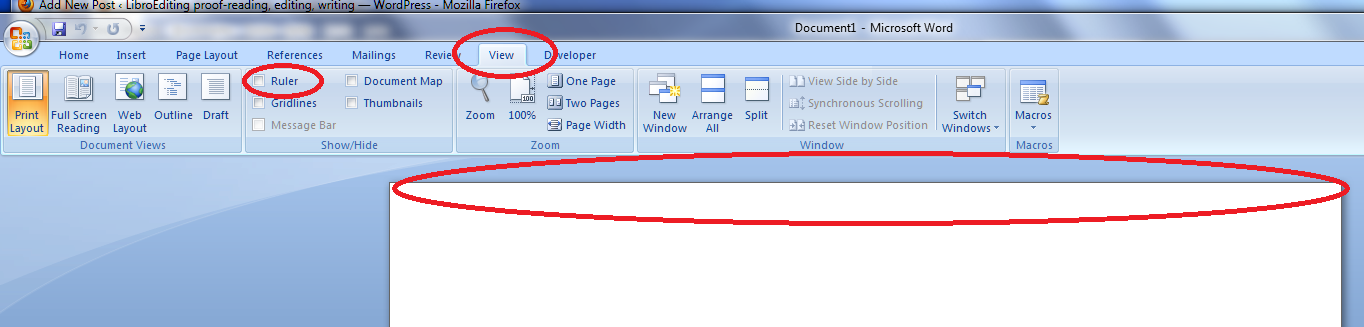
First things first: check that you can see your rulers in Word. If your document has a blank space at the top instead of a ruler, click on the “view” tab at the top of the screen:

How to make margins appear in Word

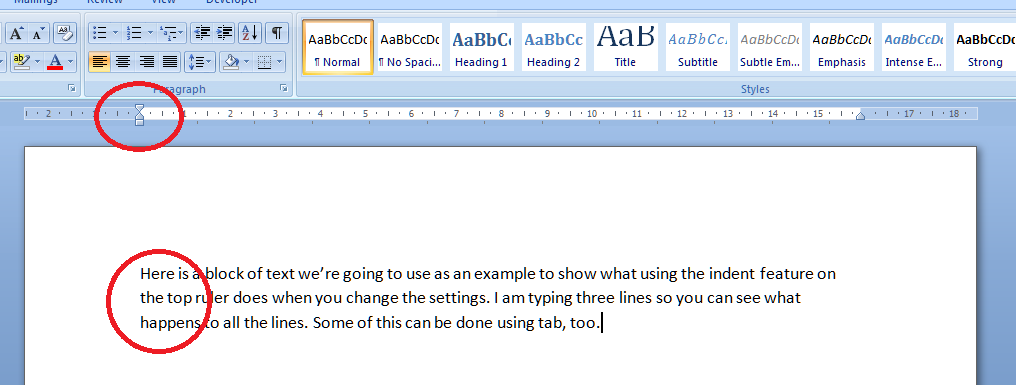
Look at “ruler” and see if the box is empty or contains a tick. If it’s empty, click on the box. Your rulers (top and side) should now appear:

making margins appear in Word

Now let’s look at setting the indents. The important thing to note here is the slider which appears at the beginning of the white part of the ruler, marking where the text starts, or the location of the left hand margin.  Note first of all that the slider’s position matches the text’s position on the page – they are both situated at the left margin.

Let’s look at how moving this slider either all in one, or the top and bottom independently, affects a block of text. First of all we take the pointer and click down on the square block at the bottom of the slider. This picks up the whole thing and, when you move your mouse (holding the button down still) the slider will move across. Very important: when you’re moving sliders or setting tabs, make sure you have highlighted the section of text you want to affect. If you don’t do this, whatever you do on the ruler will only apply to the point at which the cursor is located. You probably don’t want to do that. So: let’s move the slider across to the right a little …

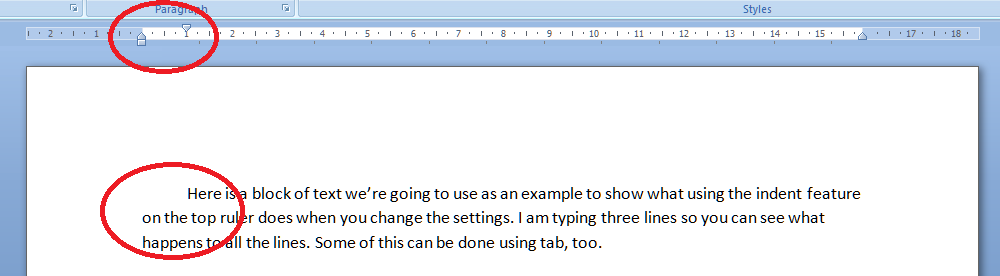
The black lines here mark the borders of the text area, and you can see that moving the slider as a whole has moved all the text across. Taking the slider back, what happens if we move just the top one across a bit?

You can do this using the tab key, too – but the useful point here is that once you’ve set it up at the beginning of a document (before you start typing), it will affect all new paragraphs in the same way, so you’ve set up a nice tidy way for your paragraphs to indent themselves throughout the text. Now what happens if we just move the bottom half of the slider?

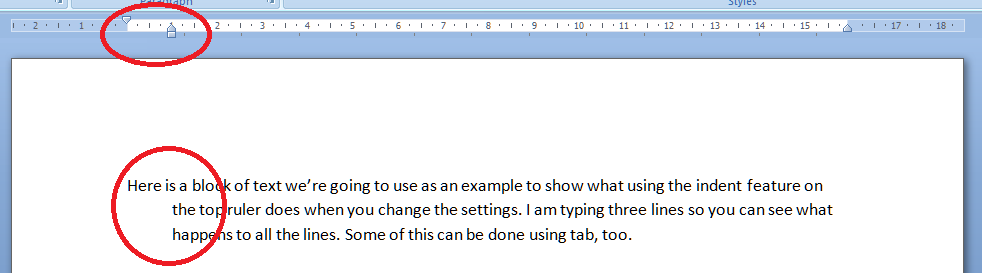
So this works the other way around: the first line of text is longer than the next ones. This looks a bit odd in a normal paragraph, but it’s very common in bibliographies.

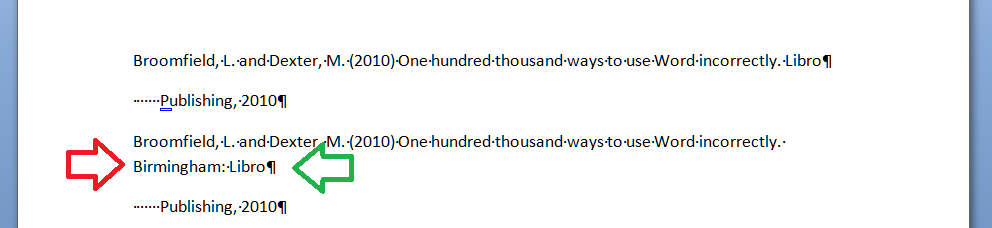
Here’s an example of how the user’s “short cuts” can actually make everything take longer, particularly if changes are involved. I noticed someone doing this in a dissertation I proofread recently, which is what inspired me to write this article.  I’ve turned “show formatting” on so you can see what they’ve done (dots are spaces and backwards Ps are line returns (enter)). In the first example, the author wants to have a hanging indent to make the author’s name more prominent, but they’ve done it by hand, hitting enter at the end of the line then spacing across to make the indent. All well and good (not really) until you need to enter some more text. Then look what happens:

Entering “Birmingham” has forced Birmingham: Libro onto a new line. But the line return at the end of Libro forces the next bit onto a new line (green arrow), and the second line of the entry isn’t even indented, because Word doesn’t know you want it to be (red arrow). Whoever entered “Birmingham” now has to delete the line return and take out the spaces before “Publishing” then re-set the hanging indent. Fine if it’s just once, but it won’t be. Contrast this with what happens if you set up the indents correctly in the first place:

Here, we’ve moved the bottom slider along so that the text automatically indents with a hanging indent on each paragraph. No spaces and only the required line return at the end of the entry. Now when we add “Birmingham” it merely pops itself onto the next line, nice and neat and tidy, and there’s nothing else to do.  Simple.

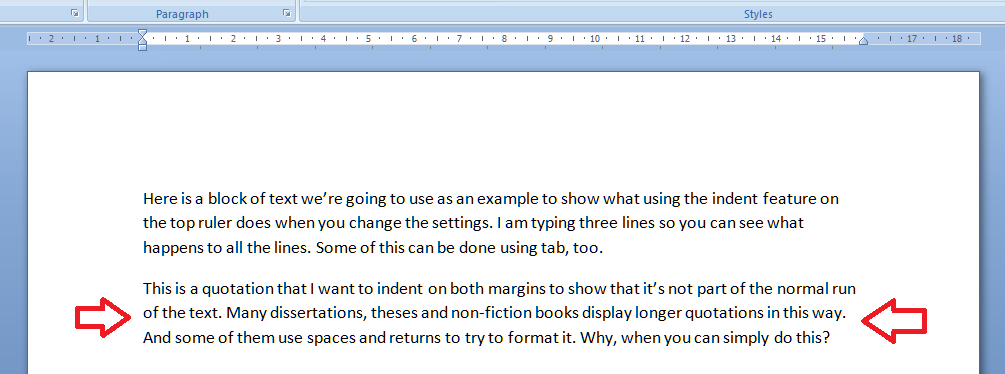
Now let’s have a quick look at indenting text from both margins. This is useful if you’ve got a chunk of quotation you want to insert into the text. Again, I’ve seen people put line returns at the end of each line and spaces across from the left. All well and good (again: not really) until you delete or add a word or character and it all goes odd. Here’s how you do it properly. Here’s the text we want to indent (marked with arrows):

Highlight the text you want to indent and move both the right and left sliders in from the margins:

The black lines show the text margins outlining the area where you can type. The grey lines show how the indented text lines up with the two sliders, one on the left, and one on the right.

One bonus bit of tidying up: if you set the justification to Full, you get nice neat margins both sides. You could not do this using line returns and the space bar.

So now we’ve learnt how to use the sliders on the rulers to make our text tidy and make it much easier to make insertions and deletions without messing up the formatting of the document. I hope you’ve found this useful: do post a comment or share this article if you did!

Note: I have added an article on the top and bottom margins.

Please note, these hints work with versions of Microsoft Word currently in use – Word 2003, Word 2007 and Word 2010, all for PC. Mac compatible versions of Word should have similar options. Always save a copy of your document before manipulating it. I bear no responsibility for any pickles you might get yourself into!

Find all the short cuts here

 
8 Comments

Posted by on February 8, 2012 in Copyediting, Errors, New skills, Short cuts, Word, Writing


Tags: , , , ,

Pedal or peddle?

I try to be understanding about all the different issues I see in my daily life as a proofreader and editor with eyes that can’t help catching things. Many of them, as I’ve described in this blog over the months, are explicable and understandable. But I have to admit that I have a bit of a block about this one, and I just can’t see how people manage to mix them up!

But I do see this one all over the place, and the Oxford Concise English Dictionary sees it necessary to have one of its special boxed comments distinguishing the two, so I’d better get on and differentiate them for you. I’ll be interested to see how many hits I get on this post from search engines – some of them are proving ever so popular! But maybe people don’t even realise there’s a distinction …

To peddle is to sell goods or promote ideas – so you can peddle the idea of a new innovation or practice – or of course you can sell goods door to door like a pedlar, which is where the word comes from originally.

A pedal, on the other hand, is an apparatus for making a bicycle move (or a similar human-powered machine like a pedalo or pedal-car), or an apparatus for making something happen, operated by the feet; thus car clutch and brake pedals or organ pedals. To pedal is to make a bike (or similar) move by applying pressure to its pedals.

Peddling – selling or promoting. Pedalling – moving oneself forward under one’s own steam on a bicycle or suchlike.

“Boris Johnson is peddling the idea of his hired bikes all over London – and you can literally get on a physical bike and pedal it all over London!”

You can find more troublesome pairs here and the index to them all so far is here.

 
3 Comments

Posted by on February 6, 2012 in Errors, Language use, Troublesome pairs, Writing


Tags: , , ,

Competition time

This competition closed in February 2012 so no further entries are being accepted!

It’s competition time! This is aimed at giving you a taste of what I do all day (in one of the areas in which I work). I’m going to give you two texts. Text 1 has a certain number of mistakes. Tell me how many on the form below! Text 2 needs to be helped to make sense. If you want to, write a new version in the form below.

Text 1

you shoul’dnt have gon eto the pub last night, it was a misstake,” She said, “how did i nkow that!’ said him.

Text 2

We need to concern about the incidences of bad spellling in the document and how they can be made made better. It influences on perception of the text in readers. However it makes it harder to understand. Because clearity is the main aim of all writing unless its v creation.

← Back

Thank you for your response. ✨


I will accept entries up until midnight in the UK on 10 February 2012. Winners will be decided by a panel of two and the prize is a Libro post-it note pad and notepad!


Tags:

What I got up to in January

I’ve had a fantastic first month of being fully self-employed – I can’t really believe how well it’s gone. I wrote about goals last week, and I’m happy to say that I hit all my goals for January, including the hardest one. This is marvellous reassurance that I can do this and make a living out of it: I was expecting January to be a bit slow, and the Jury Service (that wasn’t – they didn’t call me up for any cases and I only ended up being there for four half-days) did knock out a bit of my first week, but I took the opportunity to have a bit of rest and relaxation that I’d missed out on over my very busy Christmas! More about how it’s all going in a more personal sense over on my new blog; I’ve been hugely enjoying writing that!

So, I’ve had a good mix of my usual tasks this past month:

I’ve proofread varying pieces of academic work for the student proofreading company I do work for, Master’s course work for a few students, three of whom have signed up to be coached through their course (I provide more detailed information on their particular issues with their written English and help them develop their writing while they’re learning about their subject – I also charge for this monthly or termly so they don’t end up paying lots of little invoices) and had one mammoth session on a PhD which had got delayed by the student’s tutor (I was glad not to have to go to the day job the morning after that 11-hour day!).

I’ve copyedited documents, magazine issues and articles for my regular clients, and checked the English for my Polish, Finnish and other European translator clients. I’ve checked over the articles and proofs for Moseley B13 Magazine (I do that for free).

I’ve transcribed two webinars for my author/entrepreneur client and also edited a downloadable guide to self-publishing for her (I’ll link to that when it’s out, for all you authors out there).

I’ve localised a whole load of email text for a new American client, using software called Across, which is mainly used by translators: I’m pleased to have got to grips with this as I think it will widen the range of clients I can work with.

And I’ve written lots of little bits of marketing material for a client who’s offering my services to their small business clients, as well as a series of blog posts about dentistry and most of the new web content for my retail shelving client, working with their SEO person to make sure the text and metadata both drive click-throughs to their site (it’s working well so far!)

So a nice busy time of it! In other news, I had a guest blog post published and was quoted in an article about the rise in numbers of self-employed people.  I got back into my giving back and networking, helping at a Social Media Surgery session (find out more via this article I wrote about it), and attending Social Media Cafe (where I wore a brooch made by fellow small business, Good Girl Designs and insisted on having a photo taken) and my first Jelly co-working session.  I’ve helped two friends set up WordPress blogs (Amy’s music blog and Ali’s book reviews blog).

Coming up: I’ve got returning clients and regular clients to look after, and I have another big transcription job coming up, similar to the one I did at Christmas. I’m pleased to say that I’ve got more time for reading and seeing my friends now I’m full time, which is what I had hoped for. I’m going on a half-day course on email and social media marketing, and I’m planning a slightly different kind of newsletter this month – including exclusive access to a fun competition and a new format for the newsletter itself – do sign up here to get a look at that when it comes out!

Libro offers copyediting, copy writing, proofreading, transcription, typing and localisation services to other small businesses, individuals and corporations. Click on the links to find out more!


Tags: , , , , , ,

Of or off?

I think that the confusion people make between of and off is a simple typing or sound one, as most people understand the difference between these two prepositions.

Of expresses a relationship between a part and a whole, “half of the pie”; a scale/measure and a value, “2 metres of fabric”; an association between two things, usually of belonging, “the sister of the man involved”; a direction and a point of reference, “East of the clock tower”; any other relationship, e.g. “half of you come from Outer Mongolia”, “you, the people of Outer Mongolia”, “Of all the countries in that area, Outer Mongolia is the largest”, “the dress is made of Outer Mongolian fabric”.

Off is used as an adverb or preposition and implies the opposite of a relationship – a separation: away from the place in question “off-site data storage”; so as to be removed or separated from, “the top of the bottle comes off for easy storage”; starting a journey or race, “they’re off!”; moving away and often down from, “she got off the horse”; removed or separated from, “he is now off the Mongolia project”; having a temporary dislike of, “I’ve gone off yoghurt again”; bad or spoiled, “this meat is off”.

So they’re quite different, and it’s just important to watch your typing when you’re using one or the other.

Interesting points 1 – it is incorrect to use of instead of have in constructions such as “I should have asked him the way to Ulan Bator” – see my post on would have or would of for why this happens.

Interesting points 2 – it is also incorrect to use off of instead of of – “I picked him up off of the floor and dumped him in a taxi” – but this was used in Shakespearean English and is found in American English usages (usually not formal written English, though).

You can find more troublesome pairs here and the index to them all so far is here.

 
2 Comments

Posted by on January 30, 2012 in Errors, Language use, Troublesome pairs, Writing


Tags: , , ,