RSS

Author Archives: Liz Dexter

Unknown's avatar

About Liz Dexter

Book blog is at http://www.librofulltime.wordpress.com Writer, proofreader, editor, transcriber. Also runner, gym-goer, volunteer and BookCrosser! My married name is Liz Dexter but my maiden name and the name on the books I write is Liz Broomfield.

Constantly or consistently?

What’s the difference between constantly and consistently? Find out below …

Constant means remaining the same but its primary meaning is happening continuously, and it also has a metaphorical meaning of dependable and faithful. So to do something constantly means to do it all the time, as well as remaining constant or the same (and also doing it dependably).

Consistent means done in the same way over a long period of time, including an attribute of fairness and accuracy. It also means being compatible with (as in x was consistent with y). So doing something consistently means doing it in the same way over a long period of time, which does echo the secondary sense of constantly, but constantly also includes a sense of doing it continuously, which consistently doesn’t.

For example, I am constantly taking photos that I put up on social media, every day if not more; I consistently post a books of the year round-up on the first of January every year.

You can find more troublesome pairs here and the index to them all so far is here.

 
4 Comments

Posted by on January 9, 2019 in Errors, Language use, Troublesome pairs, Writing


Tags: , , ,

What happens to your website statistics when you drop the ball with your blogging?

When you have a professional website with a blog attached, what happens to your reader stats if you stop blogging? I did not do this experiment solely for this blog, but I thought it would be interesting to have a look at what happened when I had a blogging hiatus.

I haven’t updated this blog for six months. How did that happen? I’ll explain below. What am I going to do about it? Start blogging again, I hope …

Why did I stop writing blog posts?

Back in the summer, I made the decision to stop working at weekends. Working in this case included both paid editing, proofreading, localisation and transcription work and the additional marketing tasks like blogging, writing articles, responding to blog comments, etc. I did have to make the odd exception when work levels were high or I’d taken time off during the week (or had a holiday) but by and large I’ve stuck to this and am happier, less tired and more balanced as a result. OK, I took up a new hobby as an Endurance (cross-country and road relays) running official and lately a Track and Field official, which has involved weekend training courses and time standing around in muddy fields or boiling hot infields, but that’s a healthy, outdoors hobby.

However, the anticipated drop in paid hours didn’t happen. In fact, in 2018 I have brought in around 12% more revenue than in each of the two previous years, on average, I’ve worked the same number of hours per week, and I’ve in fact had fewer low-paid-hours weeks this year. So what had to give? Blogging.

This was exacerbated by the fact that, while my blog still obviously displays my knowledge of Word, language, business, etc., and channels people to buy my business books (still going just as strong as ever), I have been fortunate enough to have sustained my customer base through a lovely set of regular clients and through their recommendations to others. Added to this, over the nine years I’ve been self-employed, I’ve moved from a model of working with lots and lots of small jobs, editing Master’s thesis for overseas students, etc., to longer-term projects working with regular translator clients and writers / ghost-writers, so work has been more predictable, and I haven’t really needed my blog to funnel customers to me like I once did.

So it slipped. Should I just let it go?

What happens when you stop writing new posts on your blog?

Because December is always a low-traffic month anyway, I’m sharing stats from July 2016 through to the end of October 2018. Although there are peaks and troughs always, with March always being busy with those students and their Master’s dissertations searching how to put bibliographies in alphabetical order, you can see the drop-off in the latter few months of the cycle. That’s when I stopped blogging.

It’s pretty well-known that Google and other search engines like regularly updated content to index. That’s why I and others tell people to keep blogging and/or updating their website regularly. So I knew this, and the stats show it.

What am I going to do with my blog? Should I give up blogging?

Although I don’t feel at the moment that I NEED to write and publish lots of blog posts, I’m going to get back into it. How, I will share below. There are a couple of reasons WHY:

  • Although I have sufficient clients now, especially with lots of them being in Europe and the threat of Brexit looming, I can’t assume that will continue to be the case (small independent sole traders like me have had no advice from the government or HMRC). So it’s good to keep marketing yourself even when you’re busy. I am fortunate enough to have lots of lovely colleagues I can pass work to that I can’t take on at the moment.
  • I enjoy helping people. I get a buzz when I receive a comment saying I sorted out someone’s problem, or one of my Small Business Chats interviewees thanks me for a referral they received from my site. I do my job because I like helping people, and the blog allows me to help more of them while I’m doing other things!
  • I loved finding out what my Small Business Chat interviewees were up to and how they were getting on, and learning from their journeys. I don’t want to lose those connections.

What’s the plan?

I’m going to use my time wisely. Over the festive break, I’m going to add the flesh to the bones of a load of ideas I’ve put in my blog post drafts and get them all ready to schedule through the year (the plan there is to see how many I can get written and then distribute them evenly through the next year, keeping an eye on what’s about to publish as I go through the year in case there’s some awful clash between a light-hearted Troublesome Pair and a horrible news item).

I’m going to get in touch with my January 2018 Small Business Chat people as normal for their updates, but I’m also going to contact all the June-December 2017 ones I never got back to, see if they want to continue to take part and slot them in until I can spread them evenly through the year again. I will point them here and hope they appreciate my honesty and openness and continue to take part.

Over to you …

Have you paused your blog (especially a professional one) and started up again? What did you learn or change? Are you one of my abandoned Small Business Chat folk? Would you like me to continue featuring you again or has that series run its course? Have you enjoyed reading those posts? Have you, well, missed me?

 
21 Comments

Posted by on December 27, 2018 in Blogging, Business, Marketing, Writing


Tags: , , , , , ,

New editing book review – Peter Ginna (ed.) – “What Editors Do”

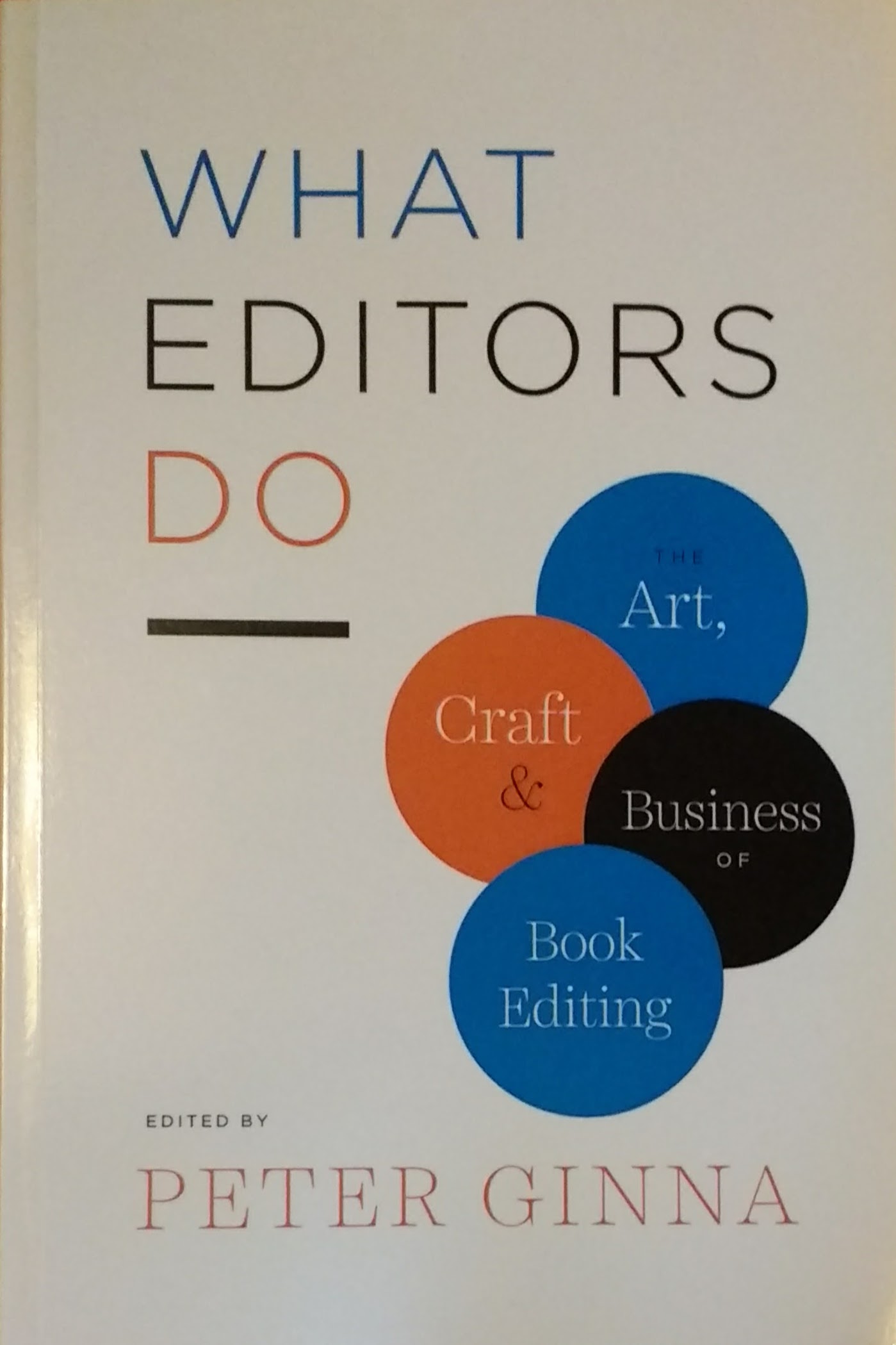
Fellow editors who follow this blog but maybe not my book review blog might be interested to pop over there and read my review of this excellent book, edited by Peter Ginna, “What Editors Do: The Art, Craft, and Business of Book Editing”.

I would recommend this book to all editors, writers and people generally interested in the process of how books get from ideas to the printed (or electronic) page. The chapters I’ve singled out are by no means the only stand-out ones: it’s of a very good quality and level of interest throughout.

(read more)

 
Leave a comment

Posted by on July 28, 2018 in Business, Reviews


I want to publish my book but I’m confused! Do I need an editor, a line editor or a proofreader?

a hand writing in a bookI was recently writing back to a prospective client who had got very confused about the different types of editing and proofreading and the process needed for publishing their book. I sent them some resources from this blog and thought it might be useful to share those here, too.

So, here are some articles I’ve written about the different kinds of editing, the process of editing and proofreading (and where your beta readers fit in to that process) and how to make sure your editor and proofreader are, ahem, on the same page. At the bottom are two articles I’ve written about how to deal with an editor – that can feel like an alarming process in itself, so hopefully I’ll reassure you there!

This one talks about the different kinds of editing and proofreading (it’s biased towards fiction but also works for non-fiction):

Do I need editing or proofreading?

This one sets out the processes you go through and their order:

What questions should I ask my beta readers? #amwriting

It’s certainly best to have different people do the edit and final proofread, as it’s not great to have the same eyes going over and over a text (that’s why we can’t proofread our own work!). If you use two people for these stages, make sure your editor provides you with a style sheet to pass on to your proofreader – more on style sheets here:

What is a style sheet? For people using editors

And when you’re ready to talk to an editor (or proofreader), here are two articles explaining that side of the process, so you and your prospective editor can experience a smooth process and happy negotiation:

How to request a quotation from an editor:

Working with an editor 1: How do I request a quote from an editor or proofreader? #amwriting

Ideas on negotiating and booking in your project:

Working with an editor 2: How do I negotiate with an editor or proofreader and book my project in? #amwriting

I hope you’ve found this very quick guide to dealing with the complexities of getting your book edited and proofread, and how to deal with contacting an editor, useful. If you have, please share this article using the buttons below, or leave me a comment. Thank you!
 
5 Comments

Posted by on June 27, 2018 in Copyediting, proofreading, Writing


Tags: , ,

How do I search in a whole workbook in Excel?

How do I search for a word or phrase across multiple sheets in a workbook in Excel 2007, 2010, 2013 and 2016?

Why would I want to search a whole workbook?

We think of Excel as being used primarily for numbers (although you might want to search for those, too), but I often encounter spreadsheets full of text. For example, when I’m localising text from US to UK English, or editing text that’s been translated, and it’s been output from a translation tool such as Trados, it often comes to me in an Excel spreadsheet.

Just like when I’m editing a Word or PDF file, I often want to either look for all instances of a word I want to change or check that I haven’t missed anything. And if that word might be in any one of many sheets in a workbook, I will want to search all of those sheets.

How do I perform a search in all the sheets of a workbook?

In this example, I want to find all the instances of the word “authorized” in all the many sheets in an Excel workbook.

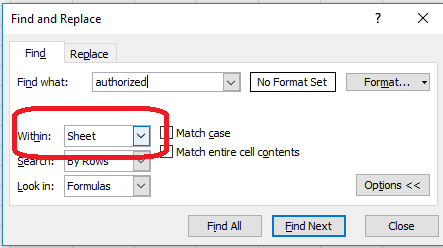
First of all, press Control and F at the same time to bring up the Find and Replace dialogue box:

Using this search without changing anything will just search in the sheet I’m currently in.

Click on Options:

This brings up a load of options, including some other exciting ones we’re not looking at here, but which might be useful as well:

Click on the drop-down arrow to the right of Within: Sheet and change it to Workbook:

Now when you click “Find Next”, it will find the cell where that text is throughout the whole workbook.


In this article, we’ve learned how to search a whole workbook in Excel 2007, 2010, 2013 and 2016.

If you’ve found this article helpful, please do post a comment below, and if you think others would find it useful, please share it using the sharing buttons below the article. Thank you!

Other useful posts on Excel on this blog:

How to view two workbooks side by side in Excel 2007 and 2010

How to view two pages of a workbook at the same time

How do I print the column headings on every sheet in Excel?

How to print the column and row numbers/ letters and gridlines

How to change rows into columns and columns into rows in Excel

Freezing rows and columns in Excel – and freezing both at the same time

How to flip a column in Excel – turn it upside down but keep the exact same order!

 
Leave a comment

Posted by on June 20, 2018 in Excel, Short cuts


Tags: , ,

What’s an acceptable error rate for an editor?

I have found this article from the marvellous industry journal copyediting.com considering acceptable error rates for editors extremely useful for sharing with clients and setting expectations. Although editors/proofreaders do tend to be perfectionists, we are human, and it’s good for us and our clients to remember this.

If a piece is full of errors, even a 99% accurate editor will leave some errors behind.

Read Adrienne Montgomerie’s article, “Error Rates in Copyediting” here.

 
1 Comment

Posted by on May 31, 2018 in Copyediting, proofreading


Tags: , ,

What else do editors and other small business owners do?

I haven’t got a Small Business Chat to share with you all today, so I thought I’d have a bit of fun and ask the editing and general small business community … what else do you do?

I’ll go first, shall I, then I’d love it if people shared in the comments. I’m looking for maybe surprising things you do outside of your job / business, whether that’s sport, crafts, volunteering or family responsibilities, whatever any of those things mean to you.

I’m an editor, proofreader, transcriber and localiser, and while my long-lasting hobby of reading All The Things (see my book review blog here) also keeps me sitting on my bottom a lot, my other hobby is running and all things to do with running.

So as well as running myself (I’m pictured here with running chums having done my third marathon, a DIY one), I’m a qualified Run Leader (so I can support groups of new and established runners), I’ve just qualified as a Level One Endurance Official (meaning I am working my way up through the levels of officiating at cross-country and road races), I regularly volunteer to lead runs and support beginners at my running club and I’m a committed parkrun volunteer. Keeps me busy and on my feet and outdoors, which is really important for balance in my life and keeping me socialised, too!

How do you keep balance in your life and switch off from your work responsibilities. Do share in the comments, and of course feel free to include your URL!

 
16 Comments

Posted by on May 5, 2018 in Uncategorized


What do I actually do? What do you actually do? Who does an editor or transcriber work for?

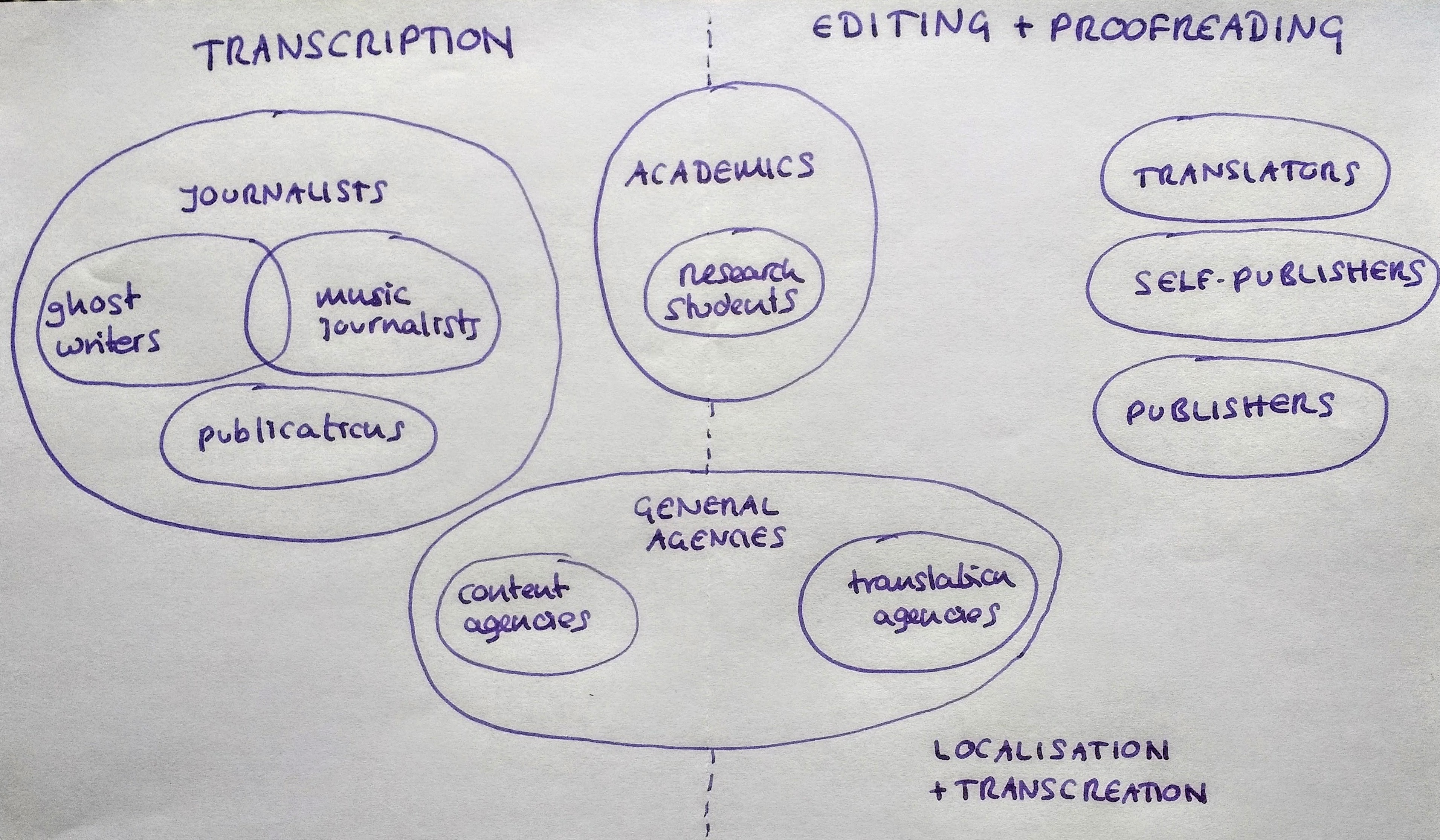
Taking a well-earned coffee break this week, my friend Jen challenged me to draw a Venn Diagram of what I actually do, for whom. I accepted the challenge.

Libroediting services venn diagram

Especially if you have a portfolio business, where you offer more than one service, can you draw out your customer base and services? How many attempts do you have to make (four for me!)? Can you see any patterns?


Tags: , , ,

Plain English – what are the business benefits?

My colleague Laura Ripper is an expert in Plain English. In this excellent article, she explains the benefits of plain language. A must-read for all businesses, and if you’re looking for Plain English editing and proofreading, head her way!

Laura Ripper's avatarLaura Ripper | Copy-editing and Proofreading

A picture of a piggybank

If you run a business, you probably know that customers appreciate clear communication. They want to be able to find important information quickly – for example, about products and services, how to find you or how to return an item they’ve bought. Direct, concise and jargon-free text saves them time, frustration and effort. It gives your customers a better experience of working with you.

But what are the benefits for you – and your company? How can writing in plain English help you achieve your business goals, such as making a profit or building your brand? Is communicating clearly anything more than ‘doing the right thing’?

Using plain English can help your business in three main ways:

  1. It saves money
  2. It saves time
  3. It builds your reputation

It saves money

– and it makes money, too.

If your marketing materials, letters and newsletters present information clearly, your customers are more…

View original post 838 more words

 
Leave a comment

Posted by on April 11, 2018 in Uncategorized


Instant or instantaneous?

What’s the difference between instant and instantaneous? Is there in fact a difference?

There are lots of pairs of words that mean the same thing, but one has a precise meaning and the other has a range of meanings. Now, if there are two words with subtly different meanings, I’m all for keeping both of them and retaining the richness of our wonderful language, etc. But when one just covers a subset of the other’s meanings, I’m not, to be honest, quite sure. At least here there seems to be a technical term lurking around which will keep the smaller (yet longer!) word going.

So, instantaneous, to cover the smaller meaning first, means being done or happening instantly. It does have a specific meaning in physics around being measured or existing at a particular time.

Instant means occurring immediately, as you would expect, as well as a precise moment in time or a very short time. It also means something that’s processed to allow it to be prepared quickly, in the case of food, mainly, Also, and I dimly remember this from when I learned to type in the Dark Ages, it means “of the current month” (your letter of the 16th instant) although surely no one uses that now?

Both of them come from the same original source, from Latin for “be at hand” (instare), but instantaneous came through medieval Latin, which added -aneus to the original instant (thank you, Oxford English Dictionary for that information). I would advise using instant unless you’re a physicist, just to save complication and make it easier to read.

You can find more troublesome pairs here and the index to them all so far is here.


Tags: , , ,