RSS

Category Archives: Ethics

On Mutual Support

Recently, I was invited to present at a training morning on small business and social media. I’m always happy to help other small businesses and community organisations learn about the things I’ve picked up over the years, and, while presenting my case study as a business person who has used social media to get an audience and clients, I emphasised the idea of mutual support.

I talked mainly about retweeting on Twitter and also about the way I feature other small businesses in my “Small Business / Freelance Chat” posts on my blog. I also talked about how some editing colleagues (who I do NOT see as competitors) kindly shared some of my blog posts on various forums to which they belong, which helped a couple of my posts go “viral” (500 hits in a couple of days is a big deal to me).

So I just wanted to take a moment to mention some of the kind instances of support I’ve had from other people in the editing / small business community (and, of course, encourage you to look at their resources too).

Louise Harnby kindly featured my Word help posts as her Link of the Week recently. This and her weekly round-up which included it again have collected me over 40 hits on my own website/blog so far. Add to that a couple of entries on her weekly round-up post for others of my posts, and she’s sent over 50 visitors my way in the past month. Thanks, Louise!

The University of Kent Careers Service found my post on starting a career in proofreading and linked to it on their Careers in Publishing web page. I’ve had a few hits a day from that since that happened.

Editor colleague, Kathy O’Moore Klopf, who is a constant support and fount of information, often (make that usually) shares my links to posts made in Facebook and Twitter. She also shares them with other communities she’s in, via forums and other discussion areas. Of course, I do the same for her! She is one of the people who helped me to those 500 pageviews.

An editors’ forum called The Editor’s POV mentioned my Stress post in one of their weekly round-up articles, and quite a few people popped over to have a look.

And last week, Nicky Getgood from TalkAboutLocal featured me in an article about people who use Twitter, Facebook and other free tools for marketing, information sharing and awareness raising.

All of these different posts in different places give me …

  • A new audience who may not have come across me yet
  • The chance to help more people, as well as to market myself to them – both are truly equally important to me
  • Link-backs, i.e. my URL on their page – Google likes these as they confirm that the site being linked to is valid and useful – so it helps me in their search results

And all this is on top of the retweeting and Facebook sharing – I’ve explained elsewhere why that is important to small businesses.

So, thank you to everyone who’s talked about me on their websites, here is some mutual support back, and if you have a Twitter account, a Facebook account, a website or blog, do share other people’s resources – it’s really worthwhile and can make a friendly small business person very happy!

 
5 Comments

Posted by on July 4, 2012 in Business, Ethics


Tags:

Are you guilty of presenteeism?

This is not my current desk

Having inadvertently given my friends and family the impression I work all day and every day, I started to think about whether the cult of “Presenteeism” is as strong in the self-employed community as it is among employees. Surely it shouldn’t be … and if it is, what can we do about it?

What is presenteeism?

We’ve all heard of absenteeism, or the practice of regularly removing oneself from the working environment for no good reason. Presenteeism is the opposite. It’s in the Oxford Concise Dictionary, and here’s how they define it:

The practice of being present at work for longer than required, especially as a manifestation of insecurity about one’s job,

This manifests itself in that classic competition over who can stay latest in the office (or, more importantly, who can be seen to be staying latest in the office. Or being in earliest. Or both. We’ve all sent an email to the boss when we’ve got in particularly early, haven’t we?

Now, that’s all well and good when you have a boss to impress. But what if you work on your own?  And I’m admitting doing this myself, here – although inadvertently. It’s easy to send that Tweet or Facebook status at the end of a long day …

Phew – done 10 hours at the desk today – big project!!!!

but is it so easy to say

Good day, did a couple of hours of work, all caught up so I lay around reading for a few hours

Well, is it?

Why do we have to engage in presenteeism?

I’d be interested to work out why we do this. Are we so busy trying to combat that insidious view of freelancers as people who sit around in their pyjamas watching daytime telly? Surely our friends and family know we don’t do that by now?

If you work in an office, you will tend to have set start and finish times, a proper lunch break, and weekends off (or a set working pattern) and holidays. How many freelancers take the full holiday entitlement they would be given as an employee? I know I probably don’t.

So when it’s quiet, we’re up to date and we skip off merrily to the cafe, or the gym, or just lounge in the garden for an hour or so, is that really a crime?

And isn’t it better for our friends and family to know we’re happy. whole, balanced and relaxed than working every hour there is on a hideous treadmill of work? Didn’t at least some of us go freelance  to avoid that hideous treadmill of work?

Celebrate balance, not overwork

I’m not suggesting we stop working when we need to be working. Everyone has to pull one of those 11 hour shifts sometimes. But let’s all be honest about how we live, celebrate the downtime as well as the busy times, and acknowledge that, yes, we do do this in order to have balance and flexibility in our lives, and we do have work patterns which are different, but balanced over the grand scheme of things.

I’m going to talk about this in public – I dare you to too!

Inspiration for this post came from one I published on my other blog about what I do all day. I have tried, since publishing that, to note when I have some time off …

 
14 Comments

Posted by on June 20, 2012 in Business, Ethics


Tags:

Businesses: be careful when marketing around the Olympics!

No Olympic logos here!

If you’re a business operating in the UK, it’s so tempting to think you can pin some of your marketing and advertising on certain summer sporting events. But be careful – the Games’ Marks are very carefully protected, and you can run into big trouble if you break the rules!

It may seem a bit harsh, but events do need to protect the investment of their sponsors, and this includes making sure that companies that haven’t paid for sponsorship don’t profit as much as those who have.

Thinking about it on more local terms, if you’ve bought kit for your local football team, and you go along to the match to see your company logo all over their kit, you’d be really annoyed to find a rival company at the gate, giving away merchandise with their information plastered all over it, but without any official status or paying for the privilege. Well, it’s really the same here.

There’s lots of information on this official website so I won’t repeat it. What I will repeat is: be careful. Just as you wouldn’t infringe other copyright, “borrowing” the typeface or logos of the market leader in your sector to confuse potential clients and drive them to buy your products, so you need to keep away from pushing the Olympic angle, unless, of course, you are an official sponsor or partner. Keep aware of the Games’ Marks and be careful, and you’ll be fine. Try to muscle in on the action, and you might find yourself with a hefty punishment.

*Note: I’m not trying to cash in myself with this post! I have had to mention this issue to a couple of my clients recently, so it seemed worth summarising it all in a more public place.

 
Leave a comment

Posted by on May 4, 2012 in Be careful, Business, Ethics


Tags: , ,

New ways to navigate the resources on the Libro blog

I’ve built up loads of information on all sorts of topics on this blog over the past few years, so I thought it was time to put together a resource to help you find what’s most useful for you. I ran a poll, people said yes, so I did it!

I put this new guide together about a week ago, and it’s proved popular so I thought I’d let you know about it quickly.

I’ve put together one simple resource guide with three main sections:

  • Resources for business – these include posts on how to set up a small business, things to do to grow your business, hints on networking, motivation, etc.; then some information about tax and finally an additional link to my small business interviews (note that business formation and tax posts are relevant to the UK although the rest of it will translate anywhere)
  • Resources for students – how to write an essay or dissertation, plagiarism and quoting sources, and lots more to come
  • Resources for Word users – all sorts of tips and hints to make your documents more consistent and easy to write, change and navigate, including tabs, margins, headings, contents pages and more obscure matters like how to put text in alphabetical order. Also includes a few notes on PowerPoint and other applications,

The whole resource guide offers a good way to find out what you need to know – do have a look and a play around, and let me know if you’ve found anything particularly useful!  I’ll be adding both resources and entries to the resource guide as I go along, of course. Watch this space …

And of course, we still have the index to the Troublesome Pairs and index to all the Saturday Small Business Chat posts.

I hope you enjoy the resource guide and indexes, and the resources they guide you to!


Tags: , , , , , , , , ,

How to quote sources without plagiarising

I work with a lot of students, and one of the things that seems to be an issue is how exactly to use your sources when you’re writing an essay. So I thought it was time to write some notes to help you.

How will this article help you?

This article will help you to avoid plagiarism. I’m going to take a text I’ve written and re-write it in some different ways. Because, and this is important, if you just take text from somewhere else and dump it into the middle of your essay … that’s plagiarism. Plagiarism is serious. It’s passing off someone else’s work as your own. And most academic departments use plagiarism detecting software. If they run your work through the software and it shows you’ve plagiarised,  you may well have marks deducted or the whole essay may be returned unmarked.

What’s wrong with just cutting and pasting stuff I’ve found?

I know that in most cases, you don’t mean to plagiarise. You’re pushed for time, you’re often not writing in your native language, and it’s easy to take that text and put it into the essay. But these are the reasons you shouldn’t do it:

  1. It’s morally wrong to plagiarise.
  2. You won’t gain an understanding of the text if you just paste it into your essay.
  3. You will get caught.

How do I use source material in the correct way?

There are two ways to use source material you’ve found in your research:

  • use direct quotations, which you’ll need to indicate using quotation marks ” … ” or ‘ … ‘
  • talk about what the author has said, but put it in your own words

So, how do we do it. Here is a passage I’ve copied from one book and some notes I’ve made from another one. These are the sources for my essay.

Using quotations to talk about your source

This is direct quotation. A simple example:

Mary says “I am going to the park”

I write: “Mary said, ‘I am going to the park'”

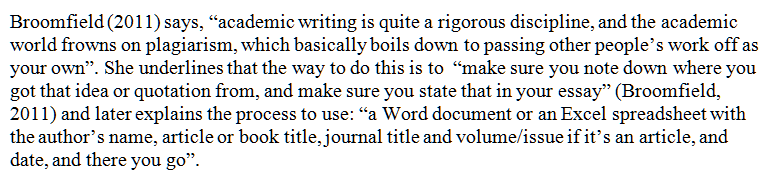
An easy way to talk about your source material is to use quotations. You don’t need to re-write what the authors say, however you do need to show you understand what you’re talking about and to link the quotations in a sensible way – you also need to make sure they’re all within quote marks and referenced properly. With the notes you’ve taken (above) you might end up with something like this:

So what I’ve done here is take sections from the text, put them in quote marks, noted where they’re from, and linked them appropriately so it’s clear I understand what I’m talking about.

Note that if you start off in the present tense, “Broomfield (2011) says that there are … ” you need to continue in the present tense; if you start off in the past “Broomfield (2011) said that there were … ” you need to stick with that. You can pop into the present tense if you are talking about a universal truth rather than something rooted in the time frame, so “Broomfield (2011) said that people are always likely to plagiarise” but “Broomfield (2011) said that the results of her study were not clear and she was not able to draw conclusions from them”.

Rewriting source text to talk about what the author is saying

This one is slightly more tricky. You need to do “indirect quoting”, or reporting what the author said. Simple example again:

Mary says “I am going to the park”.

I write: “Mary said that she was going to the park.”

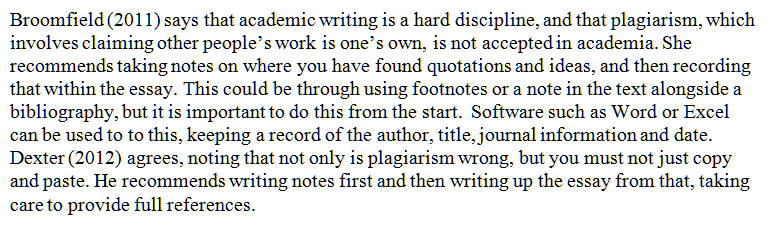
What we have to do here is retain the sense of the original, while writing it in our own words. Here’s what I came up with. Note that I can now use the notes I made on Dexter, too, as I don’t have anything in his words but can talk about what he said and I noted down:

Here I have used a number of different techniques. In no case, though, do I use more than a couple of the original source’s words exactly as they appear in the original. Instead I do this:

  • using synonyms: “hard discipline” instead of “rigorous discipline”
  • simplifying the words but getting the same sense across: “involves” instead of “basically boils down to”
  • reporting what the source said and using that to link the essay together: “she recommends using”
  • expanding on what the source says: “This could be through” rather than “you might”
  • summarising and synthesising (summing up and putting together) “Software such as Word or Excel could be used”, and “keeping a record of the author, title, journal information and date”.
  • Introducing the other research but linking it to the first idea: “Dexter (2012) agrees … “
  • Expanding notes into full sentences: the notes taken on the Dexter text.

Oh: please note here that you use “Broomfield (2011) says this is the case ” or “According to Broomfield (2011) this is the case” but never “According to Broomfield (2011) says this is the case” – I see that last one all the time.

Combining direct and indirect quotation

Of course, the best way is to combine them – some direct quotations, some reported speech or indirect quotations. This has the benefit of breaking up the text a bit, giving some interest, and allowing some use of the authors’ words to save having to rewrite everything.

Note that here I have shuffled around the order of what the first author says, too.

Rewrite, don’t copy and paste

I hope I’ve now managed to explain

  • What plagiarism is (see more in this post)
  • Why it’s not a good idea
  • Different ways to avoid it
  • Direct and indirect quotations
  • Some tips on how to rewrite text

Please do let me know if you’ve found this useful – or if there is more detail you’d like to know about. And do share using the buttons below if you’d like to tell your friends and colleagues about this information.

If you want more … here is a whole article on plagiarism, here is one on essay writing in general and one on writing dissertations and theses, and if you click on the students or writing or Word categories in the right hand column of the blog, you’ll get loads more hints and tips.

 
10 Comments

Posted by on March 28, 2012 in Ethics, New skills, Punctuation, Students, Word, Writing


Tags: , , , ,

How are you motivated … really?

How are people motivated, short term and long term? How do you motivate yourself and how does your boss motivate you? Is it all about the money … ?

I started to think about this when I was playing a couple of Kinect games. Stay with me here, it is relevant!

The dancing game – at which I was pretty bad, being a) not very good at dancing or aerobics (not putting myself down here, just not good at moving fast in a coordinated manner. That’s why I’m a runner) b) not used to this kind of thing. But the avatar dance trainer stayed really, really positive, even when it was clear I was doing badly. “Yo, you nailed that move,” he shouted. Well, no, I didn’t. If anything, the move nailed me.

Moving on … I also tried out a fitness “game” – more of a set of workouts, but fun and interesting. The best thing about it was, though, that as well as getting the visual feedback on your movements that both games offered, in this one you got realistic feedback at the end. If you did well, you were told so. If you did badly, you got something along the lines of, “this wasn’t quite what we wanted, but you can do better next time!” Just the acknowledgement that it wasn’t the best go ever did motivate me a lot more.

So, realism and trustworthiness is obviously something that motivates me.

Short-term motivation and long-term motivation: chocolate or freedom?

I decided to undertake a scientific examination of this phenomenon. Well, no, I didn’t: what I actually did was as the question “what motivates you?” on Twitter, Facebook and LinkedIn. I wanted to see what real people who I actually knew said.

And the range of responses showed first of all that there is a difference between long-term and short-term motivators. The popular answer “chocolate” didn’t mean (I think) that the respondent was motivated to do a good job, to achieve and excel, by a mountain of chocolate. But yes, a little sweet reward or some such is a great motivator to get something done. And tea, cakes and, indeed deadlines work in this way too.

Although … deadlines … is that more about having a job where you do have deadlines to hit? I would like to bet that the type of deadline you have in your job – if you enjoy it – is down to the motivators that work for you. Anyway, the long-term motivators are the interesting ones: recognition, praise, kindness make one group, which covers social or personally orientated motivators. Family, and even, from one respondent, cancer, show a deeply personal motivator which is probably about life achievements more than simple workplace ones. And then there is the set including independence, achievement and freedom (that’s my one) which are more to do with the person themselves and their own interaction with their world (as opposed to interaction with people as such).

Do we see money in there? Well, it is mentioned, but it is not mentioned by anyone first.

Here’s the scientific bit: Maslow’s Hierarchy of Needs

This all comes down, in the end, to Maslow’s Hierarchy of Needs or Maslow’s Triangle. In an article written in 1943 (andl also explained well in this Wikipedia article), Abraham Maslow posited that we have a hierarchy of needs, and that the lower ones need to be fulfilled before the higher ones.  So our basic needs are the really basic ones – shelter, food, breathing, and next up are security of employment, body, health, property and family, among others. So our money need really disappears right at the bottom, or is maybe mixed into the one above.  After these basic needs come love and belonging – family and friendship ties, then esteem, which includes self-esteem and the respect of others, and at the top, self-actualisation: creativity, spontaneity, morality, problem-solving, etc.

You can see that most of the motivators my respondents talked about came from the upper levels of the triangle. Of course, when our health is threatened, we drop “down” a couple of levels, but then I suspect those who are motivated by their illness are actually reaching for esteem and self-actualisation, beating the illness and claiming their selves back.

Unpacking my motivators

So, when I “unpacked” my feelings towards my Kinect games (other consoles are available), I could see that I’m motivated by trust and truthfulness. When I was employed, I responded best to managers who were realistic but trusted me to get on with it , while speaking up if I was overwhelmed. Likewise, I wanted to trust them to give me the right work and leave me to it. I wasn’t motivated by relentless optimism, and nor am I motivated personally by being shouted at, which is why I avoid the boot camp kind of exercise regime and hate being micro-managed. Now I work for myself, I can go up to the self-actualisation motivators and enjoy being creative and in control of sorting out my own problems. Freedom is a big one, too – I love having enough work to do to keep me busy but being able to do it when I want to, within my clients’ deadlines, and being able to go to the gym (or stop and write a blog post) if I want to. Yes, I will get my head down and plough through a big project if I need to, but I know myself well enough to understand that that kind of rigidity is not healthy for me for more than a day or so at a time.

Count your blessings and Know Thyself

Of course, all those people who answered my question – and I – are lucky. We have enough money to live on (although I live happily on a lot less than I used to – I’d rather have freedom than fancy things or a car) and so our basic needs are covered, leading us to be able to be all esteemful and self-actualising. But when we’re thinking about all of this, it’s worth remembering that not everyone is so lucky, and giving something back if we can.

And: Know Thyself. Have a proper think about what motivates you. Look up Maslow and read up on him. Are you getting what motivates you out of your job, career or lifestyle? Are you in a position where you can change that? Is it worth having that chat with your boss about how you are really motivated? (although I wouldn’t recommend being asked to be paid in chocolate coins …

In summary …

So it turns out

  • we are not motivated by money … unless we really don’t have any and we work our way up a hierarchy of levels to find more fulfilment
  • short term motivators (chocolate! tea!) are different from long term motivators (family! freedom!) but both are useful
  • it’s good to sit down and have a think about what motivates you – it can be really useful in your career and life in general

I hope you enjoyed this article – please let me know by commenting, and/or using the share buttons you can see below.  Thank you to everyone who responded to my original question!

Contact me via email or via my contact form.
 
6 Comments

Posted by on February 15, 2012 in Business, Ethics, Jobs


Tags: ,

On feedback

Feedback is an important thing. Without feedback from the world around us, through our senses, we wouldn’t know where we were, what we were doing or where we were going. In business, without feedback from our clients and prospects … well, we wouldn’t know where we were, what we were doing or where we were going!

There are two important sets of feedback we should all try to gather as we go through our business life, whether that business is a one-person enterprise or a multinational company.

Customer feedback, aka references and testimonials

Whenever I complete a job for a new client, along with their invoice I have some text I send them which includes a request for a reference or testimonial, if they are happy with my work. I used to link to my Facebook page where they could add their own reference, but since that feature has been removed, I now just provide a link to my references page where they can see what other people have said about Libro’s services.  I don’t get one from everybody, but when I do, I make sure I put it up on the references page, first in the “new” section at the top of the page, then when I add some more new ones, I move the older ones down into their categories. I arrange them into categories so people can find work like theirs to look at, rather than just having a jumble of stuff on the page – and I highlight important phrases to break it up a bit. By the way, sometimes I hear back from someone weeks after I asked. I never hassle for a reference or remind someone, though, as I feel that would be a bit pushy.

So how do I use these references? First of all, I put a little announcement up via social media when I get a new one. Hopefully people will pop over and have a look. This has a few benefits: people will see I’m doing well and be reassured that I’m a viable business to work with; people will see that I do a good job; people might see that I work in a different area to the ones they know about (I have diversified my services along the way so some people I met early in the life of Libro may still only know me as an editor) and then have some work they can put my way or someone they can recommend to me.  Obviously, having the references there means that I can direct people to them if they enquire about my services or ask what I can do for them. And quite a few companies I work with have asked for a CV – having taken some advice from peers, I put together CVs for my different work areas, using the references I’d collected but adding more detail about the kinds of jobs I’d done for the clients.

As well as using my own references page, I am on a few advertising sites which have references – and of course LinkedIn, which has a recommendations feature. I’ve had to be a bit more blatant than I might wish to be in asking people to add references onto these – and I usually only ask regular clients with whom I have a good, ongoing relationship – but no one has minded so far, and it’s helped build my LinkedIn profile and my profile on other sites.

So I make these references work for me – and I am convinced they help me when people are considering whether to use my services.

As an additional point, if the person giving me the reference has a website, I’ll pop a link to the site at the end of my reference. That’s a Google-pleasing link back for them and a touch of generosity on my part that they might remember for next time!

Oh, and if you’re building up your business and doing bits of work for free, make sure you make it a condition of your doing the work that the client gives you a reference. People actually value something more if they have to pay for it, and ‘paying’ by giving you a reference gives you that kind of relationship, plus you have something useful to add to your references page!

Market research

The other kind of feedback that’s vital for businesses large and small, young and old, is market research. You may have done this in the initial stages when you were seeing if there was a potential market for your goods or services. But it’s important to keep checking that you’re on the right track, that you know what your clients and prospects want. I’ve tended to do this myself for my blog rather than for my business as such, although I’ll look at that as I go along. After I’d been running this blog for 6 months, I put up a quick survey asking if I was posting too frequently/infrequently, posting about the right kinds of subject, and whether I was alerting people about the posts in the right way. Actually, in this case, the results I got pretty well balanced each other out: for everyone who thought I posted too much there was someone who thought I could post more, and a majority saying it was just right, and for everyone who was bored by my monthly updates on what I’d been doing, there was someone who said that was their favourite bit! But at least that told me I was on the right track, and this and subsequent feedback on my alerting process led me to minimise the alerts about blog posts on my personal Facebook page.

That’s the thing: you do need to respond to feedback and to do something if something needs doing. We’ll talk about that in  a minute …

Other kinds of feedback

You can also seek other kinds of feedback – another interesting and important area is when you are heading down a path and you need to check you’re going the right way. The Entrepreneur meetup I attend in my city is a good place to chat about what you’re doing and what you’re planning and see if you have the right ideas. I was talking to the owner of a cupcake company a few months ago and persuaded her to look into doing a range of low-fat as well as the usual gluten-free cupcakes; if I want the former, I’m pretty sure there’ll be a set of other people in the city who want them too. A couple of months ago, I had a bit of a tricky business problem that coincided with the Social Media Cafe I attend. So I talked it through with my peers – and I did that recently over email with a couple of peers too; it’s so useful to get feedback from other people in the same line of work, or same size business, as you. On another practical note, many of the authors and publishers I know will distribute online or print copies of their new books to a few selected readers (Joanna Penn calls these ‘beta readers’). They might then use their comments to improve the book, or use their reviews to publicise it upon publication. All useful interstitial feedback.

Take feedback on board and do something about it!

It is, of course, important to take note of the feedback and generate something useful from it. If your clients all describe you as friendly, and you like that, build your brand to include and emphasise that aspect, as if that’s what a lot of your clients like, then more will like that too. If people are being driven mad by your constant alerts about blog updates on your personal social media, scale it back to one round-up per week. If your beta readers hate your character’s name, look into changing it!

No request for feedback is without an ulterior motive – you want to tailor and target your outward face to match what your potential clients are looking for. If you’re going to get something out of people …

  • make sure you say thank you
  • use it

Oh, and talking of ulterior motives, I’ve got a survey on the go at the moment to try to find out how I can post the most useful articles possible on the language sections of this blog. Do go and fill it in, please. You know I’ll take note of the answers!

 
1 Comment

Posted by on December 28, 2011 in Business, Ethics, Organisation


Tags: ,

An Emotional Business

I was talking with a friend the other day about “owning” and accepting your emotions, and as the conversation sloshed around in the back of my mind, it started me thinking about emotions in business.

Running a small business, especially, I assume, if you’re fairly new to the game, can be a really emotional business. There’s the high when you get that first big customer, or actually have to pay tax on your first year’s income (I’ve made enough to pay tax! Maybe that’s just me … ); the low point when work gets a bit sparse; the utter cringing horror when you make a mistake – sure, no one likes to make mistakes when they’re an employee, but it seems so much worse when it’s your own business, utterly your responsibility, your own customer who’s personally chosen you to work with …

It’s important to acknowledge these emotions rather than let them boil away unnoticed. Running a business can be stressful at the best of times – good stress or bad stress, it’s still stress – and having stuff you haven’t taken out and given the light of day can make you stuck and hold you back.

Here are a few ideas which might help deal with those emotions in a constructive way:

  • Be happy. Yes, do acknowledge those good times. Celebrate in your newsletter, Tweet about it, tell your friends (but see below). Also, make this last and cash in on it. If a customer has praised you, ask if you can quote them on your references/testimonials page. Then you’ve got that happy time forever. I also save emails with praise on them so I can revisit them in quieter moments.
  • Be decent and do the right thing. If you’ve made a mistake, instead of dwelling on it, do something. First of all, do the right thing. That means apologising, in writing or on the phone, if you’ve messed up a job for someone. Don’t bluster, excuse and hide: just state what you’ve done, honestly, how sorry you are, and what you will do to put it right. You would appreciate a supplier or other company who did that, wouldn’t you?
  • Use your mistakes constructively. Early on in my career with Libro, I didn’t have such strong Terms and Conditions as I have now. So when I “under-delivered” in a client’s opinion (I didn’t rewrite their essay, which of course I shouldn’t have done), they complained and withheld payment, criticising me fairly strongly for what I had done (or hadn’t done). I felt awful for longer than I should have. Then I used the experience to a) firm up my terms and conditions so new clients would know what to expect, and b) inspire a blog post or two!
  • When you’re at a low point, realise it’s a low point and you will come back up. I keep a record of jobs and income per month, and my billable hours per week. I can see it dips, and I can see that some weeks I don’t do so many billable hours; but then I can see, now I’ve run the business for a few years, that these dips are temporary and it always comes up again. Every business area has cycles; keeping records helps identify these and reassure you that it’s not the end of the world.
  • Have something other than the business. Yes, your friends, your partner, your kids, the lady in the supermarket are interested in your business. But do they need to live the business alongside you? Keep some other interests if you possibly can – I’ve temporarily lost my ability to read so many books, but then again most of my work involves reading of some kind: but I’ve made the effort to keep on with the gym and running; it’s kept me sane and given me something else to think about / concentrate on / talk about (but I know I’ve been bad about this at times: sorry, friends/M!)
  • Be honest with your peers. Gather a group of people around you who also run their own business / work from home / work in the same area. This is a group of people who understand the highs and lows, who you can celebrate the highs with – but also be honest about the lows – and they will be too, and you can support each other. I was most despondent about a tricky potential customer a few months ago. I went along to my usual monthly networking event, not feeling that positive about going and having to be all jolly and upbeat. I ended up talking to a few people about my problem; they gave me excellent advice and more than one opened up about issues they were struggling with.

So, be honest, be decent, try to keep your perspective, and acknowledge the highs, lows, blahs and whoo-hoos!

 
2 Comments

Posted by on November 30, 2011 in Blogging, Business, Ethics, New skills, Organisation


Tags: , ,

On asking for what you (really) want

So, how is choosing a pony like choosing a freelancer?

I went horse-riding on Saturday (for the first time in years) and had asked for a “slow” pony. What I should have asked for, I realised, as my pony bucked a little and tried to bite her reflection in the arena mirror, all the while needing to be forced out of a v e r y slow walk, was a “slow and placid” pony. Never mind – I had fun and I could cope with the pony, and learned a lesson about asking for what I wanted as well as expecting what I’d asked for.

And then, I’ve just finished reading a book (look out for the review on my book blog) in which the heroine *twice* gets what she wanted, only to find out it’s not what she really wanted at all. Cue heartbreak and all sorts of lessons learned.

All this got me thinking about how, especially when we’re hiring people to do work for us, we need to think about what we (really) want before we specify the terms and conditions. If you’re using a proof-reader/copy-editor (yes, I know – I’ll explain the difference soon!), it’s useful to realise up front that you need to cut some word count, for example. This is something we can do, but it’s far easier for us (and cheaper for you in terms of time and money) to do it as we go along, rather than having to go back through the document, snipping away. If you’re concerned about a particular aspect of the project, tell us – ask away; if we’re any good, we’ll accept your questions, answer them and reassure you. I would much rather you, the client, were happy with the outcome and relaxed throughout the process, even if that means I do a shorter, smaller project for you or you don’t use me at all!

So, whether you’re choosing a pony, a life partner or a freelancer, think carefully about what you’re asking for, before you ask for it.

 
2 Comments

Posted by on February 15, 2011 in Business, Ethics, Jobs, Organisation


Tags: , ,

On (not) crossing the line

I had another learning experience last week. I offer a proofreading and copyediting service to students, but obviously I have to be really careful about authorship and plagiarism. Plagiarism is not just “copying”; it also encompasses “passing off someone else’s work as your own”. Now, I’m sure none of my clients would intend to do this. Usually, I’m tweaking spellings, word usage, the occasional sentence re-write – I do everything in “track changes” in Word so the client can see what I suggest and make their own decision about what to change and whether to change it or not. That means they retain their own authorship. People in the know with whom I’ve discussed it are fine with this approach and it just gently helps the meaning come through.

But just sometimes, there’s a piece of work where I feel uncomfortable with the amount I’m suggesting and working on. For “working on”, read “re-writing”. I did always wonder where the line was drawn; well, it turns out that with this one, I *should* go for gut reaction (unlike in my previous post, where I thought I couldn’t do the work, but it turned out I could). If my gut reaction says that I’m crossing the line where your work is concerned, I will – politely – turn it down and return your work to you without corrections. There are probably people who wouldn’t act like that, but I very firmly believe in doing what is right, above doing what is profitable. Work on which someone is given a grade should be their own work.

Of course, if you’re not a student and you want me to re-write your mangled metaphors, your tortured text, your slippery sentences, then bring it on!

 
14 Comments

Posted by on July 5, 2010 in Ethics, proofreading, Students, Writing


Tags: , , ,