RSS

Category Archives: New skills

What to do if your comment boxes go tiny in Word

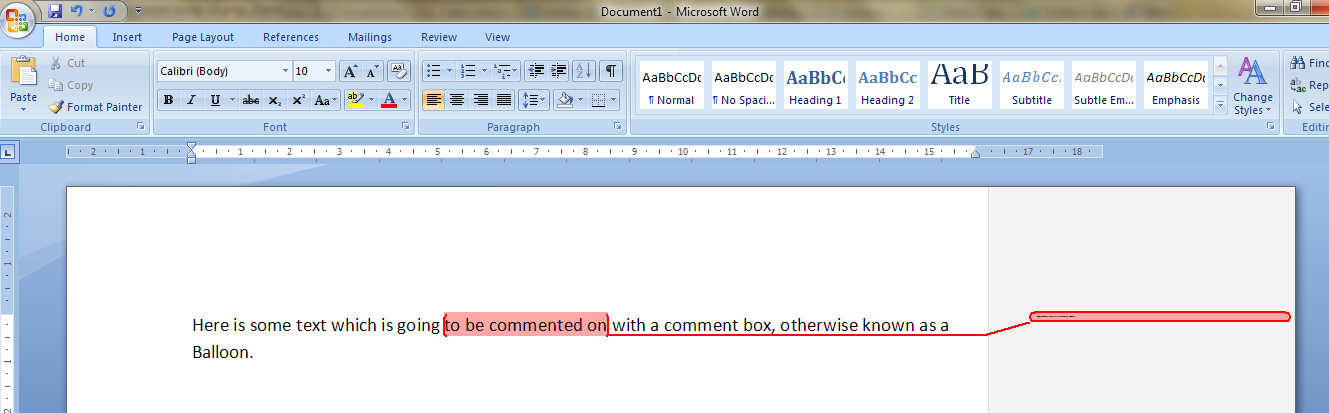
I had been editing a document for a client.  I added some comments in the margin, as always – but when my client opened it and when I re-opened it, to my horror and his, all of the text boxes containing the comments had gone TINY and unreadable. It looked like this:

It apparently happens if you’re working with a document originally created in an older version of Word which doesn’t have the requisite Styles set up for comment boxes.  You then work on it in Word 2007 or Word 2010 (this solution works for both!) and the horror happens …

It took me and Matthew longer than it should have to work out what to do, as there didn’t seem to be an easily found solution if you searched for one online – so as an aide memoire for me, for next time it happens, and as a public service for anyone else trying to work out what to do … here’s what you do (now edited to add screen shots).

Note for experts: if you’re already familiar with Styles, note that you need to change the Balloon Text.

What to do if your comment boxes go tiny in Word documents:

Let’s look at what the full horror looks like first of all:

First of all: don’t panic! The comments will have typically gone into Times at 1 point. But there is a way to make them readable again.

Open the document. Don’t highlight anything. Don’t put the cursor into a comment box.

Now you can do one of two things. Either hit Control + Alt + Shift + s all at the same time, or make sure you’re in the Home tab and click on the little tiny arrow at the bottom right of the Styles menu – this will bring up the full Styles dialogue box.

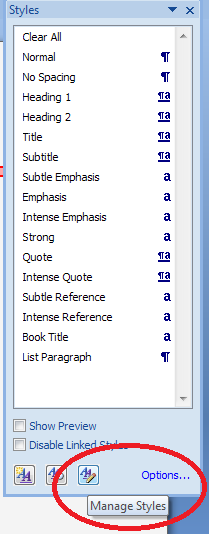
Using either of these methods, you will bring up the Styles dialogue box.

This looks like a very useful dialogue box, but for our purposes you need to ignore all of it except the three buttons at the bottom. Click on the rightmost button: Manage Styles to bring up yet another dialogue box.

We’re not there yet: the sort order shows as Recommended – but you need to click on the down arrow to change it to Alphabetical:

Once it’s in alphabetical order, it’s relatively easy to find Balloon Text (note: not Comment text) and you will see that it then confirms how you have your text set up (blue circle). Click the Modify button

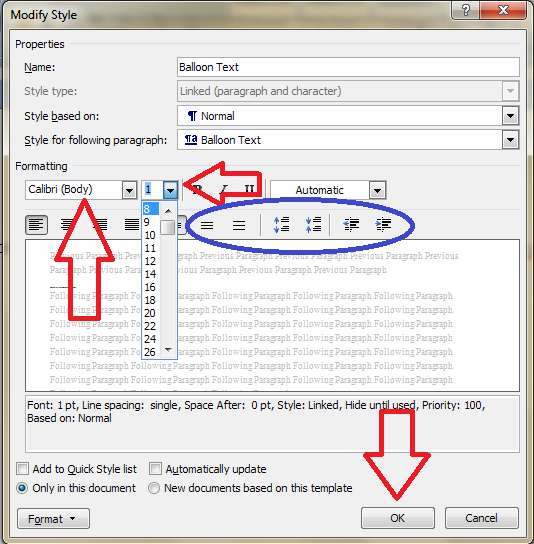
Now you can change your font (which will probably have defaulted to Times) and font size (which will probably have defaulted to 1). You’ll notice lots of other options (blue circle) to change the spacing, etc. – I don’t usually worry about changing those, but this is where they are if you want them – and of course you use this menu to change the styles on headings, normal text, etc., too. Press the OK button, and carry on pressing OK buttons until you get back to your document.

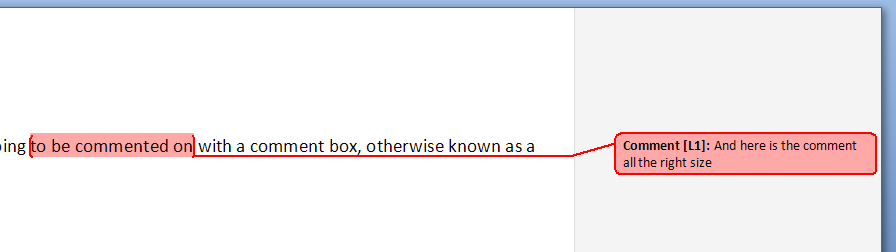
And there it is, all changed:

Save document

Want even more information on customising your comment boxes? Read this article full of everything you would ever want to know!

Related topics: What to do if your comment boxes start running from right to left

Changing the language in your comment balloons

Note that these tips are primarily for Word 2007, 2010 and 2013 for PC. Most of them will work for Word for Mac, although you may find some menus in different places. This is part of my series on how to avoid time-consuming “short cuts” and use Word in the right way to maximise your time and improve the look of your documents. Find all the short cuts here

Do let me know if this has helped you, saved your bacon, etc. – and do share with the buttons at the bottom of this article.

 
343 Comments

Posted by on November 6, 2011 in Copyediting, New skills, Students, Word, Writing


Tags: , , , ,

Proofreading as a career – some pointers

Sometimes I feel that people think “proofreading and editing” is one of those things that anyone can do, that’s a good fall-back position if you’re looking around for something to bring in a few pounds.  I think it’s a common misconception that if someone is well-read and good at spelling, that’s going to transfer into something out of which they can make a career.  There is a bit more to it than that, and as I’ve had several people ask about it, it’s got to the point where it feels useful to put something down that I can direct future enquirers to.  So, if you’re thinking about being a proofreader and you don’t know quite what it entails, read on …

Get your terms right

If you think you want to be “a proofreader” then you probably don’t know what one is.  Sorry to be blunt!  But a proofreader is a very specific kind of job, where you check materials that are just about to be published.  It’s not going through a manuscript for a novel and commenting on it (that’s copyediting) or making suggestions on changes (that’s substantive copyediting) or checking the facts in an article (that’s fact-checking) or writing up an article from bullet points (that’s copy writing).  For more on all this, see my post on proofreading and copyediting or my skill set series.   OK: so what you want to be is a copyeditor.

Get the skills

It’s not that easy correcting someone’s grammar and making their sentences work.  Sometimes, it isn’t actually that much fun.  Of course I enjoy it, but see below for why it takes a particular kind of person. And you do need to have the theory behind the practice solidly backing you up.   One way to get the knowledge is to go on a course.  Do not look at any other courses apart from those run by the Society For Editors and Proofreaders or the Publishing Training Centre.  Yes, there are lots of other courses advertised in the paper, etc.  These are the two that the industry in the UK recognises, that publishers send their editors on.  The courses and exams are quite expensive, but so are the other ones.  SfEP has a useful test on its website that might help you decide whether you’re suited for this work.

An admission: I’m not a member of SfEP and I don’t hold their qualifications.  But, and this is a route you will need to take too, I have lots and lots and lots of experience.  Most of that experience, pre-Libro, was unpaid – editing and indeed proofreading for local publications, author friends, typing theses back in the old days before everyone had a computer.  Writing.  Writing press releases and marketing material.  Working with UK and US English.  I’m nearly 40.  Most of my working life has involved this kind of stuff.  Oh, and the English Lang & Lit and Library and Information Studies degrees helped a bit, too.

If you go into this business, you will still need to take specific tests from prospective clients, even if you have qualifications.  I tend to pass these tests with flying colours, so I can get away with not having the exams.  If I was doing this again, and I didn’t have any experience, I would take those exams.  I’m going to learn Indexing one of these days.  I’m going to take the courses and exams for that: oh yes!

Are you suited for the work?

You might want to have a look at my previous post on deciding if you’re suited to freelance work at this point. In general, freelancing in whatever area you choose will have common points.  Particular to editing are the facts that: you can’t usually do it with other people around, as it’s really concentrated work; it can be a bit repetitive if you’re working on one huge text or lots of things on the same subject (if you get into student work, clients tend to recommend you on within the same course); you really don’t get to choose the subject you’re working on, and it’s fairly rare to be something that you’ll be interested in on its own merits. There are plus sides to these points, of course: if you enjoy being alone, the first is fine, and you can take your marketing work, blogging, etc., to the local cafe; it can be soothing to press on with the same thing hour after hour; and you get to learn an awful lot about an awful lot of subjects, which can be handy for pub quizzes and the like!

And you’ve got to be happy to do this, day in and day out.  You might have to miss a cinema trip with your friends.  You might be poorly – but there’s not really sick pay as such (we’re lucky to have the NHS in the UK, of course – in other countries this point is even more important). Again, these are general points. In summary from the editing side of things: you need to be good at concentrating; nit-picky; good at going for hours with no distractions; good at finding odd topics interesting enough that you’re not wandering off to Twitter every five minutes; good at keeping to deadlines (it’s often someone else’s deadline you’re affecting if you run over time).

Dealing with clients

OK, I do have great clients who come through recommendation and send me work reasonably regularly.  But I still had to prove myself to them in the first place, and I still have to send in my invoices on time and do the work when I say I will.  You will need to be able to justify what you’ve done to someone’s work, make their work demonstrably better, come in to their deadlines, keep them informed.  It’s not just a question of sitting nicely at a desk and playing with a sentence or so, just like gardening isn’t all wandering around in a big hat with a trug, snipping at a rose every now and again. You need to market yourself, be cheeky, throw business cards at all and sundry – you can’t just sit back and expect the work to come to you.  Which brings me to my next point …

Building things up

It’s over two years since I launched Libro.  Only now am I thinking of going full-time.  Much of my work comes through repeat business (hooray for repeat customers) and recommendations.  But that’s hard work in itself.  If someone is kind enough to recommend your services to a friend, you have twice the pressure: do a good job for the client and make sure you don’t ruin their trust in the original client who recommended you.  You have to do a really good job to get these recommendations, in the copyediting that you do and in the customer care and marketing that you do.

I have found myself diversifying over the years, so I now do transcription, writing, localisation from US to UK English and all sorts of other things. Do you have skills you can add in to your basic offering, that form a good portfolio (copyediting and clowning might work, but would be difficult to market, perhaps).  The other way to go is specialisation.  I’ve done this with my localisation work, building a reputation as someone who is good at turning US into UK English, and I know copyeditors who are very well-known in their field of, for example, editing medical journal articles.  But you need an outside speciality you can bring to bear on your copyediting work if you want to go down that route (for example experience in other jobs, your previous education …).

Is this for you?

So, a summary.  If you really want to make a go of a proofreading career, which we now know is actually a copyediting career, you need to:

  • enjoy working on your own
  • have a high attention span and a very high boredom threshold (I’m not saying that the work is boring: I love it; some people would be bored silly by it)
  • write a very high standard of English (oh yes, and everything else that you send out into the world has to be perfect or people will spring on it with glee!)
  • do a fairly expensive course or have demonstrably high levels of experience
  • be prepared to work very hard
  • be prepared to work on stuff you do not find interesting
  • be prepared to do all the usual freelance stuff of losing your weekends and evenings “just to turn this project round”
  • be prepared to do marketing and customer care and maths stuff as well as playing with the order of words to make the most elegant sentence
  • have other skills you can diversify into
  • or have a very particular skill you can specialise in

I don’t want to put people off, I really don’t.  But hopefully this has given you some insight into the kind of person you need to be to do this kind of work, and the kind of work it actually is.  Think of copyediting as a positive choice rather than a fall-back position, and you’ll be fine. Drift into it, and you might get some work and payments, but you might be happier somewhere else.


Tags: , ,

Essay tips for new students

This time of year, rather than January, always seems like the start of a new year to me.  I suppose I was at University, then working at a University, then studying again, working in library supply where the renewal cycle was at this time of year, then back to working at a University.  I’ve also started at University twice (undergraduate and postgraduate), and my partner, Matthew, undertook a Master’s degree a few years ago.

So, I’m going to talk today about some hints and tips for new students on coping with those first essays.  I’d like to broaden this out, too – so if you have any questions on this topic that I don’t cover here, please either post a comment to this post, or contact me via email or via my contact form, and then I’ll write a follow-up post in a question and answer format.

Starting at University or College can be really daunting. You have to get to grips with a new environment, a new place to live, new people around you … and what’s likely to be a new way of doing academic work, too. I know some A-level courses encourage students to do some research in a bigger library, but I also know from running library tours at my part-time job, that many of you won’t have been in a big academic library before, and might need a few hints and tips. So, here we go!

Use all the resources you’re offered

Your library is the main place for this. At the beginning of term, you’ll have the opportunity to go on a library tour. Take that opportunity to familiarise yourself with the library, and with the staff and where to ask for help. You’ll find where the books are for your course, and how to operate the photocopier, self-issue machines and other bits and bobs of technology. If you miss the tour schedule, many libraries offer downloadable audio tours, or other ways to help you orientate yourself.  Library staff may offer training sessions and hands-on work with databases and other resources you may not have come across before.

Seek out the support and information that’s been put together to help you.  This may come from library or departmental staff.  At my university, study skills modules are available on the student portal part of the website. This is quite common and gives tried and tested advice, in far greater detail than I can go into here, on how to maximise your study skills and learn how to learn, and write those essays.

Don’t fear your essay … or your library

Your university library might look big, and you may not have used a large, academic library before, or even have been inside one – but in reality, most of your books are going to be in just one or two locations in that big building.  You’ll need to get used to the classmarks on the spines of the books – usually made up of letters and numbers, like PR 1234.A6, these are simply a way of making sure books on the same subject are shelved together. Your library should have paper or online guides to where books at a particular range of classmarks are shelved, and once you’ve looked up a book, checked its classmark and found it, you’ll find other books on the same subject shelved alongside it.  Electronic resources are ever so easy: access them online whenever, and from wherever, you want to.

Regarding your essay … the tutors are not out to trick you. They want to see you succeed, not fail. Yes, they want to push you and help you learn, but the essence of University work is finding out, following your interests – it’s far more flexible and enjoyable than all the cramming of facts into your head that you did for your A-levels. If you get stuck, ask for help (see below). If the department offers more resources about writing essays, use them. If your tutor makes lots of comments on your work, don’t be downcast, but use them to learn for next time.

Plan, plan, plan

If you’ve just done your A-levels, you’ll be more used to doing coursework than I was when, fresh from batches of 3 hour exams, but no coursework, I suddenly had to learn how to plan an essay! It’s a cliché, but don’t leave it to the last minute. You will (believe me) remember the hell of pulling a 24 hour session on an essay on Middlemarch, but you won’t remember anything about the book or what you wrote, and you’ll go right off coffee for a bit. When you get each course outline, there’ll be a note of what coursework is due and when. Note all these down once you’ve chosen your courses, and then plan time to spend on each essay.

When you’re researching and writing your essay, write a plan. Just like you did in your exams (right?).  Now it’s all on Word, type in the headings – introduction, conclusion, the bits in between. Do some mind-mapping or write out a plan, however you like to do it. But plan the essay, even make a note of how many words you need for each section, and it’ll be all broken down into bite-sized chunks that are much, much easier to face.

For more information on essay-writing, by the way, you might want to look at this post, which is mainly for those writing dissertations and theses, but has some useful points, too.

Use some different resources

When you were at school, you probably used textbooks, the texts themselves if you were studying humanities subjects, the internet (Wikipedia? Don’t use Wikipedia now, please!).  Now you have a huge wealth of information at your fingertips: books, e-books, journals, e-journals, databases of articles … Make sure you use a range of materials. Your course reading lists will probably guide you here – they should have a mix of materials on them. I didn’t really get to grips with journal articles until my post-graduate course (but then again, in my day they were all indexed in big, fat books; online searching was only just coming in) but wish I’d learned about them earlier.

It shows initiative and differentiates you if you read around your topic and search out some interesting articles, etc. to quote in your essay. Most of the electronic databases and e-journals are really easy to search (the designers put a lot of work into making them user-friendly, and there are often tutorials within the source itself, or written by library staff and available on the library or departmental website).

If you get really stuck with a particular database, and think you’ll need to use it a lot, it’s worth finding out who your Subject Advisor, Library Tutor, Learning Support Staff – whoever it is who’s paid to help students find stuff – and booking a session with them to get some more detailed help.

Record your references

Now’s the time to start recording where you found the information you’re discussing and quoting in your essays.  Academic writing is quite a rigorous discipline, and the academic world frowns on plagiarism, which basically boils down to passing other people’s work off as your own. I’ve written a separate article about this here, so I won’t go in-depth about it again, but basically, make sure you note down where you got that idea or quotation from, and make sure you state that in your essay. You might use footnotes or you might just put a note in the text and put together a bibliography, but you’ll be expected to do this from the start.  Get in the habit, and it won’t be so bad when you come to do your undergraduate dissertation or extended essay, or if you go on to postgraduate study.

You don’t need to do anything fancy – a Word document or an Excel spreadsheet with the author’s name, article or book title, journal title and volume/issue if it’s an article, and date, and there you go.  Start doing it now, and it will become a useful habit that will help later on.

If you need help, ask for it, or accept it

If you’re feeling a bit stuck or panicky when confronted with your first tranche of essays, don’t fret. Help is at hand.

For a start, as I said above, your tutors are not trying to catch you out or trick you.  You should have a personal tutor, and there will be some sort of academic support, too. Go to them – they are there to help you. No one is going to think any worse of you for seeking help. After all, in the world of work later on, the bosses will prefer it if you ask what the big red button does rather than just pressing it! And, you’re paying fees, so the university needs to help you get the best out of your education. So, ask.

If you have a particular issue, whether English isn’t your native language, you are dyslexic or need to use voice-activated software, support should be in place at your University. You might need to contact the Overseas Students office, in the first example, or Disability Services / Accessibility in the second, but there will be something in place – as far as Accessibility is concerned, there are laws to make sure that’s the case.

If you feel happier getting some private support, using an academic coach or proofreader, be very careful indeed. There are a lot of companies out there who prey on students who need their services. Obviously I’m decent and ethical, and if you feel you need some support with your essay writing, do get in touch – I can always recommend another person or company with whom I have personal experience and contact. But beware companies who charge a high fee and then just run your essay through a spell-checker (it happens). You shouldn’t pay more than about £8.00 per 1000 words for proofreading, and try to find a company or coaching service that will tell you the person’s name who you’re dealing with, and has references on their website.

——–

OK, so these are a few general hints and tips. As I said, I’m more than happy to answer questions – ask me via email or via my contact form or just pop a comment on this post, and I’ll post up the answers in a week or so.  Good luck, enjoy your course and your University life, and if you like this article, please share it using the buttons below!
 

Tags: , ,

Saturday freelance chat – Nathan Littleton

Our chat this week is with Nathan Littleton of Future Visions, a web design and email marketing company.  I’ve  been working with Nathan since late last year, both writing content for websites he’s designed and working with him on his own downloadable content and newsletters.  The amazing thing about Nathan is that he’s been running his business for 8 years … and he’s still only 21! Actually, the most impressive thing I find about Nathan is his generosity in recommending me to his contacts and friends.  I was introduced to him via another client and he’s passed my details on to several people who have become regular Libro clients.  He is also great at retweeting on Twitter and posting reviews on various sites whenever he’s asked to – thanks Nathan!
Anyway, let’s find out what life’s like when you set up your own business aged 13 …
What’s your business called? When did you set it up?
My business is called Future Visions; we specialise in creating websites and email marketing campaigns that bring business owners a measurable return on investment. I set the business up in 2003, aged 13.
What made you decide to set up your own business?
Having practised web design as a hobby for a couple of years, I did it because I really enjoyed it and recognised the opportunity to earn a bit more money than my friends who had paper rounds or corner shop jobs.
What made you decide to go into this particular business area?
Being quite young, it was the only thing I really could do!
Had you run your own business before?
No – I’d only just started high school, so I pretty much started from scratch. I didn’t know what was expected of me when I walked into a meeting with a new prospective client, so I just did what I thought was right. There were a few slightly raised eyebrows, but looking back, I respect the clients I worked with back then for taking the plunge and choosing to work with me (some are still clients today).
How did you do it? Did you launch full-time, start off with a part-time or full-time job to keep you going … ?
It was a juggling act to maintain the business and keep up with school work, so at any given point I’d find myself giving a greater focus to one or the other until I managed to strike a balance. When I finished high school and went into sixth form college, I got a part-time job to support me through times where projects were thin on the ground. I still see that as a good decision because I’d naively forgone the planning of my business in the early stages, so it gave me chance to step back out of the business and plot where I was going.
What do you wish someone had told you before you started?
I wish someone would have told me how much I was really worth! Perhaps it came with age, experience and maybe confidence, but I priced myself quite low compared to the rest of the market. On the other hand, I was running the business from my bedroom, so anything I earned went straight into my pocket, and this may have given me a competitive advantage while I got my feet under the table.
What would you go back and tell your newly entrepreneurial self?
To start with the end in mind. I never really looked at what my goals were, so I never had any targets to meet. I wouldn’t change much about my fledgling teen career, but I’d love to look back on what I wanted to achieve back then.
What do you wish you’d done differently?
If I’d have known the benefits of systemising a business early on, I’d have done it much sooner.
What are you glad you did?
When I finished sixth form, I had a dilemma: take my business full-time and achieve as much as I possibly can, or take the same path as many of my school friends and study at university. I opted for the former and never  looked back, and I couldn’t be happier with that decision. If I’d gone to university, I’d have had to give up the business, and I didn’t want to wonder what I might have achieved had I carried on in business. Many of my friends have now graduated  and are struggling to find jobs, so I consider myself fortunate to be in a growing business. I have every intention of going to university, but I’ll study something I’m passionate about, rather than what I believe will give me the best job prospects; and hopefully, without the burden of student debt.
What’s your top business tip?
I’ll copy a tip many of the business greats have shared, and it’s to be a marketer of ‘your thing,’ not a doer of ‘your thing’. When freelancers (by definition) take on new work, they’re selling time for money. Without increasing their rates, there’s a limit to what they can earn. By outsourcing delivery or employing people to work on new projects, they can grow more quickly and start to see how lucrative running a business can be. I’m about half way there now, and I know that’s the best way for me to grow my business.
How has it gone since you started? Have you grown, diversified or stayed the same?
Growth was slow while I studied at school, but we’ve grown a lot since then. Since 2003, sales volume and profit has risen, sometimes doubled, year on year. We now work with a freelance network all over the world and even have some international clients dotted around.
Where do you see yourself and your business in a year’s time?
On a sunny beach, preferably. The goals for the next year are big ones, and we’re looking to work with more and more freelance designers who are passionate about what they do and are hungry for more business. With that, the business will be completely systemised to improve client delivery and turnaround times.
Catch up with how Nathan was doing a year on… was he on that sunny beach?
Nathan’s website is http://www.future-visions.co.uk. You can call the office on 0121 288 3688 and they’ll be happy to help.
Thanks for your interview, and I’ll look forward to hearing from you when you’re sitting on that sandy beach (still sending me work!) next year!
If you’ve enjoyed this interview, please click here for more freelancer chat, or here for information on how you can have your business featured.
 
3 Comments

Posted by on September 17, 2011 in Business, New skills, Small Business Chat


Tags: , ,

Saturday freelance chat – Zoe Austin

Welcome to the newest freelance chat interview – and this one’s with someone I’ve known for years!  I met Zoe Austin back in 2005 or 6 when we were both working at the University Library. We met via BookCrossing (she had some books to donate to the library’s BookCrossing Zone) and bonded over that and the lovely earrings she made to sell for the library charity. We kept in touch when Zoe moved away to Cambridgeshire to study Music Therapy, and I’ve been interested and proud to see her set up this creative and helpful business. As well as teaching standard music lessons, Zoe is expanding into using her qualification to provide professional Music Therapy sessions to people in her area.

Personally, I find it very interesting to see what people in the creative sector have to say about business – there are many ways the more traditional of us can learn from this and use their ideas in our own lives and businesses. So let’s say hello to Zoe!

What’s your business called? When did you set it up?

I registered my name as ‘Zoe Austin Music & Therapy’ but at the moment I am marketing it as ‘Zoe Austin Music’. It will probably change again soon!  I began teaching music privately whilst at Exeter University in 2001-2002 to make a bit of extra cash, but took it up again properly in 2009.

What made you decide to set up your own business?

I qualified as a Music Therapist in 2008 from Anglian Ruskin University with the plan to establish a part-time private practice whilst working in a related field for my day job, looking for other Music Therapy work for an agency like the NHS in the meantime. Well, the Music Therapy has not quite appeared yet in the way I had hoped (watch this space!) but I have been able to continue with what I call ‘standard’ music lessons and ‘therapeutic’ lessons/sessions in which I have taught, for example, a client with mental health difficulties and another with Down’s Syndrome.

Since September 2010, I have been teaching on a Saturday with the Cambridgeshire Music Fenland area academy, teaching and conducting young people. I have found this to be immensely rewarding and it has further cemented my lifelong love of music and the fact that, when I am sharing music in this way, I am living my authentic creative life. This is the reason why I am now expanding my business: so I can make music my livelihood as well as my life’s work.

What made you decide to go into this particular business area?

See above! Music has, I am lucky to say, always been a hugely important part of my life. I began learning violin aged 3 and the lifelong love began! As the song goes, music was my first love and it will be my last. Now I am determined to make it my living and letting, as Rumi put it, what I love be what I do.

Had you run your own business before?

Nope. I always fancied being my own boss and that is still the ultimate goal – full-time self-employment, operating out of my own premises with perhaps a member of staff to do admin things.

How did you do it? Did you launch full-time, start off with a part-time or full-time job to keep you going … ?

I have been working part-time teaching music in the evenings and at weekends whilst working full-time in children’s social care.

What do you wish someone had told you before you started?

This won’t surprise you, Liz! Register for tax self-assessment in plenty of time as you can’t complete the thing before you receive their PIN number through the post, which can take up to a week!

What would you go back and tell your newly entrepreneurial self?

I feel that I am still new to all this, really. Hmm … Maybe what Julia Cameron reminds us in ‘The Artist’s Way’: leap and the net will appear. Also, importantly, ‘YOU CAN DO IT!!!’

What do you wish you’d done differently?

Again, kind of hard to say at what still feels like the beginning of all this but … there was the tax thing, so maybe don’t be afraid of the admin side of things and get them done and in order as swiftly as possible so you can concentrate on more interesting things.

What are you glad you did?

Registered with musicteachers.co.uk. It has been the main way in which, thus far, people have found out about my business. Now that I have set up a blog and Facebook page, I am hoping to attract more business. I am hoping that the business cards I have been pinning to community notice boards county-wide will also yield results!

What’s your top business tip?

At the moment, for me it would have to involve purchasing and completing The Artist’s Way. It is a 12-week course for creative recovery, so is obviously quite pertinent for me as a musician, but I would also recommend it as a general tool for helping with clear-thinking and prioritizing what is important in our working lives.

How has it gone since you started? Have you grown, diversified or stayed the same?

Again, watch this space! I am, all being well, on the brink of some major changes which I can’t really discuss yet as nothing is set in stone yet. I will say that things seem to be changing for the better in my work life and for my business.

Where do you see yourself and your business in a year’s time?

Teaching music, providing Music Therapy and doing paid performances – all together providing my complete source of income. I hope, as more money comes in, to be able to invest in more advertising and an actual website rather than just my little blog (proud of it though I am). I would also like to be able to afford to receive music tuition for myself again, attend music workshops and MT conferences. Musical self-sufficiency, really!

I would also like to be able to afford to offer free or reduced-price Music Therapy in areas of need within Cambridgeshire, such as Oxmoor estate in Huntingdon  or the Arbury in Cambridge.

Can I just add: Thank you so much for interviewing me and helping to spread the word!

Thank you very much for participating, and I for one really look forward to watching your progress as you grow and expand the business!  Zoe’s Facebook Page is here  You can email Zoe or call her on 07791 308546.

A quick update: Zoe submitted these replies to me a few weeks ago, and there have been some exciting developments since then (the power of the Freelancer Chat Interview at work before it’s even posted?!) – I’ll let her tell you what’s happening:

“I will be teaching and providing Music Therapy through Huntingdon Regional College for 3 days a week and am very happy to have found  some part-time paid employment in this field – ideal really, as it allows me to do what I love and continue to expand my business. I am covering a 2 term maternity leave teaching violin privately in three Peterborough schools and, thanks to word of mouth and musicteachers.co.uk, I am also giving a singing lesson at Priory Grange Hospital in St Neots and hope to set up a Music Therapy group there in the near future! I am so happy and grateful for how things are working out!

Congratulations, Zoe: I’m very pleased for you!

 If you’ve enjoyed this interview, please click here for more freelancer chat.

 
4 Comments

Posted by on September 10, 2011 in Business, New skills, Small Business Chat


Tags: , ,

What is localisation (or localization)? How do I localise documents?

I’ve been doing some localisation for some new customers recently and, mentioning this on my Facebook page, etc., I realised that this isn’t a well-known process.  So, for those of you who are interested, and people who might have documents they would like to work in different regions of the world (there’s a clue!), here’s a quick guide to localisation.

One of the dictionary definitions of ‘localise’ is “to make local in character”, and that’s basically what it’s all about. Say a website, or a brochure, or an advert, or even a novel, has been produced in America. Obviously, the language is going to be American, rather than British English. Eggplant, freeway and optimize, as opposed to aubergine, motorway and optimise. Now, sometimes, the company or publisher putting out that document will want to adapt it for different markets, so that the reader feels comfortable with the text and can understand it without any strain. If the markets are in countries that don’t speak English, then a translator will be called in to translate it for their country.  And if the markets are in countries that speak English, but slightly differently, then someone like me is called in to “translate” the text into British, Australian, Canadian (etc.) English.

It’s not just a matter of turning all the “ize”s into “ise”s. There are grammatical differences (“different from” vs “different than”), spellings (“colour” / “color”, “anaesthetic” / “anesthetic”), and terms (“pavement” vs “sidewalk” and so on).  Then there are trickier things – would a British reader understand immediately what “resumé boosting” or other very American terms mean? The aim, as with editing in general, is to make the reading experience smooth, so that the reader absorbs the words and their message, rather than being jerked into consciousness that they’re reading a created text, and coming out of the immersion.

Not every editor, or every translator, can do this work. It’s more like translating than editing, and I can do it because I’ve got particular and useful experience working for the UK office of an American company, where I dealt with the two Englishes almost every day for a good few years.  Add to that my editorial experience and general language skills, plus attention to detail which means making a list of the words I’m looking out for and making sure I change them all – and that’s why I’ve been praised and will be used again by the two companies I’ve completed localisation projects for so far.

It’s fun, too!

Read more about localisation as a career


Tags: , , , ,

Saturday freelance chat – Andrew Donnelly

After a brief hiatus, the Libro blog is back with the next in our series of Saturday freelancer interviews. It’s been a difficult time for businesses and society over the past week, but one way we can pick ourselves up and drive the recovery forward is to get on with business as usual, ensuring we’re making money to put back into our local economies.

So, my next subject is Andrew Donnelly, who set up a mobile apps and websites development company that’s been running for just a year.  Andrew’s followed yet another path as he started his business, continuing to work as a contractor to bring in the money (so a bit like soft-launchers like me, who are still employed part-time, but a little bit more independent).  Andrew’s another 4N member and he talks about the value of networking – but in his case, being in the right place at the right time and embracing the opportunities offered by new technologies have kickstarted his new career.

What’s your business called? When did you set it up?

My business is called iphonemobileapp and has been set up for 1 year now. We specialise in the development of Apps and Websites to run on mobile devices.

What made you decide to set up your own business?

Having always been interested in mobile development, it was becoming frustrating working on mobile IT only in short bursts when the work came in, rather than full-time.

What made you decide to go into this particular business area?

It’s always been a big area of interest of mine; even before iPhones were launched I was interested in development on phones. When the iPhone came out, it was the perfect opportunity for me.

Had you run your own business before?

I had contracted for 7 years previously.

How did you do it? Did you launch full-time, start off with a part-time or full-time job to keep you going … ?

In between freelance work, I have taken contracts to keep the money coming in to pay the bills. When I have downtime, I’m still working, but on my skills, aiming to improve them more and more.

What do you wish someone had told you before you started?

That I could do it. Like everyone taking that big leap, it can be really scary at first. One year down the line, my confidence is high and the timing seems right for what I have done.

What would you go back and tell your newly entrepreneurial self?

Plan, Plan, Plan and more Plans; it’s all well and good having an idea, but as time went on, putting a business plan together helped me stay focused and gave me goals to achieve.

What do you wish you’d done differently?

Networked a lot more in the early days. Having just discovered networking, it’s a breath of fresh air to me and my business. Not so much in sales, but in terms of contacts and opportunities.

What are you glad you did?

Worked hard – it’s not a 9-5 job, it’s a 24/7 365 days a year thing. You have just got to keep at it.

What’s your top business tip? 

Trust your gut feeling a lot more than you do. It’s generally 99% right.

How has it gone since you started? Have you grown, diversified or stayed the same?

Still the same size, but now I have access to a lot of contacts to help me out.

Where do you see yourself and your business in a year’s time?

Hopefully on a much more solid footing, with a good client base. (Find out what he’s doing a year on!)

If you’re interested in knowing more, Andrew’s website is down at the moment for contractual reasons, but his phone number is 07795 511 083 and you can Tweet him.

Thank you for being my first app developer interviewee, Andrew! Click here for more freelancer chat.

 
4 Comments

Posted by on August 13, 2011 in Business, New skills, Small Business Chat


Tags: , ,

Saturday freelance chat – Matthew Marron

Welcome to another Freelancer chat!  Today we’re talking to Matthew Marron.  I met Matt via the 4N networking site forums and was impressed by the fact that he’s a student who’s already carving out a great career as a freelancer.  Although I did type up the odd thesis when I was a student, I would never have dared to try to go it alone and be completely self-employed, so I really admire anyone who’s trying to do that.  Matt’s website is here – and let’s now learn more about how he took the plunge and decided to go it alone.  I do like his answer to “What do you wish someone had told you before you started”!

What’s your business called? When did you set it up?

My business is called Matthew Marron Graphic Design and I first started freelancing around 3 years ago.

What made you decide to set up your own business?

I was still at college and just didn’t seem to be learning enough, and I realised I was at the age where I could start to be taken seriously by clients.  My work was well above the standard needed, so it made sense to start earning a bit of experience and portfolio work as well as a bit of money!

What made you decide to go into this particular business area?

Graphic Design is my passion; it’s as simple as that. I live and breathe it and have a lot of inspiration boiling inside of me!

Had you run your own business before?

Nah – I’d messed about with bits of freelancing throughout High School but I was entirely self taught in Photoshop back then and working at 72dpi, which meant everything I did looked terrible when printed.

How did you do it? Did you launch full-time, start off with a part-time or full-time job to keep you going … ?

It was just gradual, I do it alongside my University degree which helps me pay for living costs, and this in turn will set me up for going full-time after graduating next year.

What do you wish someone had told you before you started?

Where the tree of clients is planted, and directions on how to get to it!

What would you go back and tell your newly entrepreneurial self?

Plan my time better and don’t let £30 jobs have lots of amendments!

What do you wish you’d done differently?

Same as the above really; I was a bit too nice and a bit too cheap at first. I was getting lots of cheap work but the amendments meant that I was spending a lot more time than planned on what were supposed to be 1 hour jobs!

What are you glad you did?

Started in the first place.  Graphic Design is a hard game to get started in and I think too many people just assume they won’t be able to get work if they start up on their own.

What’s your top business tip?

Go for it!  It applies to everyone, but especially students who have a lot of spare time. If they’re good at what they do, they have nothing to lose, and the experience is priceless.

How has it gone since you started? Have you grown, diversified or stayed the same?

I only really try to get work during the holidays, which works really well for me, as I get a lot of work when I’m off uni and then I get a steady stream of work during term time on the back of that.

Where do you see yourself and your business in a year’s time?

Full-time! Huddersfield University has a business start-up scheme which helps with office space and free phones, and this, combined with the connections I have steadily built up, will hopefully help me land on my feet.

Libro of course wishes Matt the best of luck with his future endeavours! You can find the Matthew Marron website at www.matthewmarron.co.uk and contact him via email info@matthewmarron.co.uk, on Facebook at www.facebook.com/mmarrondesign or on Twitter: @matthewmarron

Click here for more freelancer chat.

 
1 Comment

Posted by on August 6, 2011 in Business, New skills, Small Business Chat


Tags: , , ,

On Why I Love What I Do

I wrote this during graduation week at the University where I still worked part time at the time, and that’s a time of year I have always loved.  The expectation, the joy of the families, the relief that the hard work is over.  And during the past couple of years there’s been the added pleasure of knowing that some of the people whose dissertations and theses I’ve proof-read are among those happy bands of people throwing their hats into the air on the library steps at my University and at various campuses around the country.

It’s not just the students, either.  OK, I also had a lovely email from a client whose English I’ve been helping throughout her Master’s year.  She’s nearly finished her dissertation, it isn’t half bad, her written English has improved hugely as she’s worked hard through the year, and I’m proud of what she’s achieved – and she appreciates the care I’ve put into my work with her.

But I’m also proud of the novelists who get their precious words in print, whether in a “tree book” or electronically.  I enjoy working with people who struggle with their writing, whether English isn’t their first language or they face issues like dyslexia, and bringing their words and meaning to life with them.  And I’m always excited to see my name on an acknowledgements page in a book!  I get a real thrill from opening a favourite magazine and seeing a journalist’s article which they’ve created from the bare bones of an interview I’ve transcribed for them – but I’m also pleased when I help someone with a transcription that is never going to see the light of day anywhere but in a research paper.

I get pleasure from seeing my corporate clients grow their businesses with the help of blogs and press releases I have written.  They are so proud of the work they do, and I love the fact that I can fill in some of the areas in which they might not be so confident.  I don’t think I’ll stop being pleased when I see the words I’ve written filling someone else’s website, helping them climb up the search engine rankings and representing their voice as well as I can – even though there won’t be a credit to me on the website and sometimes I don’t even tell anyone I’ve written it!

I also love helping other entrepreneurs and organisations, both formally through helping out at the Social Media Surgeries and more informally at Entrepreneurs’ meetings in coffee shops and the Social Media Cafe every month.  It’s great meeting other people with such enthusiasm and drive, and wonderful to share ideas, tips and hints, in a spirit of collaboration rather than competition.  As part of that, I’m really enjoying putting together the interviews I’ve been posting on Saturdays for the past few weeks.

I became a librarian because I wanted to help people and benefit society in some way.  As I transition away from my library career and more and more into Libro’s world, I am happy to say that I feel I’m helping people and benefiting them and, yes, society, perhaps more than in my library work.  Libro turns two in August, and I will continue to work in a way that I feel is both comfortable (most of the time – a few challenges along the way make it more fun!) and ethical, and, well … I love doing what I do!

Libro offers copyediting, copy writing, proof-reading, transcription and typing services to other small businesses, individuals and corporations.  Click on the links to find out more!


Tags: , , , , ,

Top tips for dissertations and theses

It’s right in the middle of dissertation season, and thousands of students will be hard at work putting together both undergraduate and postgraduate dissertations.  I work with many students  – including lots of people whose English isn’t their first language as well as native English speakers.  I love working with students – helping someone out at the beginning of their career, supporting them in their writing and helping them improve their English and writing skills (of course I’m careful not to help TOO much – see this post for how I avoid plagiarism!).

Over the years I’ve worked with almost a hundred students getting ready to submit dissertations and theses.  Although I didn’t end up completing my Library Master’s (I moved away from the population I was researching!), I supported my partner through his (and proof-read it; perhaps the hardest thing I’ve ever proof-read.  Cognitive neuroscience!) and am working on my own research project at the moment. So I’ve called upon my experience and that of the “hive minds” of Facebook and Twitter to put together some top tips for getting that dissertation or thesis researched and written.  Thank you to everyone who contributed!

The start – reading, topics and supervisors

It’s vitally important to choose a topic you’re interested in and can commit to – even for a shorter undergraduate dissertation.  For a PhD, you have to almost be obsessed with your topic, otherwise, when the going gets tough, it’ll be easier to give up.  Meg1987 (via Twitter) agrees with this from an undergraduate perspective: “Start early and make sure it’s on a subject you don’t mind taking over your life!” and tutor and supervisor Gill Rose agrees: “Choose a topic you are really interested in.  Then, when you get completely demoralised, your interest will keep you going (oh yes it will).

The proposal can be an important part of the process; this isn’t usually needed at undergraduate level, but you’ll usually have to think up your own topic from Master’s level onwards.  Gill recommends keeping it simple: “Making it complicated does not show your superior knowledge, you usually just get tied up in knots”, and is more keen on the students showing that they can take a research methodology and apply it to a real-life situation than seeing intellectual fireworks.  And if the thing changes between proposal and writing up? Linda Bates, who recently gained a doctorate from Cambridge University, reassures us: “By the end of your first term or first year or whenever, your actual work won’t bear much resemblance to whatever is in your research proposal. But that’s the nature of research and not something to worry about (unless it’s so far away from the proposal that you have to send an entirely new proposal to your funding body in order to keep justifying their payments…)”

It’s worth having a look at some books on writing a thesis / dissertation.  I’ve personally found Gary Thomas’ “How to do your research project” (London: Sage, 2009) very helpful, although it’s more for the humanities/social sciences/education fields.  You’ll be based at a University – so use the library – subject specialists will have recommended purchases that they consider to be useful, and these books can give you a good base from which to start.

A word on supervisors.  Yours is usually chosen by their specialism as well as their teaching role, so they know something about your subject or its background.  Zoe Toft (via Twitter – playbythebook) stresses the importance of a good, honest relationship with your supervisor, right from the start, adding: “It’s important not to be afraid of criticism (as a student) or acknowledging areas where you’re not an expert if you’re a supervisor – which happens more often than supervisors like to admit!”

Concentration and keeping going

So, you’ve had a chat with your supervisor, you’ve submitted your proposal and had it accepted (or chosen your subject) – now what? How do you get down to the work?

Linda Bates acknowledges the need to maintain contact with the outside world: “The internet is a real friend/foe dichotomy: in subjects like English where you can spend 3-4 years working on a PhD without having to speak to a single person, it is valuable to use [social media] to interact with peers” but warns that it mustn’t be allowed to get out of control.  I tend to turn off Twitter, etc., if I’m really concentrating on something, with a half hour break at the end for chatting and catching up with emails.

When I’ve got a big project to concentrate on, I try to make myself just sit down and DO SOMETHING, whatever that something is, for a set amount of time.  Some people structure their time management around half hour blocks, some, such as Ali Noakes, suggest longer time periods (Ali’s just finished an Occupational Therapy degree):  “It helped me to set aside a block of time, such as a day, rather than jumping between assignments. I needed to become immersed in it. We occupational therapists call it occupational flow.”

And Laura Stevens simply says: “Set yourself deadlines and stick to them.”

Keeping records

I talked about referencing in another post.  It’s so important to make a note of the books, journal articles and websites you’ve referred to as you go along.  You can use specialised software for this or just keep a spreadsheet going – or even a notebook! This will solve a lot of problems when you come to write up.

Back up your work regularly, preferably onto a pen drive or an external hard disk (or you could email it to yourself if you’ve got enough bandwidth on your email account).  And keep control of the versions – if you make a lot of changes, number the versions of each chapter as you go along, so you know which is the most recent one.

Chaletfan says, via twitter, “don’t put a superbly edited print out in the bin. I’ve *totally* not just done this.”

Writing skills and writing up

So, it’s the end of the project, and it’s time to write it up.  Or is it? Should you write as you go? One thing I was always taught was that your introduction and conclusion, at least, should be written such that a reasonably intelligent and well-educated person can understand what you’re saying.  So keep it clear, explain the acronyms, and don’t make assumptions about the readers’ prior knowledge (this also means you can use a general proof-reader, like me, rather than someone very specific to your field, unless it’s something very highly specialised, like maths).

A dissertation or thesis will usually include the following sections: Introduction – Literature Review – Design and Methodology – Findings – Analysis and Discussion – Conclusion.  Gary Thomas, in his book referenced above, suggests allocating the following amount of the work to each section: Introduction 5% – Literature Review 30% – Design and Methodology 15% – Findings 15% – Analysis and Discussion 30% – Conclusion 5%.  Break your total target word count down in these proportions and you’ll have a guide to how much to write for each section.

Zoe Austin-Cope recommends (for a dissertation) “Start writing the thing at least three weeks before the deadline, not two.”  This certainly applies to making sure you’ve got all the text in the right places and that the document works as a whole, and in many cases you can work like this.

There’s also a case to be made for writing up as you go along. Arthur Lugtigheid told me how he did this:  “When you’re doing experimental work, write as you go along. It will save you so much work later. I find writing very difficult, almost like starting a painting – where do you put your first brush stroke? Once I get going I find it easier and easier and when you have something to work from as a first draft things get very easy. But you need to get there first. I start with a rough outline – and I find that for me, getting to a first draft requires ‘verbal diarrhoea’ stages, where I just write whatever comes up. I then structure this into a more coherent story. It’s a bit like polishing a gem piece by piece.”  He goes on to detail: “I always start with the methods while I’m actually working on the experiment. Then you write results. You might argue that the introduction is important to write first, but that’s not true at all. In practice, what you want to mention in the introduction largely depends on what you find in your results and how you write your methods. The discussion is always written last, but before your abstract.”  Gill Rose, working in a different discipline, agrees that it’s best to plan it out then fill in the sections in general before going into more detail: “If you have not been given a structure to work to, organise one of your own. Don’t feel you have to do one section before moving on to the next. Much better to do an initial plan, then fill out each section a bit, then get down to the detail; that way, you are better able to see what should go where.”

I agree, too – my research consists of a case study and then a questionnaire-based study.  I’m writing about my methodology as I formulate the theory behind it into the appropriate terms, as well as getting information for the case study in two halves: one half is already written up and the other is awaiting further input.  Meanwhile, I have a lot of the theoretical background of the main study done, and am able to do this while I’m waiting for the rest of my questionnaires to come in.  It’s good to know I am learning how to code up the questionnaire results before I actually have to do it!

Other tips

I would say this, I know – but do have someone read through your work before you submit it.  Even if you can do without a proofreader (really a copyeditor but it always seems to be called proofreading in this context: you all read the blog and know the difference, anyway), then have a friend or family member read it through for any glaring errors.  We all make mistakes and we all get tired, and this can prevent you from submitting a piece of work containing the sentence “More things that could be researched on this are more things” (real-life example, not drawn from any of my clients!)

Treat yourself! Save up supermarket rewards and treat yourself to a nice meal.  Studenthood often goes with poverty, so this can be a real bonus. Also, and I can’t stress this enough: look after yourself.  It can be a really frazzling experience writing a dissertation or thesis.  Make sure you get: Enough sleep.  Enough good food (not junk). Enough exercise.  Even though I’ve got a job, a business to run and a research project to work on, I always prioritise the gym and running. I see so many students, especially if they’re in a new country, grappling with a Master’s course, or they’re on the long haul of a PhD, running themselves into the ground, getting thinner and paler (or fatter and paler), short-tempered and wild-eyed. When someone gives me the final version of their precious chapters, I usually email them: “Now have a good meal and go to sleep!”  Pay special attention to good nutrition and having enough sleep.  You don’t need to turn into a gym bunny, but go for a walk – and do get out of the house at least once a day!

I hope these fairly general hints and tips, backed up with information from people who know about the process first hand, prove helpful. If you have more tips to offer, please do put them in the comments!

All my posts to do with students can be found here.


Tags: , , ,