RSS

Category Archives: Writing

What to do if your comment boxes go tiny in Word

I had been editing a document for a client.  I added some comments in the margin, as always – but when my client opened it and when I re-opened it, to my horror and his, all of the text boxes containing the comments had gone TINY and unreadable. It looked like this:
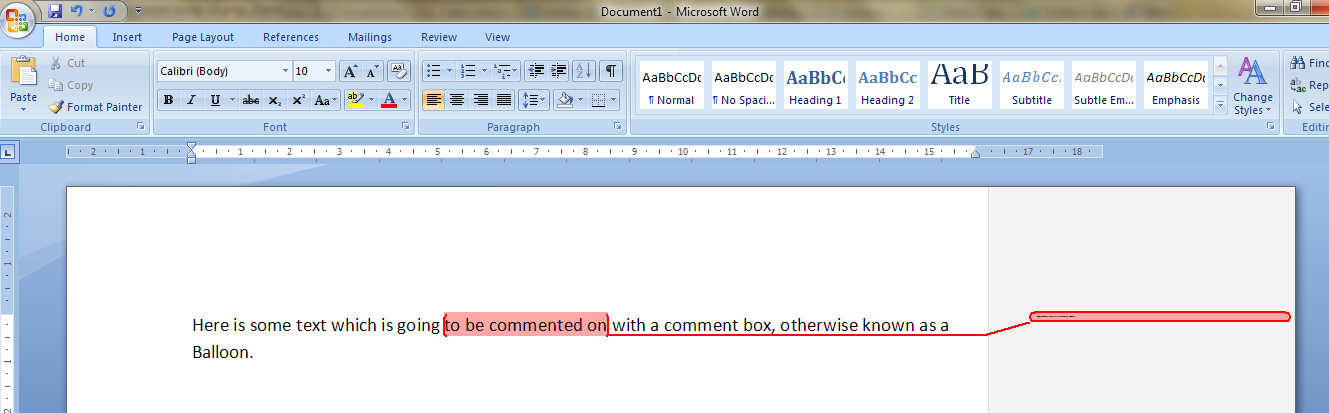
It apparently happens if you’re working with a document originally created in an older version of Word which doesn’t have the requisite Styles set up for comment boxes.  You then work on it in Word 2007 or Word 2010 (this solution works for both!) and the horror happens …

It took me and Matthew longer than it should have to work out what to do, as there didn’t seem to be an easily found solution if you searched for one online – so as an aide memoire for me, for next time it happens, and as a public service for anyone else trying to work out what to do … here’s what you do (now edited to add screen shots).

Note for experts: if you’re already familiar with Styles, note that you need to change the Balloon Text.

What to do if your comment boxes go tiny in Word documents:

Let’s look at what the full horror looks like first of all:

First of all: don’t panic! The comments will have typically gone into Times at 1 point. But there is a way to make them readable again.

Open the document. Don’t highlight anything. Don’t put the cursor into a comment box.

Now you can do one of two things. Either hit Control + Alt + Shift + s all at the same time, or make sure you’re in the Home tab and click on the little tiny arrow at the bottom right of the Styles menu – this will bring up the full Styles dialogue box.

Using either of these methods, you will bring up the Styles dialogue box.
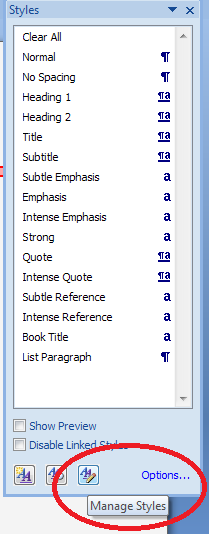
This looks like a very useful dialogue box, but for our purposes you need to ignore all of it except the three buttons at the bottom. Click on the rightmost button: Manage Styles to bring up yet another dialogue box.

We’re not there yet: the sort order shows as Recommended – but you need to click on the down arrow to change it to Alphabetical:

Once it’s in alphabetical order, it’s relatively easy to find Balloon Text (note: not Comment text) and you will see that it then confirms how you have your text set up (blue circle). Click the Modify button

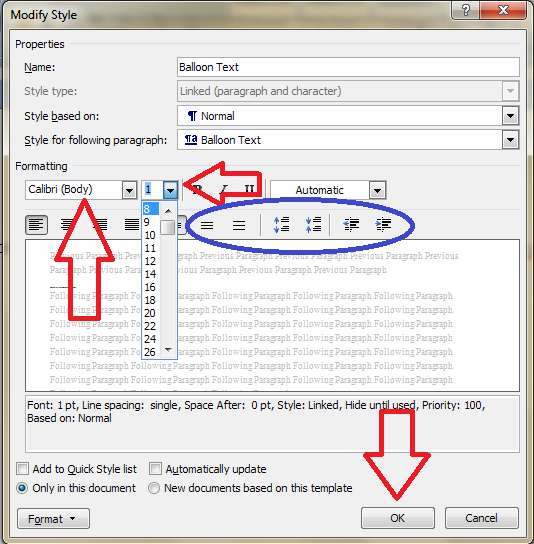
Now you can change your font (which will probably have defaulted to Times) and font size (which will probably have defaulted to 1). You’ll notice lots of other options (blue circle) to change the spacing, etc. – I don’t usually worry about changing those, but this is where they are if you want them – and of course you use this menu to change the styles on headings, normal text, etc., too. Press the OK button, and carry on pressing OK buttons until you get back to your document.

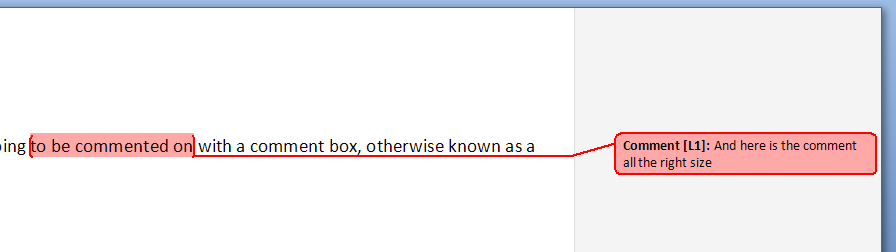
And there it is, all changed:
Save document

Want even more information on customising your comment boxes? Read this article full of everything you would ever want to know!

Related topics: What to do if your comment boxes start running from right to left

Changing the language in your comment balloons

Note that these tips are primarily for Word 2007, 2010 and 2013 for PC. Most of them will work for Word for Mac, although you may find some menus in different places. This is part of my series on how to avoid time-consuming “short cuts” and use Word in the right way to maximise your time and improve the look of your documents. Find all the short cuts here

Do let me know if this has helped you, saved your bacon, etc. – and do share with the buttons at the bottom of this article.


 
343 Comments

Posted by on November 6, 2011 in Copyediting, New skills, Students, Word, Writing


Tags: , , , ,

Yours or your’s, your or you’re?

Yours or your’s?  Here’s a clue. It’s never one of them.

Yours, theirs and its don’t take an apostrophe when they’re describing something that belongs to someone. Just like hers and his don’t.  So, it’s George’s book; the book is his. It’s your book; the book is yours. It’s their book; the book is theirs. It’s the book belonging to the club; it’s its book. No apostrophes.  The only apostrophe that comes along with yours, theirs, his, hers or its, is when it’s stands for “it is”.

So it’s never your’s – it’s always yours. If it belongs to you, it’s yours. Not your’s.  Not their’s.  Not it’s.

You’re means “you are”, like they’re means “they are” – your means “belonging to you”.

If the widget belongs to you, it’s your widget. No apostrophe.

“You’re improving your health, running regularly. Is that your sweatband? Are those trainers yours?”

Short but sweet. Now you won’t forget, will you?

More on apostrophes here.

You can find more troublesome pairs here and the index to them all so far is here.

 
1 Comment

Posted by on November 4, 2011 in Errors, Language use, Troublesome pairs, Writing


Tags: , , ,

What I’ve been up to in October

October is traditionally a quieter month after the student Master’s dissertation rush of August and September, and I have certainly seen a slight drop-off in workflow, although it’s still kept ticking along. I’ve …

Edited some PhD theses – some ongoing, some in their entirety; some large documents and a PowerPoint presentation for one ongoing client (discovering that, even if you can’t Track Changes, you can stick sticky notes all over the slides); quite a few blog posts for a new ongoing client who is not a native English speaker (picking up a lovely reference along the way); and all sorts of business and academic writing for my translator client.

Edited and proofread my usual American magazine’s quarterly publication and the MoseleyB13 local magazine.

Edited two articles for publication, ensuring they conformed to the journal’s style guide.

Set up a coaching relationship with one PhD student, where we talk via email every week about the new work he’s completed in an effort to get his thesis written up this year.

Transcribed interviews for my journalist client, who’s got some cover stories in women’s magazines as well as the usual music magazine pieces, and a new client who presents teleseminars and interviews on writing and marketing your work (learning a lot as I go along!).

And I also …

Ran my fourth Birmingham Half Marathon, with a personal best time!

Wrote some blog posts on starting your own business, including starting a proofreading business, pre-launched my new Libro Newsletter by telling people about it and inviting them to sign up, and placed some more guest posts.

Attended a Social Media Cafe, where I talked through a business problem with my peers – very useful.  I attended the Kings Heath Business Association AGM and will hopefully be helping out on their committee in the New Year, and I went along to the Entrepreneur meetup and met some more lovely, enthusiastic people with great business ideas.

Phew! I’ve also received the 22nd questionnaire response for my Iris Murdoch research project, and this month/December I will be applying to present a paper on it at the next Iris Murdoch Conference and writing up some results!

Coming up …

The Big Decision is coming up now: when to take Libro full-time. Working part-time while running the business is getting tiring, and where I haven’t had to turn any work away, I have had to turn down a few opportunities for networking and other events which could potentially drive some new business my way. I also want to be able to be more flexible for my clients as to when I can do their work, and have time for my partner and my friends! So … it’s decision time this month!

Libro offers copyediting, copy writing, proofreading, transcription, typing and localisation services to other small businesses, individuals and corporations. Click on the links to find out more!


Tags: , , , , , ,

Bare or bear?

I think I’ve seen “just bare with us” while we fix this site, reprint our menus, etc., etc., one too many times – but of course it is a troublesome pair, and not really one you’d want to mix up!  If the company or person asking you to bare with them knew that they were asking you to get naked alongside them, would they be so keen to say it?

As well as being a large, dangerous mammal in its noun form, to bear means to carry, to convey, to support (a weight) and, in the form in which we are encountering it here, to bear means to manage to tolerate (with the negative: “I can’t bear that colour!”) and to bear with someone or something means to be patient or tolerant with. “Please bear with us while we fix this website; in the meantime, here’s a picture of a puppy to look at.”

To bare means, in the language of the dictionary, to uncover a part of the body and expose it to view. We’re bare when we’re unclothed, we might bare our legs in the summer, and we can bare our teeth, which means to show one’s teeth, typically when one is angry. Like when one reads “please bare with us”.

Well, actually, we all know by now that I try to bear with people who make these mistakes, understanding that not everyone’s good at English, or can write well, or spell, or has English as their first language. I don’t ever mean to mock. And I certainly won’t start taking my clothes off next time I read “please bare with us”. Not unless the person behind the sign does it first, of course!

You can find more troublesome pairs here and the index to them all so far is here.

 
3 Comments

Posted by on October 28, 2011 in Errors, Language use, Troublesome pairs, Writing


Tags: , , ,

Lose or loose?

Another suggestion from Sorcha this morning – I really appreciate when people come up with ideas for these, so please keep them coming … (and watch out for Ron Usage and his Wrong Usage, coming soon with those troublesome single words!).

So today, we’re going to look at lose vs. loose. I do see this one a fair bit, although the two words are not really that similar or connected.

To lose something means to mislay it, to forget where you put it down, or to end up without it. “He tends to lose his gloves when they fall out of his pocket”; “I always lose the keys somewhere in the house and I can’t come out until I’ve found them”; “she would go on to lose her fiance in the First World War”.  The past tense of lose is lost. Something can’t be lose, it can only be lost.

To loose something (as a verb) means to set it free, but it isn’t often used. “She loosed the horses into the paddock”. More often, it’s used as an adjective: wobbly, not secure, not firm, not tight. A loose tooth; “This printer cable is working loose and that’s why you can’t print”; “She wore a loose and flowing dress”. The past tense of the verb loose is loosed, but again, this isn’t used much. The more common verb is to loosen – “He loosened his tie as the evening got hotter” and this means to make less tight, rather than to set free, although you can also loosen the horses into the paddock.

“His loose tooth fell out, and he managed to lose it somewhere around the house.”

You can find more troublesome pairs here and the index to them all so far is here.

 
1 Comment

Posted by on October 24, 2011 in Errors, Language use, Troublesome pairs, Writing


Tags: , , ,

Regretfully or regrettably?

Another troublesome pair suggested by Gill – the list she and her husband generated on their trip away is still going strong but I’ll get to the end one day!

So: regretfully or regrettably?  These two look quite similar, but as usual have quite different meanings.

Regretfully means in a regretful manner. Regretful? Full of regret. So you are full of regret: “She walked away regretfully, upset that she had left him sinking into the mud, but with no other choice” (sometimes I do wonder where I get my examples from. All are made up out of my head).

Regrettably means unfortunately. “The mud was regrettably sticky”.

Now … apparently regretfully gets used where regrettably should be used “Regretfully, this branch is now closed” and the dictionary says that “despite objections from traditionalists, this use is now well established” but I think we now know which one to use when, don’t we!

You can find more troublesome pairs here and the index to them all so far is here.

 
2 Comments

Posted by on October 21, 2011 in Errors, Language use, Troublesome pairs, Writing


Tags: , , ,

What can Libro do for you?

What can Libro do for you?

Here’s a handy list of everything that Libro can do for you, to make your life that bit easier and make your words work better …

Libro is all about making your words work, whether the words themselves need tweaking (editing what you’ve written, proofreading and polishing before publication), or writing (from your notes or a chat with you), or changing in terms of location (localisation from US to UK English or vice versa), or changing in terms of medium (turning handwritten notes or a taped interview into a typed document).

Follow the links for more information, but here’s a summary:

Editing  – making sure your words, grammar, punctuation, sentence structure and even your plots and non-fiction books don’t contain gaping holes.  Checking marketing content (leaflets, websites … ), blog posts, letters, reports …

Proofreading – checking that what you’re about to publish in print or online looks right and works as the document you expect it to be – checking page numbering, headers and footers, website links, etc.

(and for the difference between editing and proofreading, see here)

Copy writing – writing text for your book, downloadable e-book or leaflet, brochure, website, letter, press release, advertorial, advertisement, etc. from your notes or a conversation with you.  I can add in SEO keywords to build your presence in the search engines with text that potential clients will want to read, too.  I work with web designers, too – writing content for the websites they design.

Localisation – adjusting your copy to match UK or US English standards – not just the spellings but sentence structures, word usage, etc.

Transcription – saving you hours of time typing up dictations, interviews, meetings; why not produce a transcript of your webinar or training session to offer to your clients as an added extra?

Copy typing – bundles of notes and no inclination to type them up? Scan them in, send them to me and I’ll produce a nice, tidy, grammatically correct and properly spelled document.

I also offer all of these services as an add-on for virtual assistants, meaning they can offer a wider service without having to have all the skills themselves.

Contact me via email or via my contact form.


Tags: , , , , , ,

Dissatisfied or unsatisfied?

I thought of this one yesterday, as I was at my part-time job and we were discussing the disappointment involved when you get a new piece of office equipment and it doesn’t quite come up to expectations (I’ll miss that office … ).  Were we dissatisfied or unsatisfied? Well, in this case, probably both, but there is a difference!

To dissatisfy (yes, that’s a word!) is to fail to satisfy, and if you’re dissatisfied then you are not content or happy; you are experiencing a lack of satisfaction. “I was dissatisfied with England’s performance in the test match”.

The dictionary helpfully defines unsatisfied as not satisfied, but the definition for unsatisfactory does get across the sense of “not good enough”. So if there’s not enough of something, or it is lacking in itself, then you’re unsatisfied (if it’s perfectly good for purpose, but not liked by you, then I’d say that you’re dissatisfied). “The portion of cake was so small that she was left unsatisfied and wanting more”.

“I hate this printer. I don’t know if I’m dissatisfied because it isn’t what I expected from an office printer, or unsatisfied because it never finishes a print job.”

You can find more troublesome pairs here and the index to them all so far is here.


Tags: , , ,

Slander or libel?

OK: confession time. I mixed these two up myself the other day, and used the wrong one.  I was so excited about thinking up examples for another troublesome pair that I didn’t stop and think. Well, nobody’s perfect! And my penance is to write this post.

Both slander and libel deal with telling lies about somebody. But it’s the medium used to spread these lies that makes the difference.

Slander is the crime, or action, of making a false spoken statement that is detrimental or damaging to a person’s reputation.

Libel is the publication in print of a false statement that is detrimental or damaging to a person’s reputation, or to defame by publishing a libel.

So if you say it, it’s slander: if you print it (or publish it in a form that counts as printing it, like on the internet), it’s libel.

Got that? I have!

You can find more troublesome pairs here and the index to them all so far is here.

 
5 Comments

Posted by on October 14, 2011 in Errors, Language use, Troublesome pairs, Writing


Tags: , , ,

Whose or who’s?

This one is a request from Sorcha, and I do find I see this quite a lot, so it’s probably time to feature it. It’s one of those ones like their/they’re/there or its/it’s which people seem to know there’s something odd about, but then take a wild stab in the dark and go for the wrong one. It’s all because of the apostrophe, and that feeling that if something belongs to someone, it should have one, isn’t it. Anyway, there is a rule, and I’m going to explain it now. If you know someone who does this one on a regular basis, do point them towards this blog!

Who’s is a contraction for “who is” or “who has”. If you can use “who is/has” in a sentence, you can use “who’s”. “Who’s that girl?”; “Who’s sat on my hat?”; “Who’s going to volunteer to think up some more troublesome pairs?”; “he’s the one who’s always going on about knitting”.

Whose refers to something belonging to, or associated with, a person, or “of whom or which”: “The man whose hat it was became very angry”; “whose girl is that?”, “whose turn is it?” “The dog whose tail was wagging most was awarded the prize”.

So – who is = who’s. Who owns = whose.  “Who’s sat on that hat? The man whose hat it is will be really angry!”

You can find more troublesome pairs here and the index to them all so far is here.


Tags: , , ,