RSS

Category Archives: Organisation

Working out Return on Investment

dictionary coins watchIn Part 1 of this article I talked about how you work out if an investment is worth making. Now I’m going to look at how you work out what the ROI (Return on Investment) is for something you’ve bought, and in the final post I share some examples from me and some other people about what’s worked for us – and what hasn’t.

What is Return on Investment?

Return on Investment (ROI) is what you get out of something as compared to what you put into it. A straightforward example is if you invest in some stocks and shares. If you put in £10,000 and get £1,000 back on top, that’s a good ROI. If you put in £10,000 and get back £8,000, not so good.

It’s not quite that simple if you’re looking at your own investments, though.

Time / money / effort

Investments and their returns can be subdivided into several categories, for example, time, money and effort.

Investment:

  • Time: You might invest your time in learning a new skill or trying out a new tool, or writing your web text yourself.
  • Money: Lots of products and services and memberships cost money to buy. Even if you’re bartering,  there is still a “cost” involved, even if you’re paying your proofreader in falafels!
  • Effort: I’m including emotional/psychological factors here. You might put a lot of yourself into going out networking if you’re shy and would rather stay at home. Chasing late invoices can be full of effort if you hate hassling people for money. Working part time and running your business part time can involve a huge emotional and psychological investment, as can building relationships with your clients.

Returns on Investment:

  • Time: Do you save your time by using a new product or by out-sourcing? Your time is also money, of course, but there is only so much time in the day, or week, or month, and you should really be concentrating on doing the core tasks that only you can do, whether that’s making your jewellery, editing novels or selling widgets.
  • Money: If you streamline your production line with a new machine so you can make and sell more items per day, or get your invoices paid on time and improve your cash flow, or you buy a tool that makes your hand-made cards look more professional, then whatever you’ve done has saved you money, or made you more money.
  • Effort: If you hate doing something and you can pay someone to do it for you, or you want to branch out into a new area of work that you find attractive and interesting but need to do a course to get into it, or, indeed, you’re tired of the day job and know that by working hard on your business you can move away from it and gain a more free and flexible lifestyle, then those all save you effort or bring you an emotional gain in the long term.

These factors can inter-relate, so you might get something like this:

  • I spend MONEY on an accountant and she saves me MONEY in terms of the tax I pay
  • I spend TIME setting up automated invoicing systems and save myself TIME every month when I run my invoices
  • I put EFFORT into networking and save EFFORT in getting new clients in other ways I don’t like to use, like cold-calling
  • I spend MONEY on an accountant and she saves me time working on my accounts
  • I spend TIME setting up automated invoicing systems and make more MONEY because I’m more efficient, and save EFFORT tracking down invoices and chasing up late payers

And of course, you can have negative or neutral returns on investment, too:

  • I spent MONEY on paying to advertise on this website, but I’ve never directly made any MONEY from it (referrals can be tricky to work out as people sometimes see your name a few times before they buy, but if you pay for membership or an ad you should be able to see some direct worth coming from it)
  • I invested lots of TIME writing my blog but no one looks at it so I can’t be making any MONEY from it and if no one reads it and I never get any comments so I don’t get any emotional (EFFORT)  output either
  • I made MONEY making these rip-off teddy bears but I feel awful that I went against my principles

You get the idea.

So, is it worth it?

An investment, whether it’s in a product, a service or something less tangible, is only worth it if you get more out of it than you put in.

This can be very subjective. If you hate doing your bank reconciliation, you might be happy spending more on an accountant to do it for you than your friend, who quite likes doing it. If you join a professional association but get no business, kudos, support or fun through it, then it’s not worth paying those fees next year – but that can be very different for your colleague at a different stage of her career, as we will see.

So, it’s a question of sitting down and looking at what you’ve bought, and working out whether the return on investment, in terms of money, time or less tangible factors is worth it. You can do this in advance, too, for example “I need a new computer, it will cost me money but save me time recovering from crashes and increase my income as I can do more work more efficiently”, but you MUST also do this in arrears, rather than spend-spend-spend and never tot up the benefits.

Next time I’ll be talking about the investments I (and some other people) have made, which have been worth it and which have not.

RELATED POSTS:

How do you know if it’s worth investing?

What is worth it for me?

Interested in finding out how I made the transition from part-time to full-time self-employment and built my business safely and carefully? Take a look at my new book, out now!


 
6 Comments

Posted by on May 23, 2013 in Business, New skills, Organisation


Tips for coping with writing up a PhD

mugsI have worked with many PhD students and have several friends who are in the middle of the process at the moment, or about to start off (exciting!) so here are some top tips for how to cope with the dreaded end stage: writing up, gleaned from my experience over the years.

Think of this like a chat over a cup of tea. I’m here to help, to reassure you that everyone goes through the same stuff – and that you WILL get through it.

Yes, it’s difficult, so don’t beat yourself up

Not everyone gets to do a PhD. It’s an achievement to get onto the course, it’s an achievement to gather all your data, do all your literature review stuff, grapple with statistics … and then start to write it all up.

Hopefully, nobody said it would be easy. Because it’s not. But if it was easy, everyone would be doing it! A big achievement like a doctorate isn’t worth it if there isn’t a struggle. No one’s goes smoothly, even if they say it is. I have worked with lots and lots of PhD candidates. Even the most organised and seemingly perfect person has underlying panics, lost texts, confusions, chapter sections that just won’t go right …

If you accept that it’s difficult, that it’s going to be a struggle, that it’s a major achievement you’re aiming at, you can get your head down and bite away at chunks of it until it’s done.

Everyone goes through the same stuff

I thought this one was obvious, then I realised that not many people are privileged to work with and know so many people starting off on their research career. Almost every time I tell a student that what they’re going through is what everyone else goes through, they’re incredibly relieved.

  • It’s not just you
  • Everyone gets through it
  • There is normal life at the end

It’s a bit like when I’m doing the Birmingham Half-Marathon, which I do every year. At a certain point, around Mile 10 (of 13), you start to look around and see the pain, slight sicky feeling and effort etched on everyone’s faces. But then you see the finishers walking back down the route with their medals and silver foil cloak things and you know that the end is in sight!

You will experience this

From my experience with PhD students, I can pretty well guarantee you will experience one or more of these phenomena:

  • You will get quite a lot fatter or quite a lot thinner
  • You will get paler and a bit bug-eyed. This is because
  • You will go outside less and less
  • A frown will start to etch itself on your forehead (this will go)
  • Your hair will get really long (boy or girl. Haircuts? No time! I could write a paragraph in that time!)
  • You will eat odd things
  • At odd times
  • You will get no sleep and wake up tired
  • Whenever you get a slight break (you’ve handed in a chapter!) you will sit down and fall asleep
  • You will make excuses not to see friends
  • You will see friends and end up in a frenzy of self-flagellation about not being at your desk
  • You will wake up with heavy eyes and a feeling of dread
  • Everything about the entire document will be wrong
  • You will sit down and be unable to write anything
  • You will feel like your supervisor either hates you or pities you so much – either way, they’re sending you coded messages not to continue via the comments they make (they’re not)
  • You will feel that your supervisor doesn’t care / understand (they do: they’ve seen it all before so they’re not panicking because they know you can get through it)

I can guarantee you that everyone in the whole world of research experiences many if not all of these phenomena. You are not alone!

What can you do?

This is going to sound boring, but when I tell people to do this, and they listen and do it, it does, honestly, make it better.

  • Eat as healthily as you can. Accept that offer of a casserole or a vat of soup from your housemate or friend. Take an evening to make up batches of good sauces that you can freeze and re-heat. Keep healthy snacks around.
  • Take breaks. No one can work for more than about an hour solidly without needing to refocus their eyes, get up, stretch, and think about something else for a few minutes. This will NOT eat into your writing-up time: it will make it more productive. Every hour, stand up, stretch, look out of the window.
  • Get outside – at least once a day, in the daylight. Even if you just go into the garden and jump around a bit – but preferably get off the premises and go for a walk around the block. Again, this will NOT eat into your writing-up time: it will make you more productive.
  • Take some exercise. If you are a runner or a gym bunny, keep it up, even if you have to do shorter sessions than normal. This is not the time to take up a new sport or activity, but even a good, brisk walk is great. You need to keep your body active as well as your mind. This will help you sleep better, too.
  • Give yourself a treat. Once you’ve finished a chapter or achieved something specific, have a chocolate bar, a read in the bath, an evening off. Simple things can mean a lot at this time and really help.
  • Don’t just start at one corner and work your way round. Oh, hang on: that’s ironing a shirt. Anyway, have a plan for how to write up, don’t just start at the beginning and try to write it straight through. Set up the headings and fill bits in as you go, sure, but have those headings and structures in place so you can do that (see my post on top tips for dissertations and theses for more on this).

These seem both dull and obvious, but they are obvious because they work. They work in all sorts of contexts, actually: they’re quite similar to my Home Working Rules, for example. But when you’re concentrating on a big project, you do need to be reminded of these!

No one is superhuman, no one can just sit down and write the thing, and the more you look after yourself, the more you will get done.

Get help

It’s not weak to ask for help. If you need help, ask. People will be happy to help you, and for some of this stuff, you can help yourself, too.

  • Your supervisor – if you’re really struggling or panicking, talk to your supervisor. They might act like they’ve seen it all before, but then they have. But they do care about you: they have a professional duty to you, if nothing else, and they can’t help you if you don’t tell them you’re struggling!
  • University resources – the chaplaincy, departmental support services, University support services, services for foreign students, drop in sessions at the Library – use them.
  • Proofreaders and other professionals – if you’re struggling with your writing, whether you are using assistive technology (e.g. dictating rather than typing), have issues with dyslexia, or are writing in a language that’s not your native language, there are people who can help you. If the issue is to do with your need for technology or extra support, you may be able to talk to your department about defraying part of the cost. Note: research this carefully, try to make sure you’re talking to the real person who’ll be working on your document, and get references and examples. People like me won’t look down on you: even if English is your native language, you’re fluent and have no issues it’s easy to make mistakes when you’re mashing sentences together and mixing things around. We’re here to help.

In addition, it’s worth setting up the following at the beginning of the writing up process and during the first stages.

  • Know how to use Word – I can’t say this enough – if you don’t know how to do these things as a minimum, find out before you start writing up. You do not want to be in a big pickle about this at the end of the process when you’re rushing to hand it in. I talk about lots of these in my handy Word tips blog posts and there are lots of other resources around, too.
    • Setting up headings levels
    • Automated contents pages
    • Tabs and margins
    • Page breaks and section breaks
    • Placing images in text (if you have images or figures)
    • Tables
    • Spell checking
    • Track changes (if you are going to get the document proofread)
  • Get used to saving your work regularly
    • Press that Save button all the time. Better to save too much than lose it
    • Make multiple back-ups – on a pen drive or whatever. Save the most up to date copy each time
    • Version control – if you want to keep previous drafts, number your versions so you know which is the most up to date, which has been checked by your proofreader, etc.
  • Sort out your referencing. I have a post on this for you to read. Whatever you do:
    • Keep a note of what you refer to
    • Use a notebook, Excel, Word, a specific referencing system – but keep it all in the same place
    • Record ALL the information – book publisher details; journal page numbers
    • If you’re unsure of how to reference something, do a Google search and find out how others have done it (this particularly applies when you can’t tell which is the first name and surname of an author – easily done!)
    • Find out what referencing system your department uses and learn about it now, not right at the end. You should be given information on this at the beginning of your course. If not, talk to your library rep or supervisor
  • Make a style sheet for yourself. Stick it all down on a note pad or Word document. This seems like a fussy thing to do now, but it will make everything consistent and save you having to decide each time. If you don’t use a proofreader, this will make your examiners exclaim over your tidiness and organisation. If you do use a proofreader, it will save them (and you) time.
    • Decide what kind of spellings you’re going to use (ise / ize).
    • Decide how you’re going to number figures and tables (1, 2, 3 throughout, or 1.1, 1.2, 2.1, 2.2 per chapter – I recommend the latter)
    • Decide how you’re going to number headings if you decide to do that
    • Decide how you are going to refer to common words and phrases – initials with a key at the beginning?
    • Decide what you’re going to capitalise
    • Decide if you’re going to use footnotes or in-text citations
    • Decide how you’re going to format longer quotations and make a note (e.g. 2 cm left and right margins, italics)

You can do it

If you’re at writing up stage, you will get there. I admire you, and so do lots of people. Remember …

  • It’s not easy but no one finds it easy
  • Everyone goes through the same stuff
  • Get outside
  • Seek help when you need it

Good luck!

If you’ve found this post useful, please share it using the buttons below, and/or make a comment – I love to get feedback about my posts. Also, if there’s something I haven’t covered here or a top tip for this stage, do add a comment. Thank you!

You might find these useful: Top tips for students and Word users

 
7 Comments

Posted by on December 19, 2012 in New skills, Organisation, Students, Word, Writing


Tags: ,

Top Ten Tips for Working with Clients

As a freelancer, I’ve spent three years (so far) learning how to deal with lots of different clients. I hope that these tips will help you get the most out of the relationship. If you work with freelancers, you might find this article useful, too.

1. Communicate

This is the top tip, and comes into many of the other sections. Be clear about what you do, how much it costs, and when you can do it. Communicate the way in which you work to your client up front. Keep on top of the project and let them know how it’s going. Tell them what to expect, then fulfil that expectation and communicate that you have done so.

2. Manage expectations

It’s always best, in my opinion, to promise low and deliver high. I always add a little time when I’m offering a deadline, and almost always exceed expectations that way. If you are going to miss a deadline, let the client know – this only usually happens when it’s the client who sets the deadline. I’ve only missed one deadline, by half an hour – but there was good reason for it, and I let my client know in advance.

If you’re undertaking a project for someone and they’ve not used a freelancer before, explain the process and what they can expect from it. If you need to tell clients about your terms and conditions, send those along with your initial quotation. If an urgent job will cost more, tell the client in advance.

If you can’t offer the service you would want to offer, a “no” said honestly and in good faith is better than a “yes” that isn’t meant. Your client will respect you more for it.

3. Keep to deadlines

If you promise to return a piece of work to a client by a particular date and time, do your utmost to do this. Work all night if you have set an unrealistic deadline (and learn from that!). When I started freelancing, I found that freelancers have a very bad reputation around this issue. Ignoring deadlines makes you look arrogant at best, incompetent at worst. It’s not hard to plan ahead, and it’s not hard to say no (eventually).

This also applies to invoicing. If I’ve arranged to invoice the client directly after finishing the work, I do so. If they are on a monthly invoice in arrears, they are sent their invoice at the end of the month. If this is a bit much, it’s something you can easily automate or outsource.

4. Treat your client as a human being

Even if your client is a huge faceless entity, you will be dealing with a person at that client. Remember that they’re a human being, with other concerns than you and the project you’re both working on. They may be trapped between you and their own boss or client (I work for several freelance journalists and translation agencies, for example) and may have other pressures. If they’re a student or a new member of staff, they may be unsure as to how to work with you!

5. Inform your client about your availability

If you’ve got a holiday booked, you don’t work on weekends, or you stop at 9pm at latest, let your clients know. When I book a holiday, I send an email to my main regular clients a few months before, remind the biggest ones a month before, put a note in my signature then set up an auto reply on my email. Out of courtesy, I do communicate with them by email when I’m away, but only to remind them I am away!

6. Have backup

For my major clients, I have colleagues who do the same line of work as me and can pick up work if I’m unwell or on holiday, or very busy with a pre-booked job. I also have a list of people I can refer clients on to if I can’t book them in myself.

7. Respect your clients

Professionally and personally. You’re the expert in what you do, but they’re the expert in what they do. Treat them as you would expect them to treat you. Be as robust as you need to be, but always be courteous.

If you feel the need to let off steam about a tricky client or project, please do it privately! I have a private group of fellow editors who I can ask questions and share good and bad days – and sometimes people do make us a bit cross, but just don’t broadcast this in public. It’s not very professional, and it can reflect on you very badly.

You may have specific points with this according to the industry you’re in. I personally avoid pointing out horrible grammar and spelling mistakes on signs and menus in public. Amusing as I find these, a lot of my clients are using English as a second or third language, have issues with their English skills, or are just not very confident, and the last thing I would want to do would be to be seen to be mocking less-than-perfect English.

8. Work with your client’s working methods

You have to be flexible if you’re going to be good at freelancing for different clients. They all have different requirements and ways of working, and my reaction to this can go from noting which transcription clients need a time stamp every 5 minutes and which need it every 10 minutes, to communicating via email, the phone or a face-to-face meeting, whatever the client prefers.

I do impose my own working methods on them to an extent, for example encouraging them to use comments and Track Changes to comment on texts I’ve produced for them. But if they choose not to do that, I’ll work with how they want to work.

9. Share the joy

I have a list of people who do what I do who I will recommend to any clients I can’t fit in. I don’t consider them as competitors – yes, we’re in the same line of business, but everyone gets work they can’t do for whatever reason, and I’d rather have a known person I can send them to, knowing they are likely to do a decent job. This saves clients (particularly students) from getting ripped off, and I think it presents a professional attitude to the prospective client, too.

10. Say thank you

I try to say thank you whenever a client pays me. I also thank them for being particularly good clients – the student who doesn’t automatically “accept all changes” but asks me questions about their English, the writer who’s produced an interesting book … and if a client has a product or service I think is particularly good, I’ll pop a link on my links page here and tell people about their book, service or product. It doesn’t cost anything to say thank you, after all, and it gives your client a great final impression of you!

I hope you’ve found these top ten tips for working as a freelancer helpful. If one has struck you as particularly useful, or you have others to suggest, please comment. And you might be interested in my top ten tips for clients working with freelancers!

Why not have a look at my other tips for freelancers, small businesses, etc. – roam around the right-hand sidebar or click on the links!

 
11 Comments

Posted by on September 19, 2012 in Business, Organisation


Tags: ,

Top Ten Tips for Working with Freelancers

As a freelancer, I come across all sorts of clients and all sorts of behaviour. If you want to get the best out of the freelancers you use, whether you’re a tiny company outsourcing to an accountant and a copywriter or part of a huge tech company with hundreds of freelance programmers on your books, these tips will help you get the most out of the relationship.

1. Communicate

This is tip number one, and feeds into so many others of the top ten. Be clear in your initial communications. Express your requirements clearly. If anything changes: the project, the deadline, the date you can deliver the project to them, your expectations – tell your freelancer. They’re not a mind reader: you need to tell them.

2. Manage expectations

If you commission a chatty, friendly blog post and you get a piece of corporate spin, did you really express what it was that you wanted? Again, freelancers are not mind-readers. A good writer can write in whatever style you want – but they do need guidance. Like a computer, a freelancer will absorb your instructions and produce output to the brief given.

A good freelancer will check what you want, and in some cases will send you over a questionnaire to fill in or have a chat with you over the phone. Use this opportunity.

3. Keep to deadlines

If you promise to deliver a project specification, a document, a set of keys, whatever, to your freelancer, on a particular day at a particular time, then either keep to that agreement or, if you can’t, let them know as far in advance as you possibly can. Everyone has sudden last-minute issues and no one minds that, but freelancers do mind booking in a job, possibly turning away other clients because that time is booked, then no work arriving.

Similarly, if your end deadline changes, keep your freelancer informed, give them the chance to adjust their schedule, and understand if they can’t. Perhaps you’re a journalist and your editor changes when they need that interview write-up – let your transcriber know as soon as possible and show willing to pay an urgent fee or make the deadline as flexible as possible.

This applies to payments, too. Make your company’s payment schedule clear in advance (no – “oh, yes, it’s a 60 day payment schedule; didn’t I tell you?” please) and make sure you pay on time or let the freelancer know if you can’t.

4. Treat your freelancer as a human being

This seems to apply especially in office-type services, such as editing and virtual secretarial services. Several colleagues have commented privately that they feel like some of their clients think of them as a piece of office machinery, like a printer or network cable, and are then scandalised when real life – an emergency, a holiday – intervenes. Just because you can’t see your freelancer doesn’t mean they don’t have a face and a life! (I’m lucky, pretty well all of my clients treat me well and even let me go on holiday occasionally!)

5. Inform your freelancer about your availability

If you’re going on holiday, or you don’t work Mondays, let the person you’ve commissioned know. They might have a question and not be able to get in touch with you. Leading on to …

6. Have backup

Is there someone else in your organisation who could pick up the reins with your freelancer(s) if you were to go off sick or go on holiday? I’ve had situations where my contact at a client’s office has gone out sick, and no one’s been told about the projects I’m working on or when I should be paid.

7. Respect your freelancer

Professionally and personally. They’re the expert in what they do, just like you’re the expert in what you do. You’ve hired them to do a job, so let them do that job. If you feel you know how to do whatever you’re asking them to do, remember that it might be a part of your job, but it’s their speciality. Of course it’s fine to ask questions, but if you’ve chosen right, from a recommendation or by checking out the freelancer’s references and experience, let them get on with their job.

Having said that, I’m pretty sure I’ve typed some terrible mis-hearings into transcriptions I’ve done for clients, but I’ve never (thankfully) seen them laughing about it in public. Don’t make assumptions about their private life – it’s polite to ask if they mind working through the weekend on your project, even if they’ve done so before. I don’t mind working odd hours for my clients, as I make up for it with long lunch breaks with gym sessions and a sit in the garden, but I appreciate it when they realise that I have a life, too!

8. Work with your freelancer’s working methods

Although a good freelancer will adapt the way they work to suit you to a certain extent, there are times when you need to fit in with how they work. For example, if a client needs to comment on a text I’ve produced for them, I request them to do so in Track Changes, rather than colouring in bits of text and writing comments in the text. It’s easier for me to work my way through the comments, saving the client time and money if they are on an hourly rate, and I will always take a moment to explain how to do it.

9. Share the joy

If someone does a good job for you, offer them a reference or testimonial. Tell other people about their services. I get most of my work through recommendations, and it’s a great way for clients to get freelancers they know will be good, and freelancers to get clients who are likely to go with them because their friend or colleague has recommended them.

A freelancer who knows you’ve recommended them on to your friends and colleagues will be more loyal to you. They’ll want to do a good job for you, so you recommend them again!

10. Say thank you

On the day I wrote this post, I’d been up since 5.30 am to turn around a very urgent project for a client. What really did make that worthwhile? The client coming back to me to say a big thank you. It really does matter; it doesn’t take a moment, and it cheers everyone up.

I hope you’ve found these top ten tips for working with freelancers helpful. If one has struck you as particularly useful, or you have others to suggest, please comment. And you might be interested in my top ten tips for freelancers, too!

Why not have a look at my other tips for freelancers, small businesses, etc. – roam around the right-hand sidebar or click on the links!

 
4 Comments

Posted by on September 12, 2012 in Business, Organisation


Tags: ,

Keep an eye on your stats

Do you ever look at your blog or website statistics? If you don’t, I’m going to show you why you should. If you do, do you get all you can out of them? Do you look at them actively or passively?

Note: this post uses examples from the WordPress.com statistics pages, because that’s the blogging/website platform I use. But all of the standard blogging sites, plus Google Analytics, Statcounter and other analysis tools will offer you similar information, with similar headings.

Why should I look at my statistics?

Looking at your statistics can help you tailor your blog to match what your readers want, and will also alert you to who is talking about you and where they are doing so. You can also measure the success of your attempts to build your audience through posting on social media and other blogs and sites. Here are some of the things you can find out …

  • Which posts or pages are people looking at a lot … and which ones are they ignoring?
  • Is there a kind of post that people are particularly interested in?
  • When do people read your posts?
  • How do people find you (social media, web searches … )
  • What search terms do they use?
  • Where do your readers go next – what links do they click?
  • Are people finding your site via other sites and blogs?

How do I find and view my blog / website statistics?

Usually you’ll have some kind of button or menu option called Statistics or Analytics. On WordPress, you will find a Stats option when you go into your blog, or you can click on the bar chart at the top of the screen. Once you’ve found them, you’ll find a screen something like this:

Now we’ve located our stats, let’s look in more detail about what they can tell us.

How do I tell how many times my blog posts have been viewed?

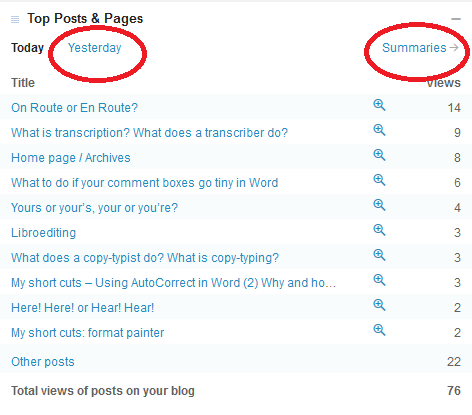
One of the important ones to look at is your most popular pages. We’re looking at one day here, and I can see that my blog post on on route or en route is, yet again, the most popular.

But I can also see what other posts and pages have been popular (and if I click on yesterday or summaries I can see previous days’ stats, while if I click on the magnifying glass next to the number, I can see all the views for that post). This is useful, as I can tell how I’m doing in the search engines, if it’s an older post, or whether my alerts are doing well, if it’s today’s post going up the ratings.

How do I tell how people have found my blog or website?

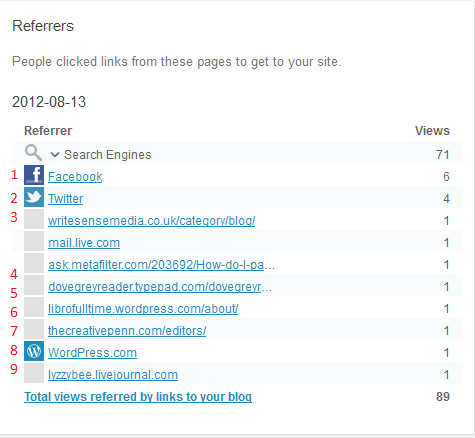
It’s very useful to know how people are finding your blog. You should have a section of statistics called something like referrers or referrals. Here are mine for a particular day.

You can glean all sorts of information from this. At the top you can see I get most of my hits from search engines (over 70 of that day’s hits so far), then Facebook (1) and Twitter (2), then a variety of websites and blogs that I’ll go through in a minute. This has changed – when you’re new to blogging, you’ll get most of your hits from Facebook and Twitter and other social media, as your friends will be looking at your posts and you will be promoting them on social media. As your blog gets indexed on the search engines, results will start showing up from them.

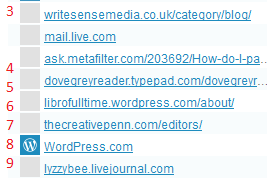
Looking at the pages from which your readers have come can be SO useful. Here’s what I can learn from this one:

3 comes from one of the people I’ve featured on my blog blogging about my feature herself – a great link-back that Google will like indexing. 4 is from an answer I gave (with a link) on an expert site. 5 is from a comment I made on someone’s blog. 6 is from my other blog. 7 is from a list of editors a client added to her website (very valuable). 8 is from WordPress itself, probably someone surfing through tags, and 9 is from my old LiveJournal blog, where I post links to this blog/website.

All good stuff, and I can say thank you to people who have sent readers my way, or even find out when they’ve done so (all these links can be clicked, so I can see exactly what people have said). Now, what about those search engines?

How can I find out what search terms people have used to find my site?

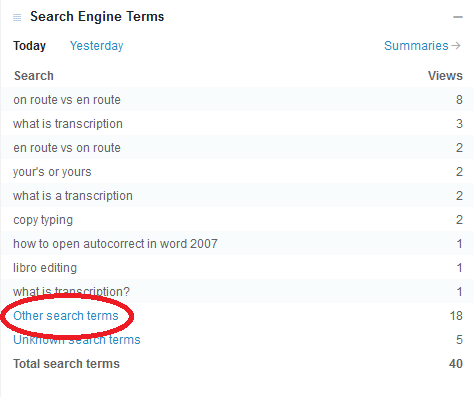
You should have a heading like Search Terms somewhere on your stats page. This offers a world of exciting information.

Clicking on Other search terms will give you the rest of the terms people have searched on – that they will only have tried once (or only one person has tried).

For a start, you can see exactly what people are searching for. It might be useful to change the wording on your blog posts to get further up the search results for a popular term. It’s also worth searching for these terms yourself and seeing where on the Google results page they appear. Another useful point is it can give you ideas for future blog posts. I noticed that someone had found me while searching for Autocorrect, which I had mentioned in a blog post. So then I wrote a post on Autocorrect itself, which has been quite popular.

It can also be quite amusing to see what people search for. Someone once came through to my blog having searched for “persuasive piece on children believing in the tooth fairy” – I think they may have been disappointed (they found me because I mention the tooth fairy in an example sentence explaining a word definition).

How can I see where my blog readers are?

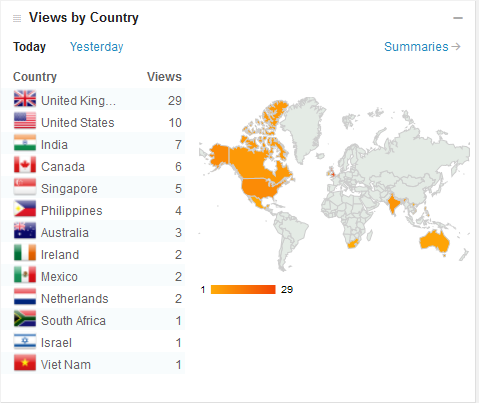
On WordPress you can see a rather nifty world map with the countries from which your visitors have come from highlighted.

This is more of a fun distraction than a useful tool, to be honest, but if you discover an anomaly, for example if you’re in the UK and you get a lot of visitors from Brazil, you could consider tailoring some of your blog posts for this market. I get a lot of international visitors, so I’m going to make sure I talk about my work with non-native speakers of English soon.

Is my website traffic increasing? What did I do to make that happen?

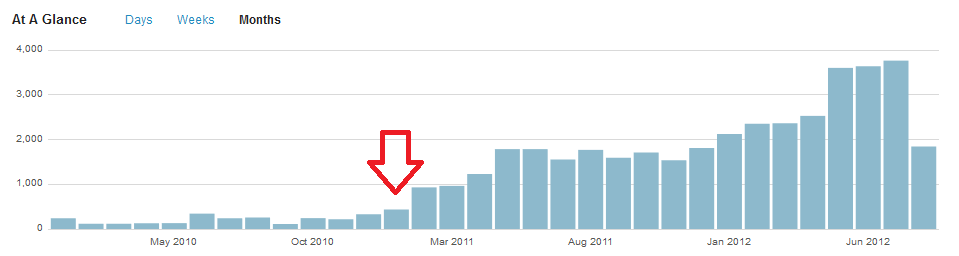
As well as today’s data, you can usually see a month or year’s worth, too. If I look at the traffic on my website and blog over time, I can see that it started increasing at the beginning of 2011.

What did I do at the time of that red arrow? Started writing this blog!

Do people read my blog more at the weekends?

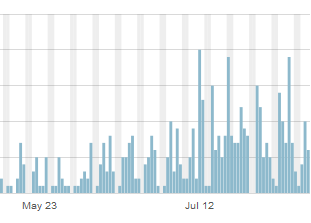
Looking at your daily traffic will show peaks and troughs. If your blog is more popular at the weekends, it might be good to post new content then. If I drill down into one of my blog posts, the ever-popular “What do I do if my comment boxes go tiny in Word?”, I can see that it’s not read very often at the weekends.

This says to me that office workers are looking for and using this post, so I can make sure I post more for that kind of audience and save other new posts for the weekends.

Where do my website visitors go when they leave my site?

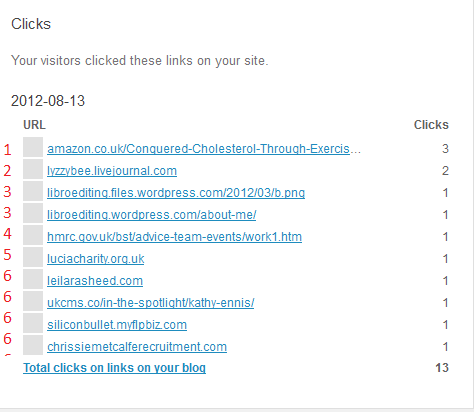
This is usually found under the heading Referrals, or maybe Click-throughs. Here’s a good representative one of mine from a few days ago:

Looking at clickthroughs from my website

You can see that the click-throughs fall into a few groups. 1 is my ebook, which I have linked to in a blog post and on the site itself. Hooray – my PR campaign is starting to work! 2 is a click to my Livejournal blog, linked to on my website. 3 is a pair of pages on this website, filed under my old url but I can see people are navigating around the site and sticking around. 4 and 5 are both links I have on blog posts; 5 is also on my references page. And all those marked 6 are websites of people I’ve featured on my blog, showing that I’m helping them get some traffic, too.

So there we go. Look at those statistics, whether you’re using WordPress or another host for your blog. And look at them actively: think about what they mean and how they can help you to find out how to tailor your blog to your audience and drive more traffic to your blog or website.

If you’ve enjoyed this post, please click on one of the share buttons below, or leave me a comment. Especially if you’ve had any amusing search terms recently!

 
5 Comments

Posted by on August 17, 2012 in Blogging, Business, New skills, Organisation, Writing


Tags: , , , ,

Is it actually worth the stress?

I was chatting to a business associate the other day. He’s enjoying his high-powered, high-stress and, let’s be honest, high-earning position, managing all sorts of change, rushing around here, there and everywhere … or he thinks he is.

Actually, he’s plagued by all sorts of niggling illnesses, that have become worse. Nothing that’s putting him in hospital, but things that are affecting his quality of life, outside work more than inside, and can’t be ignored.

So, is it worth the stress?

Downsizing your life, downsizing your stress levels

I can claim to be a bit of an expert on this, from personal experience. Having been doing a management-level, fairly demanding job in London, when we moved to the Midlands I was determined to have “a job”. In fact, we both agreed we would indulge ourselves for a year, M going back to post-graduate study and me looking for a basic level library job.

I had a bit of trouble, as a qualified librarian, getting a basic entry level job, but I did in the end. Lots of people said I would get bored; my managers tried to encourage me to apply for promotions I didn’t really want. I’d been up the corporate ladder, and I knew that it suited me at the time to have “a job” rather than “a career”, something that would pay the bills but allow me the resources and energy to enjoy my new life in a new city.

So that’s what I did, and I was perfectly content for a good few years. In fact, having that lower-stress, lower-responsibility job allowed me to start up Libro and develop my own business.

Different career paths for different life stages

Now, I could have quite easily chosen to progress through the corporate ranks again, gone for those management jobs, gone for the higher salary, which is always a consideration, isn’t it. But I decided to go this alternative route, and set up the business.

But I did that in as stress-free and risk-free a way as I could (see my article on not taking risks for more information). I’d decided it wasn’t worth the fear of going full-time at the beginning, the stress of having to scrape around for money to live on, etc. Instead, I lived very frugally, scraped together money to live on in advance, and launched Libro full time in January 2012.

Now I have a satisfying job, where I’m responsible to myself and my clients, no bosses, no employees. I earn more than I’ve earned in any of my corporate jobs, and, having identified during my career that I like to work in this way, that I don’t like office politics, being a manager, etc., I can honestly say that, even running my own business where every sick day means income and jobs lost, where I do sometimes put in an 11 hour day, but where I can claim what I know makes me happy:

  • responsibility for myself and my clients
  • no employees
  • no office politics
  • flexibility to juggle my day to fit in friends and exercise

I am as stress-free as I can be. And I have no stress dermatitis, no IBS, I’m fit and healthy and enjoying life.

I’m not boasting about this: it’s taken time to know myself and know what I want, and it’s taken hard work to get here, which hasn’t always been the most fun I’ve ever had. But I’m in my own space now, not trying to jam myself into an inappropriate role, and I’m very much happier as a result.

Know yourself and make the change

The photo at the top of this post? That’s butterflies emerging from their chrysalises. Whether what’s confining you is stress or something else, such as lack of the confidence to break free, surely it’s worth trying to achieve your potential and seeing what you can do … if you just break out of the chrysalis.

My advice to you, if you think you’re stressed, or you don’t think you’re stressed but your body does …

  • Think about what you REALLY want. Is the money worth it? Yes, we all need money to live on, yes, economic times are perilous, but if you can save anything ahead of changing your lifestyle, do it.
  • Think about what you enjoy, what you need, and work towards claiming it.
  • Talk to close friends or colleagues. How do they see your stress levels? What solutions can they offer?
  • Talk to a reputable life coach or careers counsellor. What ideas do they have?
  • Mind-map, brainstorm, go walking for a week, whatever it takes to give you space to think this through.
  • Seek mentors and role models. People have told me my blog posts have helped them on their path to self-employment (hooray!) – look around for people doing what you might fancy doing, and drill down into how they did it.
  • Think laterally. Do you really want to be an architect, or do you want to work for a housing association? Do you really want to be a social worker, or do you want to train as a counsellor? Could you work part time while you pursue your aims?

My “career path”, from corporate ladder-climber to “just a library assistant” to successful small business owner shows that you can step down, sideways, whatever. I’m not a risk-taker, I’m not particularly well-off, and it hasn’t always been easy. But it can be done.

Good luck!

 
17 Comments

Posted by on May 16, 2012 in Business, New skills, Organisation


Tags: , ,

New ways to navigate the resources on the Libro blog

I’ve built up loads of information on all sorts of topics on this blog over the past few years, so I thought it was time to put together a resource to help you find what’s most useful for you. I ran a poll, people said yes, so I did it!

I put this new guide together about a week ago, and it’s proved popular so I thought I’d let you know about it quickly.

I’ve put together one simple resource guide with three main sections:

  • Resources for business – these include posts on how to set up a small business, things to do to grow your business, hints on networking, motivation, etc.; then some information about tax and finally an additional link to my small business interviews (note that business formation and tax posts are relevant to the UK although the rest of it will translate anywhere)
  • Resources for students – how to write an essay or dissertation, plagiarism and quoting sources, and lots more to come
  • Resources for Word users – all sorts of tips and hints to make your documents more consistent and easy to write, change and navigate, including tabs, margins, headings, contents pages and more obscure matters like how to put text in alphabetical order. Also includes a few notes on PowerPoint and other applications,

The whole resource guide offers a good way to find out what you need to know – do have a look and a play around, and let me know if you’ve found anything particularly useful!  I’ll be adding both resources and entries to the resource guide as I go along, of course. Watch this space …

And of course, we still have the index to the Troublesome Pairs and index to all the Saturday Small Business Chat posts.

I hope you enjoy the resource guide and indexes, and the resources they guide you to!


Tags: , , , , , , , , ,

Income tax payment on account

Special guest Emily Coltman

Business is booming for me and Libro – and my friends and family are probably expecting me to start splashing around some of that hard-earned cash now I’m full time and earning well, after those lean start-up years. But wait! No – just when you’d think I’ll be booking that round-the-world cruise (we can only dream), in fact I’ll be giving the tax man over half of my income from Libro over the coming year. Edited to add: this is what actually happened when I submitted this year’s tax return.

It’s something called “Payment on Account”. I’m lucky: I already knew about it and so I have been saving up so I have enough money to live on. But if your business is doing well (and you only have to have a tax bill of £1000 to get into this situation, so not even THAT well), you need to be aware of this issue and make sure you have the money to hand.

I thought I’d better get someone official to explain all this, and the lovely Emily Coltman has obliged. Emily is Chief Accountant to award-winning software provider FreeAgent.com. Read on to find out all about tax payment on account.

Payments on account

Did you know that if you’re a sole trader, or in partnership, you sometimes have to pay one and a half year’s worth of income tax and class 4 National Insurance all at once?

This is because if your tax and NI bill is more than £1,000, and less than 80% of your income is taxed at source (like employment income, where tax is taken off before the money is paid to you), you have to make “payments on account” to HM Revenue & Customs (HMRC).

Calculating payments on account

Maria is a self-employed beauty therapist.  Her tax and NI bill for the year to 5th April 2012 (the tax year 2011/12) is £1,200.  This was her first year in business.

That £1,200 will be payable to HMRC by 31st January 2013.

But that’s not the end of the story.  Because Maria’s tax and NI bill is over £1,000 and none of her income was taxed at source, she must make payments on account for the tax year 2012/13.  These each amount to half of her bill for 2011/12, and will be payable by 31st January 2013 and 31st July 2013.

So by 31st January 2013, Maria must pay £1,200 for her 2011/12 tax bill, and £600 on account for 2012/13.  That means she has a whopping £1,800 to pay in total – one and a half times her tax bill for 2011/12.

Maria must also pay another £600 by 31st July 2013.

When the actual tax and NI due is known

What happens when Maria works out her actual tax bill for 2012/13?

If she’s overpaid, HMRC will give her a refund, but if she’s not paid enough yet, she must make a balancing payment.

Let’s look at that.

Refund

If Maria’s tax and NI bill for 2012/13 was actually £1,100, she’s already paid £1,200 on account towards that, £600 in January 2013 and £600 in July 2013.  That means she’s overpaid £100 which HMRC will refund her.

She must then make her payments on account for 2013/14, which will be £550 each (half of £1,100) and will be due by 31st January 2014 and 31st July 2014.

Balancing payment

But if Maria’s tax and NI bill for 2012/13 turned out to be £1,500, she’s already paid £1,200 towards that but still has another £300 to pay.  This is called the balancing payment and is due by 31st January 2014.

That means that on 31st January 2014 she must pay £1,050 (£300 balancing payment, plus her first payment on account for 2013/14, which is £1,500 / 2 = £750).

Can payments on account be reduced?

If you’re reasonably certain that your tax and NI bill for the following year will be less than the payments on account you’d make, you can apply to HMRC to reduce your payments on account.

Be warned, though, that if you reduce them too far, HMRC can charge you interest for late payment of tax.

HMRC should send you a statement of account explaining what you have to pay and when, but if you’re not sure whether this is correct, always check with them or with your accountant.

Emily Coltman, Chief Accountant to award-winning online accounting software provider FreeAgent, is a very unusual Chartered Accountant – she is fluent in plain English! Emily has been working with small business owners for twelve years and is passionate about helping them to escape their fear of “the numbers”.  She believes that equipped with the right tools anyone can learn to look after the finances of a small business. She is also a keen advocate of tax simplification, especially in the case of VAT.
Emily is author of two e-books, Finance for Small Business and Micro Multinationals. Web: www.freeagent.com
Twitter: @dialm4accounts
Mobile: 07857 162104
Office: 0131 447 0011


Tags: , ,

On feedback

Feedback is an important thing. Without feedback from the world around us, through our senses, we wouldn’t know where we were, what we were doing or where we were going. In business, without feedback from our clients and prospects … well, we wouldn’t know where we were, what we were doing or where we were going!

There are two important sets of feedback we should all try to gather as we go through our business life, whether that business is a one-person enterprise or a multinational company.

Customer feedback, aka references and testimonials

Whenever I complete a job for a new client, along with their invoice I have some text I send them which includes a request for a reference or testimonial, if they are happy with my work. I used to link to my Facebook page where they could add their own reference, but since that feature has been removed, I now just provide a link to my references page where they can see what other people have said about Libro’s services.  I don’t get one from everybody, but when I do, I make sure I put it up on the references page, first in the “new” section at the top of the page, then when I add some more new ones, I move the older ones down into their categories. I arrange them into categories so people can find work like theirs to look at, rather than just having a jumble of stuff on the page – and I highlight important phrases to break it up a bit. By the way, sometimes I hear back from someone weeks after I asked. I never hassle for a reference or remind someone, though, as I feel that would be a bit pushy.

So how do I use these references? First of all, I put a little announcement up via social media when I get a new one. Hopefully people will pop over and have a look. This has a few benefits: people will see I’m doing well and be reassured that I’m a viable business to work with; people will see that I do a good job; people might see that I work in a different area to the ones they know about (I have diversified my services along the way so some people I met early in the life of Libro may still only know me as an editor) and then have some work they can put my way or someone they can recommend to me.  Obviously, having the references there means that I can direct people to them if they enquire about my services or ask what I can do for them. And quite a few companies I work with have asked for a CV – having taken some advice from peers, I put together CVs for my different work areas, using the references I’d collected but adding more detail about the kinds of jobs I’d done for the clients.

As well as using my own references page, I am on a few advertising sites which have references – and of course LinkedIn, which has a recommendations feature. I’ve had to be a bit more blatant than I might wish to be in asking people to add references onto these – and I usually only ask regular clients with whom I have a good, ongoing relationship – but no one has minded so far, and it’s helped build my LinkedIn profile and my profile on other sites.

So I make these references work for me – and I am convinced they help me when people are considering whether to use my services.

As an additional point, if the person giving me the reference has a website, I’ll pop a link to the site at the end of my reference. That’s a Google-pleasing link back for them and a touch of generosity on my part that they might remember for next time!

Oh, and if you’re building up your business and doing bits of work for free, make sure you make it a condition of your doing the work that the client gives you a reference. People actually value something more if they have to pay for it, and ‘paying’ by giving you a reference gives you that kind of relationship, plus you have something useful to add to your references page!

Market research

The other kind of feedback that’s vital for businesses large and small, young and old, is market research. You may have done this in the initial stages when you were seeing if there was a potential market for your goods or services. But it’s important to keep checking that you’re on the right track, that you know what your clients and prospects want. I’ve tended to do this myself for my blog rather than for my business as such, although I’ll look at that as I go along. After I’d been running this blog for 6 months, I put up a quick survey asking if I was posting too frequently/infrequently, posting about the right kinds of subject, and whether I was alerting people about the posts in the right way. Actually, in this case, the results I got pretty well balanced each other out: for everyone who thought I posted too much there was someone who thought I could post more, and a majority saying it was just right, and for everyone who was bored by my monthly updates on what I’d been doing, there was someone who said that was their favourite bit! But at least that told me I was on the right track, and this and subsequent feedback on my alerting process led me to minimise the alerts about blog posts on my personal Facebook page.

That’s the thing: you do need to respond to feedback and to do something if something needs doing. We’ll talk about that in  a minute …

Other kinds of feedback

You can also seek other kinds of feedback – another interesting and important area is when you are heading down a path and you need to check you’re going the right way. The Entrepreneur meetup I attend in my city is a good place to chat about what you’re doing and what you’re planning and see if you have the right ideas. I was talking to the owner of a cupcake company a few months ago and persuaded her to look into doing a range of low-fat as well as the usual gluten-free cupcakes; if I want the former, I’m pretty sure there’ll be a set of other people in the city who want them too. A couple of months ago, I had a bit of a tricky business problem that coincided with the Social Media Cafe I attend. So I talked it through with my peers – and I did that recently over email with a couple of peers too; it’s so useful to get feedback from other people in the same line of work, or same size business, as you. On another practical note, many of the authors and publishers I know will distribute online or print copies of their new books to a few selected readers (Joanna Penn calls these ‘beta readers’). They might then use their comments to improve the book, or use their reviews to publicise it upon publication. All useful interstitial feedback.

Take feedback on board and do something about it!

It is, of course, important to take note of the feedback and generate something useful from it. If your clients all describe you as friendly, and you like that, build your brand to include and emphasise that aspect, as if that’s what a lot of your clients like, then more will like that too. If people are being driven mad by your constant alerts about blog updates on your personal social media, scale it back to one round-up per week. If your beta readers hate your character’s name, look into changing it!

No request for feedback is without an ulterior motive – you want to tailor and target your outward face to match what your potential clients are looking for. If you’re going to get something out of people …

  • make sure you say thank you
  • use it

Oh, and talking of ulterior motives, I’ve got a survey on the go at the moment to try to find out how I can post the most useful articles possible on the language sections of this blog. Do go and fill it in, please. You know I’ll take note of the answers!

 
1 Comment

Posted by on December 28, 2011 in Business, Ethics, Organisation


Tags: ,

Top Time Management Tips: For Santa … and You!

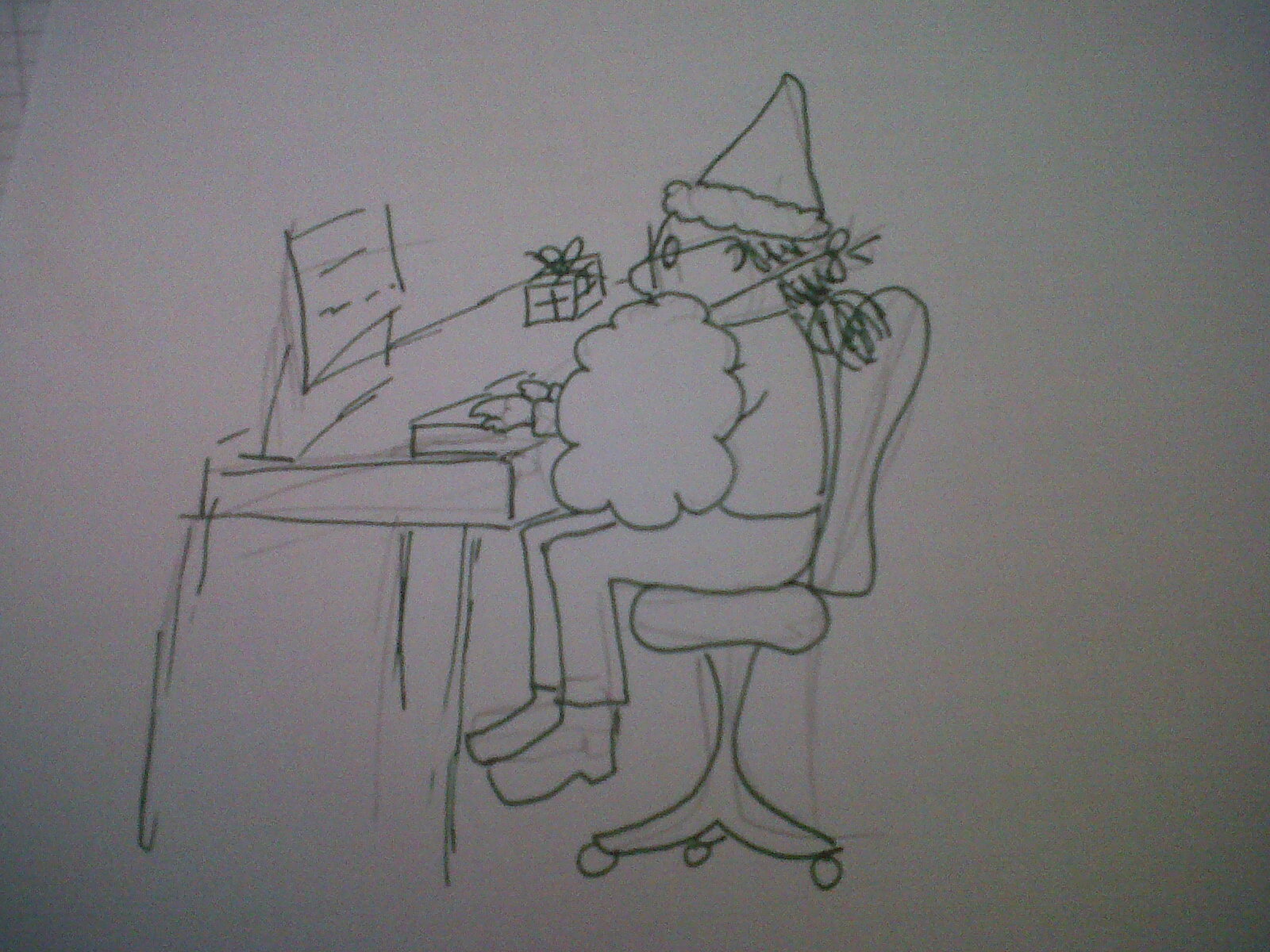
Cartoon of Liz dressed up as Santa

Liz or Santa?

This time of year is a busy one for Santa, but maybe not for you. Maybe you’re off work for the seasonal holiday now, on vacation from your studies, or your clients are on holiday so you are too, by extension. Maybe it’s time to have a bit of a think about how you’ll manage your time more successfully in the New Year. As it’s Christmas, as well as sharing some tips on time management in general, I’m going to relate them to Santa’s life, too. If you’re reading this, F. Christmas, I hope they’re helpful!

Work to your strengths

I think this and the next point are key. You should know by now when your good – and not so good – times are for concentrating and getting things done.  The key is then to arrange your day to match these peaks and troughs, aligning your work patterns to your personal patterns. This is easier when you work for yourself, but is manageable when you’re employed, too. I hope Santa’s best late at night, as his main workflow is obviously when he can zip through the dark skies! I’m best in the early mornings, so now I like to get a chunk of work done before breakfast, and when I was working, I liked to start as early as I could. I have a slight lack of concentration after breakfast, so I am scheduling in some down time or some smaller, achievable tasks for then, and I’m hopeless after lunch – but I can work fine if I have a big deadline, so I either work to a deadline there or accept it’s not a great time and do something else. People think ‘larks’ can be annoying and smug, but I’d love to be able to work late into the night. I know I will make mistakes then, as I’m not a ‘night owl’, so if I have a big project to push through, I’m more likely to get up extra early. When are your good and bad times? How can you tweak your work schedule to get the most out of them?

Blocks of time

This is the other important one, in my opinion. Say you’ve got presents to wrap, letters sent to the North Pole to read, and deliveries to make. Don’t hop from one to the other: put aside a block of time to concentrate on one thing and that thing only, whether it’s catching up with emails for half an hour, spending 15 minutes reading Twitter, or putting in an hour on that big project. When I was a training manager I learnt (from theory and experience) that people can’t concentrate for more than 45 mins to an hour at a time, so make sure you work in a 5 minute break after each hour-long block. If you have something that you don’t fancy doing, set a timer to 30 or even 15 minutes and do just that thing for at least that length of time. Often you will get into the swing of things and may be able to carry on longer.

No distractions

When you’re concentrating on one thing, don’t let the others distract you.  Santa doesn’t screech to a halt just above your chimney to answer his elf and safety hotline, and if he does, he needs to stop doing that (wear and tear on the reindeer, for a start!) There’s rarely something that won’t wait an hour. Phone calls, OK, but if you really need to concentrate, turn voicemail on, too. I keep my BlackBerry on my desk: it alerts me if an email comes in and I can very quickly check if it looks urgent without opening and reading it on my PC – works for me! Doing something wholeheartedly for that block of time will work far better than swapping to something else part way through.

Lists and priorities

It seems so obvious, but write a to-do list, either at the end of each working day, or the beginning of the next one. I split mine into work to do, work admin and other – as someone working from home there is always something like posting letters to do, and even if you work with other people you may need to pop out on an errand. As for Santa, well, his to-do list will vary according to the season, but I doubt there’s ever only one task, even on Christmas Eve (stock up on reindeer fuel, schedule toilet stops, get red suit dry-cleaned … ). I tend to write one set of lists then actually order the things for the day, with closer deadlines taking priority over more distant ones (I use a Gantt chart to record those).

Not all time is billable time

I record my billable hours in a diary every day. That’s hours I’ve worked on projects that I’m getting paid for. I can then see how much I’m making per hour, per day and per week, to make sure I’m on track with my targets. Santa needs to get a certain number of presents delivered to a certain number of houses per hour. But I’ve learnt that, just because you’re sitting at your desk for 7 hours, you’ll rarely do 7 hours of billable work (unless you’re a lawyer or suchlike and every single task is assigned a project code). You’ll have emails to answer, blog posts to write, social media to engage with, toilet breaks – and if you work at home, that mid-afternoon shower, gym session, answering the door to salespeople … Even Santa has to refuel the reindeer and restock that sleigh. So don’t beat yourself up and feel unproductive if you haven’t done 7 hours billable work in 7 hours at the desk. But do use chunks of time for the non-paid work and even take a note of it to see where you can refine the process.

Systematise

This is a posh word for putting systems in place – whether on paper or using the computer and various bits of software. Santa has a production line of elfs taking care of gift wrapping and labelling. When I do a transcription, I upload the tape into my software and create and save the Word document. Every time I finish a project, I put it on my invoice spreadsheet, generate and send the invoice (or add the line to the client’s monthly cumulative invoice) and change the colour of the red line on my Gantt chart. Morning, lunch and evening I check my bank balance and enter anything that’s come in or gone out on my spreadsheet. On the last day of the month I prepare and send my monthly invoices. If you have systems you don’t have to think about, you won’t waste time reinventing the wheel every time you come to do something.

Take advantage of other people’s peaks and troughs

I know that not many of my clients are up early, so when I’ve dealt with anything that’s come in from America or Asia overnight, I will have a good few hours without interruptions to get on with projects on which I need to concentrate. I also know that a lot of emails are likely to come in just after lunch – both from awakening North Americans and other people who seem to work hard in that hour or so. Santa, of course, needs to take advantage of his clients’ hours of sleep. So I can plan around that, and also use other phenomena, like the gym being quieter and more pleasant to visit (and more efficient to get round) in the daytime – the other Saturday I got what amounted to a free personal training session because I went early and no one else wanted the Lower Body Workshop class on the mats!  Use your knowledge and experience to take advantage of what you know about how other people work – and use it to help you be more efficient.

Build in breaks

If you’re working in an office as an employee, the Working Time Directive (or your country’s equivalent) comes into effect, telling you when to take rest breaks and how long you should work for in a day/week. If you’re a student, self-employed, or packing presents in your own Lapland factory, it’s harder to make yourself do this. But it’s vital to take breaks, to get yourself moving, get away from the screen and revitalise yourself. I recommend taking some exercise every day – be it a gym trip, a run, a walk in the park or some energetic hoovering. You’ll get a better perspective on things, too – I’ve written many blog posts while out running that I couldn’t think up in front of the computer! And get away to eat something at lunchtime, rather than snaffling a sandwich at your desk.

So, I hope these tips have helped you – and Santa – plan your time a bit more efficiently and use it more effectively. If you have any more tips, I’d love to hear about them!

 
10 Comments

Posted by on December 21, 2011 in Business, New skills, Organisation


Tags: , , ,