RSS

Category Archives: Writing

Themself or themselves?

They used to just be a plural word, referring to a number of people and having the standard reflexive form of themselves“There were many people in the queue. They were all told to help themselves from the buffet”.

But we are seeing more and more usage of they and them as a singular, to avoid clumsy uses of  he/she or him/her followed by himself/herself. Then, by extension from the him – himself or he – himself formation of the reflexive, people are starting to use themself as the reflexive. “If a child is confident, they may be able to help themself to water”.

This does seem to be sensible, and it’s something I think I’ve used myself (there’s another one!) in the past. However: no more! Because, having been asked about this via Twitter, I looked it up and found that actually themself is not regarded as “good English”. And we like good English on this blog, don’t we?

So the reflexive of singular they and them is themselves, and my above example should read: “If a child is confident, they may be able to help themselves to water”.

An easier one, I suppose, in that one is correct and one is incorrect – you don’t have to remember different usages, just not to use themself. Make that we don’t have to remember …

You can find more troublesome pairs here and the index to them all so far is here.

 
3 Comments

Posted by on January 13, 2012 in Errors, Language use, Troublesome pairs, Writing


Tags: , , ,

My short cuts – using Tabs effectively

As promised in my original post, I’m going to write some quick guides to things you do when you’re writing documents which you think are a short cut but actually cause more trouble than they’re worth.

The idea of this series isn’t to criticise people, just to show you how to do things in a more formal way which will actually make things easier for you in the long run, particularly when you’re dealing with longer or more complicated documents.

Today we’re going to talk about using Tabs. Tabs seem to be something of a mystery, but there are easy ways to use both the tab button and tabs set in the top margin which will tidy up your document, make it easier to enter neat text in lovely columns, and reduce tension when you’re trying to line everything up.

Please note: these examples can look rather wide. I want them to be as near full-size as possible, so you can see exactly what I’m doing. If you’re looking at this post on a monitor, you should be able to scroll across to see the full image. If you’re viewing on a tablet, some of the screenshot may be cut off: hopefully you can see enough to get an idea of it, or you should be able to select the image to view it separately.

Let’s start off with using the Tab button. This is a button on your keyboard which should have two arrows on it, one facing one way and one the other. Got that? Good.

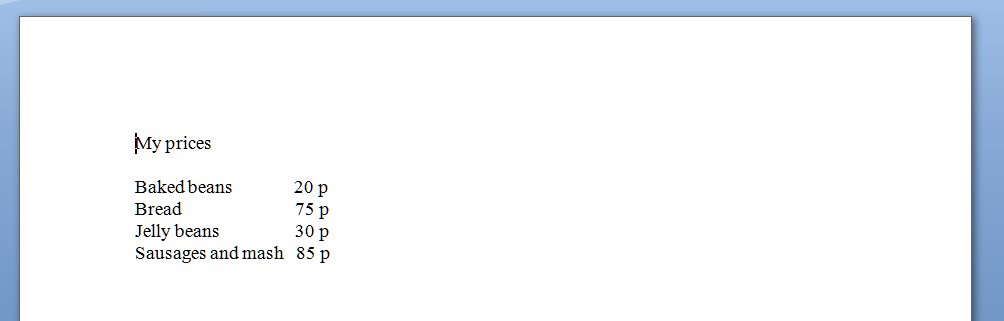
Here’s your common short cut, to start off with. You’ve got a menu you want to put on a document, with items in one column and prices in another. So you type it out, using the space bar to move along to the next column. And it looks like this:

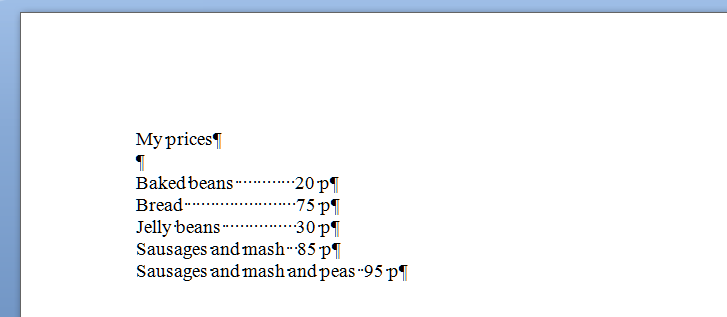
But now you want to add another item and oh dear – it’s longer than all your other ones and puts it all out of alignment (because you’ve used the space bar to make the space between one column and the next):

How do I know you’ve used the space bar? Because I’ve used that little paragraph button on Word again which shows us all the formatting, tabs, line returns, etc.

So the way you’ve achieved this spacing is by doing this (where dots are spaces and the things like a backward P are returns):

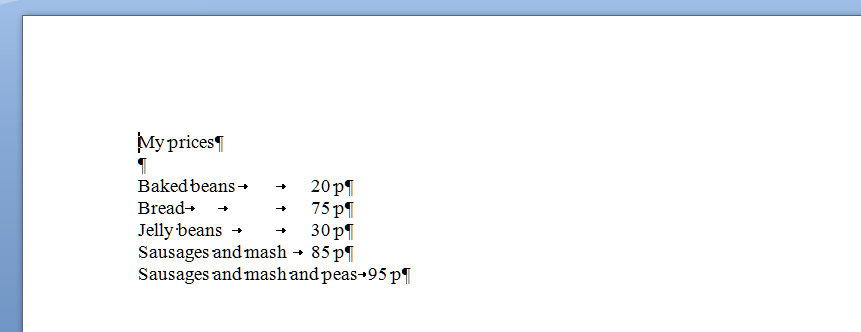
What you should have done (my short cut) instead of using space (your short cut) was to use the tab key (remember, the one with the two arrows) to space across to a set point along the horizontal ruler at the top of the screen. These tabs are represented by arrows when you’re viewing the markup:

Now, when you want to move the prices over for all the shorter items, you just need to insert one press of the tab key at the end of each item, to get them to line up perfectly.

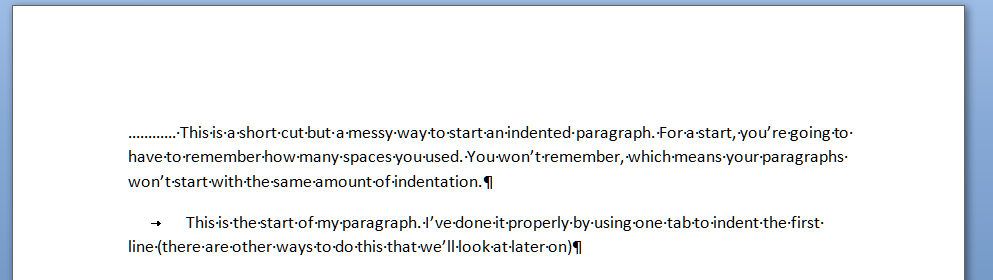
And here’s a last example. It’s very common to find people wanting to indent the first line of a paragraph, but using spaces to do so. This has its own issues – for example, you have to remember how many spaces you’ve put in and it’s likely that you’ll insert a different number each time, which will lead to indentations that don’t match. Instead, a simple press of the tab key at the beginning of your paragraph will leave everything nice and tidy

That’s enough for this session, I think. Of course, there are other ways you can format paragraphs and other indents, and you can set tab stops to wherever you want them to be across the page (and do all sorts of fancy kinds, too). But I’ll leave them for another post … (and I’ll link to them in this one when I publish them).

Please note, these hints work with versions of Microsoft Word currently in use – Word 2003, Word 2007 and Word 2010, all for PC. Mac compatible versions of Word should have similar options. Always save a copy of your document before manipulating it. I bear no responsibility for any pickles you might get yourself into!

Find all the short cuts here

 
8 Comments

Posted by on January 11, 2012 in Copyediting, Errors, New skills, Short cuts, Word, Writing


Tags: , , , ,

Counsellor or councillor?

Counsellor and councillor are very commonly mixed up – you find them everywhere, from non-fiction books to blog posts and all points in between. I suppose both of them try to help people – but they are different words for different things, and they need to be kept separate and understood as such.

A councillor is someone who sits on a council. So, local councillors are those people we elect to sit on the city council and run bits of our lives for us. Oh yes, let’s not forget our capitalisation rules in all the excitement: Councillor Broomfield sits on Libroville City Council. She is a councillor who sits on a city council.

A counsellor is someone who provides help with personal problems. They give counsel, they counsel you. Maybe that’s the way to remember it, as you can’t council someone. Can you? You go for counselling with a counsellor (I have seen the two spellings being mixed up even in that context) and maybe that’s the way to remember it.

If anyone has any nifty ways to remember these differentiations, do post a comment!

You can find more troublesome pairs here and the index to them all so far is here.

 
2 Comments

Posted by on January 9, 2012 in Errors, Language use, Troublesome pairs, Writing


Tags: , , ,

Weary or wary?

Weary or wary seems to me to be an odd pair to mix up – sorry if you do this and don’t think it’s odd, but they just seem so different. Having said that, I do keep seeing them being mixed up, so this will probably be helpful!

I see weary being used where it should be wary more than the other way round; I have a feeling that perhaps a memory of leery is getting into it, and then the pronunciation means the writer goes for the word that sounds like leery. Who knows. Anyway, here we go:

Weary means tired. And to weary of something means to be reluctant to experience any more of it. “I’m weary, because I’ve worked 10 hours today” (this is not literally true, don’t worry!). “I’m weary of writing Troublesome Pairs posts and I don’t think I’ll do it any more” (this, also, is not true).

Wary means cautious about possible dangers or problems. It’s linked to beware, and maybe that will help people to remember it. “I’m wary of dogs after being bitten a few times”, “I’d  be wary of going down that dark alleyway if I were you.”

Let’s see if we can use the two in the same sentence … “She was weary of being wary, jumped into the middle of the pack of dogs … and got bitten.”

Sorry, dog lovers – please feel free to substitute any other biting animal in these sentences!

You can find more troublesome pairs here and the index to them all so far is here.

 
5 Comments

Posted by on January 6, 2012 in Errors, Language use, Troublesome pairs, Writing


Tags: , , ,

What I got up to in December

In my previous years of Libro work, December has been really quiet, as people seemed to feel they needed to leave me alone for Christmas. This was usually a bit frustrating, as the University where I worked gave us a lot of time off over Christmas and I was raring to get on with stuff with nothing to get on with. This year, I knew I had Jury Service starting in early January, so I thought I’d be able to take advantage of the downtime to get a bit of rest, get some work done on my Iris Murdoch project and pre-write all the blog posts I needed to cover the time I’d be out of the office.

It didn’t quite work out like that! I’d have been even busier than this if two big writing projects hadn’t slipped back (through no fault of my own, just circumstances). I had Christmas Day off, but apart from that I worked pretty solidly. As we all know by now, I left my library job on 12 December, and I actually corresponded with a potential client the evening of my leaving do – I must have done a decent job with the good old Blackberry, as I ended up booking in the work for that week! I then went on to a mixture of pre-booked and just-in-time work for various clients, old and new …

Edited some articles for a local academic who’s a non-native speaker, including putting the documents and bibliographies into the specific format demanded by the publications for which they were written. Also edited English translations for two agencies, one in China and one in Poland, and did the usual checking for my long-term translator client and my French HR consultant who’s writing a series of blog posts.

I transcribed quite a lot this month: a long webinar for my novelist client (more of her later) and I had a large project for an agency, transcribing presentations given at an international conference by non-native speakers of English (on the whole: things got a bit faster when I got the odd British or American presenter, but it was all interesting!).

I wrote some web text and a downloadable “dos and don’ts” piece for my retail shelving client and had a chat on the phone with their new SEO people as I’ll be writing more web content for them in the New Year.

I proofread a PhD thesis and several essays and dissertations, both for my direct clients and the ones I work for via a larger student proofreading company.  I’ve got a couple of coaching clients booked in – I proofread their work but also make suggestions on how they can improve their written English, write out lists of common mistakes they make, etc., throughout their course.

Of course, that’s what we call proofreading, but isn’t really – I did also do a proper proofread on a long sectionof a big document outlining responsibilities and guidelines for the updated manual of a professional body, comparing the new version with the older one to make sure they matched but any dates were changed appropriately.

And I did a final line-edit on a novel by a successful self-published author. I had to read the first novel in the series so I could check for continuity, noticed the odd issue in that one and ended up doing an edit on that book, too, so I spent much of Christmas Eve and Boxing Day concentrating on fast-paced religious thrillers set in various catacombs and other exciting places – not traditional Christmas fare, maybe, but very interesting!

I did manage to work half days in the week between Christmas and New Year, more or less, with just some student work to get on with. And my lovely regular clients are all aware of the Jury Service and keeping things as light as possible for these two weeks.

In the end, December was a very busy and successful month, which encouraged me to think that yes, it was a good idea to leave the Library after all! I had my best month yet for income, which meant I nearly met the biggest of my three targets for the calendar year – so I set some ambitious ones for this year, too.

Things were a bit quiet on the networking front, it being the festive season, but I did have time for some socialising, and I also started my new blog, which is going to chart my experience as I take Libro full-time.

Libro offers copyediting, copy writing, proofreading, transcription, typing and localisation services to other small businesses, individuals and corporations. Click on the links to find out more!

 

Tags: , , , , , ,

A new survey

I’ve set up a new survey to see how I can best make this blog useful through 2012. Please take a moment to answer as many of the questions as you can – I really want to know the answers!

You can find the survey here on SurveyMonkey.

Thanks for reading … and filling in your answers!

 
Leave a comment

Posted by on December 27, 2011 in Blogging, Writing


Tags: , , ,

Confound or confuse?

I’ve been working my way through the last of Gill’s massive list and this is one of the final ones … I have had some more suggestions here and there, though, so the supply won’t run out just yet!

So, today we have confound and confuse.

To confuse someone is to make them bewildered or perplexed – “He confused her with his rapier wit until she would agree to anything”.”1% fat or 99% fat-free? I’m confused”. In a linked way, it also means to make something less easy to understand – “He confused all the issues with each other until it was impossible to understand his arguments”. And it also means to identify wrongly – “Is that Busted? Oh – I’ve confused them with McFly.”

Now, confound does carry a meaning of to surprise or confuse,  but it’s more used in the sense of proving something wrong or causing it not to work, defeating a plan, a hope or an aim “Her hopes of living off her savings were confounded by the low interest rates”; “Ha! With my intelligence and wit, I have confounded your dastardly plot!” A useful and flexible word, it can also mean to mix up with something else: “in his formula, x is confounded with y, and that makes it come out wrong”.

Special bonus word: to confute – is to prove to be wrong (shall we do confute and refute next time?)

So, a simple rule – confuse if you want to perplex or mix up; confound if you want to ruin the dastardly plans. Got that?

“She was confused by the bright lights, and he confounded her plan for escape by tripping her up.”

That’s probably the last troublesome pair for 2011 – will anybody be on the internet reading blogs next Friday?

You can find more troublesome pairs here and the index to them all so far is here.


Tags: , , ,

That, Which or Who?

That, which or who? This is a set of words that I see used incorrectly all the time, especially using “that” instead of “who” (although there are a few debates, it’s normally quite clear). I’ve also been asked for help on that/which a number of times, and I have to admit that I wouldn’t have been able to reel off the rules without checking it. Of course, I do check all of these, even when I think I know the answer, just to make sure I’m giving you the correct information!

So, to start off, you can use that OR which if you are introducing clauses that define or identify something (the fancy name for these is “restrictive relative clauses”) and it doesn’t seem to matter which – it’s a question of style preferences or what feels better in the sentence (wouldn’t you know: another one without a proper rule!) So: “A book which aims to explain all human life”, “a book that aims to explain all human life”.

Which is officially used (instead of that) if the clause gives additional information. “The book, which costs £15, has sold 1000 copies”.

Although it’s not officially specified in my reference books, I would therefore use them like this:

– If you’re just saying what the book (or whatever) does in general, use that: “these are the books that will tell you about the stars”.

– If you’re explaining something in comparison with something else, use which: “This is the book which explains all human life, unlike this other one, which just explains about men”.  The way to remember this? “Which is which?”

Moving on to who, we use who when we’re talking about a person or something that’s personified such as a group of people or a named animal. “The man who said yes”, “The proofreaders, who were all a bit pernickity”, “Felix the cat, who was very naughty” (and possibly, “the cat, who was very naughty”, if it’s a specific cat, but “the cats that lived in the barn”, “the cat that I saw on my way to work, which was white with a grey tail … “).

Things do get a bit confusing when you get to a group of people, as a group is non-personified, but the people are – you can do it either way but someone will argue with you, whichever path you take (“The group of men who were going to the ball”, “The group of men that was going to the ball” – I prefer the former, personally. Remember to make the verb agree when you do this – it depends whether you’re referring to the singular group or the plural members of the group).

You can find more troublesome pairs here and the index to them all so far is here.

 
4 Comments

Posted by on December 16, 2011 in Errors, Language use, Troublesome pairs, Writing


Tags: , , ,

Till, ’til or until?

Another troublesome pair from my friend Gill’s enormous holiday list – if you have any more you’d like me to look at, do let me know …

Today we’re looking at till (or more properly, ’til, although the Oxford Dictionaries no longer include a listing for ’til) and until, which I do see being used interchangeably by both native and non-native English speakers (this is quite rare, actually: most of the pairs I’ve been talking about are usually only found in native English speakers, in my experience. Non-native English speakers have all sorts of other common issues, but  not these.) (That gives me an idea for a new series of posts!).

Anyway: till and until. I have consulted the dictionaries and reference books and … they are the same. They mean up to a particular point in time or an event that is being mentioned (“He wasn’t able to take any holiday days until Christmas”), but in a sense that’s more concentrated on that particular date or event, as opposed to a word such as by which is more about the period itself. (“He was told to take all of his holiday by Christmas but he didn’t manage to do it until the gap between Christmas Day and New Year’s Eve”; “You can’t play on the Playstation until you’ve finished your homework”).

Until is considered to be more formal, occurring more often in written English. Till is, wouldn’t you know it, more informal, and occurs more in spoken English. Till is also used as a noun (a cash register or a glacial deposit) or a somewhat archaic agricultural verb to do with preparing the soil before planting a crop.

However, there is one important distinction: you always use until when starting a sentence.

“She gave him the pills till he felt better” or “She gave him the pills until he felt better” but always: “Until he felt better, she continued to give him the pills”.

You can find more troublesome pairs here and the index to them all so far is here.

 
6 Comments

Posted by on December 9, 2011 in Errors, Language use, Troublesome pairs, Writing


Tags: , , ,

What I’ve been up to in November

November is traditionally another quieter month, but actually I stayed pretty busy through the month and brought in more income than I did in October.  I had quite a varied month workwise, ending up doing the following …

Proofread some chapters of various PhDs and full Master’s dissertations, as well as a couple of articles which needed their bibliographies put into the format the journals required (which took longer than proofreading the text)

Copyedited a large number of documents for a client’s important project – sometimes working at very short notice and getting up very early in the morning (and getting lots of thanks and a lovely quotation for my references page, I’m happy to report!)

Did a substantive copyedit on a non-fiction/humour book – I really tore it apart, re-ordering sections and deleting chunks. There’s always the temptation to include everything you’ve researched when it’s your own book; I have no such compulsions and will rip it out if it doesn’t fit perfectly! Anyway, the author’s now going through the new version and adding references where needed, before I convert it into Kindle format and we put it up on Amazon.

Re-wrote some web text and letters for a client I “met” on Twitter.

Polished some articles for a client whose first language is French – she writes up articles about HR issues in English and I go over them for her and smooth them out into more natural English – as I do speak French, it’s useful sometimes to know what word she would have used in that language in order to express it correctly in English, so it’s a bit like translating in some respects.

Edited a Terms and Conditions document and wrote an article on overseas procurement for my retail display client.

Edited and proofread the usual Yacht Club and Moseley magazines – very different publications but with surprisingly similar issues in their layout and text!

Coached a postgraduate student who needs to get his PhD written up – we have a weekly arrangement to make sure he keeps going with it and sends me something to look at every week.

Transcribed two journalist interviews, three webinars and a corporate panel discussion – a lot of transcription this month, and a lot of keeping the heater on in my study so my fingers were warm enough to type fast!

Launched the first edition of my new Libro Newsletter; recipients told me they enjoyed it!

Attended a Social Media Cafe, where I chatted to friends old and new …

And last but not least, resigned from my part-time Library job – so I’ll be taking Libro full-time from December 13. I have started a new blog in which I’ll record what it feels like to do this – do pop along and have a read if you haven’t seen it already!

Coming up …

December is usually quiet, but I’ve got some transcribing and editing booked in already, plus I’ll be doing some work on my Iris Murdoch project. Oh, and having a rest. January sees me officially full-time with no other means of support, but I have Jury Service in the first two weeks! I’m adjusting my pricing too, and will be blogging about that in another post.

Libro offers copyediting, copy writing, proofreading, transcription, typing and localisation services to other small businesses, individuals and corporations. Click on the links to find out more!


Tags: , , , , , ,