RSS

Tag Archives: writing

Be careful! Decimated

I have always foamed at the gills slightly when someone has used decimated to refer to “lots of people/things”, as in “The invading army decimated the defenders and no one on that side survived”.

That’s because I’d learned that decimated means to kill a tenth. The clue’s in the first part of the word – from the Latin decimus or tenth (it came into English via Middle English). There is a specific use of the word that does mean that – in ancient Rome, one in ten of a group of soldiers could be killed to punish the mutiny of the whole group.

But look in your dictionary nowadays and you will see something along the lines of “To destroy a large proportion of something” as the first and major meaning. There may be a little explanation relating to those pedants among us who still insist on the idea of killing only a tenth of the population of whatevers. But this is one that has passed into common usage, and having found this out, I am no longer permitted to froth at the gills when I hear the “other” usage.

I was going to say that I’ll still never use it myself in the less precise way … but I’m not sure that I have ever, actually, used the word …

Be careful! is a series of posts about words that are misused commonly – but really shouldn’t be. It’s not a new variant of meaning, it’s an error that gets duplicated as people see the word misused and copy it.

Contact me via email or via my contact form.

 
23 Comments

Posted by on June 17, 2013 in Be careful, Errors, Language use, Writing


Tags: ,

An Editor Writes: 10 Lessons I Learned When Writing My Own Book

going_itWhen I set out to write a full-length non-fiction book, I had two ideas in my head:

1. I can just stitch this together from my blog posts – easy!

2. I’m a professional editor and writer, I’m used to writing to deadlines, so I’ll get this done quickly and efficiently.

Wrong!

This article is about what happens when you go over to the other side – when editor and content writer becomes (self-)published author.

Sitting down to write

The first thing I found when writing my own book was that it’s so hard to make yourself do it! I knew towards the end of 2012 that I had amassed the blog posts that I needed to write a book about a year of self-employment. So I picked up all the posts out of my blogs, popped them in a Word document, and thought, “Oh, look: a book”.

First lesson learned: I should probably have organised the book using a software package like Scrivener. This would have made it easier to organise … and reorganise … and reorganise it.

Second lesson learned: I should have set aside time for this process in my diary, like I do for my clients. You’d think I’d have learned this from trying to slot some academic research into my schedule – apparently not!

Emotional blocks to writing

I don’t know whether it’s because when I write for my clients, it’s “white label” work, which means that my name doesn’t appear on the finished piece, and having this appearing under my own name made it feel like I was under the spotlight, but I kept getting blocked. When it’s paid work for a client, I’m as busy as can be, but somehow there were a zillion other things I could do to avoid working on the book (sound familiar)?

I was committed to it; I knew it could actually help people; people had TOLD me to write the thing, but I’d get blocked and veer away from it in my mind and physically when I tried to sit at my desk. This happened particularly at the editing stage.

Third lesson learned: Treat writing like a job. Set deadlines and stick to them. Try to sweep aside the emotions and get on with it, as you would with a job.

How to organise your book in a million easy stages

It all looked a bit messy and unbalanced, so I made some of the posts diary entries and some of them articles. Nope, still looked wrong. This is where I realised that you can’t just turn a blog into a book without some serious editorial decisions. I moved stuff around, added an introduction to each month, and stuck bigger, more general pieces in appendices at the end.

Fourth lesson learned: If you think it’s going to be easy, you’re probably doing it wrong. Nothing good comes without a struggle, right?

How to edit an editor

Like a good writer who’s learnt from others, I was all ready and eager for some beta readers. I recruited two friends initially. Each did a useful read-through for me and gave me some good comments. One of them, and I say this with the greatest appreciation and respect, edited my book like I was editing my book. She’s not a professional editor, but she’s good. She picked out typos (ouch) and weird sentences (ouch) and missing links (ouch) and repetitions (eek) and huge structural issues (argh!).

Ouch, ouch, ouch.

I’ve written in detail elsewhere about my reaction to this edit: suffice it to say that I felt wounded, winded and disconsolate. What a marvellous lesson about how my own clients feel when I edit them! It did put me off for a good while, thinking this book was rubbish, how dare I think I could publish something, let alone publish something good that people would want to read. In fact, I left it for FOUR MONTHS!

Fifth lesson learned: Editing is vital, but it does sting. I must continue to be as kind to my editing clients as I possibly can be. However kind the editor is, it still feels brutal to have your work criticised and pulled apart. I will not make it more brutal for them.

Sixth lesson learned: You can get a blog post out of anything. Mine on being edited was one of my most popular so far!

Getting round to rewriting

I mentioned emotional blocks: this was the big one. I read through the editing comments. No: I skim-read through them, muttering and sobbing. Then I closed the file and ran away from it. It sat there, taunting me. “So, you were going to publish in the first week of January, were you? It’s February already …” I just couldn’t make myself do it.

In the end, I had to force myself. I had to treat it like any other job, open up the file, and start on it. Of course, once I started, I could see a) how good the editing was, b) how to make it better. I was tough with my precious words. One of the major problems with the text was that it was repetitive – every time you write a blog post, you’re expecting new people to read it as well as subscribers, so you tend to reinvent the wheel. Put that in one document and you’re, frankly, boring people. So out came the delete key, and I honed and polished, added some bits too, but chopped thousands of words off the total, to make a much slimmer and better read.

Seventh lesson learned: Be ruthless. If it is at all expendable, out it comes. Chop out the dead wood. If you can’t see the dead wood, get someone to chop it out for you. It will come out better for it.

When it comes to your book, looks are everything

Well, not everything, but …

I was so keen to publish that I started out with a terrible home-made cover. Then a friend tweaked my original book’s cover to make a new matching one, but it still looked a bit too home-made. I then  found a book designer online and got a lovely cover done. I looked into getting the interior of my book designed professionally so I can put out a print-on-demand paper copy, but the book needs to sell some more copies first to be able to pay for that!

Eighth lesson learned: Your book really does look more professional with a professional cover; it will stand out for the right reasons. If you have more than one book, it’s worth getting an overall consistent look. My first book started to sell more when I got its cover updated to match the new one. Get this done first – it takes ages to update the cover on Amazon when you’re embarrassed about your old one!

Soft launch aka the obsession starts …

A read-through from another friend and it was ready to go! I’d already tried the process once (with a book that was much shorter and easier to write!) so I knew the mechanics of publishing for Kindle on Amazon. I’d read up about the process and I knew about the choices, and decided to go for Amazon exclusive, as I could then enrol the book in KDP Select. I get quite a few loans on my other book, and somehow I make more royalty on loans than sales on that one, per copy. I priced the book carefully – as low as I could make it while still getting the higher royalty from Amazon. I also knew to soft launch, build some sales and reviews, and then do a bigger launch.

So I published the book, and I did the social media thing, and I told people about it, and I sent out one or two review copies. And then I was reminded of the obsessive nature of authors – I’m still constantly checking for reviews, sales, likes, comments … It’s like it’s your baby and you have to watch over its every breath.

Ninth lesson learned: Reviews will come, whether you hassle people or not. I knew a few of my first readers. I put up pleas for reviews. It takes longer to read and review a full-length book, and the reviews will come in time! And if you read a book by an indie author – do review it, it means the world to them!

What next?

Once I had a few five-star reviews (finally!) I’m making more of a noise about the book. I picked up this tip from The Creative Penn and it worked with the last one – give people something to look at when they’re making their buying decision. And here it is, out there, selling and helping people (the main thing) and I’m proud of it and all the hard work.

Tenth lesson learned: Do it. At very least you will find out something about yourself and other authors. At best, you’ll have an income stream and you’ll see some lovely reviews and know you’ve helped and/or entertained people! Go for it!

Resources

The book that I’m talking about here: Going it Alone at 40 – and the book’s own web page with links to worldwide Amazon sites to buy it.

That blog post about being edited: On Being Edited

Book designer: I actually used someone on www.fiverr.com  for this, on the recommendation of a writer friend: I don’t normally like low-cost sites like this, but my designer offers lots of extras that pay them better, so I felt it was OK.
 
14 Comments

Posted by on June 12, 2013 in Blogging, Copyediting, Ebooks, New skills, Writing


Tags: , , ,

Marinade or marinate?

This one was suggested to me by my friend, Laura Creaven. I do like it when people suggest Pairs to me – so keep them coming, everyone!

Here we have two cooking terms which look oh-so-similar – but one is a noun and one is a verb!

A marinade is a mixture of oils, spices and vinegar in which we soak meat, fish or other proteins such as quorn or tofu, so that they soak up the flavours.

To marinate is to soak such items in such a mixture.

But wait: what’s this? The dictionary also has a verb, to marinade, which means … to marinade.

So you can marinate or marinade your slab of tofu or your fish, but you can only soak them in a marinade.

You can find more troublesome pairs here and the index to them all so far is here.


Tags: , , ,

Living with the Dreaditor

I came across Tammy Salyer via Twitter and was so intrigued by the fact that she’s both an editor and a creative writer that I asked her to write a guest post for me about how this works for her. Read on to find out how she uses her “editor’s brain” (the ‘dreaditor’) to help her fiction writing …

We all know that voice. The one in our head that says, “My Godiva, woman, did you really just string five adjectives in a row to describe your character’s appearance?” Or, “What-what-what!? You do know that dangling modifier makes you sound like a complete goon, right?” We’ll call that voice “The Dreaditor”—the evil, amorphous being that skulks within the crevasses of our brains and tries at every turn to squash our creative voice into so much jumble-y pulp.

For a lot of writers, the inner editor is worse than having Spock after he’s downed ten cups of coffee quoting bad lines from Star Trek directly into our ears in a bid to create order out of our creative chaos. “Are you sure it isn’t time for a colourful metaphor?” ~ Spock,”The Voyage Home” Or, “Nowhere am I so desperately needed as among a shipload of illogical humans.” ~ Spock, “I, Mudd”).

When starting out, many of us have to work very hard to ignore that voice, which can be exhausting and stifling to our creative brains. However, in contrast to the common notion that writers must completely turn off the Dreaditor, especially in their first draft, and just let fly with whatever mental ejecta our brainmeats conjure, I’ve found incalculable benefits in my eight years of serious writing to merging the personalities of Dreaditor and writer. By bringing these two personas together, I’ve learned how to stop the Dreaditor from yucking my yum and keep the writer within from being lost down the rabbit hole of endless possibility. Let me share these benefits with you.

First, the Dreaditor does a wonderful job of helping me figure out what I’m really trying to say. It is a master at clarifying ideas and making sentences get right to the point before they get out of hand.

We’ve all done it; a brilliant idea flashes through our creative brain and we start rapping at the keyboard as if the poor tool were Hungry, Hungry, Hippo. Finally, 300 words later, we type in a period. Then reality hits. We’ve just summarized our protagonist’s inner struggle with his addiction to chocolate milk in the most babbling run-on sentence known to humankind. Already we’re loath to think about what we’re going to have to go through in the second draft to figure out what we were trying to say in the first place, then to tighten up that sentence so our readers can figure out what the heck we’re talking about. But having a well-developed Dreaditor act as a kind of babelfish by automatically taking those potentially long and quirky sentences and distilling them into writing that is both concise and comprehensible the first go round barely slows your stream-of-consciousness writing a whit.

Secondly, no one is more innately compelled to pursue the elegance of structure as an editor, and thinking with your editor brain as you create helps you write toward a stronger overall story structure sooner. It’s one thing to be writing a fabulous scene that’s going to blow your villain into a new dimension—literally—but if your story is a romance set in the Old West, this may not be the most productive use of your time (no matter how fun it is). Having part of your brain always focused on how your writing links to your story arc and anchor scenes, how best to develop your characters in all situations, and what elements of the world you’ve built can be tied into your plot and conflict keeps your forward momentum more consistent in the long run. It also mitigates the pain later of having to cut wonderfully fabulous scenes, which you’ve sweat blood over, because they just don’t fit.

The third and most obvious benefit to having the Dreaditor always on duty is the vast amounts of time and mental energy you will save on your rewrites and subsequent drafts. An editor generally values efficiency in both language and movement toward an end goal. Being diligent about keeping your writing as streamlined and error-free as possible from the outset comes in immensely handy when deadlines loom. Additionally, it saves having to make endless passes at a particular page or scene if you’ve approached it with the precision-targeting focus of an editor from the beginning.

What works for me is certainly not a universally better process for all writers. However, I can honestly say that my writing began to improve in leaps after I’d taken a few self-editing classes. Becoming a successful creative writer is a subjective path with a variety of different objectives, depending on each person’s desires. Yet, becoming a writer with polished self-editing skills can only serve to propel every author closer to whatever their personal writing goals are. Plus, how many of us haven’t secretly wanted to be that person at parties that snootily points out to others that they’ve erroneously used “which” when “whose” is the correct word?

What do you think? Does every fiction writer have a dreaditor? Can you edit as you go along? Can a good fiction writer be a good editor and vice versa? (I know I’m not good at true creative writing, although I can write marketing copy with the best of them, and I know plenty of writers who say they couldn’t edit someone else’s work).

Author bio:
Tammy Salyer is a professional writer and editor who believes the imagination is humankind’s sixth sense. Contract of Defiance is the first book in her military science fiction Spectras Arise trilogy and was released to acclaim in Spring 2012. The followup, Contract of Betrayal, came out in February. Stop by Inspired Ink Editing, her blog, or follow her on Twitter and say hi.

I did a return guest post on Tammy’s blog with ten top tips for fiction writers. Read it here!

 
16 Comments

Posted by on June 5, 2013 in Copyediting, Reading, Skillset, Writing


Tags: , , ,

Wave or waive? Waver or waiver?

After a short hiatus, the Troublesome Pairs are back! Today we’re looking at one that I see getting mixed up very often one way round, and not so often the other way – which is actually often the way.

A wave is a movement back or forth – whether it’s a hand, water or something in one’s hand that’s waving (“She gave the steam train a big wave as it chuffed past”). It’s also the signal made by that movement. The verb means to move back and forth while remaining itself fixed position (“I always wave at steam trains, and other kinds of train, too”; “She waved a stick at the dog to attract its attention”). Other meanings follow the movement of a wave, e.g. a light curl in the hair or what the dictionaries rather soberly call a ridged mass of water. It can also be a sudden increase in a phenomenon eg. a wave of copy-cat head shavings.

To waive, on the other hand, and this is the one that gets written “wave” quite often, is to refrain from claiming or insisting on – “Because you don’t have much income, I will waive my fee”, “he waived his right to anonymity”. A waiver is an act or instance of waiving a right or claim or a document recording this – “Before you drive this steam train, please sign this waiver to absolve us from blame if you get covered in soot”. A waver, however, is someone who’s waving.

“He waved the waiver in glee – ‘I don’t have to pay the fee!'”

You can find more troublesome pairs here and the index to them all so far is here.


Tags: , , ,

What to do if your comment boxes are too big in Word

I have already published a range of posts on issues with comment boxes or comment balloons, including ones on comment boxes suddenly going tiny, or comment box text running in the wrong direction, changing the language in your comment balloons. Thanks to my colleague, Laura, I realised that I needed to post an article on what to do if your comment box size, or the general comment box area, is bigger than you want it to be.

Help! My comment box margin is too large!

This is the problem that my friend, Laura, had. Her comment box margin was somehow spreading across almost the whole page. Although it doesn’t encroach on the text area on the page, it makes your total page really wide. It looked something like this:

1 too wide

Even on my wide monitor, if the comment box margin is too wide, you get the choice of being able to see all of the text, as above, or all of the comment, as below – not very helpful!

2 too wide

How do you resolve this issue? You need to pop into Track Changes (in the Review tab) and click on the little arrow at the bottom to give you the Track Changes Options. Right at the bottom, you’ll find options for making the comment review pane / margin smaller (and moving it to the left or top if you so desire).

The default is 6.5 cm but if you like to have your page of text bigger but still see your comments, change this to a smaller size.

Note, that like everything in Track Changes, this only changes the view on your computer – whoever you are sending the document to will see it however they’ve set it up.

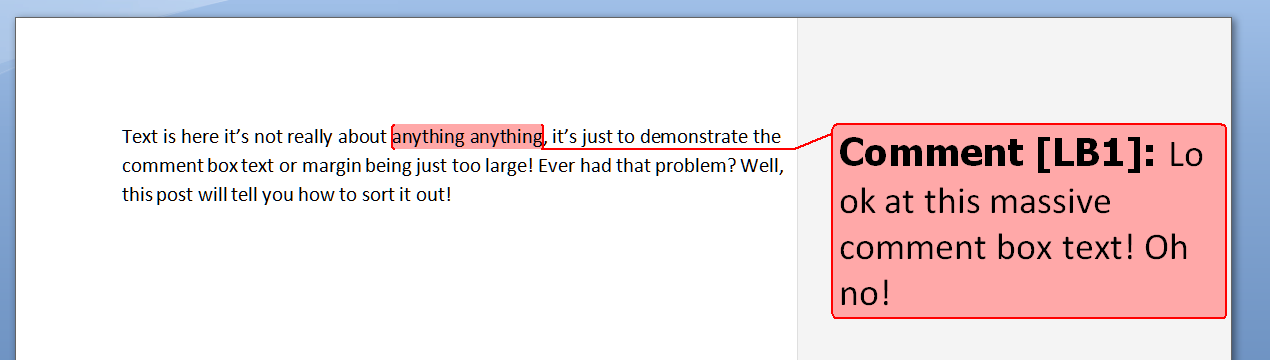
Help! My comment box text is too large!

Are you experiencing this problem:

3 too big

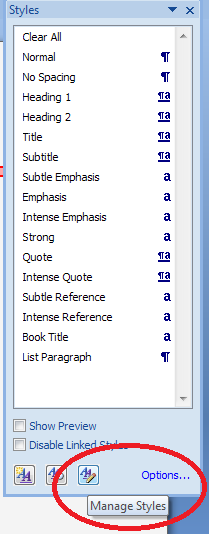
To change this to a normal size, we need to access the Styles dialogue box, by either

  • Pressing Control + Alt + Shift + s simultaneously
  • Going to the Home tab and clicking the little arrow at the bottom right of the Styles menu

This brings up the Styles dialogue box.

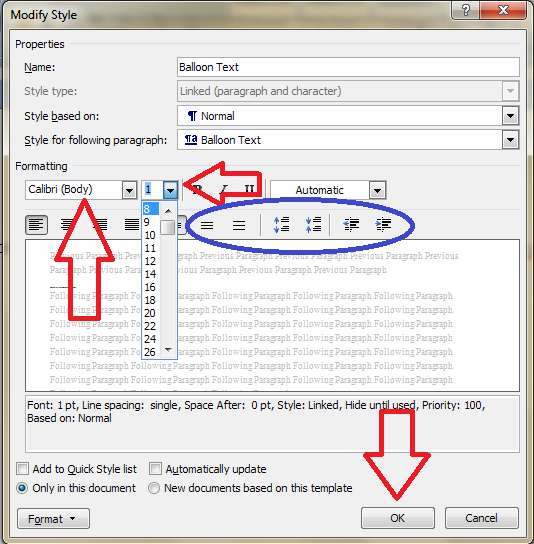
Click the right hand button at the bottom: Manage Styles. When you first open this next window, the sort order is As Recommendedclick on the down arrow to change it to Alphabetical:

Find Balloon Text (note: not Comment text) and it confirms how you have your text set up (blue circle).

Click the Modify button … to change your font and font size. You’ll notice lots of other options (blue circle) to change the spacing, etc.

The standard size for balloon text is 8 or 10 so choose that and you’ll have a nice tidy balloon again!

Press the OK button, and carry on pressing OK buttons until you get back to your document. Now, your comment will appear in the style you have chosen.

Again, these changes will only affect your computer.

These related topics should help you further:

What to do if your comment boxes go tiny in Word

What to do if your comment boxes start running from right to left

Changing the language in your comment balloons

Customising your comment boxes – everything you need to know

Customising Track Changes

This is part of my series on how to avoid time-consuming “short cuts” and use Word in the right way to maximise your time and improve the look of your documents. Find all the short cuts here

Do let me know if this has helped you, saved your bacon, etc. – and do share with the buttons at the bottom of this article.


Tags: , , , ,

Why you need to be human to produce a good transcription

Suitably funereal transcription kitWhen I receive a recording for a new transcription client and tell them I’ve loaded it into my transcription management software, I’m sometimes asked if that does the transcribing for me. Um, no.

While there are of course software packages out there that are very good at working with a single voice dictating, even those can sometimes struggle. I know this, because I’ve edited work that has been dictated in this way – and it can often be rife with homophones.

Why use a human transcriber?

I’ve been providing transcription services for several years now. While a machine might be suitable for taking down the words of a single, non-accented speaker enunciating clearly into a good quality recording apparatus, with no background noise, no interruptions and no acronyms or jargon, the projects I’ve worked on have included some or all of these features:

  • High levels of background noise – interviews in cafes with espresso machines whooshing and spoons clinking in cups
  • People talking while they’re eating and eating while they’re talking
  • Interruptions from waiters / room service / other members of the band or group
  • High levels of tape noise leaving me straining to hear what anyone’s saying
  • Multiple speakers including many people with similar voices around a conference table
  • Overlapping speech
  • Non-native English accents or heavy regional accents
  • Very technical content – jargon and acronyms galore
  • Creative content – album names, track names, novel titles, band names, author names
  • Requests to provide the transcription missing out ums and ers through to smoothing the English to make it read as standard English

As a native English speaker specialising in working with music journalists and non-native speakers of English, I can cope with all of these, with some rewinding and checking. I doubt that the most sophisticated dictation software could do so, as yet. I might be wrong of course (let me know if I am!).

Understanding what’s being said on a transcription

The first issue is actually hearing and understanding what’s being said. I have a good ear and a native English speaker’s ability to predict what will come next in a sentence / how sentence structures work, plus my experience working with speakers of and texts in non-native English allows me to do this for native Arabic, Chinese, Eastern European language etc. speakers. My ear can filter out background noise where sophisticated software can only go so far. And I can hear around the clink of teaspoons or glasses chinking to grasp what’s being said.

Checking the content in a transcription

When one of my journalist clients sends me a tape, I check who the musician / band is and look them up (usually on Wikipedia for the general information, as their own websites are usually a bit harder to plumb for information). When I’m working on an international conference I will seek out or be given a conference schedule, list of attendees, etc. When I’m working with technical content I will look up information on that topic.

All this allows me to produce a transcription which the client will not have to check for themselves, or if they do check it (which I do recommend), there won’t be too much to change. And I won’t be embarrassed by too many mis-hearings. Just try popping a few names of country leaders, bands or albums into a Word document and running a spell checker and imagine what an automated dictation program would do with these terms!

Speech on a tape to words in a document

Very occasionally I’ll be asked to record exactly what the people on the tape say, including ums, ahs, repetitions and pauses. At the moment, I’m transcribing some roleplays for students learning how to operate a telephone helpline. Here it’s important to capture all the nuances of the conversation and I’m splitting the utterances into sections, numbering them, and including all the ums and ahs.

Normally, my clients will require some smoothing out.

  • Most of my journalists like to have an indication of when their subject slowed down or had to mull over something and ask me to include notes of those pauses.
  • Business people producing podcasts and telecasts often want a fairly accurate transcription, but smoothed out to eliminate ums, ahs, pauses and repetitions, so they have a good product to sell or include in packages for their clients.
  • Some international conferences want to avoid embarrassment for their delegates by having their English rewritten as I transcribe to appear as close as possible to native British (or American) English
  • I have worked with authors who start off with a tape and want it to turn into something they can publish as a book (this, unlike all of the other options, involves two processes: transcription and then heavy editing and rewriting).

Why should I use a human transcriber and not a software program?

2 topsI think I’ve answered that for you now. You should also consider using a human transcriber who’s a native speaker of the language you’re having transcribed: there are websites out there where you can find very cheap transcribers; they are often not going to be native English speakers and while they will get the gist of the tape down, I’d be unsure whether they could give you the service you needed.

I’ve written another article about how to get into transcribing as a job and how to prepare yourself for what is often a fun and rather creative area of work, and one about the technology transcribers use.

In the meantime, if you’re thinking of booking in a transcriber, do have a look at my page about my transcription services, and get in touch if you want to ask about what I can do for you. I hope you’ve enjoyed this insight into a transcriber’s work! Do leave a comment if you have …

If you want to learn more about Transcription as a career, buy my book: A Quick Guide to Transcription as a Career – buy from Amazon UK or visit the book’s web page for worldwide links and news.


Tags: , , , , ,

Bated or baited?

Another one of those homophones that trips people up – perhaps more in one direction than the other? I see “with baited breath” a fair bit, but not the opposite error – and in fact it’s all about this one phrase, really, isn’t it.

Baited can be used as an adjective to describe, for example, a fish hook that has had something tempting slotted onto it to lure a fish – “I lowered the baited hook into the water and waited for the bite”. It’s also the past tense of “bait”, to put bait in a trap or on a hook, or to deliberately taunt or annoy someone (or something sentient).

Bated in the sense we’re discussing here only exists in this precise form within this phrase – how interesting! More reason to make sure we keep using it correctly – you know how I get about wanting to preserve the intricacies of our amazing language … So – “with bated breath” means “in great suspense” and comes from a 16th century usage, the past participle of bate (restrain), coming from abate, which we do still use, of course.

Bate, by the way, describes an angry mood in informal British English “ooh, don’t get in a bate with me, I was only teasing”  and is also a falconry term describing when a hawk beats its wings in agitation and flutters off its perch. So now you know.

“I waited with bated breath as he baited his sister that little bit too much … and she eventually flew into a bate”

You can find more troublesome pairs here and the index to them all so far is here.


Tags: , , ,

Pacific or specific?

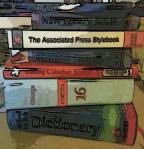
DictionariesI don’t know about you, but I had suspected that this one was something of an urban myth, encountered only in sitcoms or observational comedy. As I came across it myself, yesterday, in a verbal interaction, I do suspect that it only appears verbally, and not in written form, in its non-ironic instances. (I don’t go in for finger-pointing for the sake of it, but if you do come across a written instance, do let me know.)

So, for the avoidance of doubt:

Pacific means peaceful in either intent or character (or both), or related to the Pacific Ocean.

Specific, which I would like to hazard a guess is 99.9% of the time the word the user means to use, means precise, clear, clearly defined – so “would you like your new mattress delivered on a specific date or don’t you mind when it arrives?” and is also used in relation to a particular subject – “These tufts are specific to this particular kind of mattress”.

You can find more troublesome pairs here and the index to them all so far is here.

 
2 Comments

Posted by on February 11, 2013 in Errors, Language use, Troublesome pairs, Writing


Tags: , , ,

Zeros or zeroes?

DictionariesI have to admit that I had never given this one any consideration until it came up in something I was working on yesterday, and I had to look it up to check. So: zeros or zero?

Zeros is a plural noun, and oddly enough it’s the plural of zero. No e when you have lots of zeros.

Zeroes is a form of the verb to zero (in), meaning either to set a measuring device back to zero (I have never heard or read this myself, but M confirms that he uses it with measurement devices in his scientific job!), or to home in on something: “She zeroed in on the fact that he had hidden the muddy boots in the shed”.

So the noun has no e – “there are too many zeros in this post” and the verb does have an e – “my reader zeroes in on the fact that I had to look it up and contacts me to ask me why I don’t know everything off the top of my head”.

You can find more troublesome pairs here and the index to them all so far is here.

 
9 Comments

Posted by on January 11, 2013 in Errors, Language use, Troublesome pairs, Writing


Tags: , , ,