RSS

Author Archives: Liz Dexter

Unknown's avatar

About Liz Dexter

Book blog is at http://www.librofulltime.wordpress.com Writer, proofreader, editor, transcriber. Also runner, gym-goer, volunteer and BookCrosser! My married name is Liz Dexter but my maiden name and the name on the books I write is Liz Broomfield.

How do I cope with the ups and downs of the freelance life? 2 – when there’s too much work

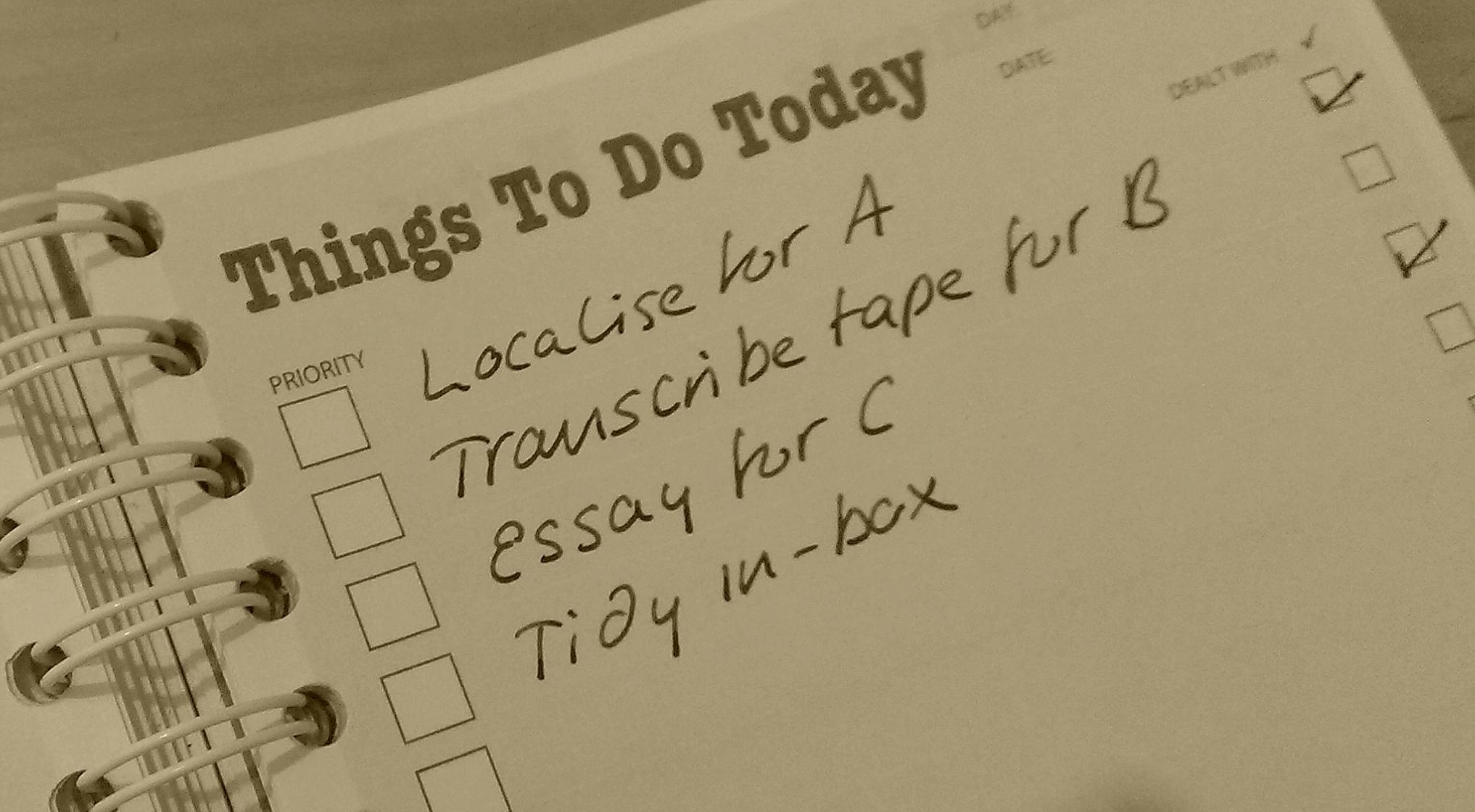
To do listsIt can be a bit scary being a freelancer / self-employed. One minute you’ve got no work at all, the next you’ve got all the work in the world, deadlines coming out of your ears, and you’re drowning in a sea of … stuff. To accompany my article on what to do if the work seems to have dried up, here are my top tips on coping with overwhelm – those times when all the work has come in and you don’t know what to do first. Maybe we can even work out a way to avoid that happening in the first place!

How do I cope when I’ve got too much work?

Yes, it’s the other side of the coin, which it doesn’t do to complain about as such, but can be a scary prospect. If you’ve got a lot of work but it’s not physically or mentally too much for you to complete in the deadline, that’s OK for short periods of time. We all get that. I’ve just booked in a large job  which will involve doing just one job for just one client, 9 hours a day for 4-5 days. However, you can bet I’ll be taking plenty of rest and cancelling everything else while that’s happening.

But what happens when you just have Too Much Work, too much to do in the time, too much to do without exhausting yourself mentally or physically?

It’s harder to organise yourself into not having too much work. Work does just tend to all come in at the same time: it’s a fact of life.

Here are some ideas for preventing overwhelm building up:

  • If you have a client who regularly overwhelms you, for example sending in orders for too many products in too short a timeframe or sending you work with no notice, reguarly, it’s worth talking to them and seeing how you can make the situation more predictable. If it’s really becoming a problem, consider offering to share their work with a colleague or tell them that you can’t fulful their requirements and they will need to find someone else to work with (yes, I know it’s really hard to do this, and you will probably want to have another prospective client lined up before you do this).
  • If you have a kind of work which regularly overwhelms you, consider how you can work to make that situation easier. I used to spend a lot of time with a particular kind of customer who tended to involve lots of emails and discussion and handholding. I now work mainly with an agency which specialises in this kind of customer – they do all the emailing, I do the work. It’s a lower rate of pay, but I am pretty sure I make that back in the time saved.
  • If you create trouble for yourself by scheduling too many jobs at the same time, keep some kind of record / calendar of what you’ve booked in. I do it on a Gantt chart with a line for each client, with the days I’ve got to do a piece of work or the dates they have booked me for coloured in. In this way, you can avoid scheduling All The Work for the same week.
  • If you have trouble with moving deadlines, put terms and conditions in place. This is a notorious problem for editors, as writers’ deadlines often slip back. Make sure you’re covered in your Ts and Cs for saying “No” if a job comes in later than planned and you’re already busy.

There are also three ways to cope with work overwhelm that involve other people …

  1. Contract out work. This involves having someone who you can book to delegate the work to. In this case, you will end up charging the cliient and paying the contractor. You may need to disclose that you’re using a contractor, i.e. someone other than you is doing the work, and I personally don’t use this method as my service revolves around me, to a great extent. Typically, the primary worker (you) will charge the client a little more than you pay the contractor, to give yourself a small profit on the job.
  2. Have at least one cover person who can take on work for your clients but act as an individual with their own relationship to the client. This is usually arranged in advance, but can be very helpful in this sort of situation (as well as when you want to take a holiday). If I am booked out and one of my clients with whom I have arranged this contacts me, I say, “I’m really busy at the moment, can you send this over to Laura, please?” They send the work to my colleague, then she will do the work and invoice them accordingly. Yes, I can’t make a little money on the fee, as you can with contracting, but my clients stay happy and the admin is minimal.
  3. Outsource work to someone else – for example, my journalist clients might usually transcribe their interviews themselves, but if they’re in a rush, they will send me the tape to transcribe while they get on with something else. You could either outsource the work itself or aspects of running your business that take up time – your social media updating, your filing, your invoicing … You may or may not have to disclose that you’ve done this (a journalist wouldn’t disclose that I’d typed out their interview) but you will generally pay the person you’ve outsourced the work to.

As with dealing with having too little work, there are two principles involved here:

  • Try to run your business such that it’s less easy for you to get overwhelmed
  • Have plans for what to do when overwhelm hits, and put them into action appropriately

With these tips and the ones on how to cope when the work dries up, I hope that I’ve given you some useful tools for smoothing out the ups and downs of the freelancer’s life. Good luck – let me know which ones work for you, or if you have other suggestions!

If you’ve enjoyed this post, please use the sharing buttons below to share it on your social media platforms. Thank you!

Related posts on this blog

How do I cope with the ups and downs of the freelance life 1: when the work goes away

Top ten tips for freelancers

How to decide who to work with

How to turn a new customer into a regular customer

What’s the best mix of customers to have?

How to make more money in your freelance business

When should I say no?

 
4 Comments

Posted by on June 17, 2015 in Business, Organisation, Skillset


Tags: ,

How do I cope with the ups and downs of the freelance life? 1 – when the work goes away

To do listsOne of the things that puts people off freelancing or self-employment is the ups and downs, feasts and famines, highs and lows of the workflow. While the freelance workflow can be tricky to manage, it is possible to get a handle on it and maintain your work-life balance (most of the time). I’m sharing with you my tips for making that work.

In this post, we’re going to talk about what happens when it feels like the work has all dried up. In the next post, we cover the other side of things: overwhelm!

The important thing to note here is that this all comes with time. No one starts out super-organised and busy at just the right level all of the time. Cut yourself some slack – things get over-busy or yawningly low for all of us, but these tips will help that to become less of a problem.

How do I cope when the work dries up?

The scariest thing about being a freelance is when the work appears to dry up. It’s easy to catastrophise here: what if NO WORK EVER COMES AGAIN? Well, in my experience, unless you’ve done something really wrong (like produced very sub-standard work or reneged on all your deadlines), the work will come back again. Part of learning to deal with the fallow periods is making yourself believe that they will come to an end.

There are two things to think about here …

  • What to do during fallow periods
  • How to prevent fallow periods happening in the first place

Let’s look at them in turn.

What should I do in times when I have no work?

There are so many things you can do to fill in the times when you have no work. They basically break down into three areas, though …

1. Rest

When it’s busy busy busy, I bet you don’t get all the rest you need. I try to get some downtime for myself when I’m slow at work – extra sleep, quiet reading, a cafe visit with a friend. Recharge those batteries ready for the next busy time!

2. Admin

There’s always admin to do, and you know it. Whether it’s clearing out your inbox, following up on leads that never came to anything, tidying your desk or sorting out your receipts, now’s the time to do it. (Extra hint: set a stopwatch. Do it for half an hour. You’ll be amazed at what you can achieve.)

3. Marketing

You can do a lot of your own marketing for no monetary cost – but there’s usually a time cost. If you have a free day, make it your mission to, for example …

  • Register on a few more free-to-advertise online boards
  • Write some amazing website content to promote your products or services, or overhaul what you’ve already got
  • Write and schedule some blog posts to keep your website regularly updated and cover you in the busy times
  • Go to that networking event you don’t usually have time for – or a new one
  • Overhaul your profiles on social media and make sure your message is getting across
  • Write some products for awareness-raising, passive income generation – free downloads, pdfs, an ebook …

The message here? Put your down time to good use, and use those troughs in incoming work to tidy things up and work to generate new business to diminish the next low point.

How can I guarantee to have a steady stream of work all the time?

You can’t. But you can work towards that situation, and this is something I have a lot of experience with, and it’s how come I write my blog posts in little scraps of time while waiting for something to come in, rather than in great blocks during days and days when I have nothing to do.

The answer is, I think, simple: diversify.

While it’s great to be an expert in a niche or to have one big customer who “always sends you so much work”, it also lays you open to sudden downturns when the industry in which you specialise or the company for which you work takes a downturn itself.

If you work supplying widgets to Company A which are different from the ones Company B uses, and you only make widgets of that kind, if the market for those widgets goes down or Company A goes bust or changes what they use, you’re in trouble. If you make widgets of all kinds and supply company A and B, it would take the whole widget market and both companies to go downhill fast before you were in trouble.

I’m not saying be Jack of all trades and master of none, but a bit of judicious diversifying can really, really help to iron out those peaks and troughs which come in any line of industry.

Here are some general ideas, with examples from my specific work:

  • Work on different products or services – I do editing, transcription and localisation, so if the market for one goes down, I have the others to look after me. I usually work on a range of tasks every week, but I can end up having a week of transcription and that’s fine.
  • Work with different types of client – even in the area of editing and proofreading, if I just worked for students, I’d get massive peaks and troughs as dissertation season comes round at Easter and the end of the summer, but disappears in October/November. But I can fill in those troughs by doing editing of self-published books or working with translators
  • Work with clients in different places if that’s possible – I have customers all over the world. I used to have a lot of Chinese customers; at the moment I don’t. If I’d concentrated only on that region, I’d be in trouble now. Similarly, with the drop in the value of the Euro, if I just had European clients who paid in euros, I’d be looking at a serious drop in my income right now.

I’m not suggesting that you take on areas of work or industry sectors you’re totally inexperienced in and unused to – but have a think about how you can diversify a little. If you work editing legal texts, maybe you can offer your services to a local university with a large law department. If you sell your handicrafts in shops, why not consider an Etsy shop or going to a few fairs?

In summary

If you want to avoid the down times and keep a good flow of work throughout  your working year, you can approach the issue on two fronts:

  • Have a plan for what to do when you have no work – rest, marketing, admin – and put that plan into action when you end up with some free time.
  • Work actively to have a good mix of work coming in from various sources, so you aren’t relying on just one income stream and don’t keep all your eggs in one basket.

When we add to these tips with some on what to do when you’ve got too much work, I hope you’ll find here a useful resource for helping you to smooth out the ups and downs of the freelancer’s life. Do let me know which ones work for you, or if you have other practical ideas that work!

If you’ve enjoyed this post, please use the sharing buttons below to share it on your social media platforms. Thank you!

Related posts on this blog

How do I cope with the ups and downs of the freelance life 2: when there’s too much work

Top ten tips for freelancers

How to decide who to work with

How to turn a new customer into a regular customer

What’s the best mix of customers to have?

How to make more money in your freelance business

When should I say no?

 
4 Comments

Posted by on June 10, 2015 in Business, Organisation, Skillset


Tags: ,

How do I change the numbering style of footnotes and endnotes in Word?

As part of my series on footnotes and endnotes, here’s how to change your footnote and endnote numbering styles on the go (e.g. while editing someone’s work, or when you change your mind, or when you’re working to a particular journal’s style and need to amend something you’ve already written)  in Word 2007, Word 2010 and Word 2013.

Why would I want to change my footnote or endnote numbering style?

The main reason to change your footnote or endnote numbering style is because of the style guide of whatever you’re writing the document for. For example, academic journals will usually have some form of Guidelines for Authors which will lay out (sometimes) the font, heading styles, reference styles and footnote styles that you are expected to use. If you’re re-using an article which has been rejected by another journal, or repurposing a chapter of your PhD, you might find that the style for one journal is different from what you’ve done previously.

Alternatively, you may just decide you would prefer to use roman numerals, arabic numerals, symbols or whatever for your footnotes or endnotes, and want to change them.

How to change the number format for footnotes/endnotes

In this example, we’re starting off with some footnotes or endnotes that use roman numerals (i, ii, iii …):

footnote with roman numeral

Now, we want to change them to, for example, arabic numerals (1, 2, 3 …)

First of all, go to the Footnotes menu. This is in the References tab, and there’s a whole area called Footnotes:

Footnote menu

Click the little arrow at the bottom right of the Footnotes area to access the Footnote and Endnote menu. Once you’ve clicked on the little arrow, you should see this menu:

footnote menu dialogue box word

We can see lots of things we can do here, including changing the number footnotes start at, whether they restart every chapter, etc. (these more obscure details will be the subject of another article). But for our purposes, the important features are choosing whether you’re telling Word about Endnotes or Footnotes and telling Word what the number format should be.

In this case, we’re using Endnotes (although these instructions cover both), so I’ve clicked the radio button (circle) next to Endnotes. This tells Word that we’re using Endnotes and talking about the Endnote numbering.

Going down one section, you can see that at the moment, the Number format is set to i, ii, iii … To change this, click on the down arrow to the right of the box saying i, ii, iii … (if the Endnotes are set to 1, 2, 3 or a, b, c, this will display in this box):

footnote menu change style

Once you’ve clicked that arrow, you will be able to see all of the choices you have for your footnote or endnote numbering. Now click on the format that you want to use:

footnotes change numbering style word

The Number format will now change to the one that you have chosen. Once you have got the correct format in this box, click the Apply button to apply the changes:

footnotes apply change word

When we return to our document, the endnote numbering has changed from a roman numeral (i) to an arabic numeral (1). You can change this as many times as you want.

footnote with correct style word

This article has explained how to change the number format in your footnotes or endnotes.

Related posts from this blog:

How to insert and format footnotes

How to insert and format endnotes

How to swap between using footnotes and endnotes

Please note, these hints work with versions of Microsoft Word currently in use – Word 2007, Word 2010 and Word 2013, all for PC. Mac compatible versions of Word should have similar options. Always save a copy of your document before manipulating it. I bear no responsibility for any pickles you might get yourself into!

Find all the short cuts here

 
30 Comments

Posted by on June 3, 2015 in Errors, New skills, Short cuts, Word, Writing


Tags: , , , , , , , , ,

Why do transcribers charge by the audio minute, not by the word?

keyboard earphonesWhat is the industry standard and fair way to charge for transcription work? Why do transcribers charge by the audio minute rather than by the typed word? This article explains why and offers a fair and standard pricing structure, too. It’s part of a series, and you can find the other articles in the series and a link to my popular book on the subject at the bottom of this article.

I was working with an agency on presenting an offer for a transcription job to a company. As usual, we provided a per-audio-minute rate. This works well and is the industry standard, as it’s predictable in advance and doesn’t change according to how long it takes the transcriber to do the job (of course, it’s up to the transcriber to check the tape and make sure they’re charging a per-minute rate that’s fair to them and the client. Mine is based on two speakers, a clear tape and non-urgent turnaround time, with fair and transparent add-ons per minute for more speakers / tape issues / urgent turnaround).

In this case, the client wanted a quotation by the number of words typed and/or the time it was going to take me to transcribe the tape. So they wanted to know my words-per-minute typing speed for a standard transcription.

Is there such a thing as a standard transcription speed?

In a word: No. There is no such thing as a standard transcription typing speed.

For a start, the speeds you can calculate from your own documents are not worked out in the same way the typing test people work out your official typing speed. That’s done on the basis of a standard five-letter word plus one space (I worked this out, because I’m like that, and a document that showed as 11,582 words would be 10,459 “standard words” which gave me a typing speed of 50 or 45.5 words per minute).

For another thing, the typing speeds you are measured on as a copy-typer are different from those you can achieve doing audio typing / transcription. I can type at about 70 wpm, but my transcription speeds vary WILDLY, as you can see below. If a client is used to hearing about a good typist typing 70 wpm, are they going to be impressed if we offer them a price based on 35 wpm? Probably not.

Of course, when transcribing, it’s rare to be able to keep up with the speakers without pausing the tape. It’s also rare to be able to hear everything perfectly first time – everyone has to rewind and check. In addition, a good transcriber will fact-check as they go along – company names, people’s names, the names of albums … and this slows things down, too, of course.

In addition, it’s completely impossible to calculate a standard transcription speed as it will vary according to

  • Number of speakers
  • Accents of speakers
  • Speed that the speakers speak
  • Turn-taking versus overlapping speech
  • Background noise
  • Quality of the tape
  • Degree of accuracy / in-transcription editing the client wants (e.g. turning non-standard English into standard English, transcribing every um, er and repetition vs. tidying the tape up slightly to not include ums, ers and repetitions)

I actually went back and checked a few transcriptions that I’d done recently (I note how long jobs take me and could take the word count from the Word document. My words-per-minute varied between 35 wpm and 60 wpm over a range of transcriptions, and that variation was not predictable by the type of client or the type of content (I do mainly journalists’ interviews and corporate work transcribing presentations, videos and conferences).

What is a fair way to charge for transcription?

The fair way to charge for transcription is by the audio minute. This is fair on the transcriber, if they have a range of pricing to suit different situations, and is fair for the client because they will in most cases know the charge up front (an exception to this would only come if they booked in 30 minutes and sent 90 minutes of tape with more speakers than expected and suddenly super urgent: if the client specifies exactly what they have, the transcriber will be able to quote clearly in advance for them).

I charge …

  • A minimum rate per audio minute for up to 2 speakers, speaking clearly on a good quality tape and not urgent (with 24 hours for up to a 60-minute tape)
  • A certain amount extra per audio minute for each additional speaker
  • A certain amount extra per audio minute for a particularly challenging tape quality (checked beforehand and only used if it’s a truly terrible tape or with huge amounts of background noise)
  • A certain amount extra per audio minute for urgent turnaround (under 24 hours for up to 60 minutes; negotiable over that tape length)

This charging structure has worked well for me over my transcription career so far.

If you are asked to provide other kinds of pricing, do bear in mind my points above, and feel free to refer your client to this article to explain further!

If you’ve found this article useful, please click to share!

If you want to learn more about Transcription as a career, buy my book: A Quick Guide to Transcription as a Career – buy from Amazon UK or visit the book’s web page for worldwide links and news.

Related posts in the series:

How do you start a career in transcription?

Why you need a human to do your transcription

Being a professional transcriber – software to use to help

Ten top tips for transcribers

 
21 Comments

Posted by on May 20, 2015 in Business, Jobs, New skills, Transcription, Word


Tags: ,

What can the politicians do for small businesses?

What can the politicians do for small businesses?

I was kind of challenged by one of our local councillors to write a blog post on this topic. I want to be clear that I’m not being political here – although the discussion was on what one party could learn from the election about engaging the “aspirational”, I am making these general points to politicians of all parties.

You see, I don’t see much mention of the self-employed person, the sole trader, in all of the political talk. When offers are made “for small businesses”, they’re often along the lines of helping them take on apprentices, or cutting the National Insurance for people who take on their first employee. However, there are around 3.6 million sole traders in the UK – a significant proportion of the 5.2 million SMEs in the country (source: British Chambers of Commerce, The Guardian). So what are the parties doing for us? Were we mentioned in their manifestos? If they’re so keen to get the country on its feet and moving upwards, shouldn’t they take us into consideration?

Here’s a personal list of things I’d like to see the politicians (both those in government and those formulating their policies outside government) to consider. I also asked in a small business Facebook group and got some extra ideas in areas I know nothing about, like VAT and childcare issues – all contributions are referenced below.

Acknowledge our existence

It’s time for people to actually acknowledge we exist in great numbers, it’s not just about small businesses who employ people. I’d like to bet that everyone knows someone who’s a sole trader. We sort out your gardens, do your accounts, paint your houses … Talk to us about what we need, include us in your plans. 3.6 million voters isn’t a small number …

Sort out the help HMRC gives us

Top of my list here is restoring the personal training sessions that the HMRC used to run. When I was setting up my business, I went to a training session in our city library. It was great – one trainer, about 20 people, and she tailored her advice to our individual needs (me, working and self-employed at the same time; a partnership; people using cars; people who needed food hygiene certificates) as well as covering general issues. Now, that doesn’t seem to happen, and you can just look at a range of videos online. You can’t ask those videos questions or network with the other people attending the course, can you!

My colleagues mentioned the HMRC, too. Alison Mead from Silicon Bullet made the point that it was now much harder to navigate to the pages about VAT including submitting your VAT return. Katie Walker from I Say Digital was fed up with having to phone them and be put on hold for up to 45 minutes, commenting that we’re not allowed to email them – “why can’t they sort out the security to do that?”

Sort out VAT

While we’re on the subject of VAT, several of my fellow sole traders had something to say about this issue. Alison Mead, as a bookkeeper and Sage consultant finds that people need more support and advice on VAT in general. Heather Barber from Minty Moose raised the issue of the VAT on digital products. This applies VAT to all digital products, leading people who don’t have to be VAT registered otherwise to have to register, and those of us who only sell through resellers (with eBooks etc.) having to lose profit or put our prices up. There was a huge outcry at the time, which was pretty well ignored- surely now is the time to review things, see what effect they are having, and work on making things more fair.

There’s also a thought that the VAT threshold should be raised: as Tony Antoss Puplett from Flintshire FItness Supplies mentioned, it can make a big hole in your income if you’re just above the current threshold, and “20% is still a killer if you are a bricks and mortar business competing with online businesses”.

Don’t pile the tax on

I have no problem with paying tax. No problem at all. The bit of my income that pokes up into the higher-level tax bracket – fine, take some more off me and redistribute it. Cool. However, the payment of tax on account system (whereby once you get to a (quite low) profit level and associated level of taxation, you have to start paying estimated tax in advance) can be crippling. Basically, you end up paying two lots of all of your tax in one year. The year I tipped over the limit, I ended up paying 49% of my total income for that year in tax, rather than my usual around 24%. If I hadn’t known it was coming (which many people don’t know), that could easily have caused a big problem, and I k now people who it has really knocked back.

Limited companies and other forms of small business don’t have this issue. I can’t think that it raises more revenue for the tax office, since they just get it all a year early and don’t get anything out of your last year trading. Taking this away would have a BIG impact at surely not much cost. More info on how payment on account works here.

Give us the odd tax break

There’s a scheme for giving small businesses relief on their NI for their first employee. This hasn’t apparently had much takeup. Maybe there could be a rise in the threshold at which we start paying NI, or a let-off for those earning a low amount from their business, but more than the current £5,500-odd covered by a Certificate of Low Income – I don’t mind paying the amount I do, but when people are starting out, it would be nice to give them a little boost. If money was set aside to cover this scheme for employing, maybe it could be released to promote such a scheme.

Make it easier to access benefits

Self-employed people can claim statutory sick and maternity pay. But it’s really complicated trying to work out how to do this, and I don’t know many people who’ve managed.

And while of course it’s important to make sure people don’t over-claim or claim when they shouldn’t be, it seems to be too difficult at the moment. Christine Whyte Hahn from Iesha’s Attic reported that it was impossible for her to claim any benefits when she was starting her business because the authorities demanded to see her audited accounts, which she had not yet had to provide to do her self-assessment, etc. (In fact, sole traders don’t have to provide full audited accounts to do their self-assessment. They cost several hundred pounds to get from an accountant, potentially wiping out the value of any benefits).

Sarah Banks from Banks’ Business Solutions also shared that it’s not possible to get childcare vouchers as a self-employed person, limiting her opportunities to grow her business.

If you read my Small Business Chats, so many of my interviewees starting their own businesses have childcare responsibilities. Surely they could be encouraged to grow their businesses by giving them the same childcare vouchers that workers can access?

Make it easier to access training and support

As well as the HMRC problem, it’s difficult to access training and support. I’ve done a few courses sponsored by service providers, which give some training but then include a pitch for the sponsor. Christine Whyte Hahn has had difficulty accessing government grants that are already there and waiting for her, being “passed from pillar to post”. Maybe some of the money the big corporations aren’t paying in tax could be reclaimed to pay for educating micro businesses so that they can make more money and give more tax back into the system!

Help us by lobbying the banks

I have a simple business model which doesn’t require loans, special banking facilities, a business bank manager, etc. But I’m still expected to have a business bank account – basically paying a fee to have an account whereby I don’t take advantage of any of the facilities. That doesn’t seem fair to me, and I would like some kind of regulator to talk to the banks – who are supposed to be helping small businesses with business loans, etc. – and get them to remove this stipulation and give free basic business accounts to those of us who don’t need the whistles and bells.

This has been a personal list, with the help of a few friends. Of course, I’m not the only person to be thinking about this, although my emphasis is firmly on those of us who are micro-businesses – sole traders. The lovely folks at Enterprise Nation came up with a list, too, which covers things like employment regulation as well, so supporting the small and mediums as well as the micros. If you have any other suggestions for things that the politicians could do to help sole traders / micro businesses, do please pop a comment below. And if you have a friendly politician in your circle, maybe you’d like to show them this, and Enterprise Nation’s list …

Thanks for reading! I’ll be back to the Word tips soon, but this felt important to write about.

 
Leave a comment

Posted by on May 13, 2015 in Business


Tags:

Offering my services (free) for charities or community groups

Offering my services (free) for charities or community groups

I’m not going to get all political here, but what I will say is that I’m concerned for the vulnerable in our society over the next few years, whether they’re vulnerable because of poverty, mental health, physical health, food poverty, lack of opportunities, disability, ethnic background, refugee status, gender, sexual orientation, age, or any other reason. Rather than ranting about it uselessly, I’ve decided to try to do something to support people who support people who are vulnerable.

I’m offering my work, free of charge, to a charity or community group. I will work for you in the same way that I do for my regular, paying customers. Here are some more details – feel free to ask questions in the comments or in any other way you choose.

What can I do for you?

I’m an editor, proofreader, writer and transcriber. In practice, this means I can do things like …

  • Proofread your website, leaflets, training materials, newsletters, reports etc.
  • Proofread and make suggestions on your bids for funding (I have experience editing tenders that businesses submit to get work from local authorities etc.)
  • Write up text for you for your website, newsletters, bids for funding, reports, etc. from your notes
  • Help you to optimise your website to appeal to search engines
  • Transcribe tapes of meetings, dictated letters and other materials
  • Review your use of social media (Twitter, Facebook, etc.) and write a report with my suggestions

I can do any or all of these things for you on a one-off or monthly basis.

Obviously, you’ll want to check that I can do what I say I can do – please do have a look at my references page to see comments from satisfied customers. I’ve been in business since 2009 and work full-time for many regular customers.

What am I offering you?

I’m offering 5 hours of my time per month.

Why 5 hours? I can get a lot done in that time. For example, I could review your website and check the words in your weekly newsletters, edit a funding bid or write one up from your notes.

Why only 5 hours? I have a full-time job (but I’m self-employed, which makes it easier to fit your work in) but I do also have other volunteering commitments (training people on using social media and volunteering at parkrun) and I want to make sure that I can deliver what I promise to deliver. Once I’ve been doing this for a few months, I will review how it’s going and see if I can offer more.

What do I want from you?

Nothing. Apart from working well with me, not rushing or over-burdening me and taking account of my terms and conditions (see below), I will ask nothing of you. I’m not looking for any links, references, mentions, etc. Thank yous are always nice, of course, but that’s all I would ever ask of you.

How would it work?

If you’re a local organisation (in Birmingham, UK), I’d be happy to meet up with you initially if you’d like me to.

Once we’ve got going, it’s easiest if you send me work via email in a digital format, e.g. a Word document with your newsletter, an MP3 file with your tape to transcribe, etc.

I will keep track of the time I’ve spent per month and let you know how much time you’ve got left every time I do some work for you. You can use the 5 hours all at once, or throughout the month. I will never charge you for any work, but I will reserve the right to turn down work if it goes over the 5 hours.

I would like to try to avoid last-minute rushes (as I do have customers with deadlines I need to honour), so it would be great if you could let me know when you’ll need me and send me work in good time, to avoid panics and rushes.

My standard terms and conditions do apply here (except for the bits about payment) so you might like to pop over and have a look at those.

How do you sign up?

If you’d like me to help you, please get in touch via my Contact Form or email.

Please let me know …

  • Your organisation’s name
  • What your organisation does and who it supports
  • A website or other source of information about your organisation (and your charity number, if you have one)
  • How you think I can help you

If I get several enquiries, I will choose someone to help based on how much I think I can help them – whether what they do fits in with topics and groups I know about, for example. I would also like to help groups local to me in Birmingham at first (I also donate to national and worldwide charities).

If I can’t help you, I will ask around and see if I can find someone else willing to help. I will let you know whether I can help you as soon as I can – I will make my initial decision within a week of posting this information, so by 18 May.

I hope to hear from a charity or community organisation that I can help. If you do have any questions, please get in touch using the Contact Form or email, or write a comment. If you know of someone who could do with my help, please share this post with them. Thank you!

 
6 Comments

Posted by on May 11, 2015 in Volunteering


Tags: , ,

What do I do if I have to cancel a booking?

What do I do if I have to cancel a booking?

As a freelancer, how do you handle it when something unexpected and important comes up – and I’m talking about those rare events like illness or a household emergency – and you have to postpone and cancel jobs that you’ve already booked in?

Last week, something happened to me which happens very rarely (thank goodness). I had the flu, and I was so ill that I could not work. At all. Couldn’t get out of bed. Had to have my husband send messages to clients on my behalf via my phone.

Look: it happens to everyone. No one is immune to all illnesses. However much we plan and back-up, life happens, things happen, and sometimes, as I did last week, we have to cancel jobs we’ve already firmly booked in. While I’ve been recovering, I’ve been thinking about how we can make the effects as minimal as possible (and how we can plan to a certain extent). Here’s what I’ve come up with – but I’d love to hear any points you’d like to add, too.

1. Accept that you can’t do it

I’d been ill for a while. I did reschedule some jobs the week before when I started to feel unwell, but I now wonder if I should have been stricter with myself at that point. Anyway, there’s no point railing against it and raising your temperature further. If you can’t do something, you can’t do it, and you need to work out what to do next, calmly and methodically.

2. Be honest

Like you, your customers are human. I contacted people with whom I had jobs booked and told them: I’ve got the flu. I can’t get out of bed; I’m too ill to work. I’m really sorry, I’m not sure when I’ll be fit, but for the time being, I can’t do your job.

3. Apologise but don’t make a big deal out of it

If you cancel a job, your client has to find someone else to do it. A brief but heartfelt apology with an explanation is fine; no one wants paragraphs of self-loathing and squirming. Keep it professional and honest, and brief.

4. Offer an alternative

For one client, I just could not offer an alternative – it’s a job I had to be trained to do and I don’t know anyone else who does it. I told them as early as I could, explained I couldn’t really take a delayed deadline as I didn’t know when I’d be better, and left it with them. For the others, I suggested they contact my wonderful colleague who covers me when I’m on holiday (having previously warned her).

This leads on to some planning stuff …

5. Have back-ups set up in advance

I’m very lucky in that I a) have a group of people I can refer work on to, b) have a good friend and colleague who covers my work when I’m on holiday or unavailable (I do the same for her, obviously!). This is something that it’s much better to have set up in advance, so you know that you can contact them in an emergency and ask for their support, and your clients are used to occasionally using an alternative person to you. In the end, my cover lady couldn’t take everything, as she was busy, too, but she was able to cover a new customer and some stuff for an on-going one. If you don’t have a back-up person set up already, I strongly recommend that you do so. Have a formal agreement on not stealing customers from each other if you wish, but set something up. You won’t regret it.

6. Maintain good relationships with your clients

I am lucky to have good relationships with my clients, which means I can occasionally ask them to bear with me.

Scrap that: I’ve worked hard to build good relationships with my clients, etc. They know I’m super-reliable, and they know I’m honest and will keep them informed. This goes a long way to smoothing over any issues that might suddenly arise. Obviously, I’m not going to do this often, but when it happens, having good relationships will make it a lot easier.

Right, back to the situation at hand. A couple more tips.

7. Keep people informed

First of all, I put an Out Of Office reply on my work email which stated that I was unwell, that regular customers should consider using their named back-up, and that I probably wouldn’t be able to help new customers (but they should look at my Links page for alternative service providers).

I also then let those clients who I had had to let down know when I was well again – this was particularly important for the ones who regularly send me work and needed to know when they could start sending it again.

8. Be realistic about your recovery, whatever form it takes

I’ve been very careful not to take too much on since I was so badly unwell. It’s important to get better, not to plough straight into a full work schedule again. Similarly, if you’ve had a personal or family crisis, a bereavement or an issue around the house, there will be stuff to sort out practically, and stuff that you need to take on board.

In my case, I made sure that I was available for my regular clients again, but have turned down work from anyone new that needs to be done straight away, and will continue doing so until I feel 100% fit again. There’s really no point running yourself into the ground.

——

So, that’s what I’ve learned from having a think about how I should – and did – handle a health emergency. Is this helpful to you? Any other hints and tips or examples from your freelancing life? Do share using the buttons below or write a comment if you’ve got something useful to share. Thanks!

 
3 Comments

Posted by on May 6, 2015 in Business, Organisation


Tags: ,

Are you on top of your Terms & Conditions?

Are you on top of your Terms & Conditions?

Once you’ve been running your business for a while, it’s easy to let your Terms and Conditions just sit there idly, waiting for the next person to come along and half-read them. But a Terms and Conditions document should be a dynamic document which responds to (or hopefully pre-empts) changes in your market or things that your clients might do. My Ts & Cs have developed fairly reactively, based on issues I’ve had with customers, and I’ll admit that freely in order to save people from making the same mistakes!

How to stop overload

Even when you’re an experienced freelancer with a good handle on your workload, things can sometimes get A Bit Much. This happened to me just before our recent holiday (doesn’t it always!). I had promised two standard time turnarounds for two similar and large jobs, months apart. Both had negotiated and checked in through those intervening months, but not recently. Then – oh joy – they came in at the same time. Both of them. Within an hour of each other. And this tipped me into a situation where, although I didn’t miss any deadlines (of course), I was right up against my deadlines a couple of times, working flat-out, slightly too many hours a day, because those two promises had to be fulfilled and then the other work fitted around them.

The reason I couldn’t turn one of those jobs down? Well, I could have if it’d really wanted to, but it wouldn’t have felt professional. The problem was that I didn’t have anything in my Terms and Conditions that expressly covered this situation. So I got the job done, but I wasn’t that happy and had lost the relaxed and flexible lifestyle that I did this all for in the first place, working right up until the night before my holiday (I’m glad I’ve got holiday cover, anyway!).

Now I have a section in my Ts & Cs covering booking me in advance. This states that if a job is delivered to me late, I reserve the right to recommend the client on to another trusted editor (or transcriber or whoever) if I now can’t fit it in. No one likes turning down work, especially if it was booked in, but we have to retain our sanity and a rushed editor is never a good editor.

Interestingly, I read a post by a colleague, Adrienne Montgomery, about what happens if there’s a delay in submitting work to you and you have a gap in your schedule. I probably have a less-than-standard schedule because I tend to do lots of smaller projects rather than a few big ones, so I can always fill in gaps (with blog writing if nothing else, but that’s actually rare) but hit trouble when I get something in in the middle of other projects. But maybe that makes me more typical of freelancers as a whole.

How to firm up payment terms

Another example of learning from experience came when a client neglected to pay me. I had to call in a debt recovery company, and from them I learned that it’s customary to add in a paragraph to your Terms and Conditions that states that non-payers will be liable for your debt recovery company fees. You can’t claim those fees back from them unless you’ve put that in your Ts &Cs first, of course. So that’s gone in there, too.

Can you make people read your Terms and Conditions?

In my original negotiations, I always ask my prospective client to read my Ts & Cs and confirm they accept them. I’ve now tweaked that to say that sending in their document to me constitutes acceptance of my terms – this protects me if they claim they didn’t know they had to pay, etc., and might just lead them to read them. If you have ways of getting people to engage with yours, I’d love to hear them!

Other additions to Terms and Conditions

Your business will vary from mine. Mine are specific to my market and my clients, and the way in which I work. For example, I have a big section on how I work with students, in order to combat the issue of plagiarism – and to be seen to be doing so. This originally arose when a very early client complained that I hadn’t done as much rewriting of their essay as they’d hoped! I also have a section on corrupt files that releases me from having to fight with recalcitrant documents that won’t behave, and bits on plagiarism for writers other than students.

Check your Terms and Conditions now

Do yourself a favour and review your Ts & Cs regularly. I had my colleagues Laura Ripper and Linda Bates look over my additions and changes before I published them. As well as adding the sections on pre-booking and debt recovery companies, I firmed up a few other areas, too. It’s worth keeping on top of things.

Here are my Terms and Conditions – a work in progress, as I said. You may know me as an editor, transcriber, proofreader and localiser, but I also write business books and you can find out all about them here!

 
3 Comments

Posted by on April 15, 2015 in Business, Organisation


Tags: , , ,

How do I accept one reviewer’s changes in Track Changes in Word 2010 and Word 2013?

This article tells you how to view just one reviewer’s changes in Track Changes in Word (the screenshots are for Word 2010 and Word 2013 separately but this works for all version of Word, including Word 2003 and Word 2007). Once you can see the changes made by one editor or reviewer, you can delete the changes made by that one reviewer, leaving only the changes made by the other reviewers.

Why would I want to accept only one reviewer’s changes in Track Changes?

Recently, I worked on a document where I made all of my usual changes or comments, then the author responded and sent it back to me for re-checking. They hadn’t accepted my initial changes, but had told me in the email that they were OK. Because the document looked really messy and confusing, I wanted to accept all of my changes and just work with the author’s additions and amendments. Here’s how I did it.

Note, it looks slightly different in Word 2007/2010 and Word 2013, with subtly different terminology, so we’ll look at 2007-2010 first and then 2013

How do I see and accept one reviewer’s changes in Word 2007 and Word 2010?

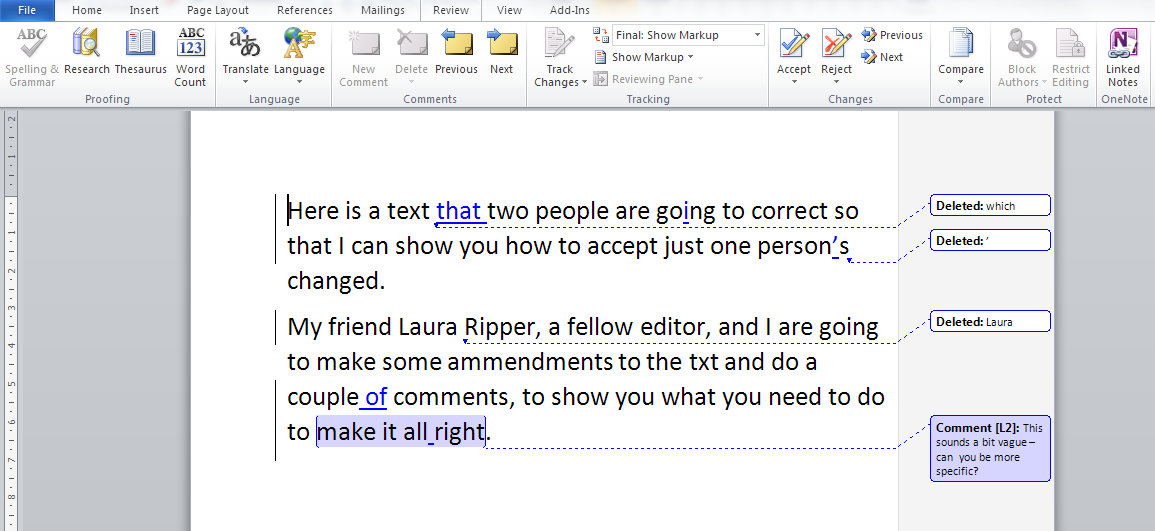
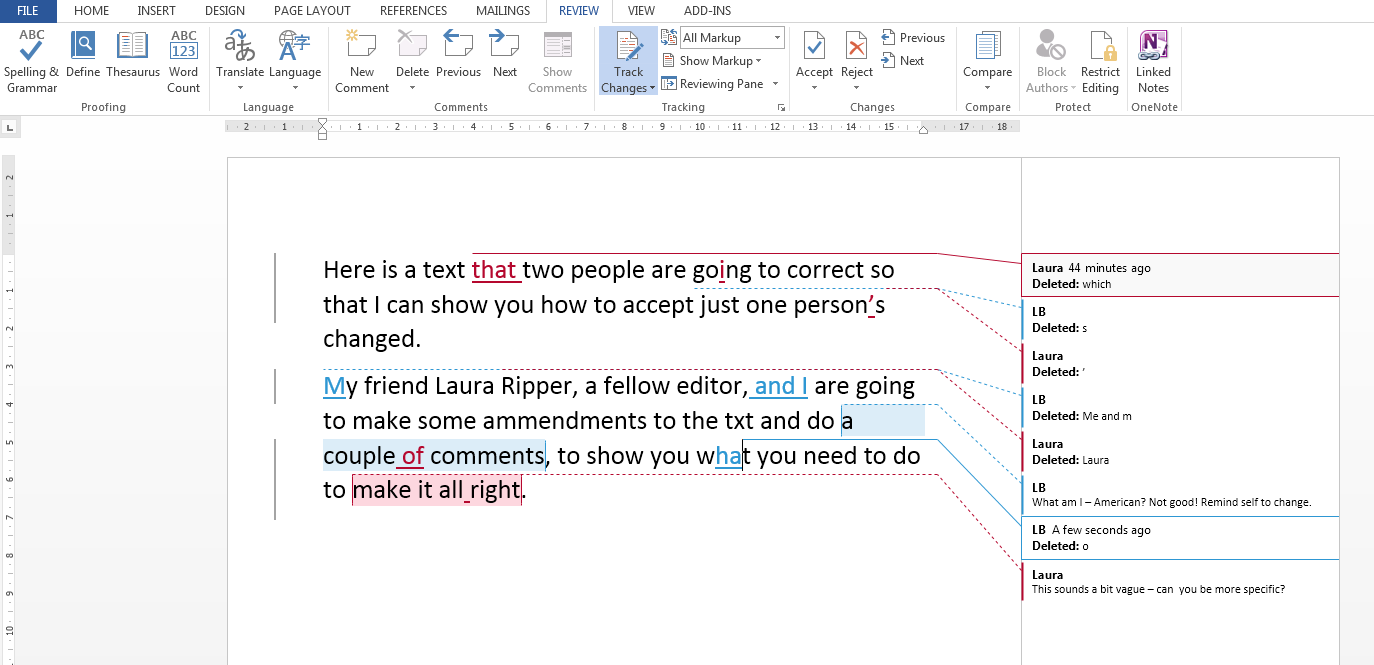
Here’s our text, with comments and corrections by two reviewers, shown in two colours. What I want to do is accept the changes made in blue and just end up with the ones in red to review.

Word 2010 two reviewers

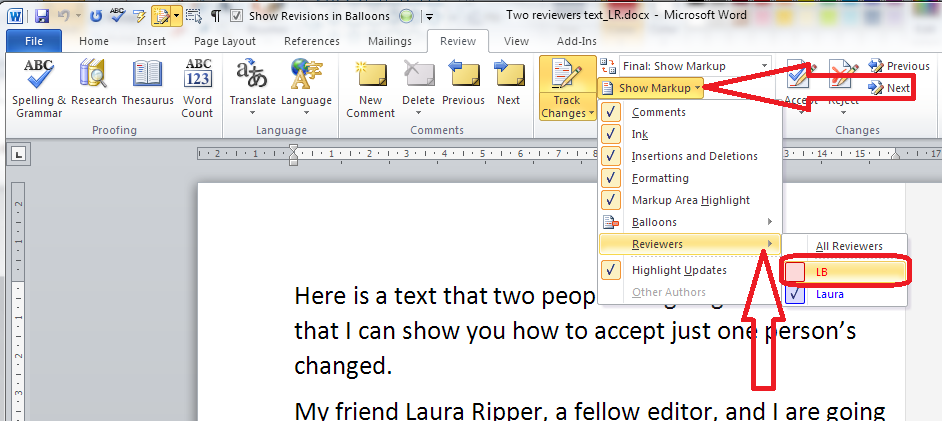
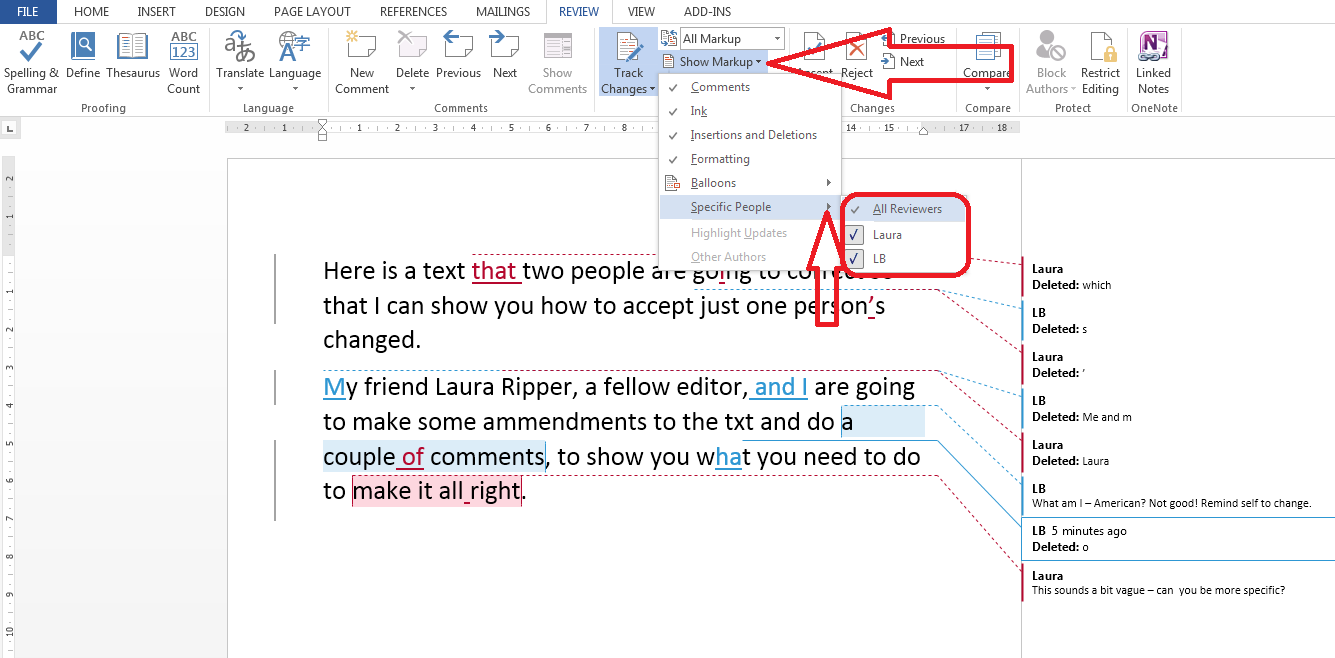
First of all, we need to show only one reviewer’s corrections. We do this in the Review tab, Track Changes area. Click on the arrow next to Show Markup and then Reviewers on the drop-down menu. This allows you to tick or un-tick by different names. IN this case, I want to interact with just the changes made in blue – the ones I want to accept. So I click on the tick box by the LB initials, to un-tick that box and only see Laura’s corrections:

Word 2010 show reviewers

Once I’ve done that, I can only see the blue corrections. Note that the red comment box has also disappeared. We only see comments and corrections by Laura, but the ones made by LB will still be there behind the scenes.

Word 2010 show one reviewer

Now I want to accept these blue changes. In the Review tab, Track Changes, I click on the arrow at the bottom of the Accept button and click Accept All Changes Shown (it’s important to pick this one – if I chose Accept All Changes in Document, all of the changes, hidden and visible, would be accepted).

Word 2010 accept changes showing

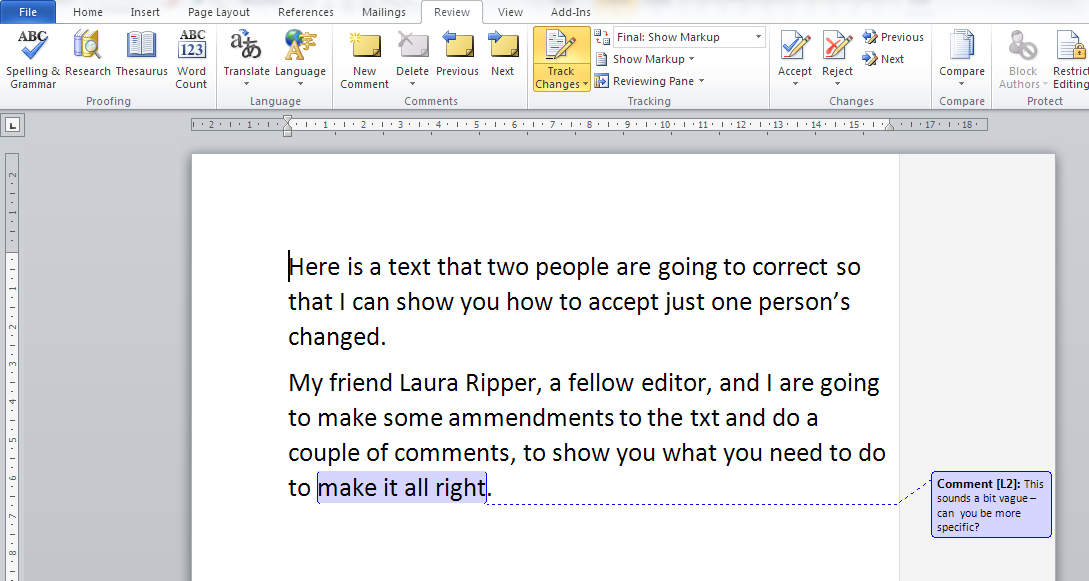
Now all of the blue changes have been accepted and only the comment by L[aura] is visible.

Word 2010 changes shown accepted

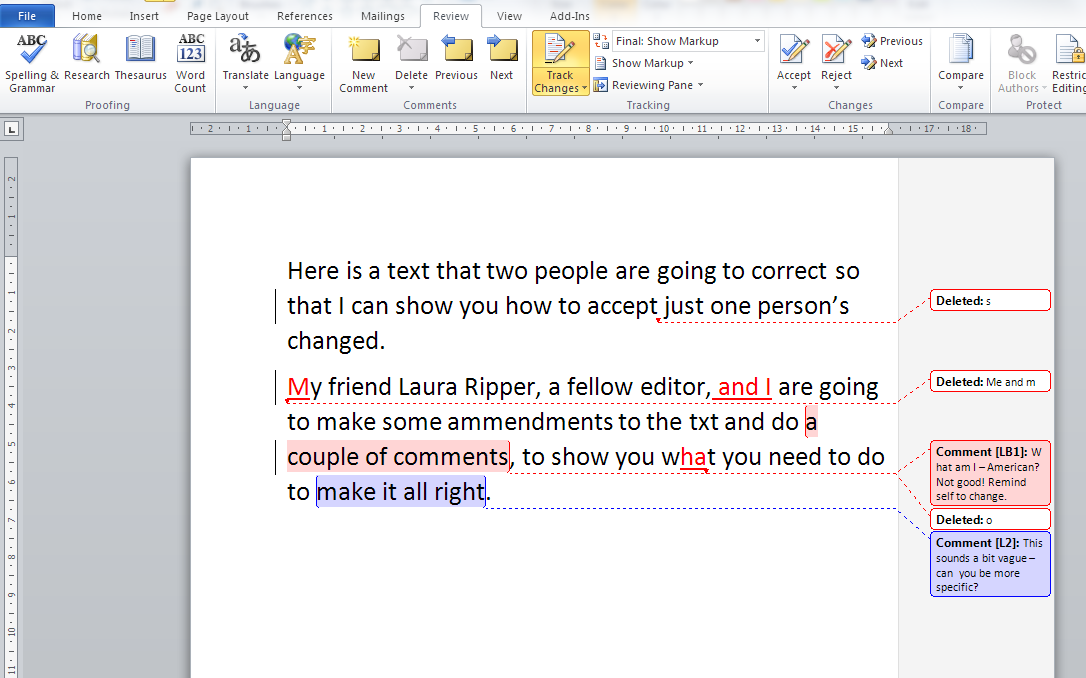
Just to prove that my corrections are still there, and in case I want to review those, we can view all reviewers by going back to Review – Track Changes – Show Markup – Reviewers and clicking in the box to tick LB:

Word 2010 show all reviewers

Now I can see the corrections in red and all of the comment boxes, and review them happily.

Word 2010 result

How do I see and accept one reviewer’s changes in Word 2013?

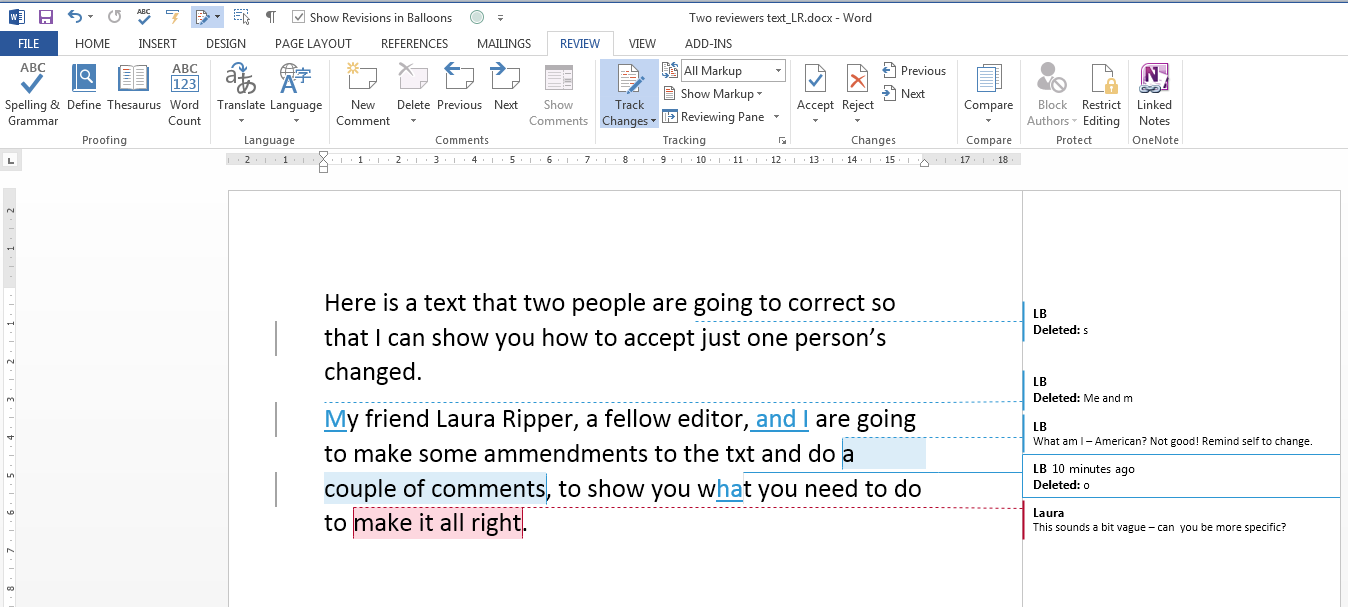
Here is our text commented on and corrected by two people. I want to view and accept the red changes made by Laura, then view my own ones in blue to review them (Yes, if you’re reading this all the way through, Word 2010 and Word 2013 chose the opposite colours for the two reviewers).

Word 2013 two reviewers


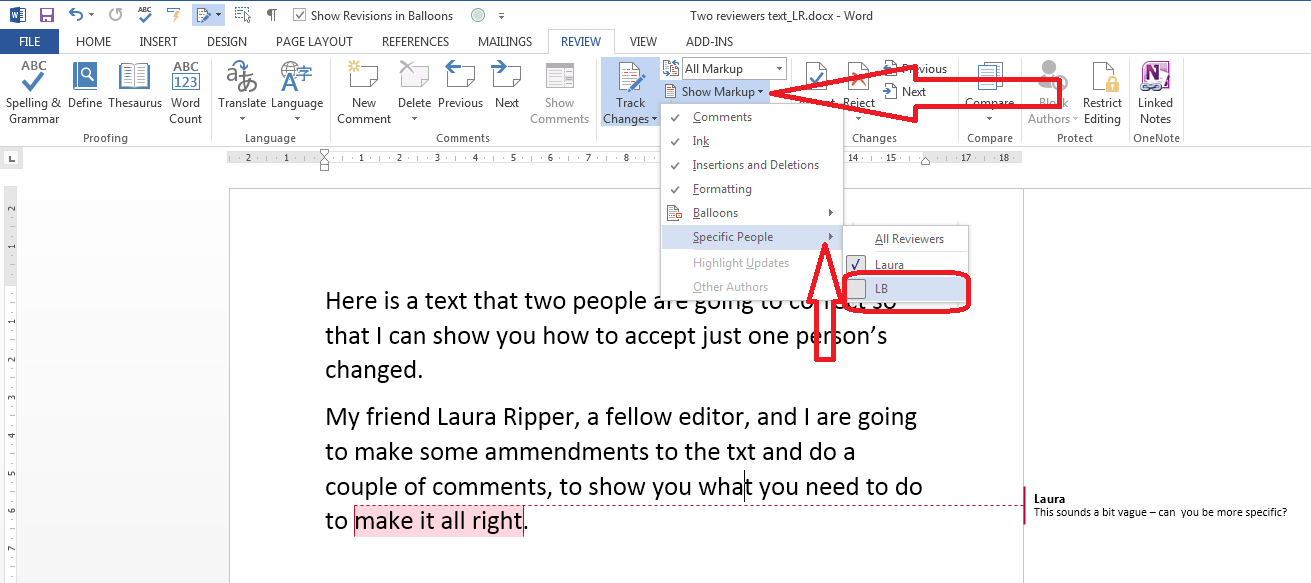
First we need to view only the blue corrections in order to accept only those ones. In the Review tab, Track Changes area, click on Show Markup then Reviewers. This gives us the option to tick or untick by each individual reviewer. Here, I’m going to untick LB.

Word 2013 show reviewers

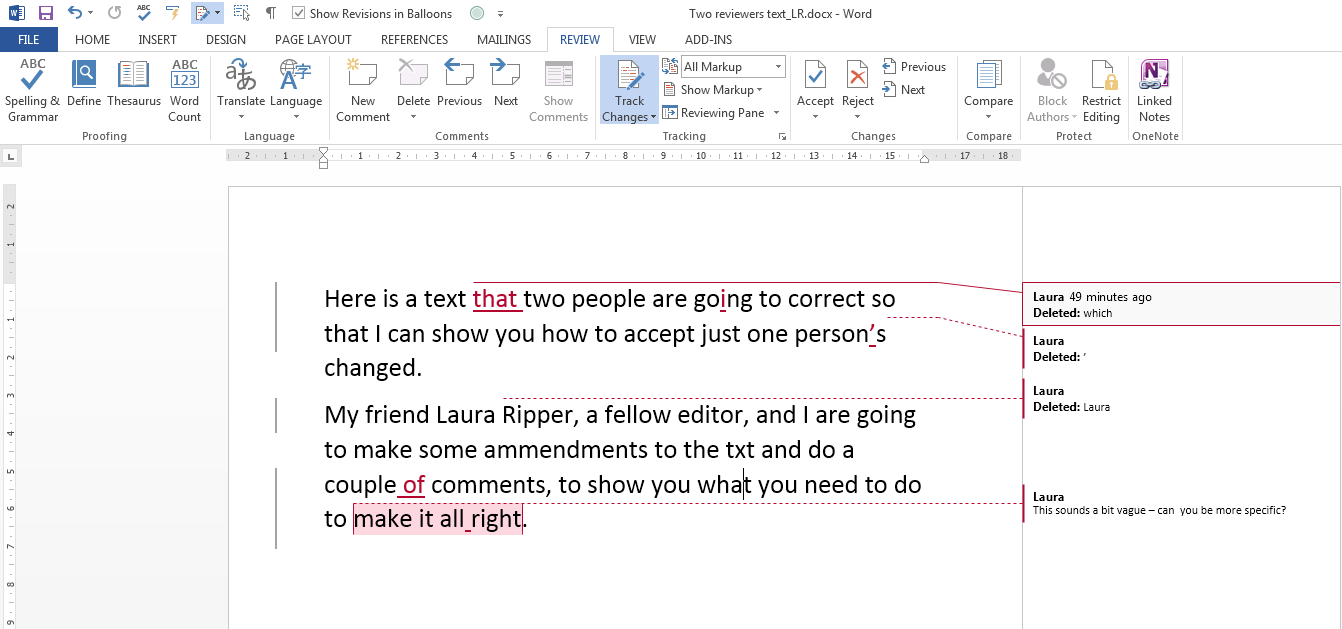
Now we can just see Laura’s changes in red.

3 2013 show one reviewer

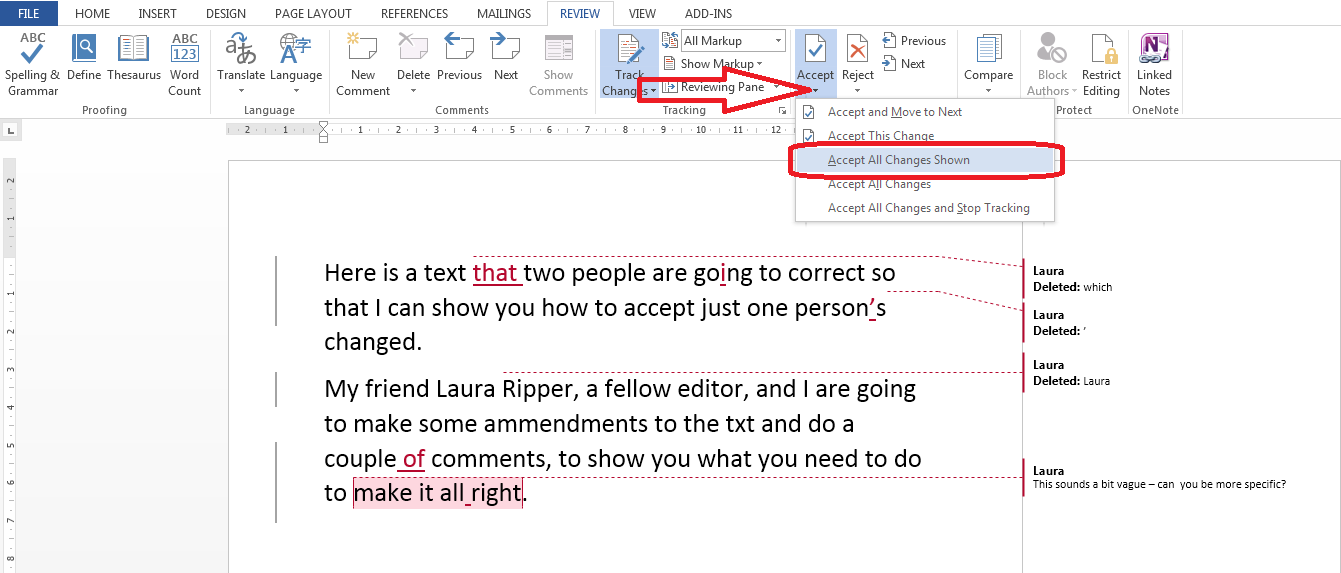
We can accept these changes by choosing Review tab – Track Changes area and clicking on the arrow at the bottom of the Accept button. Then, we choose Accept All Changes Shown (note, Accept All Changes will accept all of the changes, red or blue, visible or hidden: we don’t want that):

Word 2013 accept changes shown

Now all of the insertions and deletions have been accepted and we’re left with just the comment balloon:

Word 2013 changes shown accepted

To see and review the suggestions made in blue by me, we go back to Review tab – Track Changes area – Show Markup – Reviewers and re-tick by the LB:

Word 2013 show all reviewers

Now we can see all of the changes suggested by LB as well as the comments by both people.

Word 2013 one reviewer's corrections accepted

This is another one written when I had a specific need and had to go hunting around, so I hope you’ve found it useful. If so, please share using the buttons below or pop a comment on!

Please note, these hints work with versions of Microsoft Word currently in use – Word 2007, Word 2010 and Word 2013 all for PC. Mac compatible versions of Word should have similar options. Always save a copy of your document before manipulating it. I bear no responsibility for any pickles you might get yourself into!

This is part of my series on how to avoid time-consuming “short cuts” and use Word in the right way to maximise your time and improve the look of your documents. Find all the short cuts here

Related posts on this blog:

Track changes 1 – why use it, where can you find it, what can you do with it?

Track changes 2 – customising Track Changes

Track changes 3 – working with a document with tracked changes

Formatting comments balloons – everything you have ever wanted to know!

What to do if your comment boxes go tiny in Word – A common problem, hard to find the answer!

What to do if your comment box text runs right to left – Useful if you edit texts from Arabic authors

Changing the language in your comment balloons – From US to UK English and beyond …

 
14 Comments

Posted by on April 8, 2015 in Copyediting, Word, Writing


Tags: , , , , , ,

My business books are now available in print editions!

In case you’re not following my books blog but are interested in the books on starting and growing a business and specific aspects of business such as networking, social media and transcription as a career (and on lowering your cholesterol, that popular outlier to my oeuvre), I’m pleased to announce that all of my books are now available in print as well as e-book editions. Look – proof:

Business books by Liz Broomfield

You can read all about what I’ve been up to in this blog post.

I’ll be sharing a how-to on creating your print book in Amazon’s CreateSpace and I’ll let followers of this blog know when that happens.

 
6 Comments

Posted by on April 1, 2015 in Business, Social media, Transcription


Tags: , ,