RSS

Category Archives: Writing

Prone or supine?

I have found these words being mixed up in all sorts of contexts, from instructions to posters, and in all sorts of texts. I’ve also needed to look up which is which when following exercise or yoga instructions! Do you know the difference between prone and supine and do you use them appropriately? Or are they in fact different in the end at all?

Here’s another in my series of Troublesome Pairs to help you (and remember: if you have one for me, check the index then do send it over!).

Prone and supine both mean lying flat. But which way up, that’s the question.

Prone means lying flat, especially face downwards (Oxford Dictionaries). Collins online goes straight to the face-down aspect. Merriam-Webster have it as lying prostrate (adjective) or flat, and a second definition of lying front-downwards. According to all three of them, prostrate means lying flat with the face downwards (you prostrate yourself in front of an emperor, an altar, etc., so that makes sense, and Merriam-Webster, which is bigger than my one-volume Oxford, adds the air of worship to its definition, while Collins adds it to a definition of “prostrating yourself”).

Supine is unequivocably defined as lying flat, face upwards.

So prone can mean lying flat OR lying flat, face downards, prostrate adds an air of worship or respect and supine only means lying flat, face upwards.

You can find more troublesome pairs here and the index to them all so far is here.


Tags: , , ,

Student at risk of plagiarism 1: What to do when the student hasn’t referenced their text correctly

text with tracked changesPlagiarism is the act of passing someone else’s work off as your own. There are two kinds of plagiarism in student work: one is plagiarism done directly by a student, where they fail to reference or credit a quotation or theory and are effectively using someone else’s work without credit. The second kind of plagiarism is where an editor has done so much work on a student text that they’re almost a second author, and the student is then at risk of passing the editor’s work off as their own.

This article is written for editors who are working with student texts, whether that’s essays, dissertations, theses or articles for publication.

Let’s have a look at the levels of risk of plagiarism and an example of good practice when working with student materials when the editor is at risk of plagiarism from the level of work they’re doing on the text.

Often when working on student essays, dissertations and theses, I will come across a small example of a risk of plagiarism. This could include

  • A statement such as “researchers have found that” before an assertion, without a reference to who has found this information
  • A reference not being included after a quotation, where most of the quotations are referenced correctly
  • What is clearly a direct quotation which has not been placed in inverted commas, even if it’s got a reference after it, but this is an anomaly in an otherwise well-referenced document
  • What is clearly a direct quotation which has not been placed in inverted commas AND it hasn’t got a reference after it, but this is an anomaly in an otherwise well-referenced document

I count these as minor infringements and I will just mark these up with a comment asking the student to provide the reference, add inverted commas or rewrite the sentences in their own words.

I should mention here that I offer to re-check up to 10% of the total word count after rewrites; this feels fair to my student clients and I’ve never had anyone ask me to re-check as much as that: if it happens, it’s usually about 1%.

Red flags in referencing

Unfortunately, I do come across student texts (and this is not limited to students: have encountered web text and even books lifted from other sources without reference) where the following occurs:

  • What is clearly a direct quotation which has not been placed in inverted commas, even if it’s got a reference after it, happening multiple times
  • What is clearly a direct quotation which has not been placed in inverted commas AND it hasn’t got a reference after it, and this is happening multiple times, even pages and pages worth of direct quotations from other sources
  • A section in a different colour or font where no attempt has been made to hide this has come from elsewhere
  • A section where the client has either added a comment or put it in a particular colour and asked me to rewrite what is clearly a direct quote from elsewhere (this is thankfully rare)

How do I tell when something’s a direct quote that the student hasn’t either referenced or written themselves?

  • The standard of English changes, sometimes subtly, sometimes very obviously
  • The type of English changes (US to UK, s to z spellings, and vice versa)
  • Referencing within that section is markedly different to that within the student’s own work
  • It’s in a different colour or font

How do I check if text is not written by the student?

Google is my friend here? I take a sentence, pop it in Google and see where it came from. My suspicion that it’s someone else’s text are usually correct.

Sending feedback to the student and their supervisor

I try to be kind here. The student may be under a lot of pressure, or may not have understood how to do referencing. I will guide them to ask their supervisor or any support they have in the department or their university library.

It’s at this point that my articles on the two kinds of plagiarism coincide. if you’re following along with this series in real time, I’ve already written about what to feed back to the student and their supervisor and how to do it, so as to avoid making you wait for the punchline by doing it the other way round.

So to find out my good practice in contacting students and their supervisors over the risk of plagiarism, please see this article.

Related posts on this blog:

Student at risk of plagiarism 2: What do you do when the editor is at risk of changing too much?

Student at risk of plagiarism 3: Sending feedback to your student client and their supervisor

Plagiarism in business texts

On plagiarism

How to quote sources without plagiarising

Referencing for academic writing

Choosing a proofreader – student edition

My terms and conditions

Why has my proofreader not edited my bibliography?

On (not) crossing the line


Tags: , , , , ,

Student at risk of plagiarism 3: Giving feedback to your student client and their supervisor

text with tracked changesWhat do you do when you detect a risk of plagiarism in a student text and you need to give feedback to the student and possibly their supervisor? How do you stop a student feeling accused? How do you get confirmation from the supervisor that what you’re doing is acceptable by their institution?

In this post for editors working with student texts, I share the good practice I’ve developed over my ten years in operation when dealing with the two kinds of plagiarism I encounter in student work:

  • Plagiarism conducted directly by a student who does not reference or credit quotations, results and theories (therefore passing other people’s work off as their own)
  • Plagiarism that arises when you as the editor are doing far too many corrections and effectively risking co-writing the text (therefore risking the student passing your work off as their own)

I will write about these two risks of plagiarism in two further articles which I will link to here when they’re published. I’m publishing this one first to avoid leaving readers who are reading along dangling, as this article covers both types of plagiarism and is referenced at the ends of both articles as the end point of their processes.

What do I do if I encounter or risk enabling plagiarism?

Once I’ve realised a text is at risk of plagiarism (and in my experience, both kinds often come together in a text), I will follow these levels of action/escalation:

  1. Stop working on the text*
  2. Contact the student client immediately
    1. Explain what the problem is
    2. Offer solutions the client can use (go through the text, find where you’re missing references or need to show direct quotes/reference and insert those, etc.)
  3. The student client will get back to me with one of two answers
    1. “I will amend the text and send it back to you”. If that happens, great, and if they’ve done it correctly, I carry on working on the text
    2. “It’s OK, just rewrite the direct quotes”/”Just make the changes to my sentences, my tutor says it’s OK”. If that happens, I go to step 4
  4. It’s time to stop the work or ask for contact from the supervisor:
    1. If 3. i has occurred, I reiterate that the student must write direct quotes in their own words and I can’t do that for them. If an impasse is reached, I state I cannot work on the text any more and invoice the student client.**
    2. If 3. ii has occurred, I ask the student to provide me with evidence that their supervisor has approved the level of work I need to do on the text
      1. I send the student the text that I have amended so far, asking them to present that to their supervisor (I might in an extreme case save this as a PDF to prevent them accepting all changes and then just going and using someone else for the next part)
      2. I ask for either a letter from the tutor on headed paper OR a direct email from the supervisor instructing me to do this work. I leave this up to the student to do. This helps them not feel I’m reporting on them (as I say in Part 2, this is often down to stress, pressure or lack of understanding rather than explicit wrongdoing) and it saves me having to try to contact the supervisor myself.
  5. Depending on what I hear from the supervisor, conclude the work relationship or continue working:
    1. If I hear back from the supervisor in the negative, I stop work, invoice the client and keep the letter from the supervisor for a period of time
    2. If I hear back that I can continue, I continue with the work, present it to the client and save the tutor’s letter with the work files

* I have a statement in my terms and conditions that I will invoice for any work done before I detect plagiarism. I charge by the word, so I check the word count and invoice based on that.

** I will always suggest to the student that they contact their student support services, often attached to their department or library, who can give help with language issues and referencing procedures. I see my role as helping, not blaming or punishing the student for their mistake.

This article has outlined what I do to provide feedback to the student client and their supervisor when I encounter plagiarism in student work. My resources this website about plagiarism are listed below. Do comment if you use another good method or have used this one with success.

Related posts on this blog:

Student at risk of plagiarism 1: When the referencing is missing

Student at risk of plagiarism 2: When the editor is at risk of doing too much

Plagiarism in business texts

On plagiarism

How to quote sources without plagiarising

Referencing for academic writing

Choosing a proofreader – student edition

My terms and conditions

Why has my proofreader not edited my bibliography?

On (not) crossing the line


Tags: , , , , ,

How to customise your contents page in Word

It’s Word Tips time again and today we’re going to talk about customising your contents page.

Why do people customise their contents page?

Sometimes you have lots and lots of sub-headings in a document but you only want to show the main or main and sub-headings on the contents page, not every tiny sub-sub-heading.

In addition, you might want to change the style of your contents page or its individual font and layout. Here’s how to do it, with a worked example of changing the levels that are shown.

Reminder: how do I insert a contents page?

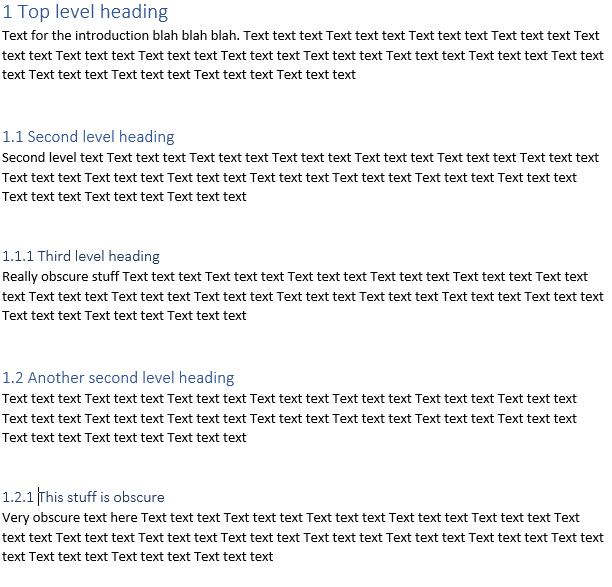
Here’s our document, with headings at H1, H2 and H3 level. I’ve marked these up with their heading levels already (see here for how to assign heading levels).

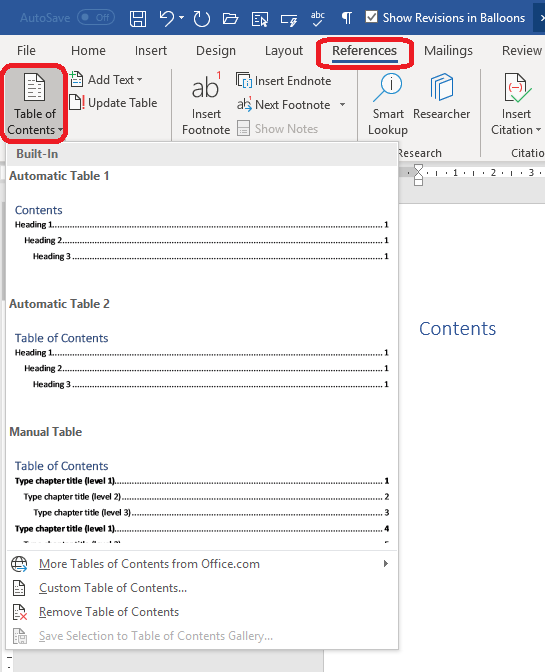
If we just follow the usual process for inserting a table of contents, we will create a blank page before this one, then go to the References tab and choose Table of Contents, then click on one of the automatic options that come up.

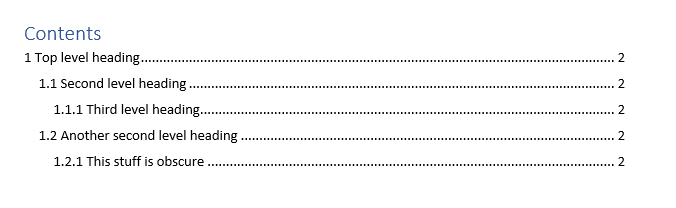
This is the result: a table of contents that includes all the headings in our original text:

How do I select which heading levels appear in my Table of Contents?

If you want to ignore all headings below level 2 (1.1, 1.2) then you need to customise the table of contents.

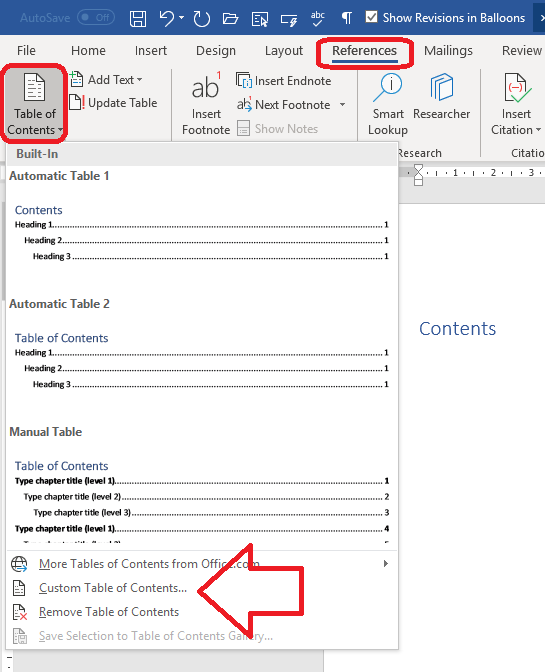
As before, select the References tab and the Table of Contents button. However, now click on Custom Table of Contents

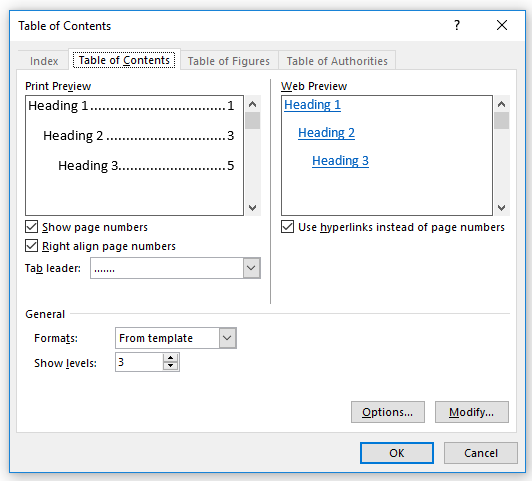
This will give you this dialogue box:

There are lots of different things you can do here. For example, you can choose to show or not show the page numbers in the table of contents, and whether or not to align them. The preview panes at the top will show you the results before you click OK.

Options allows you to choose the style for the table of contents from a set of heading styles, and Modify then Modify again allows you to completely customise the appearance of the table of contents text permanently, with underlining, different fonts, etc.

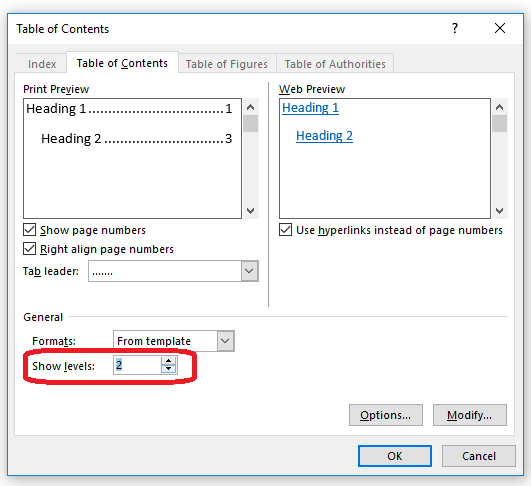
At the moment, we’re concerned with eliminating the level 3 headings from the table of contents.Click on the arrows by Show levels to adjust how many levels are displayed:

And click OK. Here we have changed the number of levels to 2, and the result is this:

Even though the text still has the same headings and levels it had before, the table of contents now just includes those headings down to Level 2

This is part of my series on how to avoid time-consuming “short cuts” and use Word in the right way to maximise your time and improve the look of your documents. Find all the short cuts here … Please note that these tips are for Word 2010 and later for Microsoft. I can’t guarantee or check they will work in Mac versions of Word.

Do let me know if this has helped you – and do share with the buttons at the bottom of this article.

Related articles on this website

How to use headings styles – make your headings clear and consistent

How to set up numbered headings – ones that automatically update themselves!

How to create a Table of Contents – read the posts on Headings first

Table of Figures and Table of Tables – how to create these tricky ones

How do I add or remove auto-captions?

Two-line caption, one-line entry in the Table of Figures: how?

How to update Tables of Contents, Figures and Tables

Tables of Contents for editors – helping the editing process run smoothly


Tags: , , , ,

Mandolin or Mandoline?

Thank you to my husband Matthew for suggesting this one (he’s quite the fount of troublesome pairs, so watch out for more of his ones as we go through this new set of them), after he discovered himself that these two are in fact two different things.

So what’s the difference between a mandolin and a mandoline?

A mandolin is a musical instrument which is like a lute, with pairs of metal strings that are played using a plectrum.

A mandoline (which can also be spelled mandolin, hooray!) is that vegetable slicer thing (a flat body with adjustable slicing blades) that always looks like it will take your finger off.

“She was playing the mandolin, being careful not to hurt her fingers on the metal strings, while he cut vegetables using the mandoline, bring careful not to slice his fingers on the metal blades.”

You can find more troublesome pairs here and the index to them all so far is here.

 
3 Comments

Posted by on February 20, 2019 in Errors, Language use, Troublesome pairs, Writing


Tags: , , ,

Arc or arch?

When is an arc an arch? Is an arc ever in fact an arch?

An arc is first of all a curve that is made up of part of the circumference of a circle. So it has a particular form which may well be like that of an arch, but it’s always part of that circumference in this case. It can also be the electrical discharge that jumps from one point to another (so lightning forms an arc: not in this case a nice tidy bit out of a circumference) and finally we have the metaphorical use in a “story arc” in a fiction book, film, TV series or play (often across several episodes of a TV series) which traces the development of a plot or side plot. The verb to arc means to move with a curving trajectory, which could include arching over something.

An arch is a physical thing rather than a mathematical concept or a plot device (though you can have over-arching ideas that act as a sort of umbrella across a narrative or other story). So it’s a symmetrical curved (though that curve can be quite pointy) structure that supports a bridge, a wall, etc. It’s also the inner side of the foot, which is the same thing but in nature rather than constructed. The verb means to form an arch.

So an arc has a specific shape unless it doesn’t, and an arch is a physical thing unless it’s a metaphor. But you don’t have a story arch and most arches couldn’t be said to form part of a circumference of a circle.

You can find more troublesome pairs here, and here’s the index to them all!

 
6 Comments

Posted by on February 6, 2019 in Troublesome pairs, Writing


Tags:

Upmost or utmost?

In this series of “Troublesome Pairs” I discuss words which people get easily confused, or where it’s not clear what the difference is between them – if indeed there is a difference. Some of these I find in my work, some out in the world at large, and some are suggested to me by friends, family and colleagues (do get in touch if you have a good one for me that I haven’t written about yet!). Some of the words are homophones (words that sound the same), some just seem to get people confused.

So today we’re looking at upmost and utmost. Words with just one letter different can be easily confused – even more so when they sound very similar. Do you confuse upmost and utmost? Here’s the difference.

Upmost is also spelled uppermost, and that might be the best one to stick with if you do mix these two words up. Uppermost means at the top, the highest in importance or rank or level.

Utmost means most extreme, the greatest amount or extent of something. That doesn’t neccessarily mean the highest of something like upmost.

“I did my utmost in training to appear on the upmost reaches of the chart showing who could lift the heaviest weight.”

You can find more troublesome pairs here, and here’s the index to them all!

 
1 Comment

Posted by on January 23, 2019 in Troublesome pairs, Writing


Tags:

Constantly or consistently?

What’s the difference between constantly and consistently? Find out below …

Constant means remaining the same but its primary meaning is happening continuously, and it also has a metaphorical meaning of dependable and faithful. So to do something constantly means to do it all the time, as well as remaining constant or the same (and also doing it dependably).

Consistent means done in the same way over a long period of time, including an attribute of fairness and accuracy. It also means being compatible with (as in x was consistent with y). So doing something consistently means doing it in the same way over a long period of time, which does echo the secondary sense of constantly, but constantly also includes a sense of doing it continuously, which consistently doesn’t.

For example, I am constantly taking photos that I put up on social media, every day if not more; I consistently post a books of the year round-up on the first of January every year.

You can find more troublesome pairs here and the index to them all so far is here.

 
4 Comments

Posted by on January 9, 2019 in Errors, Language use, Troublesome pairs, Writing


Tags: , , ,

What happens to your website statistics when you drop the ball with your blogging?

When you have a professional website with a blog attached, what happens to your reader stats if you stop blogging? I did not do this experiment solely for this blog, but I thought it would be interesting to have a look at what happened when I had a blogging hiatus.

I haven’t updated this blog for six months. How did that happen? I’ll explain below. What am I going to do about it? Start blogging again, I hope …

Why did I stop writing blog posts?

Back in the summer, I made the decision to stop working at weekends. Working in this case included both paid editing, proofreading, localisation and transcription work and the additional marketing tasks like blogging, writing articles, responding to blog comments, etc. I did have to make the odd exception when work levels were high or I’d taken time off during the week (or had a holiday) but by and large I’ve stuck to this and am happier, less tired and more balanced as a result. OK, I took up a new hobby as an Endurance (cross-country and road relays) running official and lately a Track and Field official, which has involved weekend training courses and time standing around in muddy fields or boiling hot infields, but that’s a healthy, outdoors hobby.

However, the anticipated drop in paid hours didn’t happen. In fact, in 2018 I have brought in around 12% more revenue than in each of the two previous years, on average, I’ve worked the same number of hours per week, and I’ve in fact had fewer low-paid-hours weeks this year. So what had to give? Blogging.

This was exacerbated by the fact that, while my blog still obviously displays my knowledge of Word, language, business, etc., and channels people to buy my business books (still going just as strong as ever), I have been fortunate enough to have sustained my customer base through a lovely set of regular clients and through their recommendations to others. Added to this, over the nine years I’ve been self-employed, I’ve moved from a model of working with lots and lots of small jobs, editing Master’s thesis for overseas students, etc., to longer-term projects working with regular translator clients and writers / ghost-writers, so work has been more predictable, and I haven’t really needed my blog to funnel customers to me like I once did.

So it slipped. Should I just let it go?

What happens when you stop writing new posts on your blog?

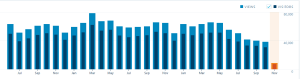
Because December is always a low-traffic month anyway, I’m sharing stats from July 2016 through to the end of October 2018. Although there are peaks and troughs always, with March always being busy with those students and their Master’s dissertations searching how to put bibliographies in alphabetical order, you can see the drop-off in the latter few months of the cycle. That’s when I stopped blogging.
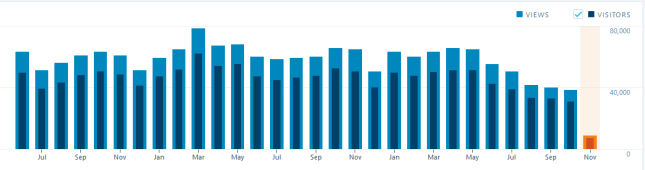
It’s pretty well-known that Google and other search engines like regularly updated content to index. That’s why I and others tell people to keep blogging and/or updating their website regularly. So I knew this, and the stats show it.

What am I going to do with my blog? Should I give up blogging?

Although I don’t feel at the moment that I NEED to write and publish lots of blog posts, I’m going to get back into it. How, I will share below. There are a couple of reasons WHY:

  • Although I have sufficient clients now, especially with lots of them being in Europe and the threat of Brexit looming, I can’t assume that will continue to be the case (small independent sole traders like me have had no advice from the government or HMRC). So it’s good to keep marketing yourself even when you’re busy. I am fortunate enough to have lots of lovely colleagues I can pass work to that I can’t take on at the moment.
  • I enjoy helping people. I get a buzz when I receive a comment saying I sorted out someone’s problem, or one of my Small Business Chats interviewees thanks me for a referral they received from my site. I do my job because I like helping people, and the blog allows me to help more of them while I’m doing other things!
  • I loved finding out what my Small Business Chat interviewees were up to and how they were getting on, and learning from their journeys. I don’t want to lose those connections.

What’s the plan?

I’m going to use my time wisely. Over the festive break, I’m going to add the flesh to the bones of a load of ideas I’ve put in my blog post drafts and get them all ready to schedule through the year (the plan there is to see how many I can get written and then distribute them evenly through the next year, keeping an eye on what’s about to publish as I go through the year in case there’s some awful clash between a light-hearted Troublesome Pair and a horrible news item).

I’m going to get in touch with my January 2018 Small Business Chat people as normal for their updates, but I’m also going to contact all the June-December 2017 ones I never got back to, see if they want to continue to take part and slot them in until I can spread them evenly through the year again. I will point them here and hope they appreciate my honesty and openness and continue to take part.

Over to you …

Have you paused your blog (especially a professional one) and started up again? What did you learn or change? Are you one of my abandoned Small Business Chat folk? Would you like me to continue featuring you again or has that series run its course? Have you enjoyed reading those posts? Have you, well, missed me?
 
21 Comments

Posted by on December 27, 2018 in Blogging, Business, Marketing, Writing


Tags: , , , , , ,

I want to publish my book but I’m confused! Do I need an editor, a line editor or a proofreader?

a hand writing in a bookI was recently writing back to a prospective client who had got very confused about the different types of editing and proofreading and the process needed for publishing their book. I sent them some resources from this blog and thought it might be useful to share those here, too.

So, here are some articles I’ve written about the different kinds of editing, the process of editing and proofreading (and where your beta readers fit in to that process) and how to make sure your editor and proofreader are, ahem, on the same page. At the bottom are two articles I’ve written about how to deal with an editor – that can feel like an alarming process in itself, so hopefully I’ll reassure you there!

This one talks about the different kinds of editing and proofreading (it’s biased towards fiction but also works for non-fiction):

Do I need editing or proofreading?

This one sets out the processes you go through and their order:

What questions should I ask my beta readers? #amwriting

It’s certainly best to have different people do the edit and final proofread, as it’s not great to have the same eyes going over and over a text (that’s why we can’t proofread our own work!). If you use two people for these stages, make sure your editor provides you with a style sheet to pass on to your proofreader – more on style sheets here:

What is a style sheet? For people using editors

And when you’re ready to talk to an editor (or proofreader), here are two articles explaining that side of the process, so you and your prospective editor can experience a smooth process and happy negotiation:

How to request a quotation from an editor:

Working with an editor 1: How do I request a quote from an editor or proofreader? #amwriting

Ideas on negotiating and booking in your project:

Working with an editor 2: How do I negotiate with an editor or proofreader and book my project in? #amwriting

I hope you’ve found this very quick guide to dealing with the complexities of getting your book edited and proofread, and how to deal with contacting an editor, useful. If you have, please share this article using the buttons below, or leave me a comment. Thank you!
 
5 Comments

Posted by on June 27, 2018 in Copyediting, proofreading, Writing


Tags: , ,