RSS

Author Archives: Liz Dexter

Unknown's avatar

About Liz Dexter

Book blog is at http://www.librofulltime.wordpress.com Writer, proofreader, editor, transcriber. Also runner, gym-goer, volunteer and BookCrosser! My married name is Liz Dexter but my maiden name and the name on the books I write is Liz Broomfield.

Getting your business ready for no-deal Brexit if you don’t pay VAT – EORI number registration

HMRC state UK businesses need an EORI number to trade with Europe after a no-deal Brexit.

I received this email from HMRC yesterday and I suspect I only received it because I signed up for their update emails (none of the others of which have been useful so far). I am just putting it here for people to see – I’ve been through the process and got my number (but when they give it to you, copy and paste the page into your own records otherwise you have to go back in and search for it once you’ve been approved). You need a Government Gateway login to access it.

This is not legal or business advice, I am merely sharing what I’ve been sent in case it helps any other sole traders who are not VAT-registered.

Dear Liz,

The Government has said that the UK will be leaving the EU on 31 October whatever the circumstances.

Leaving the EU without a deal means there will be immediate changes to the way UK businesses trade with the EU that may impact your business.

  • UK businesses will have to apply customs, excise and VAT processes to goods sold into the EU (these are the same rules that already apply for goods and services traded outside of the EU).
  • Trading partners in the EU will have to apply customs, excise and VAT processes to trade they carry out with you, in the same way that they do for goods and services traded from outside of the EU.

HMRC is helping businesses get ready for Brexit by automatically issuing them with a UK EORI (Economic Operator Registration and Identification) number. We have written to more than 88,000 VAT registered companies to let them know the UK EORI number they’ve been assigned. Businesses will not be able to move goods in and out of the UK without one.

If your business is not VAT-registered, you will still need to apply now for a UK EORI. HMRC cannot give you this automatically.

You can check the next steps you need to take to ensure that your business is ready for Brexit using our trader checklist.

We will continue to provide you with the latest guidance and support to help you prepare your business for the UK leaving the EU.

You can sign up for HMRC emails here.

You can register for Government Gateway here.

Not legal advice. Not tax advice. Sharing what I’ve been sent.

 
Leave a comment

Posted by on August 23, 2019 in Brexit, Business


Tags:

Can I print a Word document to PDF and retain the tracked changes?

If you want to print or save a Word document to change it into a PDF, and you have Tracked Changes showing in the Word document, will those tracked changes still show up in the PDF?

I needed to check this myself this morning, so now I’ve confirmed what happens, I thought I’d write a quick article about it, on the grounds that if I’ve had to check, someone else will need to, too (bloggers: this is a good way to inspire blog posts if you’re lacking ideas!).

So here is the definitive answer to the question Can I save a Word document as a PDF and keep the tracked changes showing.

Why save a Word document with tracked changes into a PDF?

This came about because I was discussing plagiarism with a colleague and explaining what I do if I need to confirm from a client’s supervisor that it’s OK to make as many changes as I’m making to their text. I mentioned that sometimes I will send over a copy of the work so far, and sometimes I’ll go as far as to turn the Word document into a PDF so it can’t be altered between me and the supervisor. But will the tracked changes still show up?

Proof that tracked changes still show on the PDF

So here’s my Word document, complete with tracked changes (make sure these are showing):

A word document with tracked changes

Just a reminder that in the newer versions of Word you can save to a PDF automatically without having to go through third-party software. Choose File – Save As then drop the file type down to choose PDF:

Save Word as PDF

Then when you open it in your PDF reader (I use PDF-XChange Viewer), there are all the tracked changes!

Tracked changes showing in PDF

So, if you want to preserve your tracked changes so they can’t be, um, well, changed, printing to PDF will give you an image of them you can share.

I hope you’ve found this useful – do click the Like or Share buttons or comment if I’ve helped you out!

Please note: these tips work for Microsoft Word version 2007 and upwards. They are not guaranteed or tested for Word for Mac.

Other track changes articles on this website

Track changes 1 – why use it, where can you find it, what can you do with it?

Track changes 2 – customising Track Changes

Track changes 3 – working with a document with tracked changes

How do I accept one reviewer’s changes?

Why are my tracked changes changing colour?

How do I get rid of tool tips on tracked changes?

 
Leave a comment

Posted by on July 24, 2019 in Copyediting, proofreading, Skillset, Word


Tags: , , , , , , ,

Student at risk of plagiarism 2: What do you do when the editor risks changing too much of the text?

text with tracked changesPlagiarism involves passing someone else’s work off as your own. There are two kinds of plagiarism: there’s plagiarism done by the student when they don’t reference or credit a quotation or theory and are therefore effectively using someone else’s work without credit (which I’ve written about here). The second kind of plagiarism, which we’re talking about here, is where an editor has done so much work on a student text that they’re almost a second author, and the student is then at risk of passing the editor’s work off as their own.

I have written this series of articles for editors who are working with documents produced by students: an essay, thesis, dissertation or article, for example.

Let’s have a look at the levels of change an editor might make when working with student materials and how to tell when the editor is at risk of plagiarism from the level of work they’re doing on the text.

Usually when working on student essays, dissertations and theses, I will come across issues with the language and writing:

  • Uses capitals and hyphens inconsistently
  • Uses British and American spellings (or British s and (Oxford) z spellings) inconsistently
  • Uses inverted commas for quotations and scare quotes inconsistently
  • Uses the wrong tenses
  • Uses the wrong agreements (he have, they has)
  • Includes typos (form/from)
  • Has a sentence structure which is confused BUT I can tell they understand what they’re writing about and have made a good attempt to write that in English (English is not the first language of most of my student clients)

There’s an accompanying issue with the reference list or bibliography, so a minor issue would be:

  • Some mistakes and inconsistencies in the bibliography, where I’m not changing more than about one in ten entries in a major way (turning book titles into italics, etc.) or one in five in a minor way (full stops after initials, making spacing of initials consistent)

In these cases I will (with Track Changes turned on, of course!) and make it all consistent and amend the tense, agreement, typo or sentence.

And, if I find

  • A theory or term which is not explained
  • A sentence which can be taken in one of two ways, and it’s not clear what it means
  • A sentence or paragraph which is jumbled or confused and I can’t make it out

I will leave the sentence and add a comment explaining that the term needs to be explained, what the ambiguous sentence could mean or that I can’t understand it and the student needs to rewrite it.

And if there’s

  • A reference that’s missing publisher or place, journal volume, etc. information

I will add a note that the student needs to check and add the relevant information

It’s probably worth mentioning here that I offer to re-check up to 10% of the total word count after rewrites; this feels fair to my student clients and I’ve never had anyone ask me to re-check anything like that amount of text.

But what if it’s more major changes and the resulting risk of plagiarism?

More major issues would include

  • Confused use of terms which clearly show a lack of understanding of the subject (this sounds nebulous but jumps out in real-life examples, none of which I can obviously show you!)
  • Garbled results which don’t make sense
  • Many sentences which aren’t at all clear or, if I can guess the meaning, would need a complete rewrite to make them at all clear – and I start having to do that
  • A completely chaotic bibliography with no attempt to make it consistent or match it to the style guide which needs work on almost every entry

If any (or all) of these are present in the text, and I’m making a lot of comments on the text, plus a lot of the changes in the above sections, I will get to a certain point (usually 1,000-2,000 words in), have a look at what I’ve done, and make a judgement as to whether I’m risking changing too much.

It’s all done in Tracked Changes so surely I’m not writing it for them!

Yes, we do everything in Tracked Changes as standard, and I have standard text which asks the client to examine all changes and decide if they accept or reject them. However, there is an “Accept All Changes” button and with the best editor will in the world, some students will just press that. How much of the work then is theirs?

What do I do if I find I’m doing too much on a text?

I want to highlight here that this is often not the student’s intentional fault. This applies to referencing, too, and it’s often to do with the learning they’ve received in their home country, the pressures of having to write in their non-first language, and pressures from home around getting this UK or US degree and bringing that knowledge home. But I believe we have a duty to help the student not plagiarise. In the case of referencing, this will get caught by software used by the universities such as TurnItIn. In the case of our work, it might not be so detectable, although a supervisor presented with perfect English by a student who struggles to write in English may be suspicious. We want to help our clients and make sure they don’t get accused of something they didn’t intend to do.

Sending feedback to the student and their supervisor

It’s at this point that my articles on the two kinds of plagiarism coincide. if you’re following along with this series in real time, I’ve already written about what to feed back to the student and their supervisor and how to do it, so as to avoid making you wait for the punchline by doing it the other way round.

So to find out my good practice in contacting students and their supervisors over the risk of plagiarism, please see this article.

Related posts on this blog:

Student at risk of plagiarism 1: What do you do when a text isn’t referenced properly?

Student at risk of plagiarism 3: Sending feedback to your student client and their supervisor

Plagiarism in business texts

On plagiarism

How to quote sources without plagiarising

Referencing for academic writing

Choosing a proofreader – student edition

My terms and conditions

Why has my proofreader not edited my bibliography?

On (not) crossing the line


Tags: , , , , ,

Prone or supine?

I have found these words being mixed up in all sorts of contexts, from instructions to posters, and in all sorts of texts. I’ve also needed to look up which is which when following exercise or yoga instructions! Do you know the difference between prone and supine and do you use them appropriately? Or are they in fact different in the end at all?

Here’s another in my series of Troublesome Pairs to help you (and remember: if you have one for me, check the index then do send it over!).

Prone and supine both mean lying flat. But which way up, that’s the question.

Prone means lying flat, especially face downwards (Oxford Dictionaries). Collins online goes straight to the face-down aspect. Merriam-Webster have it as lying prostrate (adjective) or flat, and a second definition of lying front-downwards. According to all three of them, prostrate means lying flat with the face downwards (you prostrate yourself in front of an emperor, an altar, etc., so that makes sense, and Merriam-Webster, which is bigger than my one-volume Oxford, adds the air of worship to its definition, while Collins adds it to a definition of “prostrating yourself”).

Supine is unequivocably defined as lying flat, face upwards.

So prone can mean lying flat OR lying flat, face downards, prostrate adds an air of worship or respect and supine only means lying flat, face upwards.

You can find more troublesome pairs here and the index to them all so far is here.


Tags: , , ,

Student at risk of plagiarism 1: What to do when the student hasn’t referenced their text correctly

text with tracked changesPlagiarism is the act of passing someone else’s work off as your own. There are two kinds of plagiarism in student work: one is plagiarism done directly by a student, where they fail to reference or credit a quotation or theory and are effectively using someone else’s work without credit. The second kind of plagiarism is where an editor has done so much work on a student text that they’re almost a second author, and the student is then at risk of passing the editor’s work off as their own.

This article is written for editors who are working with student texts, whether that’s essays, dissertations, theses or articles for publication.

Let’s have a look at the levels of risk of plagiarism and an example of good practice when working with student materials when the editor is at risk of plagiarism from the level of work they’re doing on the text.

Often when working on student essays, dissertations and theses, I will come across a small example of a risk of plagiarism. This could include

  • A statement such as “researchers have found that” before an assertion, without a reference to who has found this information
  • A reference not being included after a quotation, where most of the quotations are referenced correctly
  • What is clearly a direct quotation which has not been placed in inverted commas, even if it’s got a reference after it, but this is an anomaly in an otherwise well-referenced document
  • What is clearly a direct quotation which has not been placed in inverted commas AND it hasn’t got a reference after it, but this is an anomaly in an otherwise well-referenced document

I count these as minor infringements and I will just mark these up with a comment asking the student to provide the reference, add inverted commas or rewrite the sentences in their own words.

I should mention here that I offer to re-check up to 10% of the total word count after rewrites; this feels fair to my student clients and I’ve never had anyone ask me to re-check as much as that: if it happens, it’s usually about 1%.

Red flags in referencing

Unfortunately, I do come across student texts (and this is not limited to students: have encountered web text and even books lifted from other sources without reference) where the following occurs:

  • What is clearly a direct quotation which has not been placed in inverted commas, even if it’s got a reference after it, happening multiple times
  • What is clearly a direct quotation which has not been placed in inverted commas AND it hasn’t got a reference after it, and this is happening multiple times, even pages and pages worth of direct quotations from other sources
  • A section in a different colour or font where no attempt has been made to hide this has come from elsewhere
  • A section where the client has either added a comment or put it in a particular colour and asked me to rewrite what is clearly a direct quote from elsewhere (this is thankfully rare)

How do I tell when something’s a direct quote that the student hasn’t either referenced or written themselves?

  • The standard of English changes, sometimes subtly, sometimes very obviously
  • The type of English changes (US to UK, s to z spellings, and vice versa)
  • Referencing within that section is markedly different to that within the student’s own work
  • It’s in a different colour or font

How do I check if text is not written by the student?

Google is my friend here? I take a sentence, pop it in Google and see where it came from. My suspicion that it’s someone else’s text are usually correct.

Sending feedback to the student and their supervisor

I try to be kind here. The student may be under a lot of pressure, or may not have understood how to do referencing. I will guide them to ask their supervisor or any support they have in the department or their university library.

It’s at this point that my articles on the two kinds of plagiarism coincide. if you’re following along with this series in real time, I’ve already written about what to feed back to the student and their supervisor and how to do it, so as to avoid making you wait for the punchline by doing it the other way round.

So to find out my good practice in contacting students and their supervisors over the risk of plagiarism, please see this article.

Related posts on this blog:

Student at risk of plagiarism 2: What do you do when the editor is at risk of changing too much?

Student at risk of plagiarism 3: Sending feedback to your student client and their supervisor

Plagiarism in business texts

On plagiarism

How to quote sources without plagiarising

Referencing for academic writing

Choosing a proofreader – student edition

My terms and conditions

Why has my proofreader not edited my bibliography?

On (not) crossing the line


Tags: , , , , ,

Student at risk of plagiarism 3: Giving feedback to your student client and their supervisor

text with tracked changesWhat do you do when you detect a risk of plagiarism in a student text and you need to give feedback to the student and possibly their supervisor? How do you stop a student feeling accused? How do you get confirmation from the supervisor that what you’re doing is acceptable by their institution?

In this post for editors working with student texts, I share the good practice I’ve developed over my ten years in operation when dealing with the two kinds of plagiarism I encounter in student work:

  • Plagiarism conducted directly by a student who does not reference or credit quotations, results and theories (therefore passing other people’s work off as their own)
  • Plagiarism that arises when you as the editor are doing far too many corrections and effectively risking co-writing the text (therefore risking the student passing your work off as their own)

I will write about these two risks of plagiarism in two further articles which I will link to here when they’re published. I’m publishing this one first to avoid leaving readers who are reading along dangling, as this article covers both types of plagiarism and is referenced at the ends of both articles as the end point of their processes.

What do I do if I encounter or risk enabling plagiarism?

Once I’ve realised a text is at risk of plagiarism (and in my experience, both kinds often come together in a text), I will follow these levels of action/escalation:

  1. Stop working on the text*
  2. Contact the student client immediately
    1. Explain what the problem is
    2. Offer solutions the client can use (go through the text, find where you’re missing references or need to show direct quotes/reference and insert those, etc.)
  3. The student client will get back to me with one of two answers
    1. “I will amend the text and send it back to you”. If that happens, great, and if they’ve done it correctly, I carry on working on the text
    2. “It’s OK, just rewrite the direct quotes”/”Just make the changes to my sentences, my tutor says it’s OK”. If that happens, I go to step 4
  4. It’s time to stop the work or ask for contact from the supervisor:
    1. If 3. i has occurred, I reiterate that the student must write direct quotes in their own words and I can’t do that for them. If an impasse is reached, I state I cannot work on the text any more and invoice the student client.**
    2. If 3. ii has occurred, I ask the student to provide me with evidence that their supervisor has approved the level of work I need to do on the text
      1. I send the student the text that I have amended so far, asking them to present that to their supervisor (I might in an extreme case save this as a PDF to prevent them accepting all changes and then just going and using someone else for the next part)
      2. I ask for either a letter from the tutor on headed paper OR a direct email from the supervisor instructing me to do this work. I leave this up to the student to do. This helps them not feel I’m reporting on them (as I say in Part 2, this is often down to stress, pressure or lack of understanding rather than explicit wrongdoing) and it saves me having to try to contact the supervisor myself.
  5. Depending on what I hear from the supervisor, conclude the work relationship or continue working:
    1. If I hear back from the supervisor in the negative, I stop work, invoice the client and keep the letter from the supervisor for a period of time
    2. If I hear back that I can continue, I continue with the work, present it to the client and save the tutor’s letter with the work files

* I have a statement in my terms and conditions that I will invoice for any work done before I detect plagiarism. I charge by the word, so I check the word count and invoice based on that.

** I will always suggest to the student that they contact their student support services, often attached to their department or library, who can give help with language issues and referencing procedures. I see my role as helping, not blaming or punishing the student for their mistake.

This article has outlined what I do to provide feedback to the student client and their supervisor when I encounter plagiarism in student work. My resources this website about plagiarism are listed below. Do comment if you use another good method or have used this one with success.

Related posts on this blog:

Student at risk of plagiarism 1: When the referencing is missing

Student at risk of plagiarism 2: When the editor is at risk of doing too much

Plagiarism in business texts

On plagiarism

How to quote sources without plagiarising

Referencing for academic writing

Choosing a proofreader – student edition

My terms and conditions

Why has my proofreader not edited my bibliography?

On (not) crossing the line


Tags: , , , , ,

How do I find out my Kindle’s email address?

This is not strictly about editing, business, transcription or my other core topics. However a) I do write e-books and I might send you a copy you need to email to your Kindle one day, and b) I keep forgetting how to do this and I started this blog with How Do I Stop My Comments Going Tiny in Word? for my own purposes several years ago!

So here goes. How do you check what your Kindle’s email address is using your PC?

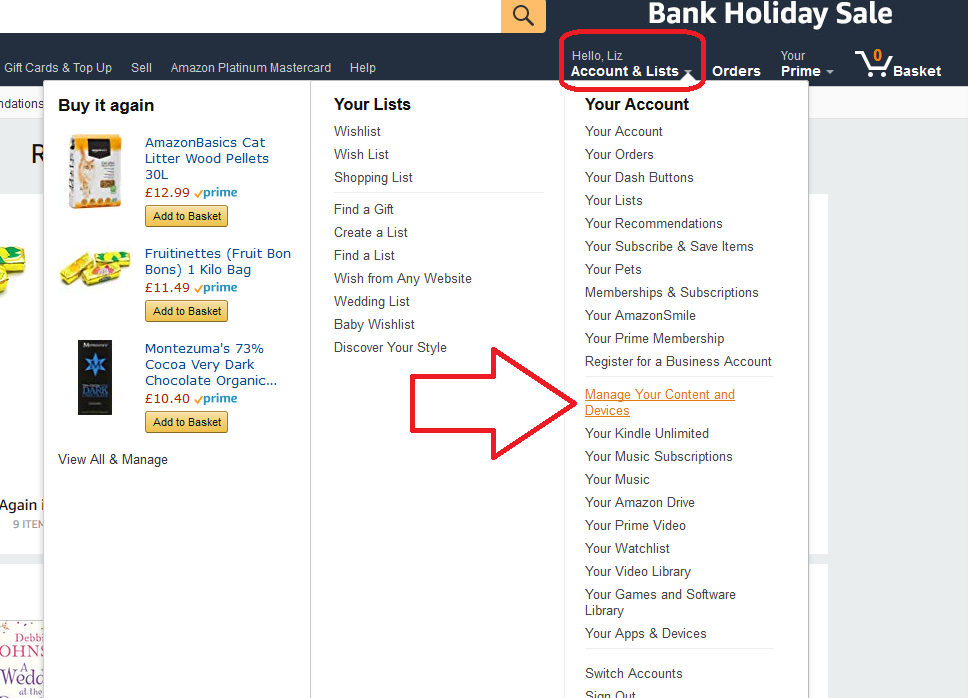
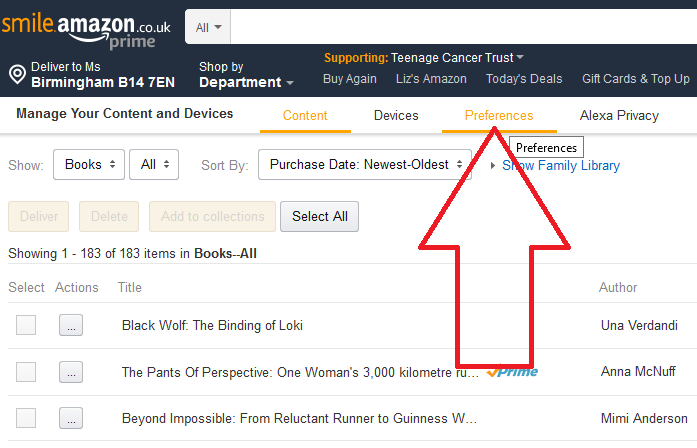
Go to the Amazon home page and select Account & Lists then Manage Your Content and Devices:

Manage Your Content and Devices defaults to Content view, showing you the alarming number of Kindle books you have downloaded and that’s just from Amazon, it doesn’t include all the ones you’ve had from NetGalley or Gutenburg, etc. Argh! Anyway, ignore that and select Preferences:

Once you’re in Preferences, you need to scroll down a bit and then choose Personal Document Settings:

and then, finally, a whole set of a million different email addresses for all the devices you’ve ever used as a Kindle or opened the Kindle app on will appear:

Please also note, in the second half of the screen it reminds you that the Kindle will only accept emailed documents from known email addresses. Like netgalley@kindle.com and your own home email addresses. So do make sure they’re all added there.

And that’s how to find out your Kindle’s email address, so you can send books and documents to it if you need to.

 
4 Comments

Posted by on May 21, 2019 in Ebooks


Tags: ,

Happy birthday to me! (or, rather, to my business)

Happy birthday to me! (or, rather, to my business)

Although I issued my first invoice in August 2009 (and so will be celebrating in August, too), when I set up as self-employed, I matched my financial years to the UK’s financial years, to make everything easier, and so Libro officially started in April 2009. I cannot believe I’ve been going ten years, though – that astounds me.

Originally, after a lot of experience working on various types of texts through my working life (see About Me for more information), I was approached by one of my colleagues at the university library where I worked to see if I could edit their student’s Master’s dissertation. I said yes, did it, and instigated a string of lovely referrals. For the rest of that year, I mainly worked on dissertations for people whose English wasn’t their first language (I still do that today, although I work on more PhDs now).

I was lucky enough to have a fairly routine job and flexitime, so with a lot of time management and hard work, no holidays and an understanding then-boyfriend (now-husband), I worked part time editing and full time in the library through 2010. Then in 2011 I made the decision to go part time at the day job, after making sure I was replacing my wages with my self-employed income. I came off the Certificate of Low Earnings (which lets people who don’t earn much from their self-employment not pay national insurance: something I only did because I was paying NI through my PAYE in the job). Later that year I dropped a second day of the day job and in November 2011 I resigned, starting full-time self-employment in January 2012 (at which point I got jury service for the first two weeks of January!).

It’s been a lovely part of my working life and one I hope never to leave. I have a reasonable amount of flexibility, working alone at home (but with lots of friends a Facebook messenger message or “meet me at the cafe!” request away). My earnings went up and then stabilised, I had a good year last year and I’m aiming to work a bit less this year to retain my flexibility. I’m grateful to my lovely clients, some of whom have been with me almost from the very beginning, and I now edit, proofread, localise and transcribe, so I have a lovely variety of work, from helping academics record the voices of their interviewees to sorting out philosophers’ words and making sure British people understand American companies. Here’s to the next ten years!

And to celebrate, I added two chunks to my Kiva portfolio and, with the repayments I had sitting in my account, made three loans to three entrepreneurial women around the globe:

  • loan Rosa
    Honiara, Solomon Islands

    A loan helps to buy bags of rice, biscuits, soft drinks, and noodles for her canteen (general store) business.

    $25.00

  • loan Jivtiben
    Kutch, India

    A loan helps to purchase kurtas, sarees, leggings, etc., to expand her clothing business.

    $25.00

  • loan Mwanaisha
    Makumbusho-Dar es salaam, Tanzania

    A loan helps to add stock of braids, weaves, earrings, necklaces, hair food, hair pegs, and hair treatments.

    $25.00

 
10 Comments

Posted by on April 18, 2019 in Business, Celebration


Tags: , ,

Words I have looked up – conspectus

No one knows ALL the words, not editors, not professors of English, not writers. But I do pride myself on having a wide vocabulary, as befits an editor and wide reader with an honours degree in English language and literature.

As an aside, English vocabulary, with its pairs of words for so many things (bloom/flower, beef/cow, food/comestibles) makes learning other languages form the same broad family much easier. Learning Dutch, German or Icelandic? Reach for those Germanic terms to help find pairs of friends. Learning Spanish, as I am at the moment, and find Yo como means “I eat”? Aha – comestibles!

All this is working towards saying that I don’t hugely often encounter a word I don’t know, aside from technical terms I come across in texts I’m editing. When I meet on in my everyday reading, I’ve been noting it down, looking it up (of course) and then putting it aside to share.

On holiday recently, I was reading Alan Hollinghurst’s rather excellent “The Sparsholt Affair” (my review of it on my book review blog is here), which is a work of literary fiction about people studying and knowing about things, but is in the main clearly written without jargon, and I came across the following passage (the narrator is visiting the “facilities” at the back of an Oxford pub):

the foul-smelling gutter at the back, with its one light bulb and conspectus of venerable graffiti.

… and obviously the word I didn’t know there was “conspectus”.

So, what is a conspectus? Well, actually it’s an overview or summary of a topic, an overall view, an outline or a synopsis so I’m not sure that he had completely and exactly the right word here. What could he have meant? Palimpsest (layers of text, etc., overwritten again and again) seems a good bet. I’d have queried it were I his editor.

But anyway, I learned a new word and now maybe you have, too.

(Sources: OED Concise, Merriam-Webster online, Collins)

 
Leave a comment

Posted by on April 10, 2019 in Errors, Language use


Tags:

When you see businesses being criticised for not being prepared for Brexit, this is why some of us are not prepared for Brexit

So having had lots of emails telling me how to export goods to the EU in the event of a no-deal Brexit, I tried once again to find out what happens to tax arrangements for people who export services. I’m by no means the only UK person in this situation. Please note I do not expect them to have all the answers, however it would be nice to know if this issue has been discussed, what to do if there’s no deal, etc. I think I am right to want to know how to conduct my business after Brexit, especially given the government, etc. reports detailing the horror of companies NOT being prepared! (Financial Times reports, for example)

Here is my somewhat Kafkaesque conversation over live chat with a representative of HMRC (I checked and it is OK to share this, see below).

[Note, I seem rude to start without saying hello but you’re told to enter your question first!]

LIZ DEXTER: Are the reciprocal tax arrangements between the EU and UK going to continue?
Additional detail: I provide services to EU clients. Currently, I only need state I pay self-assessment taxes to HMRC in the UK, or occasionally need to provide my UTR to prove this, in order for companies to pay me my full invoice and not tax me at source. However, some countries insist on further
paperwork (e.g. a client in Lithuania asked me to get an HMRC employee to sign a letter for them stating I paid tax in the UK). Is this situation being
monitored over the time of Brexit and how can I find out what’s happening?

HMRC: Good afternoon

LIZ DEXTER: Note: I have signed up for all the email alerts, but they are solely about companies that export and import goods, not services. There’s nothing I can find having read the WTO rules which we revert to with a no-deal Brexit. And hello.

HMRC: There is no further information I can give you regarding leaving the EU other than what’s available on gov.uk

LIZ DEXTER: There’s no information on gov.uk about this specific situation that I can find. Can you point me towards any information for exporters of services, not goods, please?
The reason I ask this is that the Ease of Doing Business if I have to get an HMRC employee to sign a paper for every client I had will badly adversely affect my business (and the tax I’ll pay in the UK!).

HMRC: Give me a moment whilst a check my guidance.

LIZ DEXTER: OK thank you.

HMRC: I don’t have any guidance I can give you. It just tells me to direct you to guidance published on gov.uk

LIZ DEXTER: Which doesn’t have anything to do with exporting services at all. OK it’s not your fault but can you please feed back that there are so many people in my position, I have EU customers asking me how they’re going to deal with me post-Brexit, whether they can continue to use my services. It’s embarrassing and very stressful. Or HOW they can continue to use my services.

LIZ DEXTER: Is it permissible to share my download of this chat with other self-employed people or my clients?

HMRC: I will feed that back. Sorry but at this time we don’t have the information you require.

HMRC: Yes that’s fine.

LIZ DEXTER:  Thank you. And I appreciate your help and that
you’ve done all you can.

REFERENCE: Record of your HMRC webchat [url redacted, can be provided upon request]

 
7 Comments

Posted by on March 28, 2019 in Brexit, Business


Tags: ,