RSS

Author Archives: Liz Dexter

Unknown's avatar

About Liz Dexter

Book blog is at http://www.librofulltime.wordpress.com Writer, proofreader, editor, transcriber. Also runner, gym-goer, volunteer and BookCrosser! My married name is Liz Dexter but my maiden name and the name on the books I write is Liz Broomfield.

Using a style sheet – for editors and proofreaders

DictionariesA little while ago, I wrote an article explaining what a style sheet was, mainly for my own clients, so I could send them a link when I sent their completed work and style sheet to them.

It struck me, though, that it might be useful to write about style sheets from the perspective of the editor / proofreader as well (I’m going to use “editor” to refer to both here, for simplicity, unless I’m distinguishing between the two).

I assume this will primarily be useful for people new to editing who are picking up tips from those of us who have been in the game a little longer. But whoever you are and however long you’ve been editing, do pop a comment below if you have anything to contribute!

What is a style sheet?

A style sheet is a list which spells out how things are to be done when writing and/or editing a text, including information on spellings, hyphenation and capitalisation, referencing and special information. Its aim is to keep texts consistent.

When you’re an editor, you will encounter three types of style sheet:

  1. Style sheets you receive from someone earlier in the process or general ones prepared by particular publishers, journals, etc.
  2. Style sheets you create yourself as you work on a project
  3. Style sheets created by the previous editor when you’re taking over a job or doing the proofreading for something that’s previously been edited (this is unfortunately rare, in my experience)

All three types serve the same purpose: to record the style decisions (more on this later) that have been made in order to keep the look, feel and detail of the text or texts consistent.

When you’re creating a style sheet, it might only be for a single use, for a single client (e.g. a PhD student). When one is created by a journal or publisher, it’s usually so that their “house style” will be consistent across publications and journal issues. But the idea is the same: it’s a tool that’s used to keep things consistent.

What do you mean by “style decisions”?

English is a funny old language. Even if you’re adhering strictly to one of the major style guides, (Chicago Manual of Style, Oxford Style, etc.), you will find there is still room for choice in some aspect of your text.

An example where even Oxford didn’t tell me what to do: I was editing a set of articles which included lots and lots of words and phrases in a different language to English. Each then had the English translation in some form before or after the foreign word. Of course, the articles were all written by different people who had used different ways to express this (word in italics / non-italics / double or single quotation marks and English in parentheses or not, italics or not, quotation marks or not). I was looking to make this consistent … but after some rules on what to do, Oxford told me to choose a way I did this as long as it was consistent!

There will also often be individual names, phrases, etc. in the text you’re editing which will need to be set out in a consistent way, which might not have rules.

An example where there can’t be any rules: your client has lots of interviewees and they’ve referred to them with a code to ensure anonymity. Do they put Respondent OH1, just OH1, OH-1, (OH1), [OH1], etc., etc.?

Although a client a while ago said that his first editor “kept it all in his head”, I prefer to note all of this down so I have it to refer to and keep things consistent.

What does a style sheet look like?

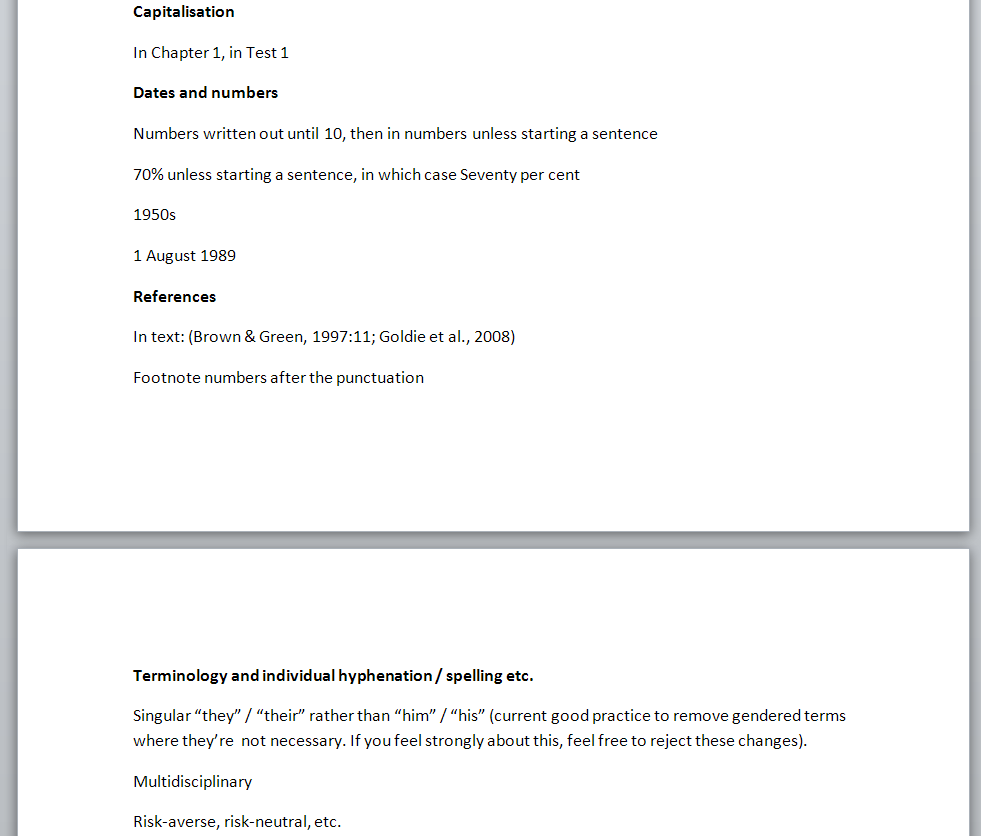
I’m sharing here an example of one of my own style sheets. Note that I have a little explanatory note at the top to explain what it is.

You can see that I set out the most common things that can differ (in my experience) and need noting down – s or z spellings, how the paragraphs are set out, how the headings and figure / table titles are set out, etc.

style sheet 1

In the second half, I go on to dates and numbers, how references are laid out, and some specific things to do with the particular text I’m working on.

style sheet 2

I find that a publisher’s style sheet is set out in the same way, although it might sometimes be online or a pdf with links.

If I’m working on a text destined for a particular publisher or journal article, if their own style sheet is very long and my text is quite simple and doesn’t need all that detail, I’ll often summarise the parts I need on my sheet anyway.

When should I set up a style sheet?

I set up one of these for any text that …

  • Isn’t for a publisher or journal that has its own style sheet
  • Is for a publisher or journal that has its own style sheet but that sheet is very long and complex and I can use a summary
  • Is more than a few pages long
  • Is being sent to me chapter by chapter (this happens with PhDs I work on)
  • Is going to form part of a larger body of work or a series (e.g. the regular publications of an organisation
  • Is being worked on with a colleague – this is quite rare but does happen

When and why should I send a style sheet to my client?

I pretty well always send the style sheet to my client along with my completed work.

I typically send it with a note in the email directing the client to my explanatory article, as I’ve found that most of my clients haven’t come across this before (I happen to work with a lot of students and self-publishers, as well as translation agencies; your experience may differ if you mainly work with publishers).

I will send the style sheet to my client if …

  • They’ve asked me a lot of questions about grammar and wording issues before we start (I will probably pop down the standard hyphenation and capitalisation rules on it if that’s the case)
  • They are likely to add to the text (for example if I’ve pointed out gaps or missing references)
  • They are sending me their work chapter by chapter – sending the style sheet with the first chapter can often nip certain issues in the bud, the client learns from it and they’ll be more consistent in the next chapter (I’m always so happy when this happens!)
  • They plan to send me regular publications, etc. – if they didn’t have a style sheet I provide one for their writers to use, making my work easier and less time-consuming and meaning they have less to correct
  • It’s a substantial document (more than a few pages)

Hopefully, having a style sheet from me will mean that the client will keep things more consistent in the future.

I do also mention that they should send this on to their proofreader if they’re planning to use one in the next stage of publication. This saves their proofreader from busily changing all the Chapter Ones to chapter 1 (or at least it explains that it was an active, considered choice on my part, and not an error).

Making changes to a style sheet

If I send my style sheet to my client mid-way through a project, for example with their first PhD chapter, I ask them to look through it carefully and let me know if there’s anything they’d like to change or they’re not happy with. Sometimes in this case I ask them questions (e.g. “You’ve used ‘Interviewee RD1’ and ‘RD1’ in equal numbers in your text; which one would you prefer to use throughout it?”). If they give me feedback, I record that, or if they ask to change something and their change does actually defy a stated grammar rule I will explain why I can’t.

Working with an established style sheet

If the text I’m working on is destined for a publisher or journal that has a full style sheet, I will of course obey that to the letter, to make things as easy as possible for the in-house editor or designer. Even if that means leaving footnote numbers before the punctuation, something I don’t like to do (but some publishers prefer).

If I’m proofreading a text that someone else has already edited, or I’m working on for example corrections in a PhD that someone else has worked on, I will use their style sheet to guide the changes I make. Even if I don’t approve of their decisions personally, as long as they don’t defy a rule of grammar, I’ll keep it consistent (even if I have to move a footnote number to before the punctuation!). I aim to make as few changes as I can at the proofreading stage, in order to keep corrections (and the chance of new mistakes creeping in) to a minimum.

—-

I hope this post has been helpful and given you some more information about why we use style sheets, where they come from, setting up your own one and working with your style sheet with your clients. Do pop a comment at the bottom or like and share this article if you’ve found it useful and interesting!

Related posts on this blog

What is a style sheet? For people working with editors

 
9 Comments

Posted by on February 4, 2016 in Copyediting, Organisation, Word, Writing


Tags: , , , , ,

What is a style sheet? For people using editors

DictionariesIf you work with a proofreader or editor on any project, either for a publisher or working independently or as a student, you might receive a Style Sheet from them with your corrected work. This article explains what a style sheet is, the purpose of a style sheet, and what might be included on it. I’ve also written this article to send to my clients so they understand what the document I’ve sent them is – so if you’re one of my clients, hello!

To make this article easier to read, I will refer to the person who has worked on your document as your “editor” – although I might refer to proofreaders in some places, too.

If you’re an editor or proofreader who wants to find out more about style sheets, I’ve written an article just for you, too.

What is a style sheet?

A style sheet is a list setting out the decisions that your editor has made on aspects of the layout and language of your document, in order to keep the document consistent.

It might include notes on what font is used, whether the text is left or fully justified, how particular words are capitalised or hyphenated, how much indent your indented quotations have, what is put in italics, etc. We’ll have a look at an example later on, but that’s a very short summary.

Why use a style sheet?

Especially if you’ve learned English as a second or other language, you will know that the English language is not consistent, and it doesn’t even have proper rules for some things! This can be really frustrating, as two people might do things in two different ways, BOTH of which are correct.

For example, in English …

  • we can use -s- spellings or -z- spellings in words like “organisation”
  • we can capitalise or not capitalise words like Chapter 1 or experiment 2
  • we can use orient or orientate
  • we can hyphenate or not hyphenate pairs of words like policy-maker

And that’s before you get to decisions like …

  • are you going to use 20%, 20 per cent or twenty per cent?
  • are you going to describe America as America, the United States, the US, the USA, the U.S. etc. etc.?
  • are you going to use double inverted commas for quotations and single inverted commas for concepts, or vice versa?
  • are you going to refer to other research as (Brown, 2003; Green and Jones, 2005, p. 23) or (Brown 2003, Green & Jones 2005:23) or any other variant

Now, the important thing with all of these is to keep it consistent.

Some of these rules might be set down in a style guide or referencing guide (see below). But whether you and your editor are working to a style guide or not, it’s useful to have these decisions written down in one place for you both to refer to.

What’s the difference between a style guide, a referencing guide and a style sheet?

A style guide is a specific guide to how to deal with things like the above decisions – famous ones include Oxford Style in the UK, APA Style and Chicago Manual of Style and AP Stylebook in the US.

A referencing guide is a specific way of writing out references to work you are talking about in your dissertation or book – an example is Harvard referencing.

Some universities and many publishers and marketing agencies etc. will have their own guides which documents published under their name or submitted to them will have to have.

In this case, I could do without a style sheet and just refer my client to … well, a massive website or a giant book. Maybe not. In that case, I’ll note which style guide or referencing system I’ve used and still write out any important points which will impact the document in question.

Please note that I (and I imagine most editors) have favourite style decisions – I prefer orientate to orient, for example, and where there is no clear preference in the text, I will go for my preferred option. If, however, the text itself has 33 orients and 2 orientates, I will go with the majority.

This also means that some parts of the following examples might jar with any editors reading this – they are only examples!

What does a style sheet look like?

Here’s an example style sheet with some of the decisions I might make …

style sheet 1

This is a standard style sheet – I tend to go from the general (the whole layout, all quotations, the tenses used) down to the particular …

style sheet 2

What should I do with the style sheet my editor has sent to me?

Good question – now you understand why your editor has sent you a style sheet and what it’s for … well, why does it matter and what should you do with it?

Here are some important uses of the style sheet:

  1. It will help you to understand some of the changes your editor has made.
  2. If your editor has just edited one chapter, they might send you the style sheet with that chapter and ask you to look through it and check you agree with everything on it. They might even send over some queries – if it’s not clear which option my client prefers, I will highlight the choice and ask them to look at it. If you don’t agree, let them know straight away, then they might change it if it’s not a rule of grammar that can’t be flexible.
  3. If your work is going to be edited by more than one person, they will share a style sheet to make sure it is edited consistently.
  4. If you are planning to add to the document, you can make sure that any additional text you write is consistent with the text that your editor has already checked.
  5. If you have been through edits and your document is going to be proofread, send the style sheet to your proofreader, then they will know what choices the editor has made, and will be able to look out for any errors much more easily.

——-

In this article, we’ve learned what a style sheet is, why it’s used, how a style sheet is different from a style guide and referencing guide, but backs them up, and what to do with a style sheet when you’ve been sent one, as well as seeing an example of one. I hope this helps you: do comment and/or share this article using the sharing buttons below if you’ve found it useful!

Other relevant posts on this blog

Style sheets for editors and proofreaders

 
24 Comments

Posted by on January 14, 2016 in Copyediting, proofreading, Students, Writing


Tags: , , , ,

End-of-year housekeeping questionnaire

handshakeHello there! I’m doing some end-of-year housekeeping, I’d love to know what people think of the on-going Libro blog. I’ve got 1,000,000 hits and counting this year, so I know people are reading, but it’s always good to check that I’m providing what you need!

Please share your answers in a comment below if you have a moment …

What are your favourite posts on the Libro blog (social media tips, Word tips, business info, editing tips, small business chats?)

Do you read the Saturday Small Business Chats? Would you read them more regularly if they were published on a different day? Do you find them interesting and useful? Do you like the update element of them? What would make you comment on them more?

Do you take part in the Small Business Chats? Do you find taking part useful or a chore? Do you read other people’s? What would make you comment on them more?

Thank you and Happy New Year to those of you on the same calendar as me!

 
6 Comments

Posted by on December 31, 2015 in Blogging


Season’s Greetings from Liz at Libro

Reykjavik in the snow

Reykjavik in the snow

Season’s Greetings, however and whatever you celebrate, as we slip past the turn of the year and, in the Northern Hemisphere, the days get longer again.

I wish all the readers of this blog and Libro customers older and newer a happy, peaceful and healthy 2016.

2015 has been a good year, and I’m looking forward to achieving some personal and business goals in 2016. Thank you to everyone who’s helped get me to this position of freedom to be able to work hard, give back, maintain connections, read a fair bit and keep fit.

The Small Business chats and other blog posts will be taking a short break, but will be back with a vengeance in the New Year. I will be taking time off 24-26 December inclusive, and working part time between Christmas and the New Year.

With best wishes from Liz and the household.

xx

 
2 Comments

Posted by on December 22, 2015 in Celebration


Tags:

Transcription tips: How do I transcribe a tape with multiple voices?

keyboard earphonesAlthough transcribing interviews by journalists or students that only involve two voices is the most common work I do, transcribers often have to work with tapes with more than two voices on them. How do you tell the voices apart so that you can differentiate them on your transcript? This article shares some tips I use to tell different voices on a tape apart.

What’s the problem with transcribing multiple voices?

I was transcribing an interview with two fashion designers today; my client had said it was OK not to differentiate them and the women themselves said that their voices were often confused. How did I tell the voices apart so I could produce a transcript that had the correct words attributed to the correct people?

Although it’s sometimes very easy to tell the people who are talking on a tape apart, for example if they’re a man and a woman, or one has a very strong accent, sometimes it can be difficult. Because it will help my client to know who said what, it’s important for me to try as hard as I can to differentiate the voices and make the transcript as useful as possible.

Before the interview: who are the interviewees?

If you know it’s going to be an interview with more than one participant, you can ask your client to help you from the very beginning.

Either they could ask their interviewees to introduce themselves by name at the beginning of the tape. Even if they are all, for example, young male voices, you can pick up a lot of information from this that will allow you to differentiate between them …

Or they could ask people to introduce themselves every time they make a point (this works in a more slow round table discussion at a conference, for example)

Taking the first option once led to a very sweet tape where the musicians in a band introduced themselves by name to me, mentioning my name, at the start: “Hello Liz, my name’s … and I hope you can understand me”. Aww!

After the interview but before you start typing: checking who is who on the tape

If you didn’t get the option to ask your client to get the interviewees to introduce themselves, it is OK to ask them who is who – for example, who speaks first, who has a voice that is distinctive in some way. They might also mention that, for example, the lead singer talks most and the person who only talks about one track is the drummer.

If you’re working on a discussion at a conference, you might be able to get some information from the conference website. For example, there might be a video up already that time stamps each person’s speech with a note of their name. Play the video, check the speech against your tape, and there you go.

When you’re transcribing: how do you differentiate between the different voices?

If you have no clues about who is who or who says what, there are still ways in which you can differentiate between voices on a tape. It can take time to get used to doing this, but it is useful.

  1. Check the video. This one sounds obvious, but if you have a video to transcribe, do look at it carefully. There may well be captions stating who is speaking, at least for the first time, and you can recognise who is who by their appearance. If there’s the option of a video for a conference or marketing meeting / focus group, do take it, even if it takes longer to download.
  2. Check where people are in space. In the tape I’ve been working on most recently, the speakers were sitting either side of the tape recorder. So, even though their voices were similar, one came from the left and one from the right. Result!
  3. Check the sound level/volume. If one person is sitting further away from the recorder, they will sound fainter.
  4. Check for even slight accents. There may be a non-native-speaker or regional accent on the tape: listen for different vowel sounds or intonation.
  5. Check the ums, ers and filler noises. These really vary across speakers and can make a difference. Person 1 might say “like” constantly, while Person 2 “ums” and “ers”.
  6. Check for clues in the environmental context. Does Jane order food but Sally just have a coffee? The one talking through her dinner is likely to be Jane.
  7. Check for clues in what they say. I often switch off from the content when I’m transcribing, just letting the words come into my ear and out of my fingers. But people will refer to each other by name, and this gives you a good clue to who is who, or reinforces your first thoughts (If the person you think is Pete refers to “Pete”, unless you have several interviewees with the same name, he’s unlikely to actually be Pete!).

I have two other handy hints to add, which I use all the time …

  • Draw a plan or write notes! When I work out who is who, I will write a little diagram out or make notes – “Bella … Jean” for the left/right ones, “Jim: high-pitched. Bob: rumbly and quieter” etc.
  • If you can’t put a name by each participant, at least try to break the text up into paragraphs spoken by different people. You might be able to go back and add the names if Julie says, “As Veronica said earlier, it’s difficult opening a tin of Spam”, for example.

It can be challenging when you find you need to transcribe a tape with more than one or two voices on it. As you have seen, there are things you can do to make this easier before the interview even starts, once you receive it and during the transcription process.

If you’ve found this article useful, please click to share! If you are a transcriber and have any tips to share on this topic, please do comment below!

If you want to learn more about Transcription as a career, buy my book: A Quick Guide to Transcription as a Career – buy from Amazon UK or visit the book’s web page for worldwide links and news.

Related posts in the series:

Why do transcribers charge by the audio minute and not per word?

How do you start a career in transcription?

Why you need a human to do your transcription

Being a professional transcriber – software to use to help

Ten top tips for transcribers

 
4 Comments

Posted by on December 18, 2015 in Business, Jobs, New skills, Transcription, Word


Tags: ,

How do I stop seeing my friend’s posts in a Facebook group or page appearing in my newsfeed?

This is a companion piece to the article I published last week on how you can stop your posts in a public Facebook group appearing in your friends’ newsfeeds (hint: you can’t). That post explained the different kinds of Facebook group and how much you post in each kind is visible to the outside world.

This article looks at the situation from the other side: how do you hide the posts that your friend makes in a Facebook group or on a Facebook page that you’re really not interested in.

What’s the problem?

Say your friend has just joined a quilting group and all he does is post, post, post in this group about quilts he’s made, ones he wants to make, techniques, meetups etc. And while you love your friend dearly, you really do not want to see all this stuff about quilting, because you’re all about judo and archery. Is there a way to hide this stuff, and the posts he puts on a fan page for a famous quilter? Yes, there is.

How do I hide my friends’s posts on a particular Facebook page or in a group?

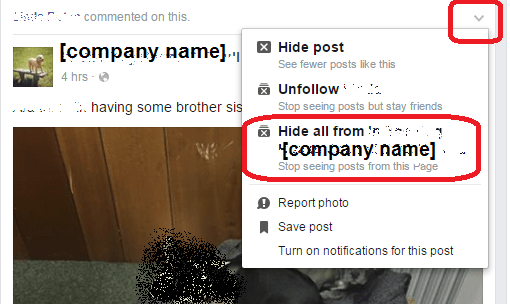
When you catch one of the posts in a group you don’t want to see (and this isn’t always easy, as Facebook likes to show you random stuff every now and then, rather than all of everything all the time), you will see a little down-arrow in the top right corner of the post.

Click on the down arrow and you’ll be given some options. Note: this example is for a page, and I don’t really want to stop seeing these posts, it’s just for illustrative purposes …

Hide in your feed

You can see here that you can hide just this one post, unfollow your actual friend (but stay friends), or hide posts from that particular page. This message is the same whether you’ve Liked the page yourself or not, but you won’t get the option for a Group you’re a member of.

Click on “Hide all from … [group name / page name] and you won’t see posts from that source again.

Note that there’s no way for your friend to stop their posts in a public Facebook group appearing on your newsfeed (see the link at the top of this article for why), so if you don’t want to see them, this is the way to stop seeing them.

——

I hope you’ve found this useful – do feel free to share it on social media or email using the buttons below.

Other useful posts on this blog

How to stop your posts in a public Facebook group appearing in your friends’ newsfeeds

Facebook for business

How to delete posts and block users from your Facebook page

How to add a moderator or admin to your Facebook page

How do I stop videos auto-playing in Facebook and Twitter?

How do I stop seeing new comments on a Facebook post?

How do I hide a Facebook post?

How do I remove a member from a Facebook group?

How do I delete a Facebook group?

 
1 Comment

Posted by on December 9, 2015 in Facebook


Tags:

How do I stop my posts in a Facebook group from appearing on my friends’ newsfeeds?

1 menuThis issue came up for me today and I thought it was worth sharing, as I had to go searching around for the answer.

What’s the problem?

You’re a member of a Facebook group discussing, for example, interior decoration. The group is a public or open Facebook group, so even if you have to ask to join and be approved before you can post, the posts are public.

So, you merrily start conversations about sofas and wallpaper, post pictures, create Events and join Events, and respond to other people’s posts.

Nothing appears on your own timeline out in main Facebook.

But your friends who aren’t in the group will see a selection of your posts in that Facebook group, whether or not they’re interested in interior decoration.

Why can my friends see my Facebook group posts?

If the group is a Public or Open group, that means that anyone can see the group, the members of the group and the posts they post.

It’s all down to the group, not to your individual settings. There is no way you can stop this happening (and there are some very cross posts and comments about this all over the Internet).

What are the kinds of Facebook groups?

A Public / Open group – everyone can see who is a member and what they post. You might have to be approved to post in the group or you might not, but everything will still be seen.

This kind of group is intended to be welcoming and visible and isn’t suitable if it’s for discussing private matters.

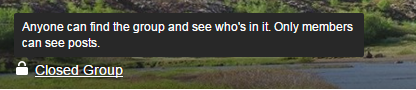
Closed group – everyone can see the group name and find the group, but no one who isn’t in the group can see the members and posts. You will need to ask to join this group and need to be approved before you can post.

If you have friends in a private group, you will see their posts in your timelines / newsfeed, and vice versa, but no one else will.

This kind of group is good if you want to be found, but don’t want your discussions all over the whole of Facebook.

A Secret group – no one can see the group name or the members or posts. It’s not searchable, even to find the name of the group. Members have to invite people to join the group.

This kind of group is useful for a support group or private discussion about an event where you know who you want to invite to join the group.

How do I tell what kind of group a Facebook group is?

When you look at the group home page, there will be a note underneath which states what kind of group it is. Here are some examples:

A Public group:

4When you hover over Public Group:

1 menu

A Closed Group:

2

When you hover over Closed Group:

3

A Secret Group:

5When you hover over Secret Group:

6

How do I stop my friends seeing all my posts in this Facebook group?

Short answer: if it’s an open group, you can’t.

Your friends can hide the posts from that group using the down-arrow in the corner of one of the posts, but you’d have to instruct all of your friends to do this and I’m sure this is not really feasible.

There is no setting in your profile that can stop your friends seeing the posts.

The only way to make sure that no one except friends who are also in the group can see your group posts is to change the group setting to Closed. Obviously, a moderator will need to do this, if you’re not the moderator.

I hope you’ve found this useful – do feel free to share it on social media or email using the buttons below.

Other useful posts on this blog

Facebook for business

How to delete posts and block users from your Facebook page

How to add a moderator or admin to your Facebook page

How do I stop videos auto-playing in Facebook and Twitter?

How do I stop seeing new comments on a Facebook post?

How do I hide a Facebook post?

How do I remove a member from a Facebook group?

How do I delete a Facebook group?

 
21 Comments

Posted by on December 2, 2015 in Facebook


Tags:

How do I get back to the full dashboard on WordPress.com?


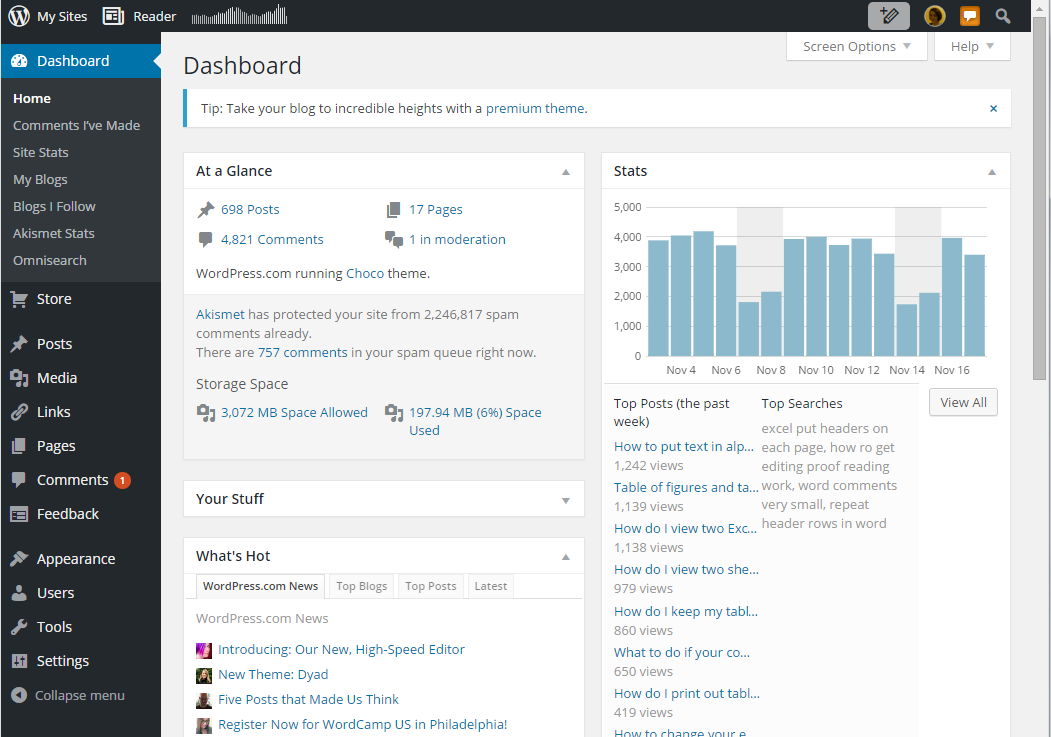
I’ve been asked this question a few times recently, as WordPress has sought to make it easier for users to post a quick blog post or create a page. People who are familiar with the old, more detailed dashboard want to find it again. So here’s how.

How do I find the old dashboard on WordPress?

When you log on to WordPress, you will find a button marked My Sites. Click on that and you’ll get the new, simplified dashboard:

WordPress new admin page

Now click on WP Admin, circled on the above image.

This will take you to the old familiar interface:

Old WordPress dashboard

If this doesn’t work there is another tip, which is to add /wp-admin to the end of your page’s URL.

Note: this works for WordPress.com, the free version – self-hosted WordPress.org is a little different. If you’ve found this post useful, please do share it using the sharing buttons below.

Other useful posts on this site

Is it worth having a website for my business?

WordPress 1 – the basics – joining and setting up a blog (links to all the other WordPress tutorials)

Resource guide – blogging and social media

 
47 Comments

Posted by on November 18, 2015 in Blogging, Business, SEO, Social media, WordPress


Tags: , , , , , ,

Small businesses – what do you wish you’d known when you started?

Small businesses – what do you wish you’d known when you started?

I’ve interviewed 105 small business owners since June 2011 when I launched my Small Business Chat Interviews series on this blog. Some of them have just appeared once, two of them (so far) have reached their fifth interview. There’s a lot of info there, and every now and then, I pull out some useful stuff and put it all together in one post. Today, I’m looking at what people wish someone had told them before they started their business.

Of course, as expected, it falls into a few categories. Here they are – all anonymous, some edited down, but thank you to all of my interviewees again for sharing so honestly and openly! I think it’s so interesting that it doesn’t matter whether you’re a maker, a service provider or anything else – these are universal.

Money, tax and cash flow

Expect to spend several times more money and time on marketing than you plan to.

It would take time to develop, so to start with funds were stretched and there were initially a few worrying moments.

Certainly everyone wanting to be a writer should be aware that it is difficult to make a living – the average member of the Society of Authors earns less than five thousand pounds per annum from their writing.

None of your clients will pay on time!

Register for tax self-assessment in plenty of time as you can’t complete the thing before you receive their PIN number through the post, which can take up to a week!

I wish someone would have told me how much I was really worth! Perhaps it came with age, experience and maybe confidence, but I priced myself quite low compared to the rest of the market. On the other hand, I was running the business from my bedroom, so anything I earned went straight into my pocket, and this may have given me a competitive advantage while I got my feet under the table.

Don’t spend money on marketing companies which offer Google front page search results when you can do it yourself!

Not to bother with approaching banks and go for crowd funding right from the offset. The banks I’ve approached did not want to lend at all to me, which made equipment and investment in premises very difficult to fund initially.

That high street banks are not there to help you.

Sort out your prices from the start. Make sure to include everything you’ve used in your costing.

Finding Customers and Networking

That sales are harder than just rolling up and asking for the work! I really wish I’d overcome my reluctance to get out there and network much sooner than I did.

One thing would be don’t waste your money advertising in Yellow Pages and similar companies; networking and going out to meet people is by far the best way to gain new clients, although print directories are rather an old idea now with all the internet sites available.

Where the tree of clients is planted, and directions on how to get to it!

How many prospect clients are prepared to put up with a low quality or average quality of service from their existing provider and sometimes appear to be too lazy to want to make the effort to change to a new supplier.

It’s hard work and always keep in contact with clients and potential clients.

That at least half my time freelancing would be spent finding the next … project.

Don’t rely on just one or two clients. I lost my major client after a few months and, although I was able to replace them fairly quickly, I could have done without the panic!

Don’t put all your eggs in one basket, which I did … because they gave me so much work. When they closed, I was sunk. My other clients had all gone off and found other suppliers. I was really struggling to find childcare and it was all distinctly hairy for a bit.

You can’t set up a business and expect work to fall into your lap. You have to work really hard to get yourself out there and get clients. I knew this, but I was far too timid at first

The importance of contacts and networking.

Branding, marketing and differentiation

I wish someone had told me that by investing in my business I would take it more seriously – which would mean other people would take me more seriously. It was only really when I paid for a professional brand to be created that I began to treat it as a fully fledged business!

The importance of marketing. At the beginning I really expected that I would have clients kicking my door down without any effort on my part. I sat back and expected the business to come to me.

You need to understand two things to succeed – how you are different from all the other folks out there and how that translates into a value proposition for your clients.

The importance of promotion. Promotion is very important if your company and brand is to stand a chance in people’s memory retention when they’re looking for the services you provide.

That you need to work hard to market the business, not just do a few things and hope that lots of business will come your way. The first stages of a business are the most critical, and also where the most amount of marketing and advertising would be of the greatest benefit. Ironically, often new businesses scrimp on the advertising when working out a budget.

To be yourself, and not to be afraid of adopting a unique approach. When you start out its tempting to benchmark yourself with everyone else  and not to stick your head above the parapet in case you make a mistake. In fact, the market – ANY market – wants fresh original ideas and approaches rather than re-hashes of existing products and services, so I think it’s important to make your own mark as quickly as possible.

I wish I had been told to design my business stationery to meet my needs rather than adhering to a ‘normal’ format. For example: I designed my business cards with my name, job title, address, phone number, email and website because that’s what I had on my business card when I was a project manager. However, nobody that I hand these cards to will ever need to write to me. Phone me – yes. Email me – again yes. But write to me? Never.  I wish I’d saved the space I wasted on my address for showing more of the services I offer.

Don’t buy cheap business cards!

Get to grips with marketing – make a list of potential marketing strategies which can be developed as the business evolves.

Confidence, emotions and energy

That I could do it. Like everyone taking that big leap, it can be really scary at first. One year down the line, my confidence is high and the timing seems right for what I have done.

How much more of an emotional rollercoaster it would become.

That sometimes it is really difficult to get your head down and work from home – but that you are not the only one that feels like that.

Running your own business is a rollercoaster of emotions. The good days are so much better but the bad days so much worse because everything matters so much more!

That I could do it, and that I should have faith in myself. (this one is me!)

Have more confidence in yourself – take the plunge and go full-time earlier!

Just how busy I would be.

That nothing goes to plan!!

That there would be good days and bad days but that the excitement of managing your own destiny is worth it.

That it would take some time but I just had to hang in there and things would work out.

That you get out what you put in. Moving to self-employed, I thought it would be all fun and games and a walk in the park. Go to work when I want and leave when I want. This wasn’t the case.

Pace yourself.

Don’t worry. You will be fine!

How much time would need to be invested in networking to make a FB page work…

I wish someone had told me that getting a balance between work and home life is difficult.  I find that so many other businesses are run by people who have another job, that when I want to network online with them, I have to do a lot of it in the evening, meaning that there is a tendency to work all the time!  Had I been told this early on, I might have got the balance right sooner!

You can do this! I wish I had known someone who ran their own business back then, now I know loads of people! Maybe I would’ve taken the plunge sooner.

‘ITS LATER THAN YOU THINK! Sort your life out, you lazy sod!’ I would have liked them to have shouted that to me while shaking me by the lapels. I probably would have cried, but it would have been worth it.

Quite how many hours of my life it would absorb and how unfit I would become, spending so many hours at a computer. There are no nine to five hours involved when somebody wants to book, so it can be difficult to really relax and switch off from work.

Don’t panic, don’t stress!

Not to be as self-critical of what I do.

Keep going. You might think it’s too difficult, and some say it is very hard, but the emotional rewards that come from working for yourself are great.

Freelancing is a pretty slow slog to start off with, but if you keep at it, it does pick up.

That the ebb and flow that you get in business is normal. It takes a while to not panic when things slow down.

That it really is not as scary as you think it will be… quite the opposite – its exhilarating. The fear we build up in our heads, whilst it can feel very real, is really unjustified.  You have to realise and accept that things will not go to plan, and it may feel like it’s going wrong – but that is your opportunity to pick yourself up and find another way.  And every single time this has happened, I’ve always had a better result.

To keep going and remember to take time for yourself. It’s always difficult at first and each time I have progressed, it it has taken a few months to get into a comfortable work/life balance – but it always happens in the end!

That there will never be a right time to launch. It took me a long time to pluck up the courage to make the move, I was always waiting for something to get finished, or something else to fall into place. The perfect time will never come, so if you’re going to do something, you have to just make it happen

Believe in yourself and your abilities! Don’t wait until everything is perfect, just take those first few steps and before you know it things fall into place.

I guess the Guide motto is always useful – be prepared!  – and then be prepared to be surprised.

That this is a 24-hour business, both from the point of view that obviously someone could ring us in the middle of the night to ask about our services, but also more fundamentally that if it’s your own business, you can’t switch off. It even invades your dreams!

You will need to work harder than you ever thought you could. You need to forget about holidays for a few years.

How to know who to trust and when to say no

Be cautious in what you sign up for!

Learn to say no. When I quit my job, I was offered all sorts of opportunities, and as that kind of thing is very flattering, you commit to things that perhaps you shouldn’t. I have narrowed it down to four major projects now and happily they all tie in together.

Everyone has an opinion, they can’t all be right!

Not to trust everyone who offers to help you. Do your research and get to know people first.

No matter how desperate you are for work, if a prospective client makes your teeth itch, just say no. Trust your instincts, because if you engage with that person, you will regret it. I can still be conned occasionally, but I’m a lot better at qualifying customers than I was when I started out.

I wish someone had told me not to listen to the purveyors of doom and gloom. The people who draw breath through their teeth when you tell them you’re setting up a new business in the middle of a recession. This is a great time to set up: bigger companies cannot compete against SMEs on either price or quality of work. Nobody can afford the over-inflated prices of the fat cats and so they look elsewhere. Once you understand this you realise that this is the best time to start up!

From a freelance consultant’s perspective: don’t expect too much loyalty from people you know beforehand.  However positive they seem about you, they may not actually have the decision-making power to give you work!  Imagine starting out knowing ‘0 people’ and ask yourself if you think you can get complete strangers to believe in you.

That it’s OK to negotiate and that you don’t have to accept any rate proposed to you by clients or agencies. A bit of confidence in your skills goes a long way.

To never undersell yourself and realise the value of your time. I started off charging a ridiculously small fee for my work, not really taking into account the time an effort I put into each piece.

That people won’t always be happy for you . I’m a very honest and trusting person, so it shocks and upsets me when people actively try to stop you achieving your goals. I don’t understand it – it’s not in my mentality.

Stand up for yourself. For example, If you’re working for someone who has their own crazily complicated payment plan say, “No, this is how I work, this is how I invoice”, end of story.

Sometimes enough is enough and it’s OK to say no. I have been fortunate in that I’ve always had plenty of work, but that means I tend to work a lot of evenings and weekends. On the whole, I get a lot of satisfaction from doing that, but occasionally I think I could take on a little less work, and have a bit more time off.

That the value lies in the quality of the work I do, not the length of time I’ve ‘officially’ been doing it. I severely undervalued my services in the beginning, assuming that this was necessary to ‘break into the market’. In fact, that caused more problems; potential clients didn’t trust a low-priced service and consequently I had to work much harder for much longer, in terms of finding and securing clients and in terms of hours in for cash out.

Don’t be afraid to turn away clients who aren’t a perfect match.

One of the most important lessons is learning to say “No” to certain projects. When starting out, you are hungry for business and do not want to lose any potential deals, but there are some projects you need to walk away from. It is not worth winning a project at any cost, because you end up spending too much time and don’t make any money, or have clients you can never please. Being willing to walk away has provided me with the freedom to choose who I work with, and now when prospecting for clients, I want to see if the potential client is a fit for my company, as much as they are looking to see if I am a fit for them.

Contracts, legalities and business advice

It sounds cynical, but always get an agreement/contract in place with clients from the start so there is no room for misunderstandings especially when some clients try it on and try to not pay or pay late. Unfortunately there are some people like that out there.

That the customer was not always right! Well, partly due to my fault since I did not have documented ‘Terms and Conditions’ when I started. I had some challenges with customers owing money or not collecting their outfits at agreed times.

Listen to sound good business advice given from reliable sources such a Business Link.  You can’t do everything yourself, so outsource tasks to other people.

I read numerous books and watched endless programmes on other entrepreneurs and I learnt a lot from doing so.

How to price up my items correctly, I have under-quoted for so many jobs!  To have clear terms & conditions and a cancellation policy, I forgot about that bit and ended up out of pocket. ALWAYS take a deposit, even if the job is for a friend!

Knowledge and technology

Make sure you are fully up to speed on the technology side of things.

Make sure you are fully up to speed with the technology. We have to learn as we go.

How to run a business! It sounds so stupid to me now, but when I started I thought that running a business meant money coming in, money going out and paying an accountant once a year to submit my tax return.

I wish I had known how many resources were available to help get me started, such as classes and training, list-serves and discussion groups, online invoicing, etc. I did not need to reinvent so many things—it was all out there but I didn’t know where to look for it.

I wish I could have sat down with real entrepreneurs and just sounded them out before I started in business. I would have liked to have shared their wisdom.

I had really great advice from a successful friend before I started who shared so much of her knowledge. I wish I had listened and constructed a proper business plan, as I left that on the back burner and became a bit chaotic.

[For makers] photography is key. It seems obvious, but it’s really not when you start out.

I had the artistic skills, but I hadn’t appreciated how much time and effort all the other aspects of running a business – admin, marketing and so on – would take up.

I hope this huge wodge of learning points have helped you. If you have others to offer, or you think this article is great and would help other people you know, please add a comment or click the sharing buttons below!

If you’ve enjoyed this article and want to know more about the Small Business Chat interviews, please see more small business chat, the index to all the interviewees, and information on how you can have your business featured (I have a full roster of interviewees now so am only taking on a very few new ones). If you’re considering setting up a new business or have recently done so, why not take a look at my books, all available now, in print and e-book formats, from a variety of sources. 

 
10 Comments

Posted by on November 11, 2015 in Business, Small Business Chat


Tags: ,

Wyke Farms: Please change your mind on your Superlight Cheese!

Reblogging from my Adventures in Reading, Writing and Working from home blog to leverage the bigger audience for this blog. This is a plea to bring back the only cheese I could eat on my cholesterol-beating regime, which has now been discontinued. Please click through to the article, like, share, etc. Thank you!

Liz Dexter's avatarAdventures in reading, running and working from home

Wyke Farms Superlight Cheese Wyke Farms Superlight Cheese

Way back when I discovered I had high cholesterol and became determined to get it down using diet rather than drugs, my friend Gill went to the Good Food Show and came back with some SuperLight cheese by small producer Wyke Farms. Hooray – created for a family member who had high cholesterol himself, this cheese had only 1.5% saturated fat. And.

And.

AND

AND

it tasted really nice. Like proper cheddar. Because it was proper cheddar. Cheese you would want to cut a slice off and actually eat (but would melt nicely on toast or on top of your pasta, too). I wrote about it in my book. I wrote about it in this blog.

First of all, I could get it from a few places locally. Then it narrowed down. But hey, it was OK, because I could still get it direct from…

View original post 410 more words

 
Leave a comment

Posted by on November 5, 2015 in Uncategorized